Launch the Runes self-developed marketplace: How to explore the Rune ecosystem in one stop via OKX Web3 Wallet?
TechFlow Selected TechFlow Selected
Launch the Runes self-developed marketplace: How to explore the Rune ecosystem in one stop via OKX Web3 Wallet?
The OKX Web3 team, as active builders in the Bitcoin ecosystem, has long been inspired by Bitcoin's origins and its hacker ethos—this is precisely why they were able to swiftly step in and support ecosystem development from the very beginning.
 Navigating Web3 tides with focused insights
On April 20, as the block height reached 840,000, Bitcoin successfully completed its fourth halving. At the same time, the highly anticipated Runes protocol officially launched.
As an early supporter of Bitcoin ecosystem development, OKX Web3 Wallet immediately launched its self-developed Runes marketplace to help users explore the Rune ecosystem in one place.
1. Launching a Self-Developed Runes Marketplace to Empower One-Stop Exploration of the Rune Ecosystem
Runes is a new Bitcoin protocol proposed in 2023 by Casey Rodarmor, the creator of the Bitcoin Ordinals protocol. It aims to facilitate the issuance and use of fungible cryptocurrencies using Bitcoin's native UTXO transaction model. Compared to protocols like Ordinals, Runes is more efficient and user-friendly.
Specifically, Runes has the following technical features:
- Runes introduces a UTXO-based fungible token protocol to the Bitcoin network, offering an alternative to traditional models such as BRC-20 and ORC-20.
- Based on the UTXO model, it simplifies the creation and management of tokens, providing a smoother solution compared to address-based or off-chain protocols.
- It seamlessly integrates with Bitcoin’s architecture, helping reduce blockchain bloat and improve scalability.
- It sets a new benchmark for Bitcoin token protocols by minimizing the creation of "junk" UTXOs, providing users with a more friendly system.
In short: a simple, UTXO-based, and better user-experience-focused fungible token protocol.
Currently, OKX Web3 Wallet’s browser extension has launched its self-developed Runes marketplace, supporting viewing, transferring, trading, and minting (mint) Rune assets within the ecosystem. Users can experience the product based on their needs. Additionally, the deploy function for the Runes market will be available soon, enabling projects in the Runes ecosystem to deploy their corresponding tokens.
How can you explore the Rune ecosystem through OKX Web3 Wallet? (Take the browser extension as an example)
- Connect your wallet (update to the latest version of the plugin wallet)
- Enter the Runes Market
- Click “Minting” to view tokens currently being minted
- Select the token you want to mint
- Mint/Buy (the minting process is the same as BRC-20)
- Confirm
- List


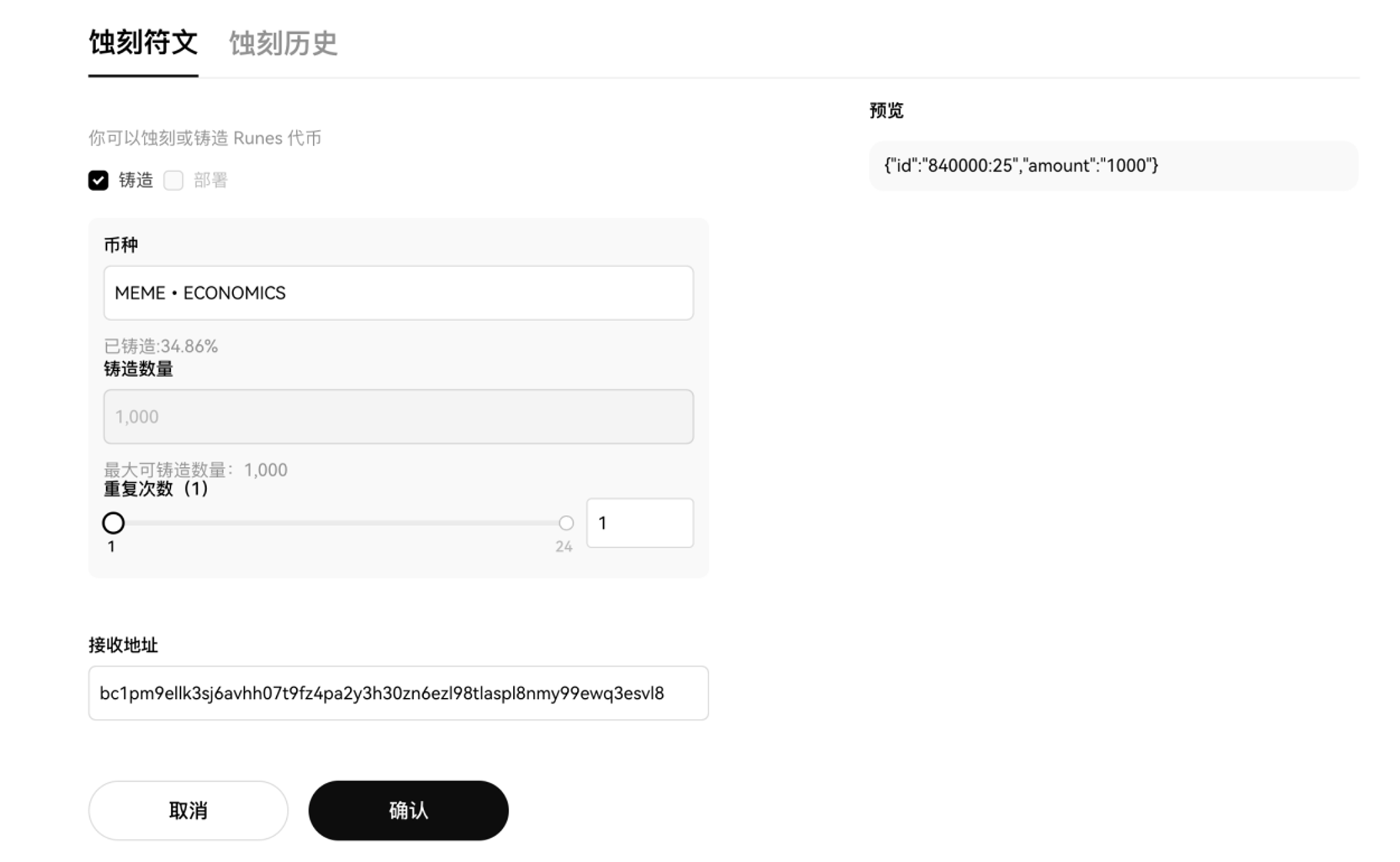
Users familiar with the process will quickly notice that the Rune minting procedure is very similar to that of BRC-20 tokens. More importantly, OKX Web3 Wallet’s Runes marketplace currently supports 17 popular projects including Runestone and Runepups, empowering users to fully engage with the Rune ecosystem in one place.
2. What Are the Key Differences Between Runes and Ordinals?
To understand the differences between the two, we must first consider the context behind Runes’ emergence.
Last May, core developers in the Bitcoin community publicly stated that the Ordinals protocol was generating excessive "junk" data and frequent transactions, causing network congestion, and called for action to stop it. In September, Casey began advocating for halting BRC-20 mints and subsequently announced the development of Runes—a new protocol intended as a replacement for Ordinals. Casey believes that the improved Runes protocol reduces the generation of large numbers of junk UTXOs and offers a better, lighter, and cleaner asset issuance method compared to the experimental Ordinals protocol.
Currently, the potential of the Runes protocol lies primarily in three areas:
First, Runes demonstrates excellent compatibility and extensibility, seamlessly integrating with Bitcoin’s UTXO model and second-layer protocols built upon it, such as the Lightning Network. Compared to other fungible token protocols like BRC-20, Runes significantly improves operational efficiency and user experience through simplified transaction processes and direct binding of token balances to UTXOs.
Second, at the token issuance level, Runes offers greater flexibility, allowing token names from 1 to 28 characters in length and adopting various innovative issuance mechanisms—including fixed-supply issuance and public minting—as well as exploring more expressive approaches. Fixed-supply issuance is relatively centralized, where the issuer directly mints the corresponding Runes assets and distributes them later. Public minting, on the other hand, sets specific parameters—such as block height or timestamp—and the final total supply of the Runes asset depends on how many users mint during the designated period.
Lastly, regarding UTXO management, Runes uses OP_RETURN scripts to avoid the complexity and security risks associated with witness data in transactions, reducing unnecessary UTXO creation and thereby enhancing overall network health and efficiency. The design philosophy of Runes emphasizes minimizing on-chain "footprint," encouraging optimized UTXO usage, and achieving seamless integration with Bitcoin’s foundational architecture—driving innovation and growth in the Bitcoin ecosystem through simpler and more intuitive means.
How does the user interaction flow of OKX Web3 Wallet’s Runes marketplace differ from that of the Ordinals inscription market?
At the product interaction level, the "etching" function in Runes corresponds to "inscription" in BRC-20. However, while Ordinals inscribes data onto individual satoshis, Runes writes data into the OP_RETURN field of transactions and binds token balances directly to UTXO outputs. More importantly, Runes enables transfers and purchases with just a single transaction, without requiring dummy placeholders or initialization steps as needed in Ordinals.
Because the Ordinals protocol inscribes data onto sats to record information and relies on off-chain indexing, whereas Runes operates directly on the UTXO model, recording information on-chain. This means that transaction outputs can contain not only Bitcoin but also varying amounts and types of Runes. For example, a single transaction output could simultaneously include 1 BTC, 100 units of Rune A, and 1,000 units of Rune B.
Interestingly, during its initial four months, Runes required token names to be at least 13 characters long (e.g., “UNCOMMON•GOODS”). After that, the minimum name length decreases by one character approximately every four months until the next halving event, when single-character Runes will become possible (totaling 26). Finally, in terms of issuance models, while Ordinals allows anyone to launch assets publicly with one click, Runes project teams can choose either to pre-distribute a fixed amount of tokens to designated addresses during deployment or opt for Open Mint (fair launch).
3. Where Does OKX Web3 Stand in Bitcoin Ecosystem Development?
To date, OKX Web3 Wallet has launched marketplaces for Ordinals, Atomicals, and Runes, enabling users to access the latest developments in the Bitcoin ecosystem instantly while providing a one-stop entry point for exploring the broader Bitcoin ecosystem. Users can easily acquire and trade assets via the Web3 wallet, discover and participate in trending Bitcoin ecosystem projects, and directly access the DeFi section to stake Bitcoin assets and earn on-chain yields with low gas fees.
Since March last year, rapid development in the Bitcoin ecosystem has brought forth tens of billions of dollars in assets and led to the establishment of over 20 infrastructure platforms. Against this backdrop, OKX Web3 and UniSat have emerged as key players, largely driving the construction and expansion of the Bitcoin ecosystem.
In fact, inspired by Bitcoin’s origins and its hacker ethos, the OKX Web3 team has been actively involved in ecosystem development from the outset—the core reason they were able to enter early and provide strong support. Now, as the Bitcoin ecosystem continues to thrive, OKX has become a leading force thanks to its smooth and secure products. Whenever the community discusses hot topics related to the Bitcoin ecosystem, OKX Web3 Wallet is often the first name that comes to mind.
Disclaimer:
The content of this article is for reference only and does not constitute and should not be construed as an invitation, offer, solicitation, recommendation, or investment advice regarding any product transaction. Investing involves risk. Digital asset prices are subject to market risks and volatility. Derivatives such as contracts and options are particularly vulnerable to market fluctuations and may result in the loss of your entire investment. Therefore, digital asset trading may not be suitable for all investors. You should understand how the products work and make your own informed decisions. Readers are solely responsible for understanding and complying with applicable local laws and regulations.
Join TechFlow official community to stay tuned
Telegram:https://t.me/TechFlowDaily
X (Twitter):https://x.com/TechFlowPost
X (Twitter) EN:https://x.com/BlockFlow_News