









Crypto Market Plunges to Greet the "Halving" Amid Turn-Based Geopolitical Conflict?
TechFlow Selected TechFlow Selected
Crypto Market Plunges to Greet the "Halving" Amid Turn-Based Geopolitical Conflict?
With less than 24 hours to go before the halving, the market seems poised to undergo a "halving of asset prices" first.
 Navigating Web3 tides with focused insights
Author: Frank, Foresight News
"When the cannons roar, gold pours in"?
This morning at around 9:00 AM, breaking news headlines reported "strong explosions near Tehran, the capital of Iran" and "explosions heard in Iran, Syria, and Iraq." Amid escalating tensions between Israel and Iran, Middle East tensions have flared up once again. Gold prices swiftly surged past $2,400, marking five consecutive weeks of sharp gains.
Meanwhile, Bitcoin—previously hailed as "digital gold"—moved in the opposite direction. It successively broke below key support levels of 63,000 USDT, 62,000 USDT, and 61,000 USDT, briefly falling below 60,000 USDT and reaching a recent low of 59,587 USDT (based on OKX spot data, same below). Ethereum also declined sharply, breaking through 3,000 USDT and 2,900 USDT, bottoming out at 2,864 USDT.
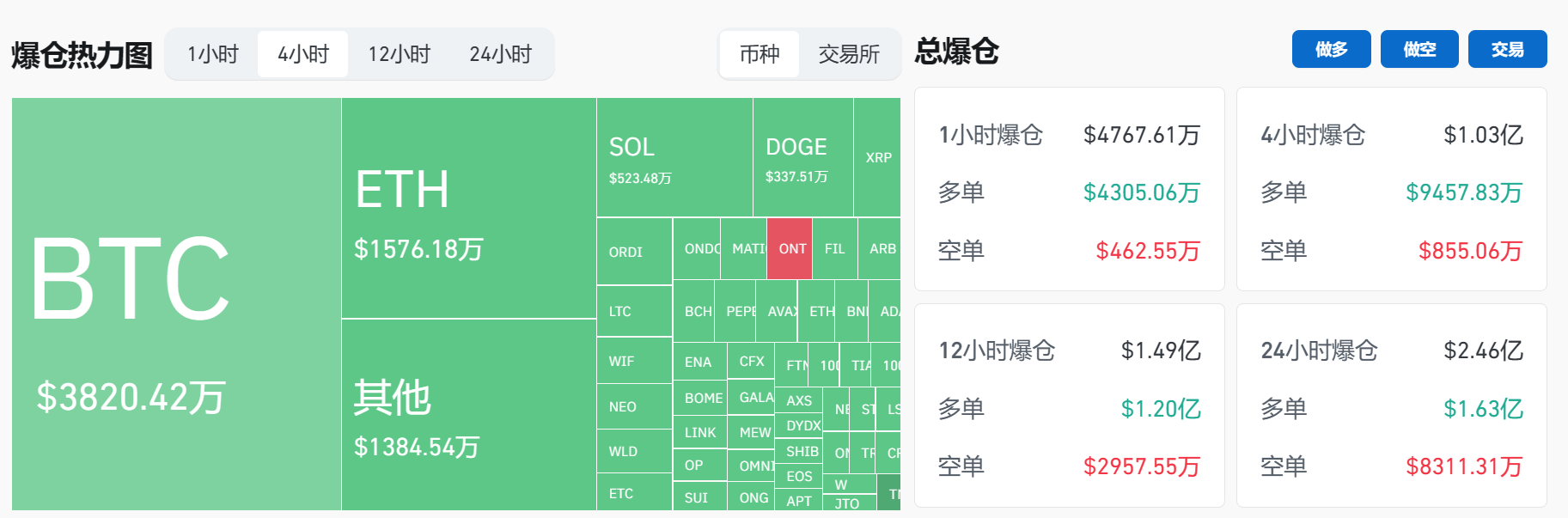
Coinglass data shows that over the past four hours, total liquidations across the market exceeded $100 million, with long positions accounting for $94.57 million. The altcoin market has been devastated, with numerous assets halved over the past half-month.
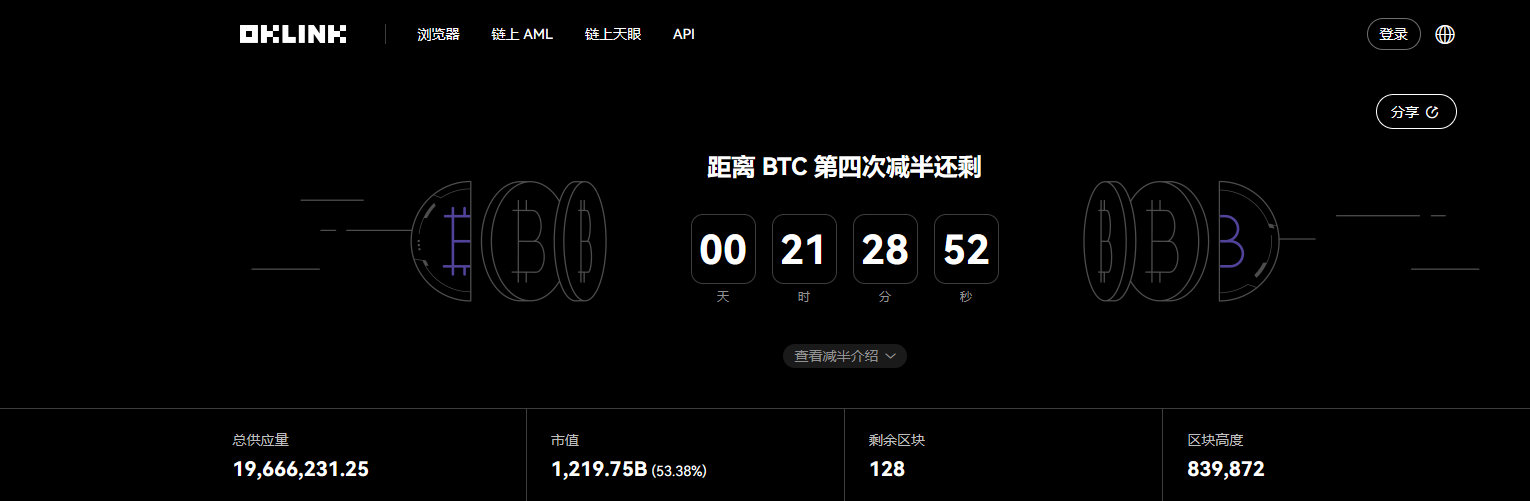
Ironically, at the time of writing, according to OKLink data, Bitcoin’s fourth halving is less than 22 hours away—but the market has poured cold water on expectations by behaving as if the asset had already undergone its “pre-halving” drop, deepening bearish sentiment.
Thus, whether this downturn marks a trend reversal or merely a mid-term correction has become critical to positioning ahead of future market movements.
What Caused the Crash?
In summary, potential factors behind this sharp decline can be broadly categorized into external and internal forces, including geopolitical conflicts and a hawkish Federal Reserve shift, along with internal triggers such as ETF fund outflows.
Impact of Middle East Conflict on Global Financial Markets
First, the impact of Middle Eastern geopolitical conflict on global financial markets. It's important to note that since institutional investors began entering the market en masse last year—and especially after the approval of spot ETH ETFs earlier this year—Bitcoin’s supposed “safe-haven” status has become more myth than reality. In truth, it behaves more like a risk asset, closely tied to global macroeconomic conditions and bull-bear cycles (see also: "When the cannons roar, gold pours in"? A Guide to Crypto Investing Amid Geopolitical Turmoil).
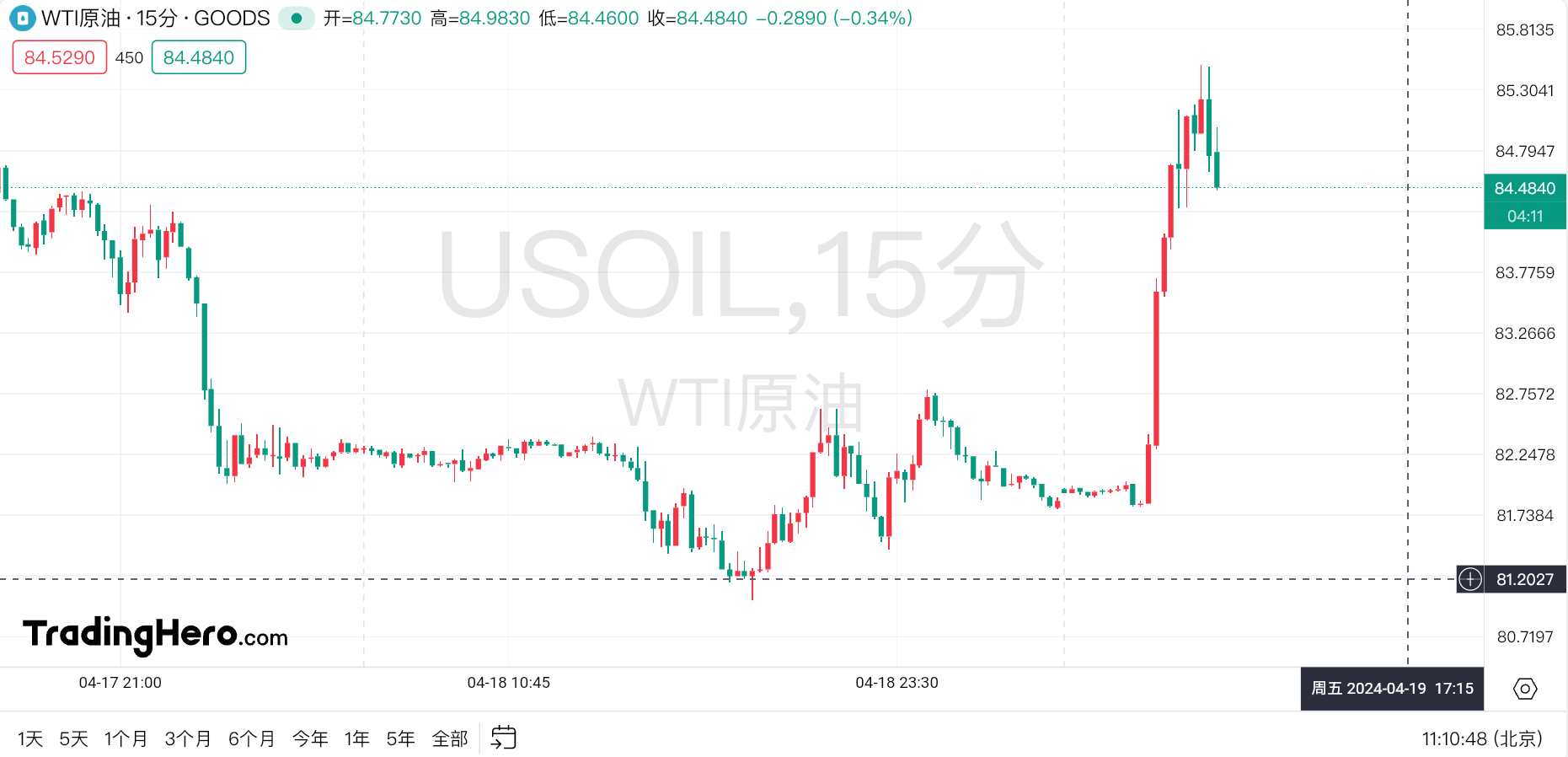
The ongoing drama between Iran and Israel heightens concerns about disruptions to global oil supplies. Following today’s latest developments, U.S. WTI crude futures rose over 2.5% during the session, briefly surpassing $85 per barrel, while Brent crude futures climbed toward $89 per barrel.
If the conflict escalates further—even targeting nuclear facilities—it could drive oil prices higher, complicating the U.S. inflation fight and increasing the likelihood of additional Fed rate hikes. As a risk asset, Bitcoin would naturally suffer under stronger hiking expectations.
At the same time, these developments have cast a shadow over U.S. equities. This morning’s news triggered widening losses in U.S. stock index futures: Nasdaq 100 futures dropped over 2%, S&P 500 futures fell 1.5%, and Dow Jones futures declined 1.32%.
The Fed Turns Hawkish
Additionally, over the past two months, market expectations for a mid-year Fed pivot to rate cuts have significantly weakened, as an increasing number of Fed officials have begun openly discussing the possibility of further rate hikes:
New York Fed President Williams, often referred to as the "third most powerful figure at the Fed," warned that if incoming data shows the need to raise rates to achieve inflation targets, the Fed will do so. Atlanta Fed President Bostic stated he remains open to rate hikes should inflation reaccelerate.
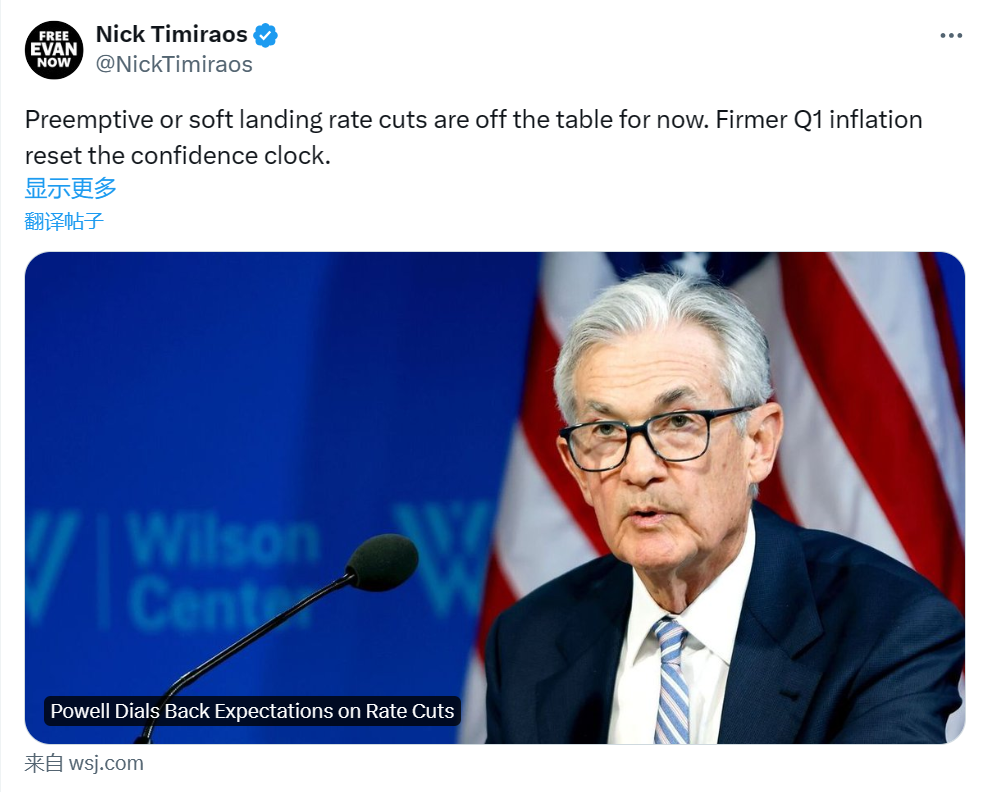
More critically, in his remarks this week, Powell emphasized that the lack of further progress on inflation suggests it may be appropriate to keep interest rates elevated for longer. Nick Timiraos, widely regarded as the "new Fed whisperer" at The Wall Street Journal, commented that the Fed’s outlook has clearly shifted, dashing hopes of a preemptive rate-cutting cycle.
Recall that at the end of last year and beginning of this year, markets expected the Fed to cut rates 5–7 times in 2024, starting as early as March... Instead, Treasury yields have spiked again, with the 10-year yield breaching 4.75%. Some Wall Street banks even warn of a possible return to the 5% level in the near term.
Moreover, throughout April, a series of strong U.S. economic data—including retail sales, initial jobless claims, and nonfarm payrolls—have reinforced the case for sustained high rates, regardless of how one interprets their reliability.
Under these circumstances, some risk capital reallocating portfolios is only natural.
Five Consecutive Days of ETF Outflows
Another notable signal: According to SoSoValue data, Bitcoin spot ETFs saw a net outflow of $23.15 million on April 18, marking five consecutive days of net outflows.
As of publication time, total net assets of Bitcoin spot ETFs stood at $52.41 billion, representing an ETF net asset ratio (market cap relative to total Bitcoin market cap) of 2.82%, with cumulative net inflows reaching $12.24 billion since inception.

Notably, Ethereum has already fallen toward its 120-day moving average, while the BTC/ETH weekly chart shows three consecutive red candles—an extremely bearish technical pattern.
Given that the 120-day moving average is traditionally viewed as one of the key bull-bear dividing lines, whether Ethereum can defend this critical support and stage a strong rebound—and how Bitcoin follows—will be pivotal in the coming days.
Join TechFlow official community to stay tuned
Telegram:https://t.me/TechFlowDaily
X (Twitter):https://x.com/TechFlowPost
X (Twitter) EN:https://x.com/BlockFlow_News
 Foresight News









