Understanding Mezo: Backed by Pantera and Multicoin, Building Bitcoin L2's Economic Layer
TechFlow Selected TechFlow Selected
Understanding Mezo: Backed by Pantera and Multicoin, Building Bitcoin L2's Economic Layer
Mezo aims to build a Bitcoin L2 that is not merely technically connected, but more importantly, economically integrated—essentially creating an economic layer for Bitcoin.
 Navigating Web3 tides with focused insights
Authors: Frost, Luccy
On April 9, the Bitcoin Layer 2 network Mezo completed a $21 million Series A funding round led by Pantera Capital, with participation from Multicoin, Hack VC, Draper Associates, and others.
The rapid development of "inscriptions" has fueled the prosperity of the BTC ecosystem but also intensified competition for BTC network resources. Excessively high gas fees are continuously raising the entry barrier for participants in the BTC ecosystem. The demand for Layer 2 solutions is urgent, and a wide variety of L2 projects are now capturing attention from the community and investors.
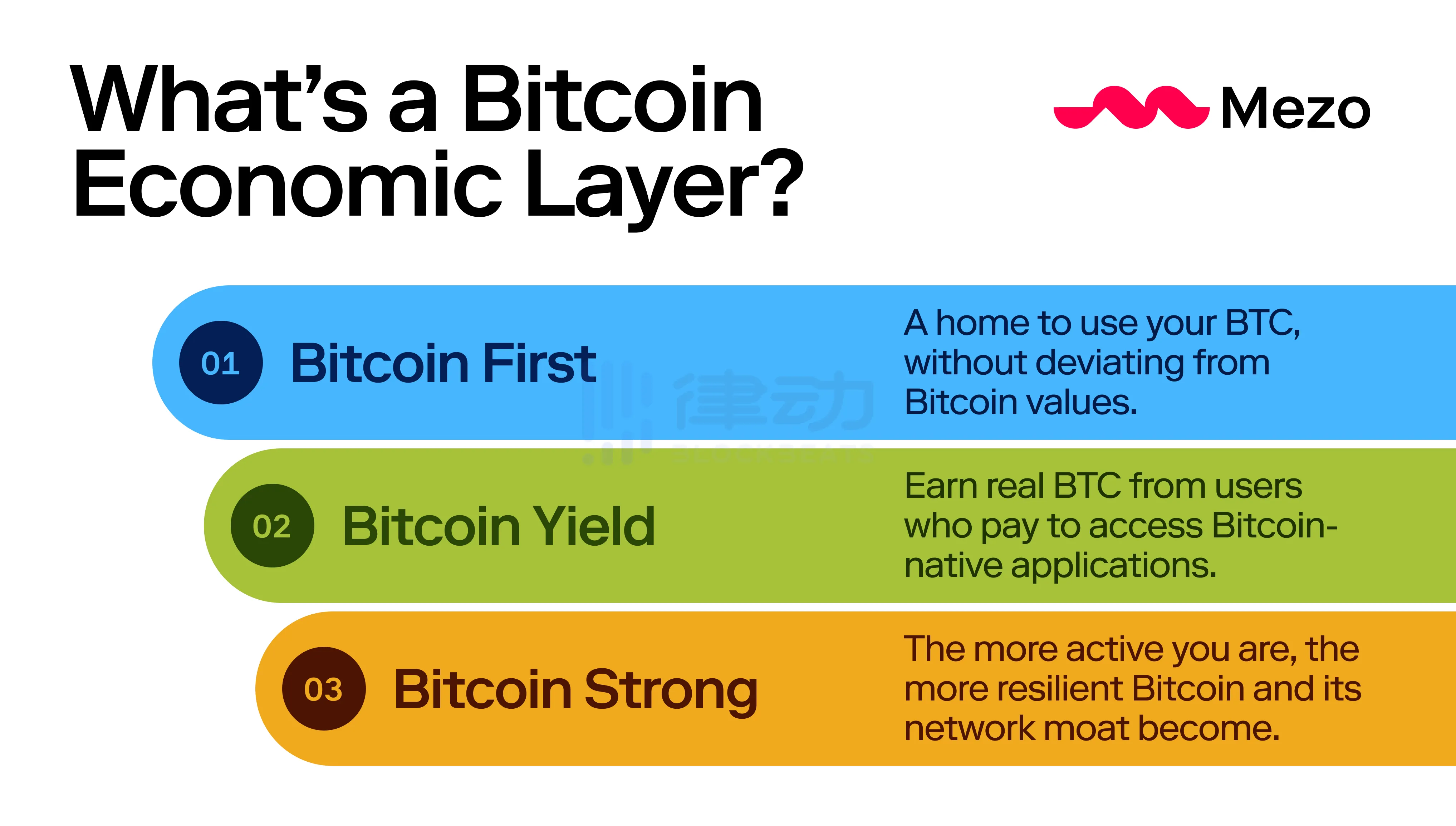
Many BTC L2s prioritize the needs of Bitcoin miners over those of end users. In contrast, Mezo prioritizes the economic interests of users and Bitcoin holders, introducing the concept of a "Bitcoin Economic Layer." To realize this vision, Mezo focuses on long-term active HODLers within the BTC ecosystem.
The project team stated, “We want to ensure that people who own Bitcoin can truly run this chain.” To achieve this, Mezo provides rewards to users securing Bitcoin’s network safety, ensuring they continue holding Bitcoin—benefiting both coin holders and on-chain traders alike. The team believes anyone who genuinely engages with Bitcoin should be able to earn from it, rather than treating it as a mere decorative object sitting idly on a shelf.
What Is the Bitcoin Economic Layer?
From current projects operating on Bitcoin Layer 2, we can observe that well-known Bitcoin L2 initiatives were established early and have explored related technologies for a long time. Their developers include original builders from the Bitcoin ecosystem, contributors from Ethereum Layer 2 projects, and experts in cross-chain connectivity technologies.
As Bitcoin's base protocol matures—with foundational technologies like Segregated Witness (SegWit), Taproot, Schnorr signatures, MAST (Merkelized Abstract Syntax Trees), and Tapscript gradually forming—the technical groundwork becomes increasingly solid. However, newly entering teams lack significant accumulated advantages. Emerging teams must identify their late-mover strengths, such as researching cutting-edge technologies, addressing lightweight yet highly attractive use cases first, and attracting a critical mass of applications.
Since most BTC L2s use BTC as gas—a key part of their Layer 2 narrative—this strategy boosts miner income and sparks interest among developer communities. Yet, whether this alone can drive overall growth remains questionable.
Therefore, Mezo aims to build more than just a technically linked Bitcoin L2—it seeks deep economic integration, constructing what it calls the Bitcoin Economic Layer.
According to Mezo, the Bitcoin Economic Layer centers on user benefits, aiming to transform how users interact with Bitcoin by increasing their wealth, community engagement, and productive utility while expanding Bitcoin’s core functionalities. It intends to integrate Layer 2’s core technology and features directly with the economic needs of Bitcoin holders.
How Does Mezo Build the Bitcoin Economic Layer?
Mezo aims to deepen Bitcoin infrastructure functionality by enabling cheaper, faster transactions without deviating from the network's fundamental principles. To fulfill this vision, Mezo focuses on long-term participants in the BTC ecosystem through three mechanisms: HODL Proof, HODL Score, and deposit custody.
Built on tBTC
Mezo uses tBTC as its foundation—an asset bridged via Threshold Network. Threshold Network is a privacy-focused merged network combining capabilities from Keep and NuCypher. Keep enables any user holding BTC (and some ETH) to create tBTC using a decentralized network of signers.
Unlike previous solutions, there is no central custodian for locked Bitcoin. Signers are randomly selected, and a different group is assigned for each minted tBTC. These signers provide collateral (in ETH) to prevent malicious behavior or theft. Additionally, deposits are always over-collateralized: for every 1 BTC deposited, signers must post ETH worth 1.5 BTC as collateral.
Another notable feature is that signers use threshold signature protocols to generate a unique address. This means no single signer can take control of funds—they require cooperation from all designated signers to execute actions. If all signers collude to break the protocol and steal locked BTC, they must act together. Should any signer deviate from the rules, anyone can submit cryptographic proof of misconduct. The whistleblower would then receive the signer’s collateral as a reward. Given the over-collateralization, stealing BTC results in greater losses than potential gains.
As an Ethereum token pegged 1:1 to BTC value, tBTC serves as a bridge between Bitcoin and Ethereum. BTC holders can deposit BTC into a smart contract and receive tBTC in return.
All BTC in Mezo is held in smart contracts. The locking contract can be upgraded via a multi-sig managed by Mezo’s development team. Each tBTC issued is backed 1:1 by Bitcoin reserves and protected by signers—nodes responsible for managing Bitcoin deposits and redemptions.
Incentivizing BTC Holders
Mezo employs HODL Proof as its consensus mechanism. At mainnet launch, users will contribute to network security via HODL Proof and earn rewards in return. A portion of gas fees burns BTC from circulation; as network activity grows, this method reduces supply, rewards long-term holders, and strengthens Bitcoin’s security and economic foundation.
Users can lock BTC on Mezo to build their HODL Score, calculated based on their Bitcoin deposits and success in inviting new users to participate in HODL. The longer the deposit duration, the higher the score. In addition to locking BTC, users can also stake MEZO tokens and validate transactions via CometBFT consensus to help secure the network.
Currently, deposits are supported in BTC, tBTC, and wBTC.
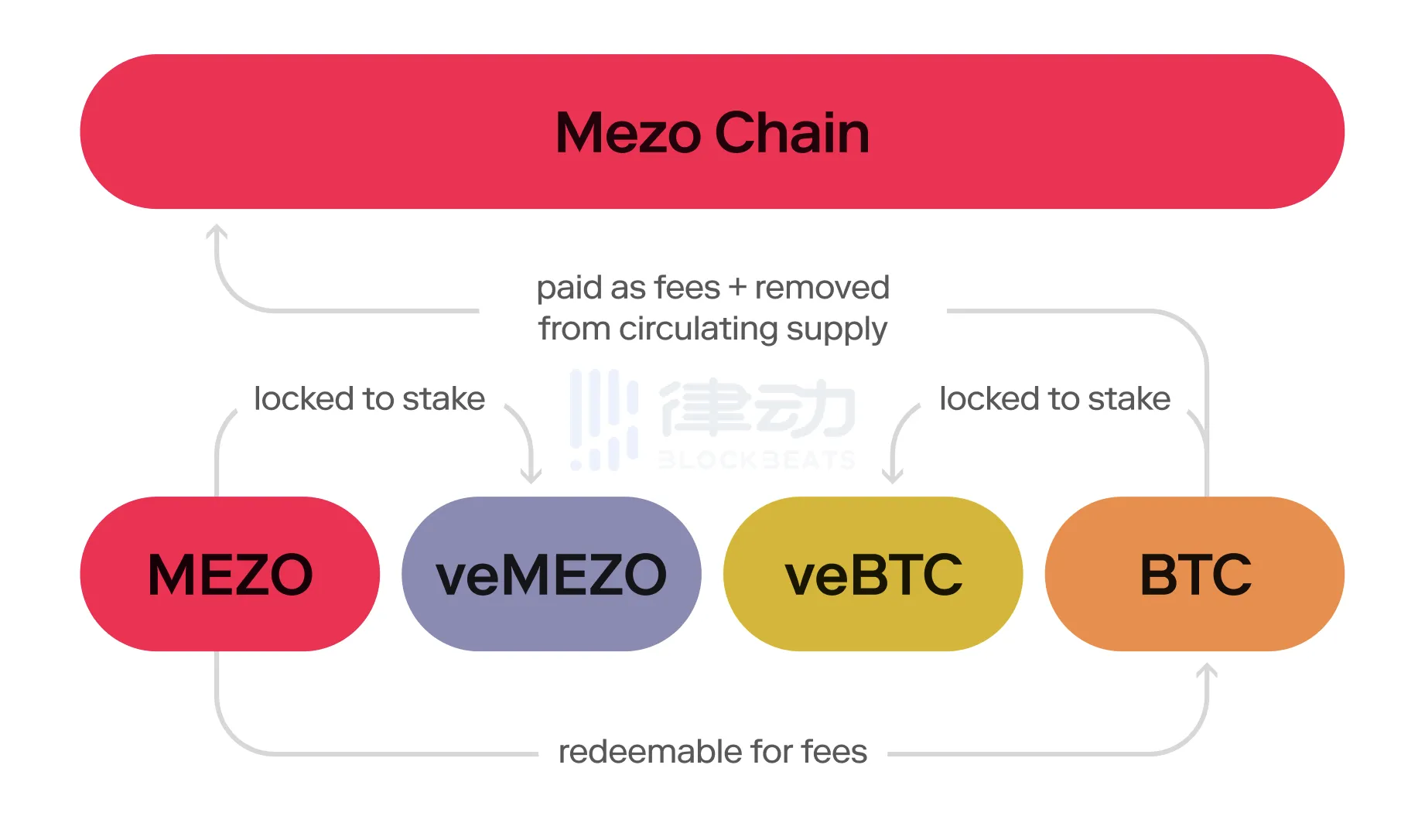
Additionally, when users HODL on Mezo, they receive five one-time-use invitations to share with friends. Their invitees also receive five such invitations. Users earn HODL Score not only from their own deposits but also from those of their invitees and even secondary invitees. Users may choose to lock deposits for 2, 6, or 9 months. Notably, locked deposits cannot be withdrawn until the lock-up period ends.
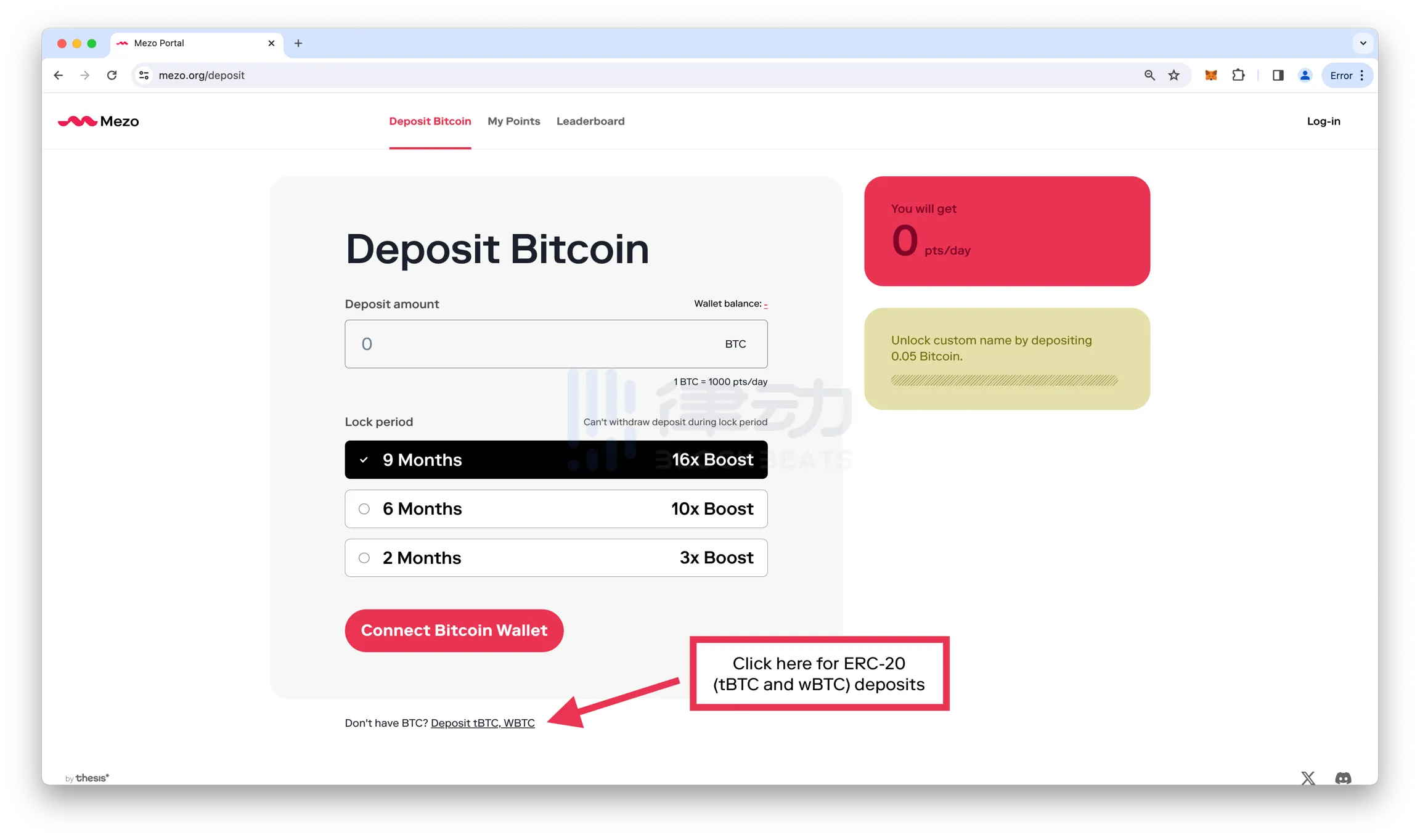
HODL Score accumulates based on the amount of BTC deposited and the lock-up duration. All versions of BTC deposits earn equal points. Locking 1 BTC per day earns 1,000 points. Longer lock-up periods offer score multipliers: 2-month locks get 3x bonus, 6-month locks get 10x, and 9-month locks get 16x.
How to Earn HODL Score?
The project currently supports wallet connections via Metamask, Taho, and Unisat. For native BTC deposits, Mezo accepts "legacy" or "native SegWit" wallet address types—those starting with "1" or "bc1q". The team is working to add support for nested SegWit addresses (starting with "3").
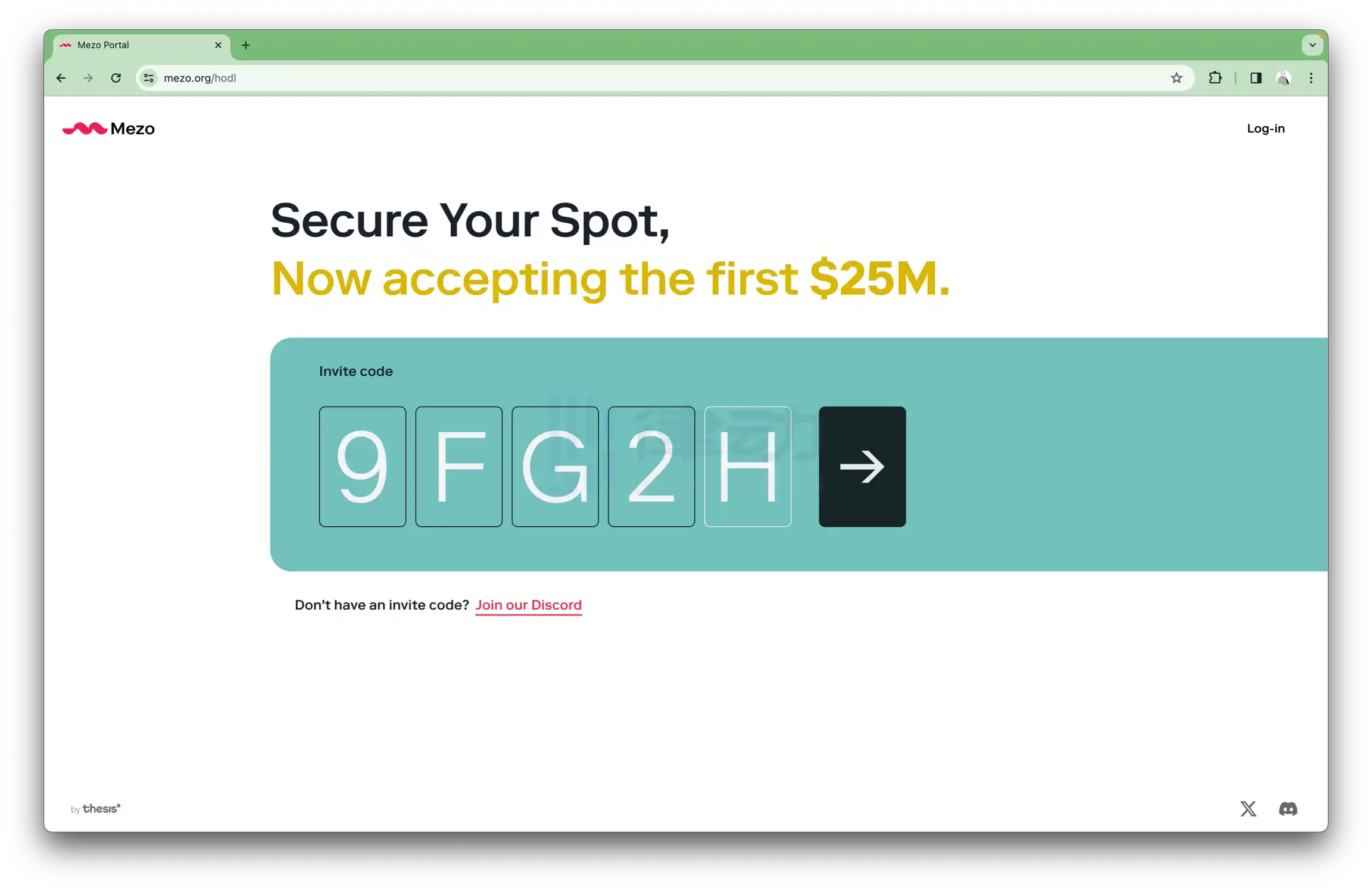
First, visit the project website and enter an invitation code. If you don’t have one, join the project’s Discord server, go to the waiting room, and contact administrators to access the invitation code channel.

After entering the invitation code, click the arrow to proceed to the deposit page.
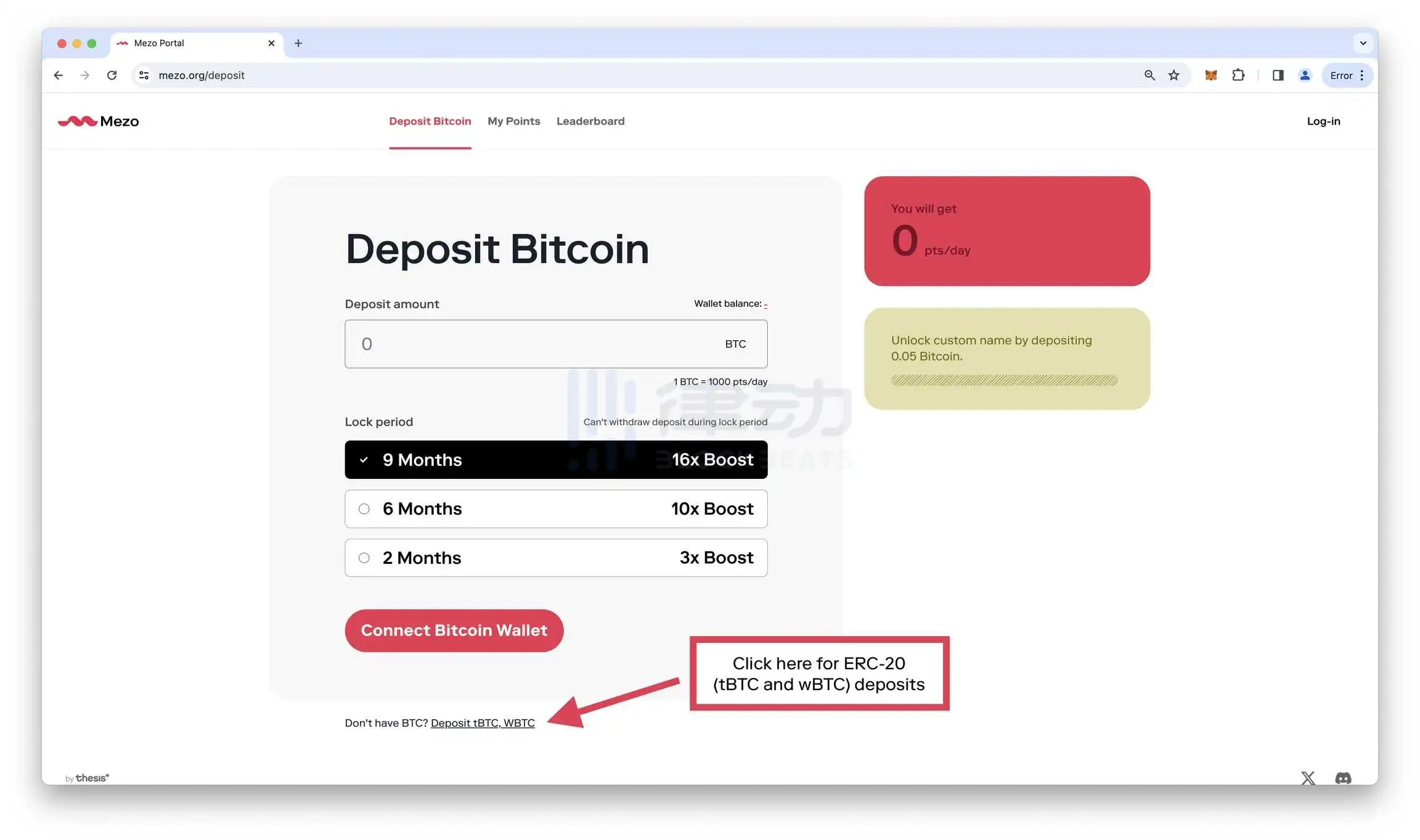
The currency deposited on Mezo is native BTC. If users wish to deposit tBTC or wBTC, they can click the link at the bottom of the site after entering the invitation code.
After clicking “Connect Bitcoin Wallet,” you’ll be directed to a “Log in with Bitcoin” page. Note: Once you proceed with login and sign the transaction, your wallet becomes bound to the invitation code. One invitation code corresponds to one wallet address, and you can only deposit additional BTC using the same address.
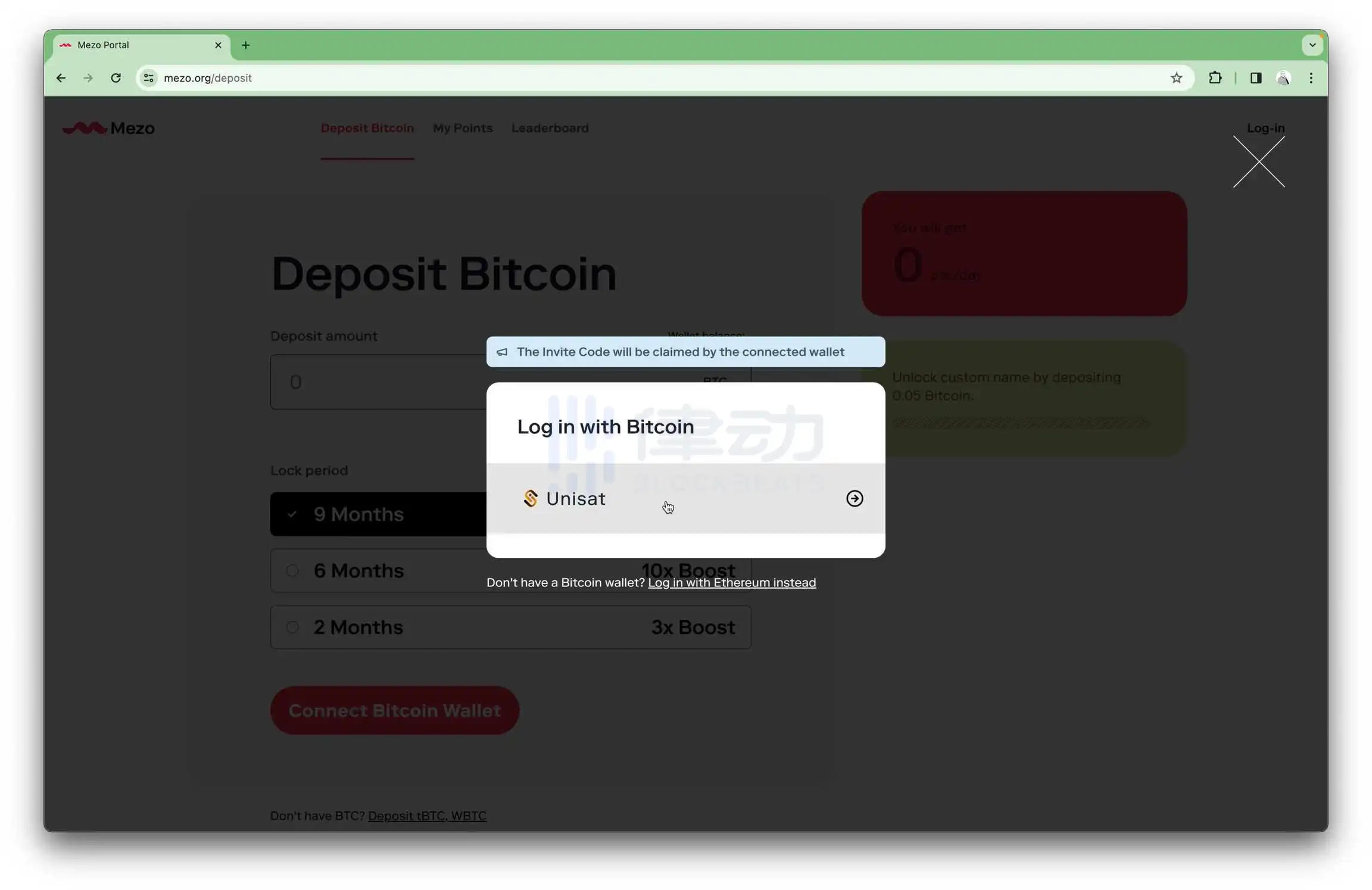
After clicking “Log in with Bitcoin,” click “connect” and then “sign” to complete UniSat wallet connection and transaction signing.
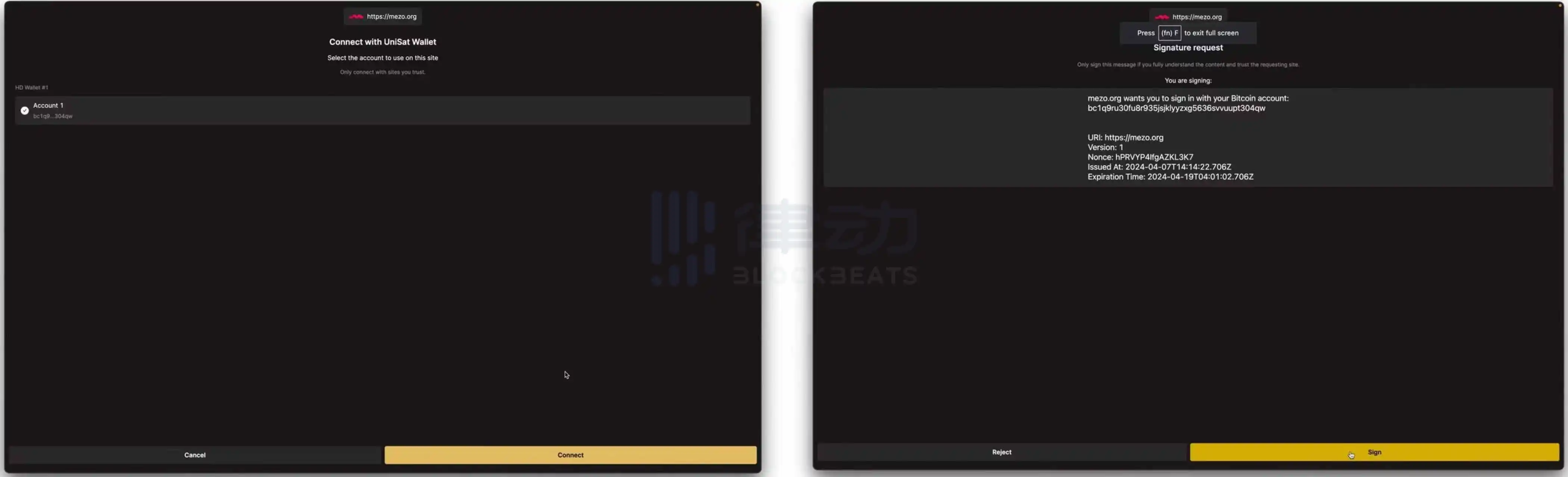
Once these steps are completed, your wallet will be successfully linked to the invitation code, allowing you to begin deposit operations.
BTC Deposit
Different lock-up durations allow users to boost their HODL Score by 3x to 16x. In the upper-right corner, users can view their daily HODL Score based on selected lock-up duration and deposit amount.
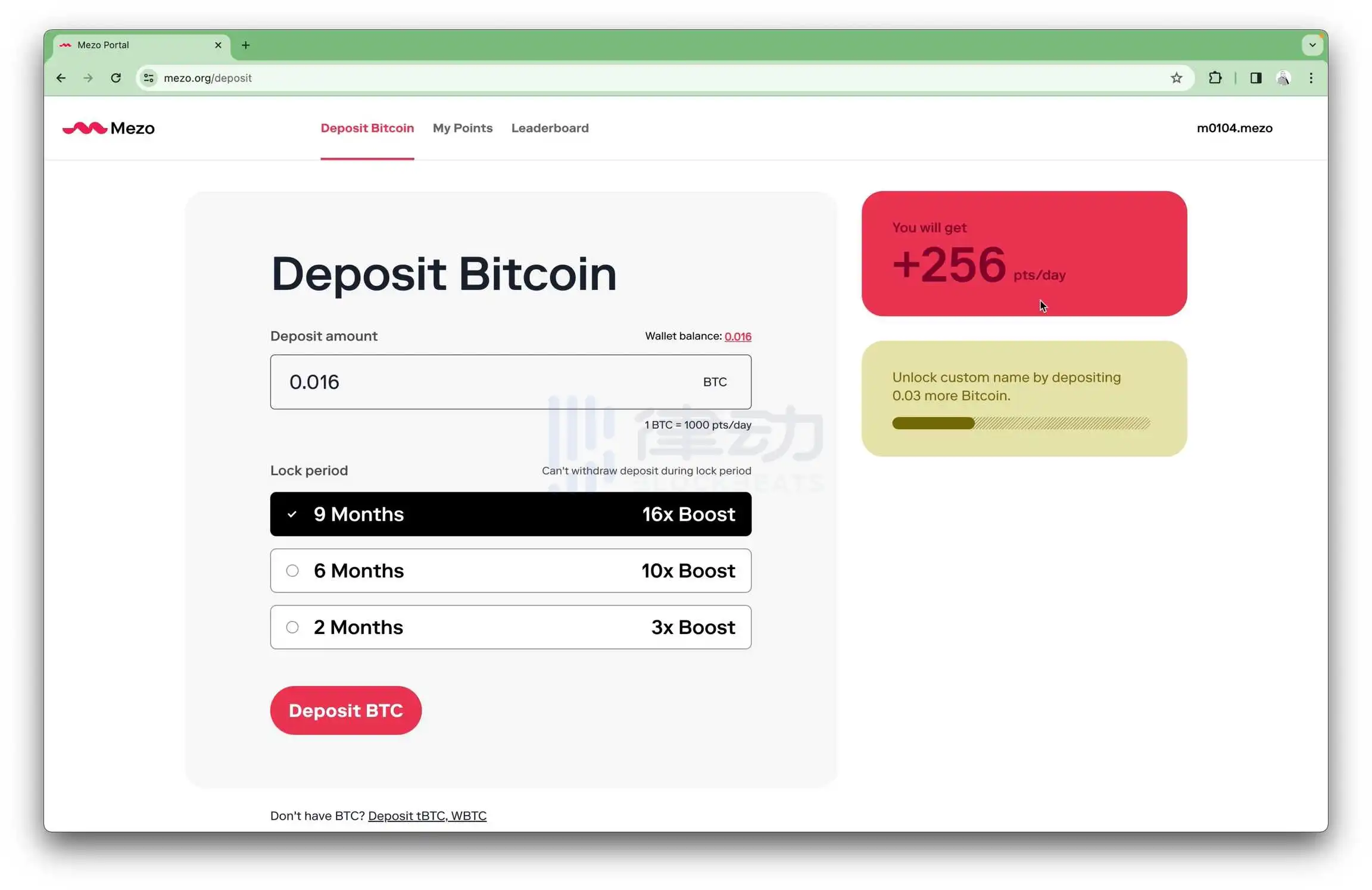
Enter the deposit amount, click “Deposit BTC,” and sign the transaction. Your deposit will then be processed, and you can check your ranking on the leaderboard.
tBTC Minting and Deposit
When minting tBTC, users must deposit BTC from a supported BTC wallet type into a wallet generated by Threshold Network. This wallet is created and signed by 51 out of 100 signer wallets. After sending funds, the depositor leaves their Ethereum receiving address. The tBTC bridge verifies consistency on the Bitcoin network; if everything checks out, tBTC is sent to the user’s Ethereum address.
After completing these steps, users will have tBTC in their Ethereum wallet and can directly deposit it into the Mezo portal. After entering the invitation code, click the tBTC/wBTC deposit link at the bottom of the page to go to the ERC-20 deposit interface.
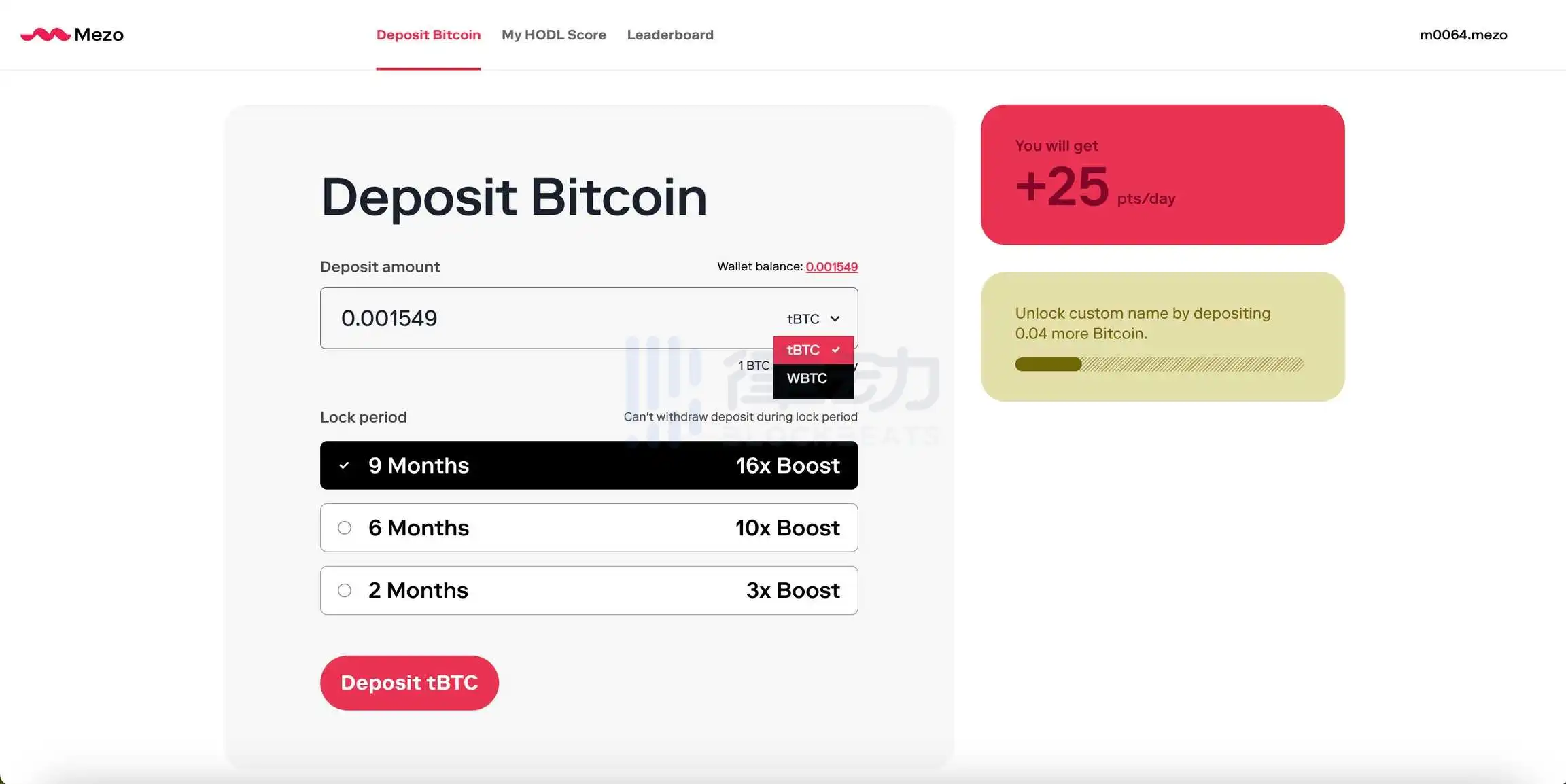
On the deposit page, users can select whether to deposit tBTC or wBTC. After choosing the BTC type and entering the amount, click “Deposit tBTC” to complete the deposit. The page will display the corresponding HODL Score based on the deposit.
Funding and Development Roadmap
On April 9, the Bitcoin Layer 2 network Mezo completed a $21 million Series A funding round led by Pantera Capital, with participation from Multicoin, Hack VC, Draper Associates, and others.
Launched by Thesis—a startup studio founded in 2014—Mezo uses HODL Proof as its consensus mechanism. Users secure the network by locking BTC and MEZO tokens and validating transactions via CometBFT consensus. By locking BTC on Mezo, users earn HODL Score, which increases with longer lock-up durations. HODL Score may serve as a weighting factor for future airdrops. At Mezo mainnet launch, users can contribute to network security through HODL Proof and earn rewards. Mezo is built to enable cheaper, faster transactions without compromising Bitcoin’s core principles, thereby enhancing Bitcoin’s infrastructure.
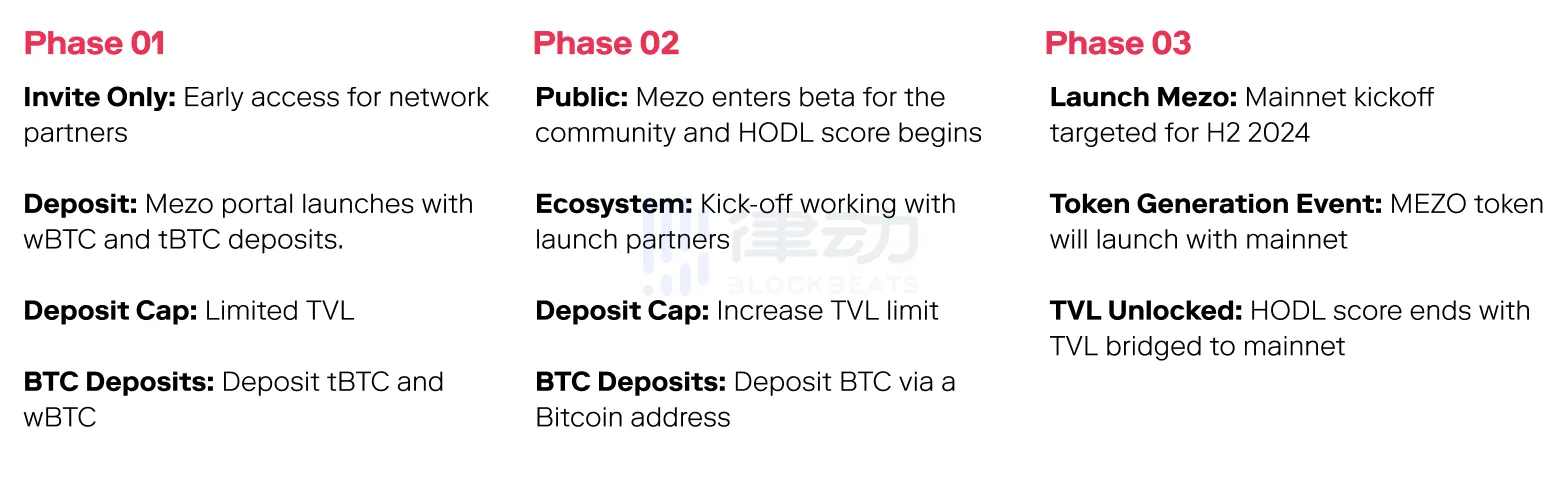
According to project documentation, Mezo is divided into three phases, with the current phase being the first.
Phase One is limited to early project partners and involves launching wBTC and tBTC deposits on the Mezo portal, with deposit caps in place.
Phase Two opens community testing, begins HODL scoring, and initiates partnerships. It raises the TVL cap from Phase One and supports more BTC address types for deposits.
Phase Three will launch the Mezo mainnet, expected in the second half of 2024. The MEZO token will debut alongside the mainnet, TVL caps will be lifted, total HODL Scores will be finalized, and TVL will be bridged to the mainnet.
Join TechFlow official community to stay tuned
Telegram:https://t.me/TechFlowDaily
X (Twitter):https://x.com/TechFlowPost
X (Twitter) EN:https://x.com/BlockFlow_News
 BlockBeats