Raised $21 million, is Mezo replicating Blast's L2 path on Bitcoin?
TechFlow Selected TechFlow Selected
Raised $21 million, is Mezo replicating Blast's L2 path on Bitcoin?
Mezo uses the "Proof of HODL" consensus mechanism, where users secure the network by locking BTC and MEZO tokens and validating transactions through CometBFT consensus.
 Navigating Web3 tides with focused insights
By 1912212.eth, Foresight News
The Bitcoin ecosystem appears to be undergoing a renaissance. Vertical applications and niche sectors are sprouting up like mushrooms after rain, generating various forms of yield and utility around BTC, with one project taking the stage right after another. However, upon closer inspection, there remains a gap between industry development and ordinary users' actual needs—the potential for BTC-based yield generation has yet to be fully unlocked, an issue the industry continues to explore.
Among numerous technically strong players in this space, Mezo—a Layer-2 network built for Bitcoin—has taken an unconventional path by entering the market as a Bitcoin economic layer. Recently, Thesis, the developer behind Mezo, completed a $21 million Series A funding round led by Pantera Capital, with participation from Multicoin Capital, Hack VC, and others.
Introduction to Mezo
Launched by startup studio Thesis, which has years of experience developing within the BTC ecosystem—including creating tBTC—Mezo aims to enhance Bitcoin’s infrastructure by enabling cheaper, faster transactions without deviating from the network's core principles.
There's a popular saying that many current projects in the BTC ecosystem resemble “performing elaborate rituals inside a snail shell”—constrained by Bitcoin’s lack of native smart contract functionality, most ecosystems struggle to expand their capabilities.
As such, newly emerging Bitcoin L2s and data availability (DA) solutions have prioritized technical advantages, differentiating themselves through technological narratives. Mezo takes a different approach—by shifting focus toward distributing BTC yield directly to users to grow its network. In simple terms, Mezo is akin to Blast on Ethereum.
Mechanism Design
In Mezo’s view, most Bitcoin Layer-2 solutions prioritize miners over user needs, which does little to advance the overall development of Bitcoin. Mezo defines itself as a Bitcoin economic layer where Bitcoin remains central—whether in usage, yield generation, or activity levels. Gas fees are paid in BTC, all value on the network is denominated in BTC, and BTC underpins the network’s security model.

Specifically, using Bitcoin on Mezo does not dilute its value. Users can earn real BTC yield through staking, and the higher the user activity, the stronger Bitcoin’s network security and resilience become.
To achieve this, Mezo employs a "Proof of HODL" mechanism, where users secure the network by locking BTC and MEZO tokens and validating transactions via the CometBFT consensus algorithm.
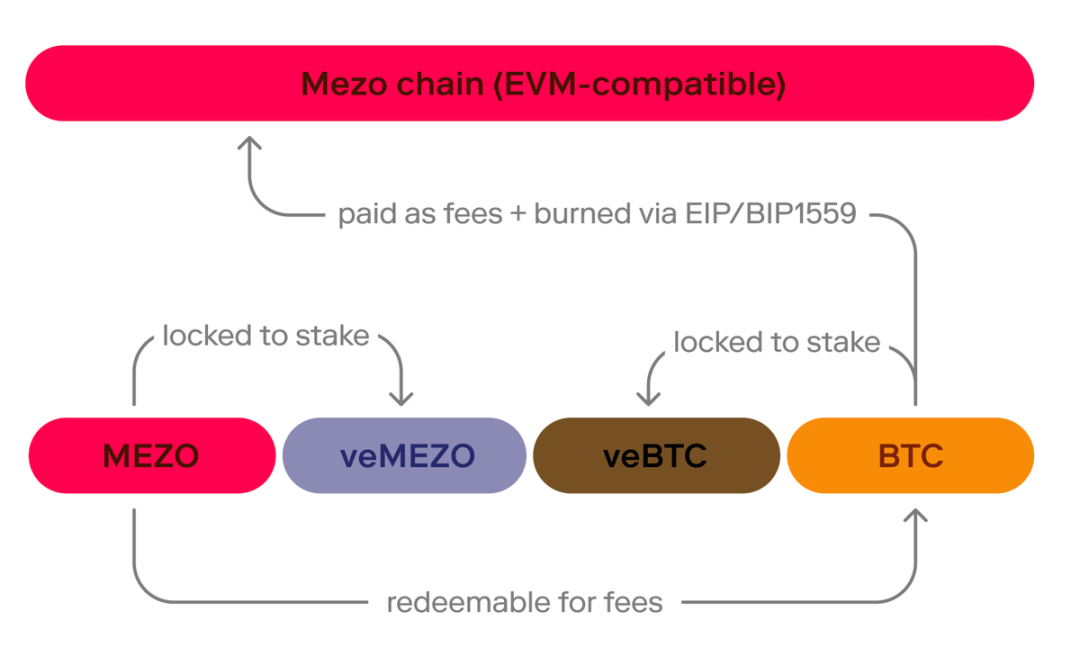
Users can lock BTC on Mezo, and the longer they hold their deposits, the higher their HODL score becomes. Upon mainnet launch, users will be able to contribute to network security via Proof of HODL and earn rewards in return.
How It Works
Mezo supports direct BTC staking, as well as tBTC and wBTC.
For point calculation, a user’s HODL score is determined by deposit amount, duration, and lock-up period. According to official documentation, users receive 1,000 points per BTC deposited per day. If the lock-up period is two months, the point reward triples; for six months, it increases tenfold; and for nine months, sixteenfold. Once confirmed, the lock-up period cannot be changed, and funds can only be withdrawn after the period ends.
Additionally, users can earn bonus points by inviting friends. At the start, each user receives five invite codes, which cannot be reused.
Summary
According to its official documentation, Mezo’s mainnet is expected to launch in Q2 this year, alongside its MEZO token. Current data from Mezo’s website shows over 800 HODLers, with total staked BTC rising to 1,059.
Blast previously attracted massive user attention through its points system and anticipated airdrop, demonstrating that developers crave liquidity. It’s therefore natural for developers to flock to the Bitcoin L2 ecosystem—Bitcoin being the most liquid cryptocurrency.
Mezo has brought the battle into the BTC ecosystem. Whether it can replicate similar success remains to be seen. As Bitcoin halving approaches, for investors bullish on BTC performance over the next two years, Mezo may offer an attractive yield-generating opportunity.
Join TechFlow official community to stay tuned
Telegram:https://t.me/TechFlowDaily
X (Twitter):https://x.com/TechFlowPost
X (Twitter) EN:https://x.com/BlockFlow_News
 Foresight News