After working at a VC and with project teams, Fiona chose to become a "full-time retail investor"—a skilled alpha hunter sharing her crypto investing philosophy
TechFlow Selected TechFlow Selected
After working at a VC and with project teams, Fiona chose to become a "full-time retail investor"—a skilled alpha hunter sharing her crypto investing philosophy
Every position, every identity, actually limits your way of thinking—it is both a gift and a枷锁.
 Navigating Web3 tides with focused insights
Text: Jack, Deputy Editor-in-Chief, BlockBeats
Guest: Fiona
In the crypto space, being a KOL is becoming increasingly difficult. In past bull markets, due to fragmented industry demographics, limited knowledge dissemination channels, and generally low average awareness among participants, so-called "crypto influencers" like Irene Zhao and Liangxi could gain influence merely through looks and drama, enjoying strong monetization from traffic within the crypto world. But as the industry matures and more professional players enter, life for crypto KOLs has become harder.
Nowadays, any misinterpretation of project mechanisms or improper sourcing of data by a KOL will be exposed, amplified, and publicly shamed by crypto researchers across the board. After the Chinese crypto community migrated to Twitter, market expectations—and those of ordinary investors—for KOLs have evolved: they must demonstrate deep understanding, professionalism, and an ability to spot alpha early. Under these increasingly stringent standards, crypto KOLs are undergoing a new wave of natural selection. The older generation is gradually fading from center stage, creating space for a new breed of capable, performance-driven KOLs to rise.
Among this new generation of skilled KOLs, Fiona stands out with exceptionally high recognition in the community. She first gained attention during last year’s “Arbitrum boom,” then capitalized on the Ordinals inscriptions and PEPE meme trends between March and May, and truly shined at the beginning of this bull market by identifying multiple 10x to 100x opportunities such as Ronin, TurtSat, and Auction for her community. Just as Bitcoin broke through $70,000 and bullish sentiment soared, she chose to “strategically lay flat,” successfully avoiding the massive market crash over the weekend.
Many followers wonder—where exactly does this talented and attractive rising star come from? What's her philosophy when trading crypto? Recently, we sat down with Fiona to explore these questions.
“After Working at VCs and Projects, I Chose to Be a Retail Trader”
In reality, compared to most long-time crypto veterans, Fiona didn’t have an early advantage—she only entered the space in 2021.
Unlike most who start in crypto, Fiona’s career path appears somewhat “counterintuitive.” Her journey began at a professional VC firm, then moved into a breakout project team, before she proactively transitioned into becoming a full-time retail trader. This reversed order of experience gives her unique perspectives and methodologies when spotting and seizing opportunities. According to Fiona, retail traders are often the most clear-sighted and comprehensive in their understanding of the crypto market.
A Strong Start
Before entering crypto, Fiona worked as a financial journalist. During interviews, she met Yi, a well-known partner at LD Capital (LD Group), one of China’s prominent crypto investment firms.
In mid-2021, Fiona planned to study in Singapore. Upon hearing this, Yi reached out with an offer. He told her that Singapore hosts abundant crypto resources and emphasized: “The most important thing in this industry is the ecosystem, and VCs are a crucial part of it.” Soon after, Fiona joined LD Capital. Reflecting today, she remains deeply grateful: “Most of what I learned was acquired at LD—it was like my first school in crypto.”
Fiona joined LD in mid-2021, right during the peak of the “narrative explosion” in crypto. DeFi was booming, and GameFi and NFTs were rapidly gaining traction. At the time, however, beyond Bitcoin and Ethereum, Fiona knew almost nothing about the crypto space. She recalls not even knowing how to use MetaMask, let alone navigating Twitter, Telegram, or Discord—everything had to be learned from scratch.
“The office had a strong crypto-trading culture, but all the project names sounded foreign to me. With so much to catch up on, I didn’t have the bandwidth to trade actively.” As a newcomer at LD, Fiona initially followed along, listened, studied, and conducted independent research. But her role focused primarily on primary market investments, which accelerated her learning curve dramatically.
BlockBeats: What was your overall experience like working at a VC? How did you learn and what were your sources?
Fiona: I attended meetings and held many conversations. I think growth at a VC is exponential because you’re under pressure—deals flood in daily, and every conversation becomes a knowledge-absorbing sprint. Initially, I didn’t have my own opinions; I just listened. But around six months in, things shifted—I started forming my own judgments.
BlockBeats: So talking to more people leads to faster cognitive growth?
Fiona: It helps, but you need to distinguish between the right and wrong people. That said, both types offer perspectives—you absorb experiences either way.
BlockBeats: How do you find and identify the “right people”?
Fiona: At first, I used conventional metrics—like looking at a project founder’s other investors. If top-tier VCs backed them, we’d assume it was promising. Or checking team members and referrers. Back then, I relied on known information because I lacked the ability to judge projects independently.
BlockBeats: Did your evaluation criteria evolve later?
Fiona: First, I believe founders matter greatly. After speaking with them, you can sense certain qualities—their logic should resonate with you.
Second, cryptocurrencies differ fundamentally from traditional public companies—they are inherently consumer-facing (to C). Even if the product logic targets businesses (to B), token distribution makes it ultimately consumer-focused. You must examine its public image and community atmosphere. Hence, all social media channels are critically important.
Third is product logic—all underlying mechanics deserve close scrutiny. For example, StepN’s rise and fall were tied directly to its core design. The initial blueprint determines the outcome. Once you analyze the entire logic, you’ll feel it intuitively.
BlockBeats: Do the analytical frameworks VCs use to assess projects help your personal trading?
Fiona: I believe retail traders are the most objective group in crypto. Their only real disadvantage is information asymmetry. Otherwise, they sometimes perceive things even better than VCs because they can follow a single project deeply and engage closely with its community. VCs rarely have that luxury—their portfolios are too large, their time too fragmented to focus efficiently.
I’ve received VC offers since then, but haven’t felt strongly motivated to return. I believe each position and identity shapes—and confines—your thinking. It’s both empowering and limiting. It forces you to view issues through specific incentive lenses, which I find neither objective nor holistic.
BlockBeats: Why can’t VCs follow projects deeply?
Fiona: Imagine a VC during a bull market receiving at least 10 project decks per day. Time allocated per project is extremely limited. But if a retail investor holds many tokens, they naturally track the project closely. That level of attention is fundamentally different.
Moreover, every project evolves dynamically. Retail traders often observe community changes more continuously. For VCs, due diligence often ends once funding is committed. Post-investment work shifts to another team, often under greater pressure.
For most VCs, focusing deeply on a project’s community is rare—it’s not aligned with maximizing VC interests unless it’s a personal passion or heavily concentrated bet. There are exceptions, like Delphi Digital designing Axie Infinity’s tokenomics, but that usually stems from early involvement or significant skin in the game. Broad portfolio strategies typically lack deep community engagement.
Faith in Sneakers
During her half-year at the VC, Fiona encountered many promising crypto projects, but none impacted her trajectory more than StepN.
Old-school crypto users know StepN well—it was a rare breakout application promoting “Move to Earn,” allowing users to earn money while walking or running. Owning a StepN sneaker back then felt like holding a golden ticket to an ideal life—exercise plus passive income. At its peak, with hundreds of thousands of DAUs, StepN briefly made mass adoption seem achievable.
For Fiona, StepN was deeply personal. She discovered the project early, but her team wasn’t interested. So she bought sneakers herself to try it out. Around Lunar New Year 2022, she noticed degens expressing strong interest in the app during casual chats. After exchanging insights, she decided to go all-in on the secondary market.
Soon, StepN went viral, becoming a sensation across GameFi and the broader crypto world. Beyond Bloomberg features, headlines emerged about VCs and institutional analysts quitting jobs to join StepN. Fiona was among them.
Initially, Fiona handled PR at StepN—managing community mods and coordinating mainstream media interviews. But the experience quickly soured. What began as working for Web3’s “great hope” soon felt like enduring a daily grind.
Eventually, she left. Shortly after, GMT—the governance token—crashed, and the product-community loop spiraled into collapse. The dream of mass adoption temporarily died. From this ordeal, Fiona learned a painful lesson: don’t get overly attached.
BlockBeats: Why were you so bullish on StepN?
Fiona: Its popularity in Taiwan reached my parents’ generation—they used it and learned about decentralized wallets and Solana network congestion through it. Once, at an off-chain dinner with TV anchors and producers, I saw them using sneakers during walks and attending offline events at Da’an Park.
Web3 projects rarely break into mainstream circles, but StepN did. Though I was already immersed, this reinforced my belief that it was a true bridge between Web2 and Web3. I was thrilled—its failure hit me hard. I genuinely hoped they’d succeed.
BlockBeats: Was the blow mainly about your optimism for the industry’s future?
Fiona: Not entirely, but I believed it could educate more people subtly on essential blockchain concepts—wallets, network choices, etc. To date, only StepN and Luna achieved this (though Luna eventually collapsed due to its Ponzi-like model).
I mention Luna because many investors mortgaged homes or invested pensions into it, lured by Anchor Protocol’s 20% stablecoin yield. Despite technical barriers, people willingly learned. That showed real traction.
BlockBeats: What were the main issues at work?
Fiona: I wasn’t deeply involved in product development, but as a user, I constantly reported bugs. It became clear later that the team shifted focus away from StepN, chasing new products instead.
As a mod liaison, I dealt directly with users—hundreds of shoe-related requests daily. Issues piled up with no resolution, and new ones kept emerging—pure accumulation without relief. I desperately wanted to fix things, but had zero control. I became the middleman absorbing all the frustration.
BlockBeats: When did you realize StepN couldn’t sustain itself?
Fiona: I knew from the start. The core issue was the death spiral—xx-to-Earn models don’t solve it. To stabilize in-game token prices later, you need exponential user growth, but new users join solely to earn. Thus, xx-to-Earn is a doomed premise—unless not everyone participates purely for profit. All projects in this category face the same fate. StepN attempted fixes later, aiming to break the spiral, but failed. I believe the founders knew this too, which is why they strategically abandoned the project at some point to pursue the next venture.
BlockBeats: Did you eventually sell your sneakers and tokens?
Fiona: Yes, I sold. Being inside gave me insight into when to cut losses. Had I not been on the team, I might’ve held until the end—typical of blind faith. After leaving StepN, I told a friend it felt like ending a long relationship with a toxic partner—lost money and heartbreak.
I left some shoes with my parents. Initially, they walked daily regardless of weather, earning hundreds or even thousands per day. Later, I asked if they’d continue if prices dropped. They said yes. But everyone has a threshold—when daily earnings fell below $1, they quit entirely.
BlockBeats: How do you reflect on your StepN experience? What lessons did you learn?
Fiona: Actually, I see StepN as a valuable growth experience. Before, as a VC, I evaluated projects based on paper promises. But working inside taught me what truly happens behind the scenes—the real pace, departmental dynamics, and pain points. Only then did I feel I truly understood projects.
And above all, never get overly attached. That’s a lesson I still carry—one that’s saved me substantial money.
“Calendar Notes” and “Lottery Tickets”: Fiona’s Trading Philosophy
From 2021 to now—nearly three years—Fiona’s journey has been rich: Year one learning at a VC, year two gaining experience at a project, year three mastering hands-on trading.
After leaving StepN, Fiona intended to rest—but grew restless within two months. Though VCs extended offers, she declined, choosing instead to trade full-time: “Done with VC, understand investing; done with project teams, know the good and bad. Time to go solo.” That decision turned her into a respected KOL with over ten thousand followers.
Timing Over Sector
Fiona’s first major trade post-StepN emerged around February the following year. Arbitrum’s massive airdrop injected strong liquidity into the market, sparking a small bull run amid a deep bear. Arbitrum’s ecosystem exploded—with Camelot standing out, delivering 20x returns in under two months. Fiona was among the earliest to spot it.
In March, she swiftly caught the Ordinals inscription wave. In May, as a PEPE meme enthusiast, she captured tens of multiples. By year-end, she seized high-return plays in Atomicals, Ronin, and Multibit. To the community, Fiona always seems present at the right time and price. Earlier this year, during the meme coin surge, she was constantly active in her Telegram group, pulling all-nighters with members hunting micro-cap gems.
Recently, however, Fiona chose to “passively lay flat”—reducing intense trading. In her words: “Wake up naturally, cook breakfast, check charts in the afternoon, post on X.” Yet this pause maximized protection of her portfolio during last weekend’s market bloodbath.
BlockBeats: Was there a process of finding your rhythm—what style or framework suits you?
Fiona: Definitely. This phase is crucial. Except for prodigies, no one thrives trading nonstop. I’m a classic case—I don’t trade nearly as frequently as people assume. I only engage during specific windows when my win rate peaks. I make money in those periods and do other things the rest of the time.
BlockBeats: Does “full-time” refer to market cycles or daily timing?
Fiona: Market cycles—bullish, bearish, or sideways. These categories may oversimplify, but everyone performs best under different conditions.
BlockBeats: Your call on Arbitrum last year is a great example. How do you identify turning points?
Fiona: I keep a calendar. It tells me what key events are coming and when. So my calendar highlights a few major projects and approximate timelines each year. I might start researching or positioning two months ahead. This method is especially helpful for beginners.
I recall hearing Arbitrum would launch its token in the first half of the year, around February, and Blur would go live. So I focused on just two sectors—starting NFTfi in December, then Arbitrum’s ecosystem. That wave rewarded both: NFTfi projects soared (BendDAO up 4x), and everything in Arbitrum surged, with Camelot going wild.
BlockBeats: Did you use the same approach to catch the early bull trend last year? Many denied the bull market, yet you spotted Ronin early.
Fiona: Volume patterns changed noticeably. When Bitcoin broke from $25K to $32K, the volume shift was unmistakable—I knew a new trend had begun. A market breakout requires significant capital inflow. That conviction came from volume. I entered with half my position, added more as it rose, eventually going all-in.
I’d long followed Ronin because of my history with Axie Infinity. A key signal came when IMX’s market cap surpassed RON’s—I thought RON was undervalued despite superior fundamentals. Having played Pixel early, I felt strongly about Ronin. A close friend Mori, also in gaming, agreed RON was cheap. That’s how I built a solid secondary-market position—larger and earlier than most.
BlockBeats: Beyond the calendar, do you evaluate sectors differently? What methodology do you use to pick projects within them?
Fiona: I sometimes guess big ecosystems, but random guesses aren’t as reliable as calendar signals.
For project discovery, basic data sites like DefiLlama are surprisingly effective. You can track metrics—like whether a project or ecosystem’s TVL or volume spiked in the last seven days—to surface hidden gems.
Also, always try new things when they emerge. I remember seeing Bitcoin-based NFT minting in March last year. I didn’t mint Ordinals, but bought early on secondary. Sold too soon, but still did well.
BlockBeats: So avoid bias when trading.
Fiona: Exactly. I’m unusually open-minded—I try everything, free from “old veteran” biases. Never become that jaded trader—otherwise, the industry loses its appeal.
Stay open to novel ideas. Minting NFTs on Bitcoin sounded cool—that ultra-early stage, especially in a new sector, limits downside. Test with altcoin money—potential upside can be extraordinary.
BlockBeats: Sometimes people confuse experience with bias—calling bias “experience.”
Fiona: True, but experience and bias serve different purposes. Experience matters most at exit points.
I have a rule: if I lose money twice consecutively during an aggressive phase, I stop. Either the market or I am off. It’s no longer my time to profit. That’s why I’m resting now—after two straight meme losses. That’s my signal to pause.
A few days ago, I tweeted the market was “dehydrated” because altcoin liquidity clearly weakened. My advice: if you’re not a skilled trader, retreat to defensive positions—Bitcoin and Solana. I sold some alts and increased holdings in core assets.
BlockBeats: How do you assess liquidity quality? Any metrics?
Fiona: Try selling yourself—impact is obvious. If $50K drops the price several percent, liquidity is poor—market makers are fighting each other. Check order books—they reveal truth. Trade more, build intuition. Also, if price can’t climb, it must fall. Sustaining high levels is tough. But I don’t think the bull market is over—just that easy money is gone.
“Fading Bag” and “Buying Lottery Tickets”
Beyond timing, Fiona employs quirky “jungle-clearing” tactics.
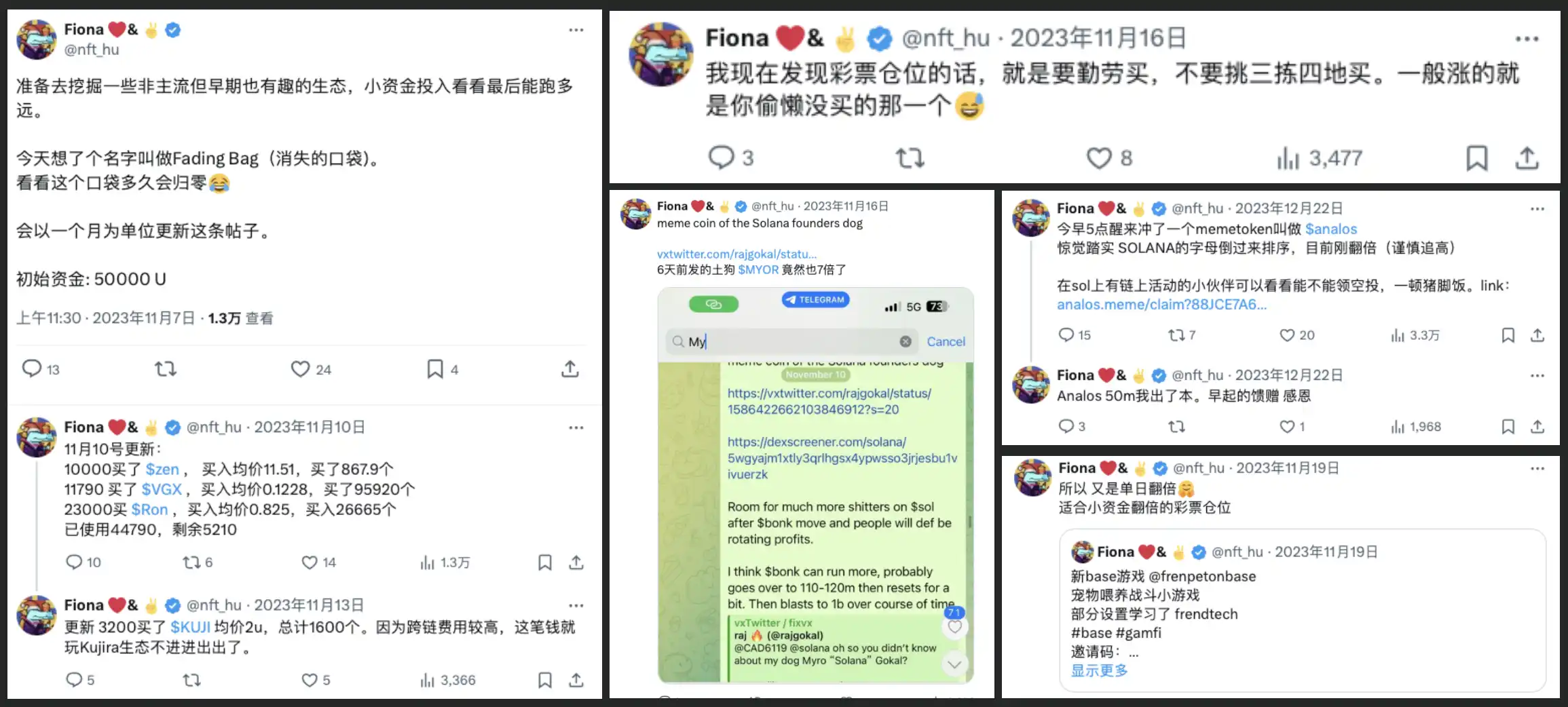
In November last year, Fiona tweeted about deploying $50K to explore non-mainstream ecosystem projects—a fund she dubbed “Fading Bag,” meaning “disappearing position.” Approaching it with zero expectations, she bought RON, KUJI, ZEN, and shared periodic updates. Her latest update showed the bag exceeding $200K.
Another favorite tactic—“buying lottery tickets”—keeps Fiona and her community engaged. Though hard to integrate into formal portfolio management, she still joins late-night and early-morning meme raids with small stakes. Her feed regularly flashes “10x!” “20x!” posts featuring obscure tickers—triggering mild FOMO among new followers.
BlockBeats: Where did the idea for Fading Bag come from?
Fiona: My Taiwanese friend Woody (a prominent local KOL) mentioned someone ran a $10–20K “micro fund” during the bear-to-bull transition, growing it to $2M. Watching Chu Mu’s (a famous KOL) live portfolio, I felt it offered limited value for average users—too fast-paced, volatile, hard to follow. So I thought—why not create something similar but longer-term? That’s how Fading Bag began.
BlockBeats: What’s your strategy managing Fading Bag?
Fiona: Investing in early-stage projects lacking Ethereum/Solana-level certainty but showing promise—like seeking another Camelot. Most successful finds include RON and MUBI. Returns were solid, though I exited poorly.
BlockBeats: Your “lottery ticket” approach is fascinating. Isn’t it too small-scale? Why spend time on it?
Fiona: It’s a great way to diversify mental energy. I didn’t want to constantly adjust large positions. Once my core holdings (like Solana) were set, smaller bets let me “clear jungle”—stay active and engaged.
I was overly excited then—couldn’t stop, but didn’t want to touch my Solana stack daily. It wouldn’t make sense. I enjoy meme trading—it’s community culture, part of crypto’s DNA. It’s not just money anymore—it’s participation. The adrenaline rush from small multipliers is intense.
BlockBeats: What was your daily routine like then?
Fiona: Wake up at 4–5 AM to trade memecoins, sell, nap by 8–9 AM, wake for lunch. Afternoon at a café trading till evening. If not sleepy, hunt night memecoins until 1–2 AM, repeat next day. Now I sleep 9–11 hours, but back then only 3–4. Totally different state—required far less sleep.
BlockBeats: You reacted quickly to news—especially GROK, the “Musk AI” concept.
Fiona: I wanted to buy more GROK, but hesitated when the price didn’t move after Musk’s tweet. I was online 24/7 trading memes, constantly scanning Dexscreener rankings. When GROK appeared, I realized Musk’s theme was powerful—his new AI guaranteed ongoing tweets, thus sustained traffic. I couldn’t understand why others ignored it. In hindsight, I underbought.
BlockBeats: Did you catch any opportunities in the recent meme frenzy?
Fiona: Caught my favorite PEPE on secondary. This cycle, I bought many Binance-listed memes early but sold too soon—left me feeling down lately. Like Myro—I posted it in the group at $1M MC, happily exited at $10M. WIF? By today’s standard, I sold too early, but at the time it felt reasonable.
KOL Benefits
Becoming a KOL was never Fiona’s intention. Right after leaving StepN, she had barely a hundred followers—half friends. She had no idea how to grow. Then, a tweet about South Korea’s crypto regulations, reposted by Jeromeloo (a well-known Chinese KOL), brought 300+ new followers overnight. She decided to give it a try. Over time, she found that being a KOL not only enabled monetization through traffic but also helped her uncover early opportunities.
BlockBeats: How did you catch the Metis trend?
Fiona: They launched aggressive marketing campaigns. A friend handling PR in Korea took on Metis’ account when METIS was around $20. She shared details with me. One benefit of being a KOL now is access to such signals—large-scale promotions mean the team has something to push, whether a pump or a new product, often both.
Another factor: Metis announced a substantial ecosystem fund, reminding me of Avalanche pre-rally. So I bought METIS and ecosystem tokens. METIS performed decently, but most ecosystem tokens underperformed.
BlockBeats: Lately, “KOL rounds” are hotly debated—seems there are real perks to being a KOL now.
Fiona: True, but I’ve recently felt stretched thin. KOL rounds require work—posting for teams creates obligations, making it hard to stay fully degenerate and immersed as before.
BlockBeats: How many KOLs does your PR agency currently work with?
Fiona: About 37 in the Chinese-speaking space—I prefer quality over quantity to deliver real value. Korean side is larger—over 200. Currently focusing on these two languages, possibly expanding to others later, but too early now.
BlockBeats: How do you expand into overseas KOL markets?
Fiona: I rely on local friends—it’s easy to get scammed otherwise, especially with language barriers and limited time. A close friend, a top Korean KOL, introduced reputable agencies and his own PR firm. Together, they form our Korean market backbone.
More Than All-In
If you follow Fiona’s Twitter, you’ll notice her trading life isn’t separate from daily living—in fact, they blend seamlessly. Beyond trading logic and opportunity sharing, her most popular tweets are intimate glimpses of her lifestyle: burning food while trading, posting photos of dinners with KOL friends, collapsing from熬夜trading and tweeting from the hospital upon waking. Stocks, real estate—outsiders easily see that every trade idea or insight she shares stems directly from lived experience, consistently traceable in past posts. One word sums it up: authentic.

Fans especially love her “onboarding” journey with her parents. Her thread explaining how she convinced them to buy SOL now boasts 140,000 views.
Her parents knew she traded crypto early on, but viewed it differently. Early media coverage of blockchain was mostly negative. But after Fiona earned income working in the space, their perception shifted. Their crypto literacy began with StepN—“walking daily to earn money made them open-minded toward crypto.” Since then, Fiona has discussed portfolio management, investment logic, and even NFT art picks with her parents—an unusual dynamic among traders.
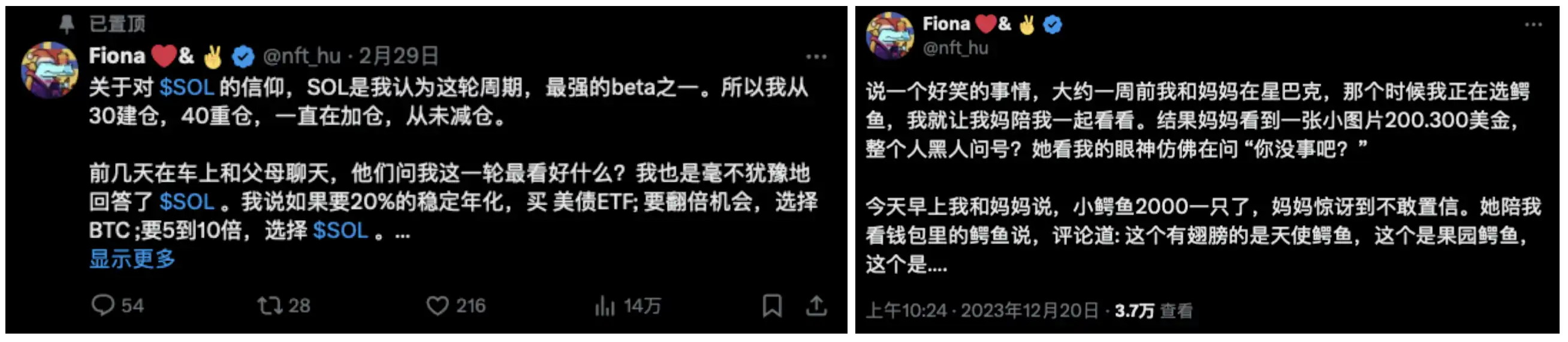
Last year, Fiona urged her parents to “freely buy” Ethereum near $1,000 and Bitcoin near $25,000—making them some of the best-positioned buyers in this bull run. She believes irresponsible bank wealth products abound, and parents lack time or expertise to manage funds—someone should help them invest and hold. “They’re quite happy now—just watching Bitcoin and Solana prices daily,” says Fiona. “Better their money is locked in Bitcoin than lost to scams.”
Join TechFlow official community to stay tuned
Telegram:https://t.me/TechFlowDaily
X (Twitter):https://x.com/TechFlowPost
X (Twitter) EN:https://x.com/BlockFlow_News
 BlockBeats