








What changes will a16z Crypto's newly released zkVM solution Jolt bring?
TechFlow Selected TechFlow Selected
What changes will a16z Crypto's newly released zkVM solution Jolt bring?
a16z Crypto has released Jolt, a zkEVM solution designed to accelerate and simplify blockchain scaling operations.
 Navigating Web3 tides with focused insights
By Frank, PANews
On April 10, a16z Crypto unveiled Jolt, a new zkEVM solution designed to accelerate and simplify blockchain scaling operations. Integrating SNARK-based zero-knowledge proofs, Jolt provides a framework for EVM-compatible rollups, enabling developers to build SNARK-based Layer 2 solutions. The team claims Jolt is "twice as fast" compared to current zkVMs.
Given the technical complexity of Jolt, here’s a simplified explanation of several key technical terms and their relationships:
-
zkSNARK is a powerful zero-knowledge proof primitive and serves as the foundation for building zkVMs and zkEVMs
-
zkVM is a general concept referring to a zero-knowledge virtual machine that supports arbitrary instruction sets
-
zkEVM is a specific instance of a zkVM, tailored specifically for EVM compatibility
-
ZK Rollups leverage either zkVM or zkEVM to enhance Ethereum's scalability while preserving privacy
What is Jolt?
Jolt is a novel SNARK solution that offers a more streamlined and efficient approach to constructing zkVMs (zero-knowledge virtual machines). In fact, as early as August 2023, a16z Crypto introduced related concepts named Lasso and Jolt, developed in response to the traditionally slow and costly nature of SNARK technology.
Lasso is a new lookup argument that significantly reduces prover costs; Jolt leverages Lasso to provide a new framework for designing SNARKs for zkVMs and broader frontends. Together, these technologies improve the performance, developer experience, and auditability of SNARK designs, thereby enhancing Web3 development and expanding the use of zero-knowledge proofs in blockchain.
Before understanding Jolt, it may help to first understand zkVM and zkEVM.
zkVM is a general term for a zero-knowledge virtual machine. Similar to zkEVM, a zkVM allows programs to be written in high-level languages like C++ or Rust, which the virtual machine then compiles into an intermediate representation (such as circuits or arithmetic constraints), and subsequently proves execution using proof systems like zkSNARK. Unlike zkEVM, however, zkVM is not limited to EVM compatibility and supports arbitrary instruction sets. Jolt is a high-performance zkVM implementation targeting the RISC-V instruction set.
We can think of a zkVM as a special "black box" that, while preserving privacy, can prove to the outside world that it has correctly executed a predetermined computation. However, traditional zkVMs require extensive and cumbersome computations during proof generation, leading to poor performance.
Jolt’s core innovation lies in finding a more efficient mathematical method for generating this proof:
First, Jolt cleverly transforms the computation to be proven into a special kind of polynomial—let’s call it the "computation polynomial." The defining feature of this polynomial is that its value equals zero if and only if the black box correctly executed the computation.
To prove that the "computation polynomial" evaluates to zero, Jolt employs an interactive protocol known as "sumcheck." This protocol enables the verifier to become convinced that the polynomial is zero without having to compute it entirely—a process similar to a teacher checking only a few problems on a student's exam to judge the correctness of the entire paper.
Technical Advantages of Jolt
The technical principles behind Jolt are highly complex, but in simple terms: zkVM is a key technology for improving blockchain scalability, offering effective proofs while preserving privacy. During his keynote speech at the recent Hong Kong Web3 Festival, Vitalik provided a detailed discussion on zkSNARK technology, stating: "Finding ZKSNARKs is very useful for privacy and also very useful for scalability."
However, proof generation speed and computational overhead have long been major challenges hindering the practical adoption of zkSNARKs, making them a key focus for both academic research and industry development. Traditional zkSNARK schemes such as Pinocchio and Groth16 can take hours or even days to generate proofs for complex computations, requiring substantial memory and storage resources. These performance bottlenecks severely limit zkSNARK applications in many real-world scenarios.
For blockchains to achieve large-scale adoption and enable real-time verification, improving zkSNARK performance is a critical step.
Specifically, zkSNARK proof generation involves complex cryptographic algorithms such as elliptic curve pairings and polynomial interpolation, all of which are extremely resource-intensive. Especially when the size of the computation circuit being proven is large, the computational complexity of proof generation increases exponentially.
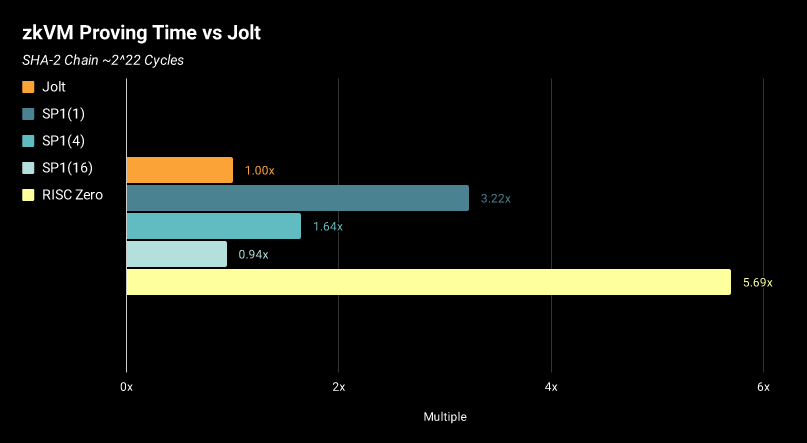
According to a16z Crypto, the initial Jolt implementation is approximately six times faster than RISC Zero and twice as fast as the recently released SP1 on CPU, with plans to boost Jolt’s speed by another 1.5x in the coming weeks.
Jolt is already over twice as fast as existing zkVMs, yet still has significant room for optimization.
Jolt also cleverly leverages certain algebraic properties of polynomials to implement a more efficient polynomial commitment scheme, further reducing proof size and verification time.
Potential Impact of Jolt
From an engineering perspective, Jolt employs a series of optimizations—such as more compact circuit design, more efficient pipelining, and greater parallelization—to maximize hardware computational power utilization.
Imagine you're a Web3 developer aiming to deploy an on-chain poker game on Ethereum. This game requires shuffling cards, dealing hands, and comparing card values—all operations needing to be implemented via zkVM circuits to ensure privacy and verifiability.
Using existing zkVM solutions like ZoKrates or bellman, building such a circuit could take hours or even days. Given the current low performance of zkVMs, generating zero-knowledge proofs for complex circuits demands considerable computing resources and time, resulting in lengthy development and testing cycles.
With Jolt, the situation changes dramatically. According to Jolt team benchmarks, the current implementation generates proofs 2–5 times faster than mainstream zkVM solutions. This means that if proof generation previously took 10 hours, it might now take only 2–5 hours.
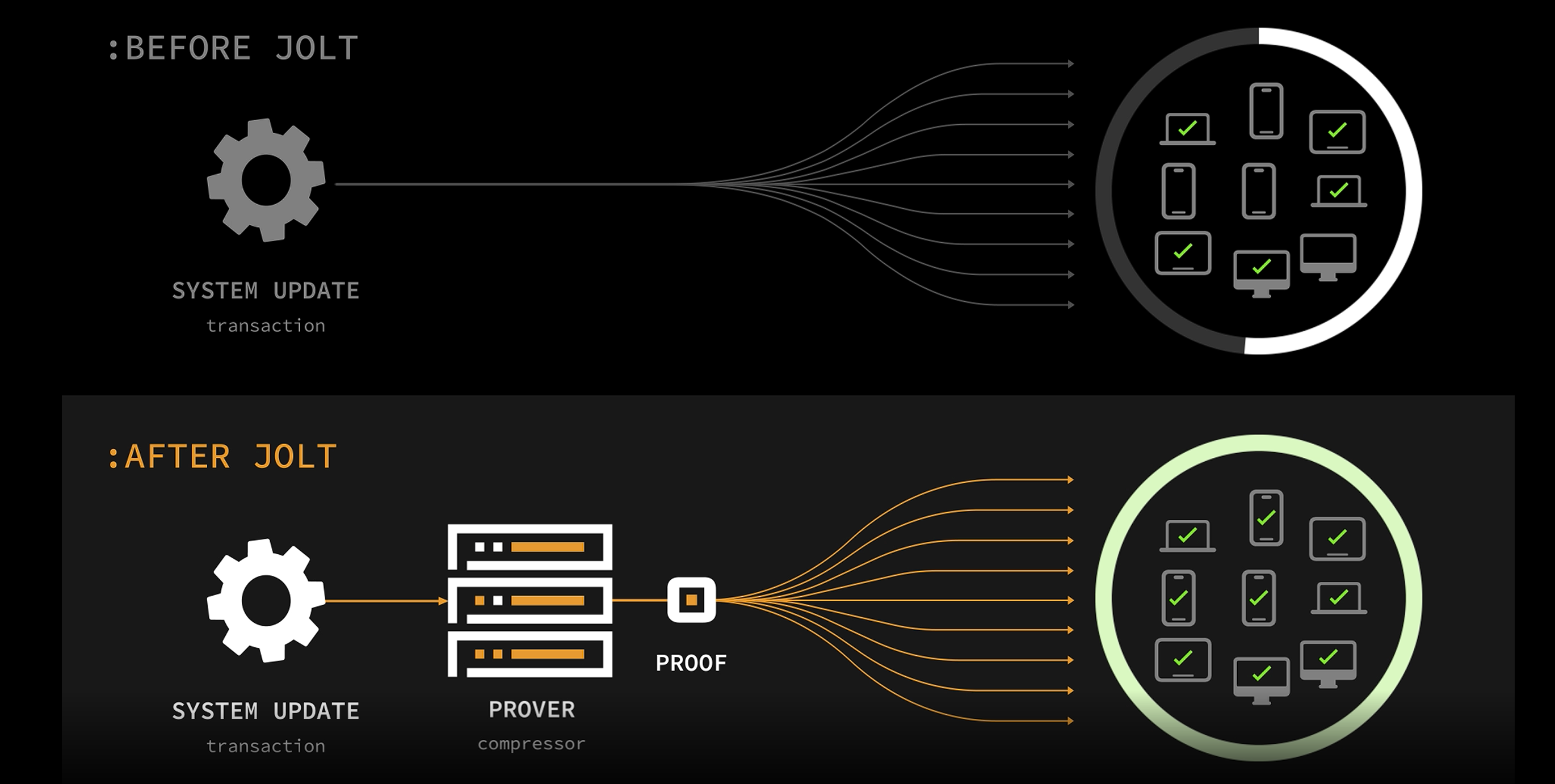
Overall, the 2–5x performance improvement brought by Jolt significantly enhances the usability and accessibility of zkVM technology. This will substantially lower the barrier to entry for Web3 developers, shorten application development cycles, and deliver better user experiences. In the longer term, Jolt has the potential to accelerate widespread adoption of zkVM technology, bringing stronger privacy protection and verifiable computation capabilities to every Web3 user.
Of course, Jolt is still in its early stages—the 2–5x speedup is just the beginning. As Jolt continues to evolve and optimize, zkVM performance is expected to see further breakthroughs, ultimately paving the way for mass adoption of Web3 applications.
Join TechFlow official community to stay tuned
Telegram:https://t.me/TechFlowDaily
X (Twitter):https://x.com/TechFlowPost
X (Twitter) EN:https://x.com/BlockFlow_News
 PANews







