









Binance: Lessons from History – A Review of Bitcoin Halving and Industry Momentum
TechFlow Selected TechFlow Selected
Binance: Lessons from History – A Review of Bitcoin Halving and Industry Momentum
Bitcoin halving has increased Bitcoin's visibility and adoption, while also promoting discussions around blockchain technology, Bitcoin network dynamics, and cryptocurrency assets.
 Navigating Web3 tides with focused insights
Written by: Binance
Translated by: Kate, Mars Finance
Key Takeaways:
-
The Bitcoin halving, designed to regulate the supply of new BTC tokens, has historically influenced token supply dynamics, market sentiment, and adoption.
-
Halvings tend to increase Bitcoin's visibility, leading to price appreciation and higher adoption. They also spark discussions around blockchain technology, Bitcoin network dynamics, and crypto as a unique asset class.
-
Although historical patterns show BTC price increases and broader adoption in the months following past halvings, it is important to note that the upcoming April 2024 halving has already proven unprecedented in several key aspects.

The Bitcoin halving is an event at the core of the original cryptocurrency’s value proposition—it is far more than a footnote in digital financial history. This transition impacts the entire ecosystem, reshaping market dynamics and investor sentiment each time it occurs. In this article, we examine the multifaceted impact of Bitcoin halvings on the digital asset industry, revealing effects that extend beyond short-term price movements. With the next halving expected in mid-April fast approaching, reviewing historical data is instructive. However, the patterns observed this time do not guarantee similar outcomes: the current cycle is unfolding under unique conditions and has already diverged from historical precedents in significant ways.
It’s Ancient History
Halving is a fundamental mechanism within the Bitcoin protocol designed to regulate the issuance of new tokens by periodically reducing mining rewards. This deliberate reduction, intended to slow the creation of new bitcoins, plays a critical role in shaping Bitcoin’s tokenomics and supply dynamics, reinforcing its deflationary nature and supporting its value proposition. To recap the basics of Bitcoin halving, check out our video explanation:
Historically, Bitcoin halvings have had powerful ripple effects across the crypto industry and the broader financial ecosystem. Looking through a historical lens at the 2012, 2016, and 2020 halvings, we can identify recurring patterns in how these events influence the crypto world. These moments acted as turning points, catalyzing shifts in market sentiment and investor behavior, and interrupting Bitcoin’s evolution as the locomotive of the crypto ecosystem.
150 Days Later
When analyzing the aftermath of halving events, one cannot overlook their impact on Bitcoin’s price and market capitalization. At the heart of the halving mechanism lies the principle of scarcity, which attracts investors seeking assets with limited issuance, thereby driving up value. Over time, reduced supply coupled with increasing demand theoretically sets the stage for price appreciation—though this typically unfolds gradually over the following months rather than immediately.
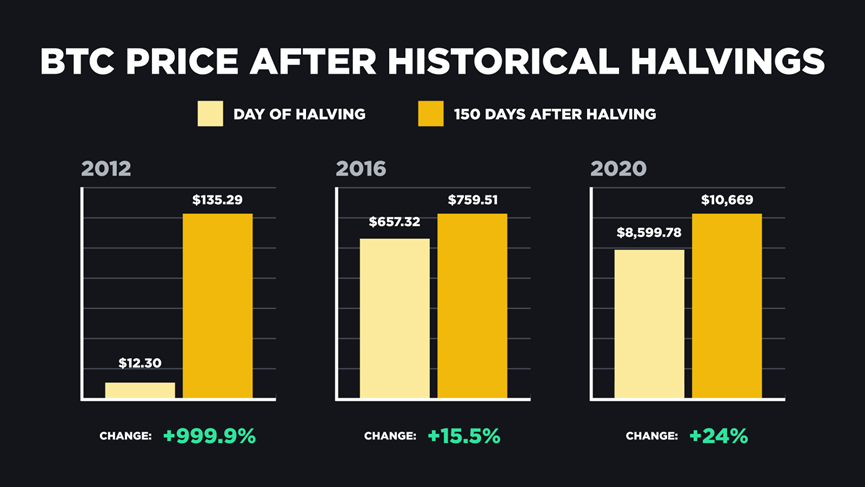
Historically, Bitcoin has experienced significant price increases within 5–6 months after each halving event. For example, within 150 days following the first three halvings in 2012, 2016, and 2020, Bitcoin’s price rose by 999%, 15%, and 24% respectively.
In each four-year period between prior halvings, Bitcoin reached a new all-time high. In the 2020–2024 cycle, this peak was achieved in October 2022, when Bitcoin surpassed the $66,000 mark. The uniqueness of the upcoming 2024 halving lies in the fact that, for the first time in its history, Bitcoin reached a new all-time high in early March 2024—before the halving. Whether this is a warm-up ahead of post-halving highs or an early peak remains to be seen.
The mechanism through which halvings affect price may operate via shaping market sentiment and investor perception. Beyond building anticipation within the crypto community, halving events promote narratives about the benefits of algorithmic monetary policy and the deflationary characteristics of digital assets, sparking interest beyond the crypto space and drawing in new participants.
Beyond Price
In addition to price-related impacts and increased attention (partly driven by those impacts), halvings are also associated with profound, long-term growth in adoption metrics. Increased awareness of Bitcoin before and after halvings encourages more newcomers to explore and potentially purchase the cryptocurrency, contributing to an expanding user base.
Moreover, Bitcoin halvings prompt miners to reassess the underlying technology and network dynamics of the cryptocurrency as they undergo transformation. Discussions around network security, transaction fees, and scalability solutions intensify. Advancements in these areas enhance the robustness of the Bitcoin network, boosting confidence among users and businesses, thus creating a favorable environment for Bitcoin adoption. Halvings also tend to reduce miners’ profit margins, resulting in additional selling pressure from miners and accelerating consolidation among mining operations and pools.
With each halving, the need for efficiency and innovation becomes more pronounced, driving technological progress that not only improves Bitcoin’s network performance but also increases its appeal to a broader audience.
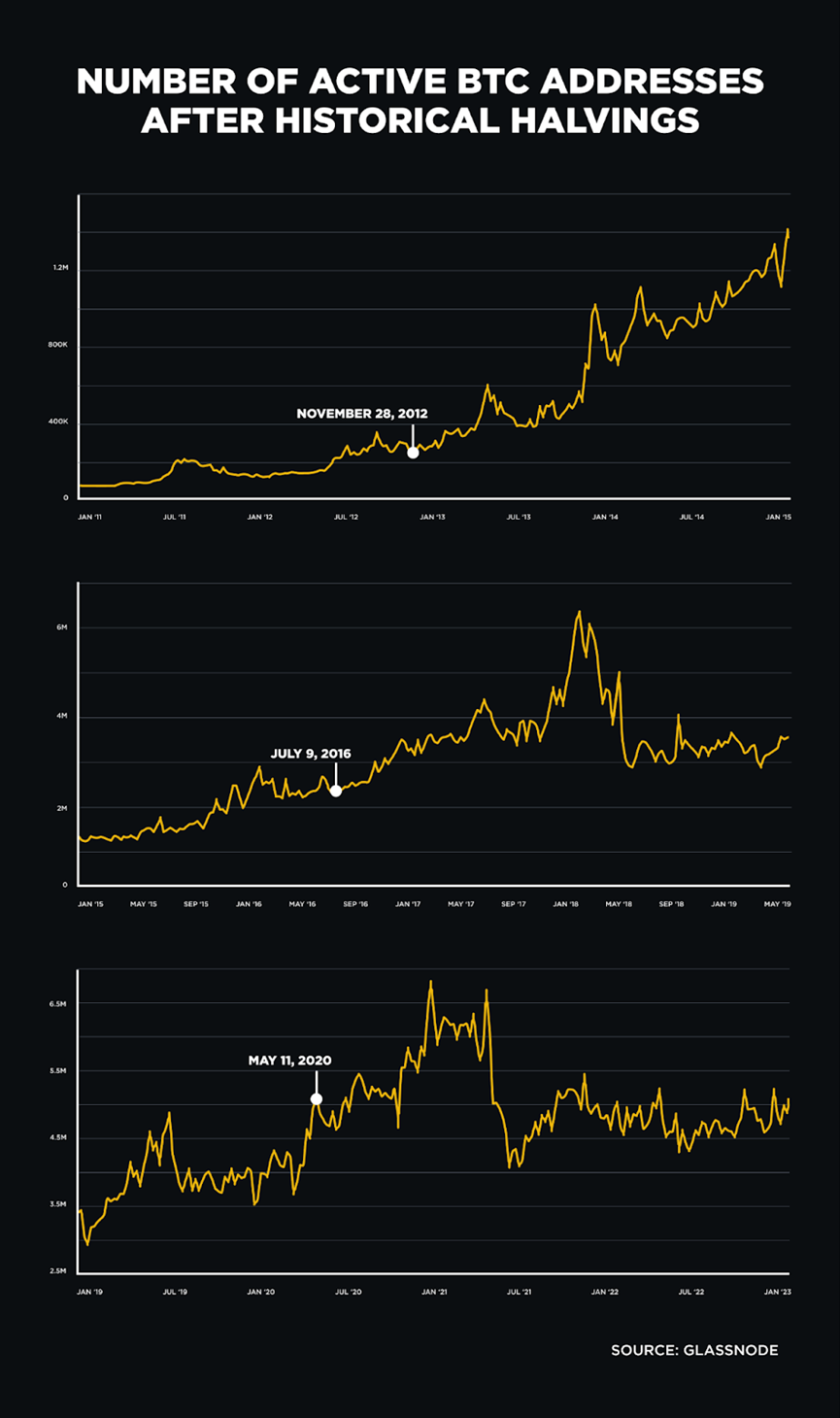
Let’s consider a simple adoption metric—the number of active Bitcoin addresses—using the same 150-day window applied to price dynamics. In the 150 days preceding each previous halving, the number of new Bitcoin addresses grew by 83% in 2012, 101% in 2016, and 11% in 2020.
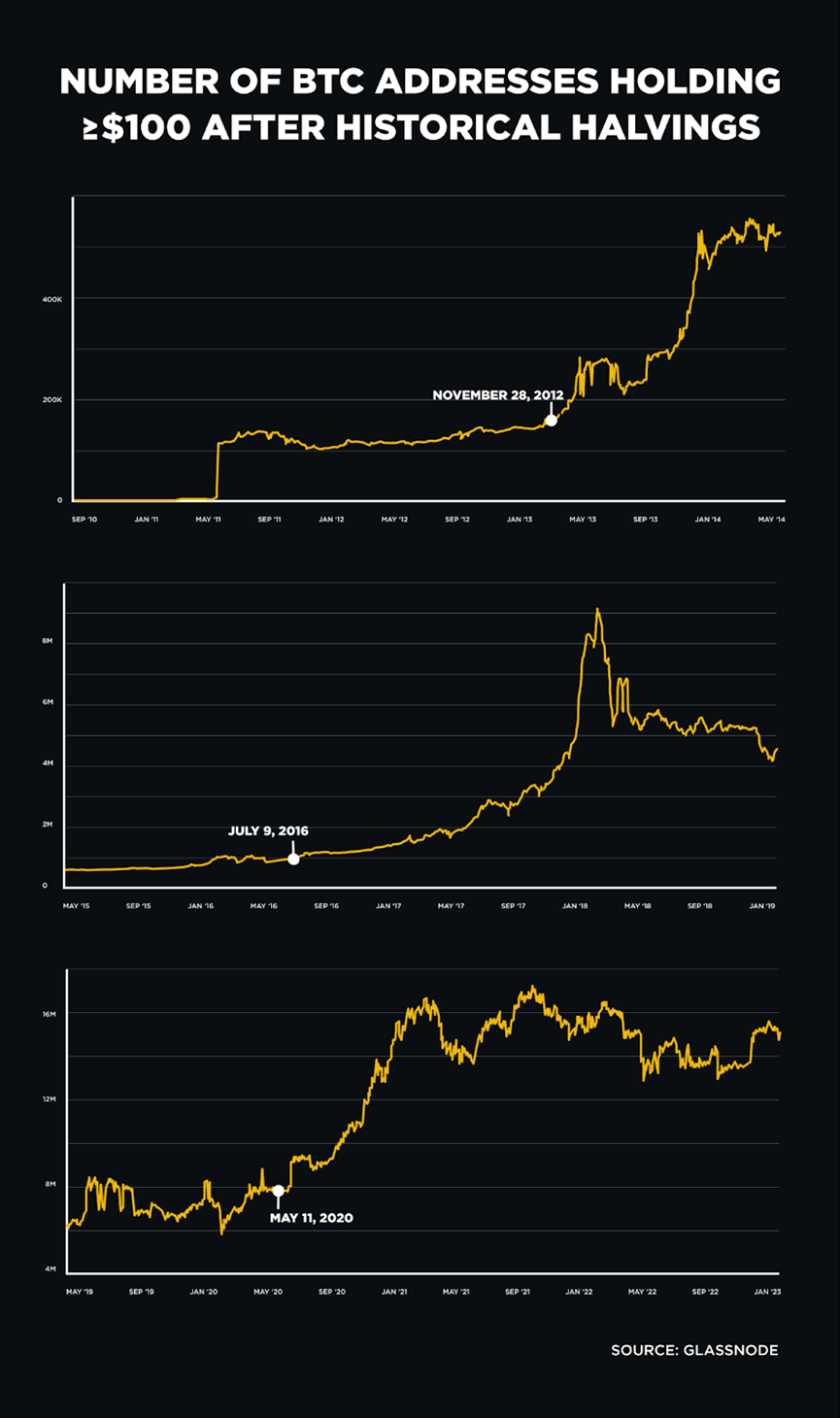
The number of addresses holding $100 or more—an imperfect proxy for retail investor count—increased by 12% in 2012 and 6% in 2020, remaining largely flat in the 150 days following the 2016 halving. While these are imperfect indicators of adoption and sentiment (e.g., one person can create multiple wallets), they suggest directional trends and magnitudes observed after past halvings.
Likewise, institutional interest in Bitcoin often surges around halving events, driven by perceptions of Bitcoin as a store of value and a potential hedge against inflation. High-profile endorsements from corporations and well-known investors validate Bitcoin’s legitimacy as an investable asset class, further fueling adoption. As institutional capital flows into the crypto market, infrastructure and products emerge, paving the way for broader adoption by both traditional financial institutions and retail investors.
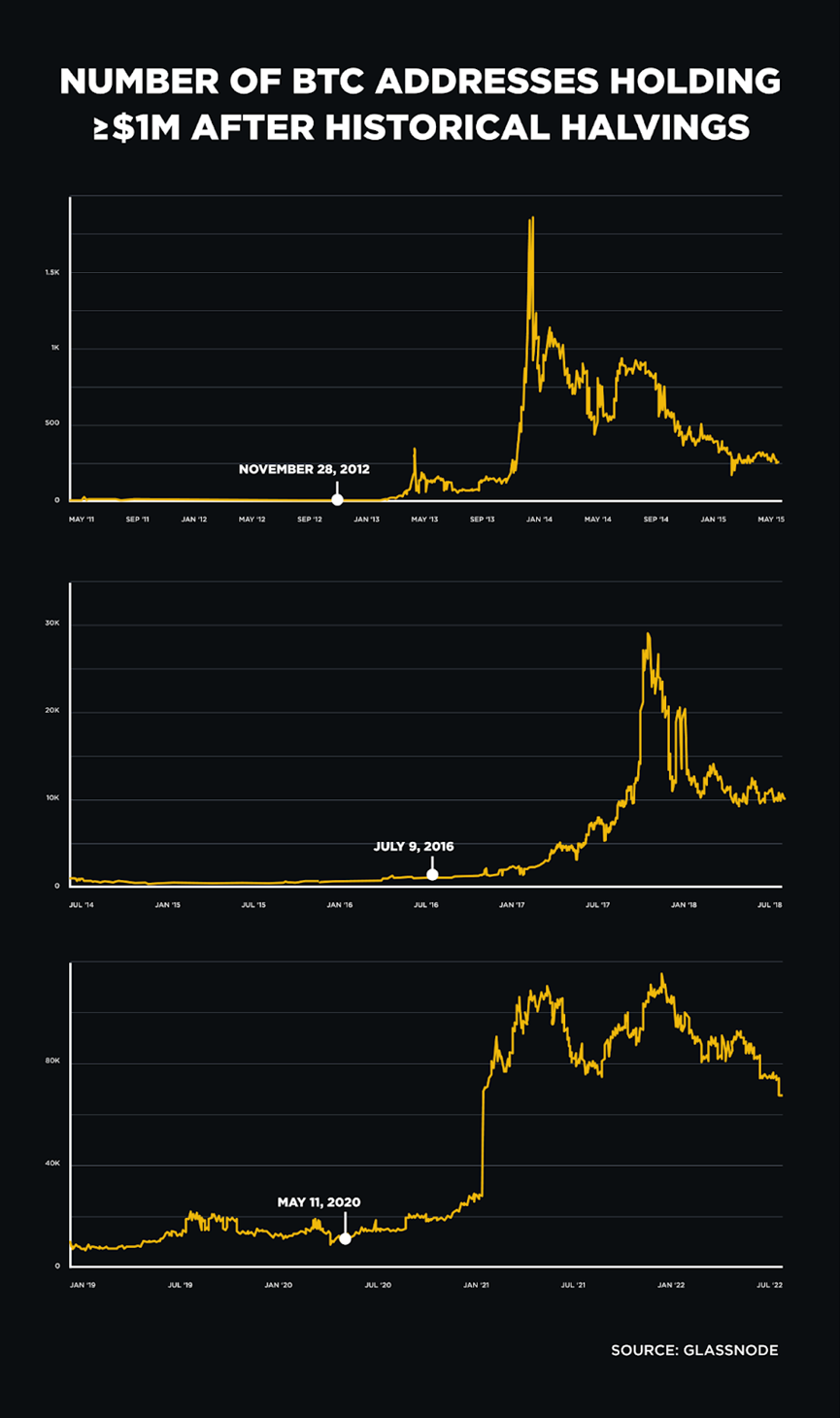
For instance, the number of wallets holding over $1 million—often viewed as an indicator of professional or institutional investment activity—grew by thousands of percentage points in 2012, 10% in 2016, and 43% in 2020.
What’s Next?
The next Bitcoin halving will occur in April amid strong capital inflows into the Bitcoin industry and centralized exchanges like Binance, alongside the U.S. approval of spot Bitcoin ETFs, which has fueled a surge in institutional participation.
Coupled with the rise of Layer-2 solutions and DeFi activity that enhance the network’s practical utility, this setup is beginning to look highly favorable for the Bitcoin ecosystem and the broader crypto space.
However, it is crucial to remember that while the context surrounding the 2024 halving appears favorable, there is no guarantee that its dynamics and impact will mirror previous halvings. Each halving represents a unique node in Bitcoin’s development, shaped by evolving market conditions, technological advances, and regulatory developments. Therefore, while optimism around the transformative potential of the 2024 halving is warranted, prudence demands acknowledging the inherent unpredictability of market dynamics and the need for vigilance when navigating the ever-changing landscape of digital assets.
Each Bitcoin halving marks a fundamental shift in the crypto industry, with profound implications for adoption and market evolution. Beyond direct impacts on price and investor sentiment, Bitcoin halvings foster greater interest and awareness, institutional engagement, and technological innovation, laying the foundation for sustained growth and maturation in digital finance. As we navigate the evolving crypto landscape, the significance of Bitcoin halvings stands as a testament to the enduring strength and resilience of our industry.
Join TechFlow official community to stay tuned
Telegram:https://t.me/TechFlowDaily
X (Twitter):https://x.com/TechFlowPost
X (Twitter) EN:https://x.com/BlockFlow_News
 @binance







