Solana Q1 Report: Memecoin Boom Drives New User Growth, Funding Rises to $89.2 Million
TechFlow Selected TechFlow Selected
Solana Q1 Report: Memecoin Boom Drives New User Growth, Funding Rises to $89.2 Million
Solana's average daily new paying users increased 266% week-on-week to 115,000.
 Navigating Web3 tides with focused insights
Source: Messari
Translation: Felix, PANews (with edits)
Key Insights:
-
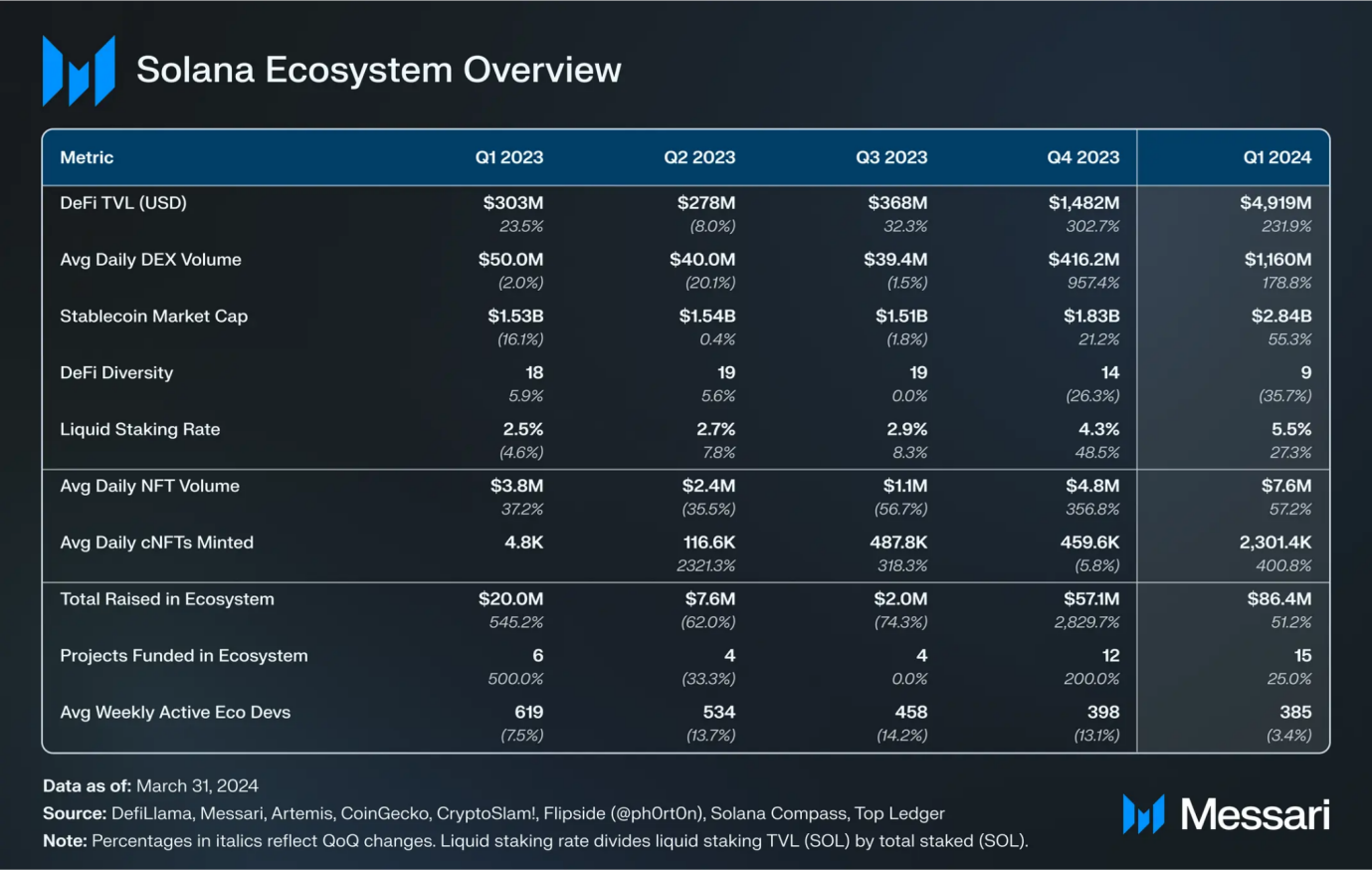
Solana's average daily spot DEX trading volume surged 319% quarter-over-quarter to $1.5 billion. Solana has become a hub for retail and memecoin traders.
-
Projects primarily built on Solana raised $89.2 million in Q1, exceeding the total funding raised in 2023 by $2.5 million.
-
Token Extensions were launched, offering token issuers a set of configurable features. So far, stablecoin issuers including Paxos and GMO Trust, along with crypto-native projects such as Photo Finish LIVE and Wen, have adopted Token Extensions.
-
With the launch of developer marketplace Anza and growth organization Colosseum, Solana’s ecosystem made significant progress toward further decentralization.
-
Solana experienced its first network outage in nearly a year due to a bug in a legacy loader, but the network remained stable. Upcoming scheduler and network upgrades will reduce spam and improve user experience.
Financial Analysis
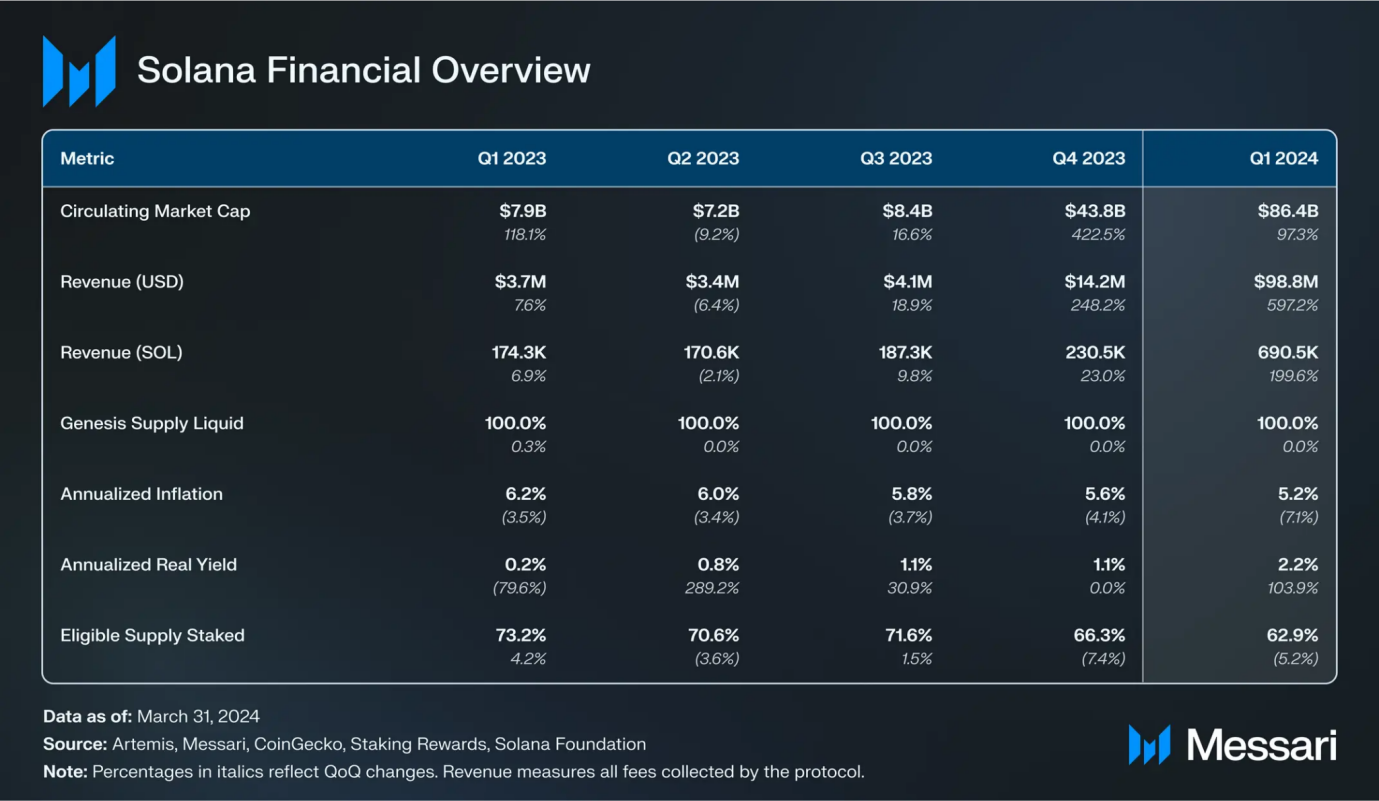
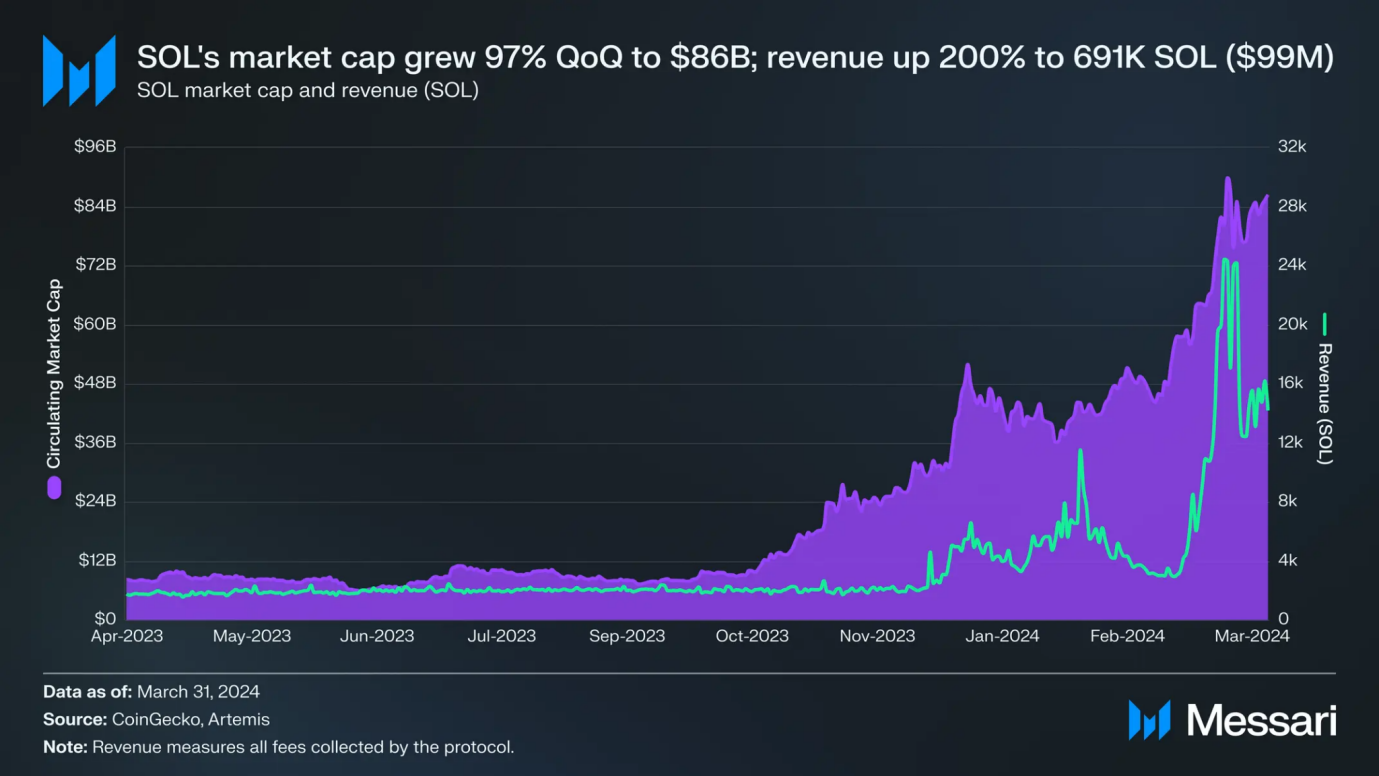
SOL continues to lead the market in terms of market capitalization. It ranks fifth among all tokens, behind only BTC, ETH, USDT, and BNB. After peaking at $77 billion in the previous cycle, SOL’s market cap reached a new all-time high. As of Q1 2024, it stood at $86.4 billion, up 97% quarter-over-quarter. However, SOL remains about 25% below its historical peak near $260.
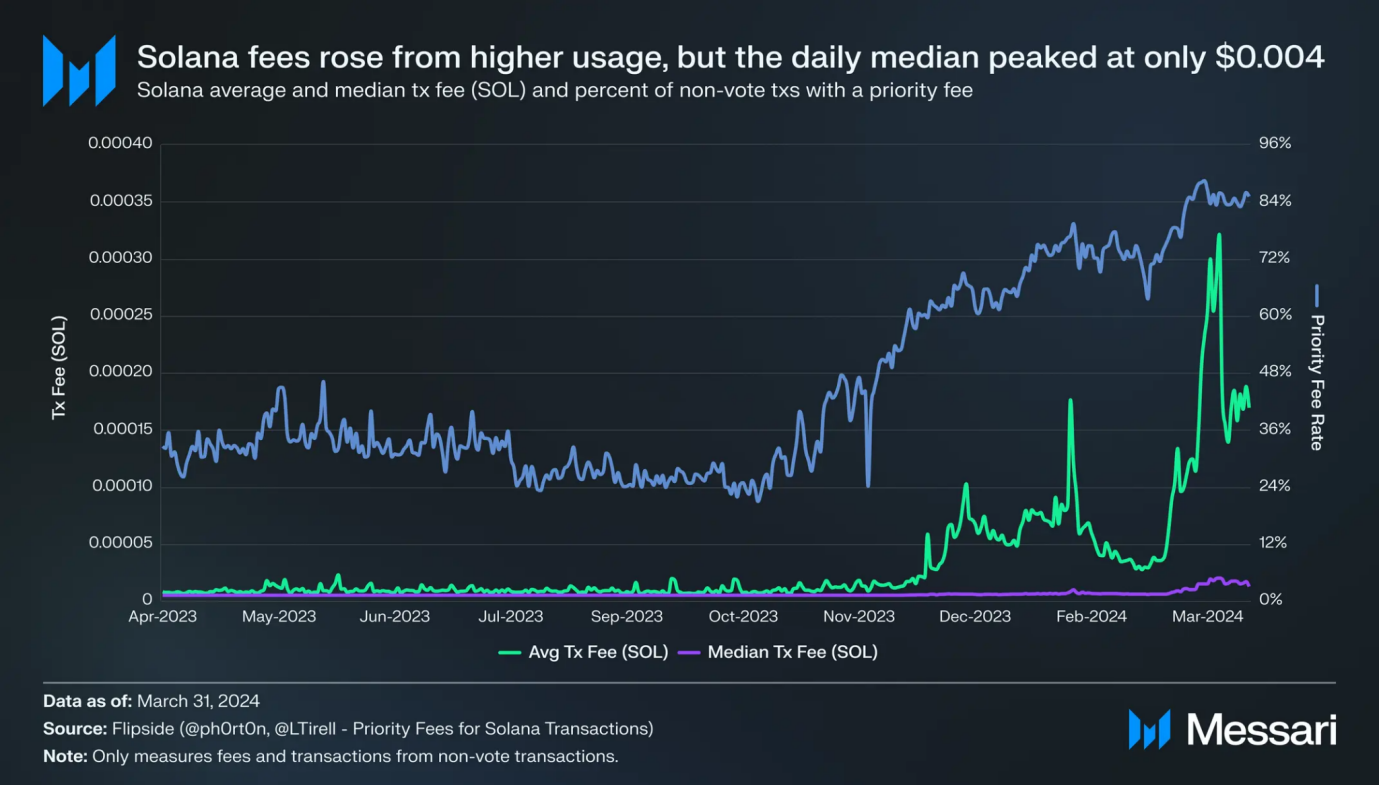
Revenue measured in SOL increased 200% quarter-over-quarter. With rising SOL prices, quarterly revenue in USD surged 597% to $98.8 million. On March 18, Solana achieved a record single-day revenue of approximately $4.9 million.
Half of these fees are burned, while the other half is distributed to block producers. The burning mechanism reduced Solana’s annualized quarterly inflation rate from 5.5% to 5.2% in Q1. The SOL issuance rate will decline by 15% annually until it reaches 1.5%.
Network Analysis
Adoption
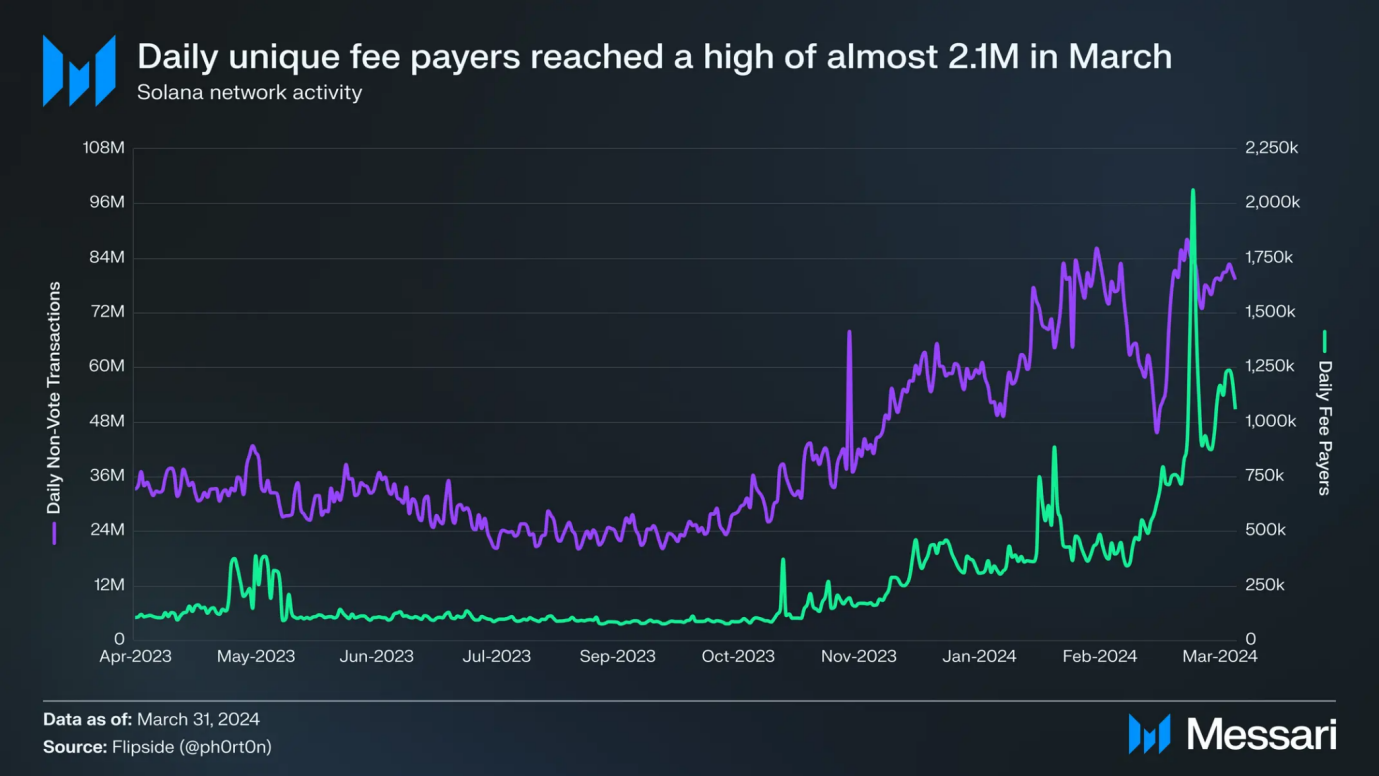
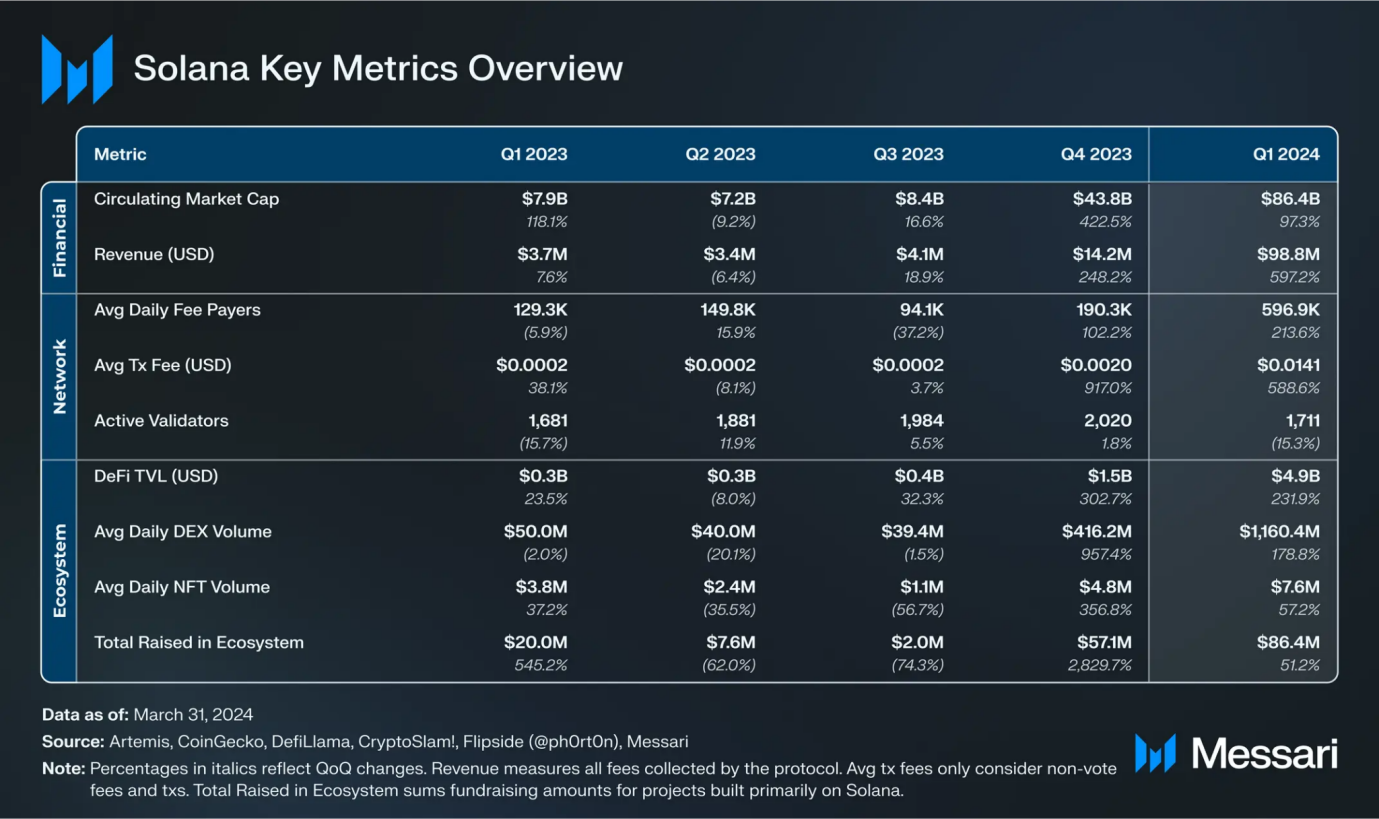
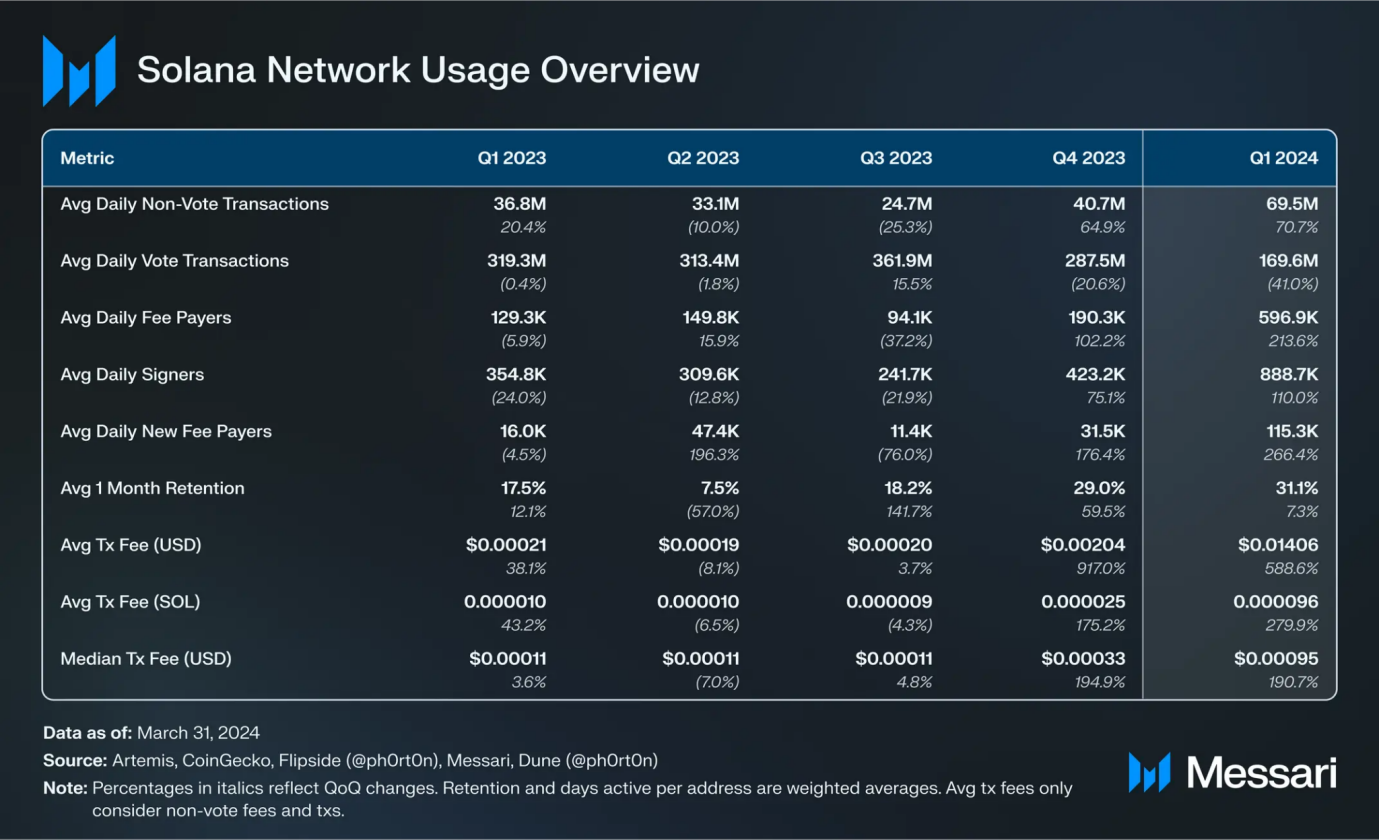
Network activity, measured by non-vote transactions and paid transactions, continued to rise in Q1. The number of daily paying users grew 214% quarter-over-quarter to 597,000, peaking at over 2 million on March 17. This surge in addresses was largely driven by memecoin trading. Average daily non-vote transaction volume rose 71% quarter-over-quarter to 70 million. However, 62% of non-vote transactions failed, an increase of 10% quarter-over-quarter. Failed transactions mostly originated from arbitrage bots or user trades on DEXs.
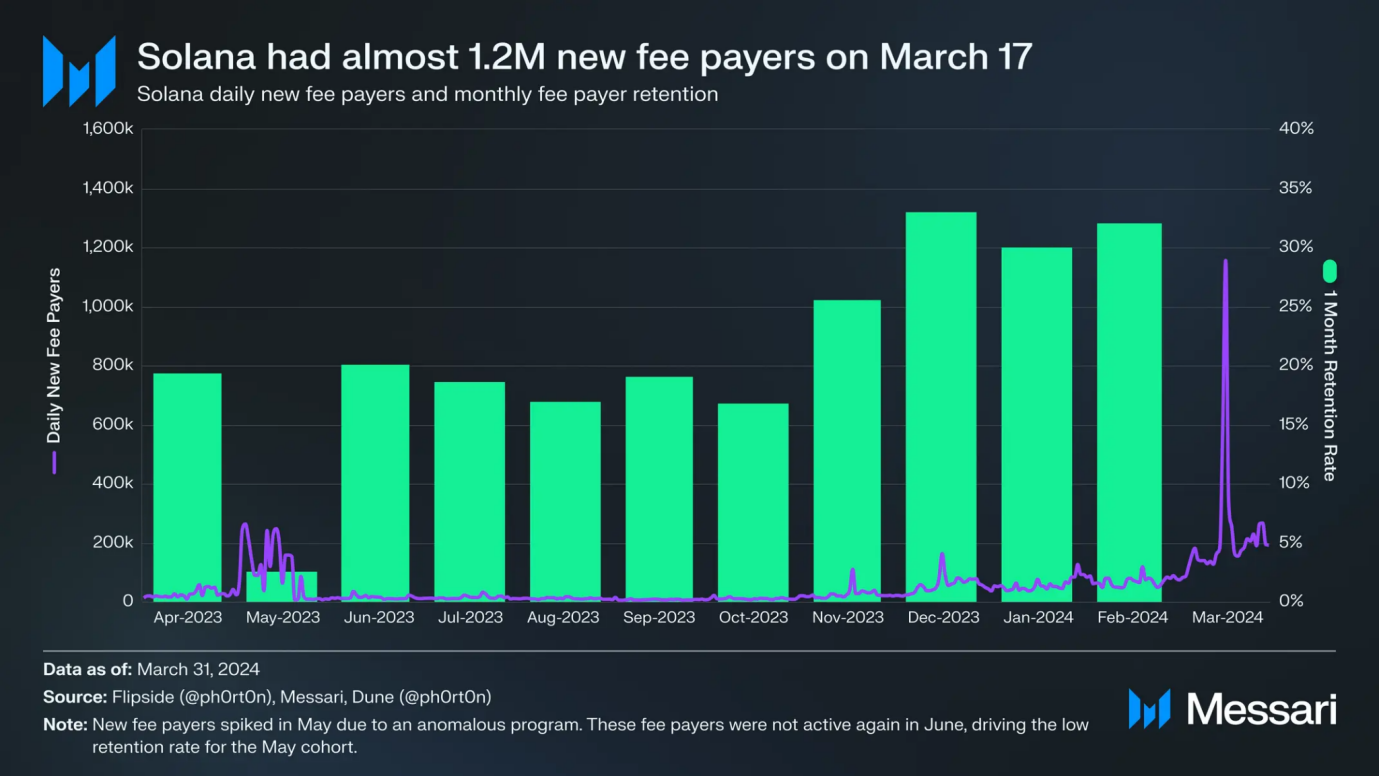
New paying users followed a similar growth trend, reaching a high of approximately 1.2 million on March 17. Average daily new paying users increased 266% quarter-over-quarter to 115,000. Retention rates for new paying users also improved significantly. The one-month retention rate for new paying user cohorts from December 2023, January 2024, and February 2024 all exceeded 30%, compared to an average retention rate of 18% from January 2023 to November 2023.
Security and Decentralization
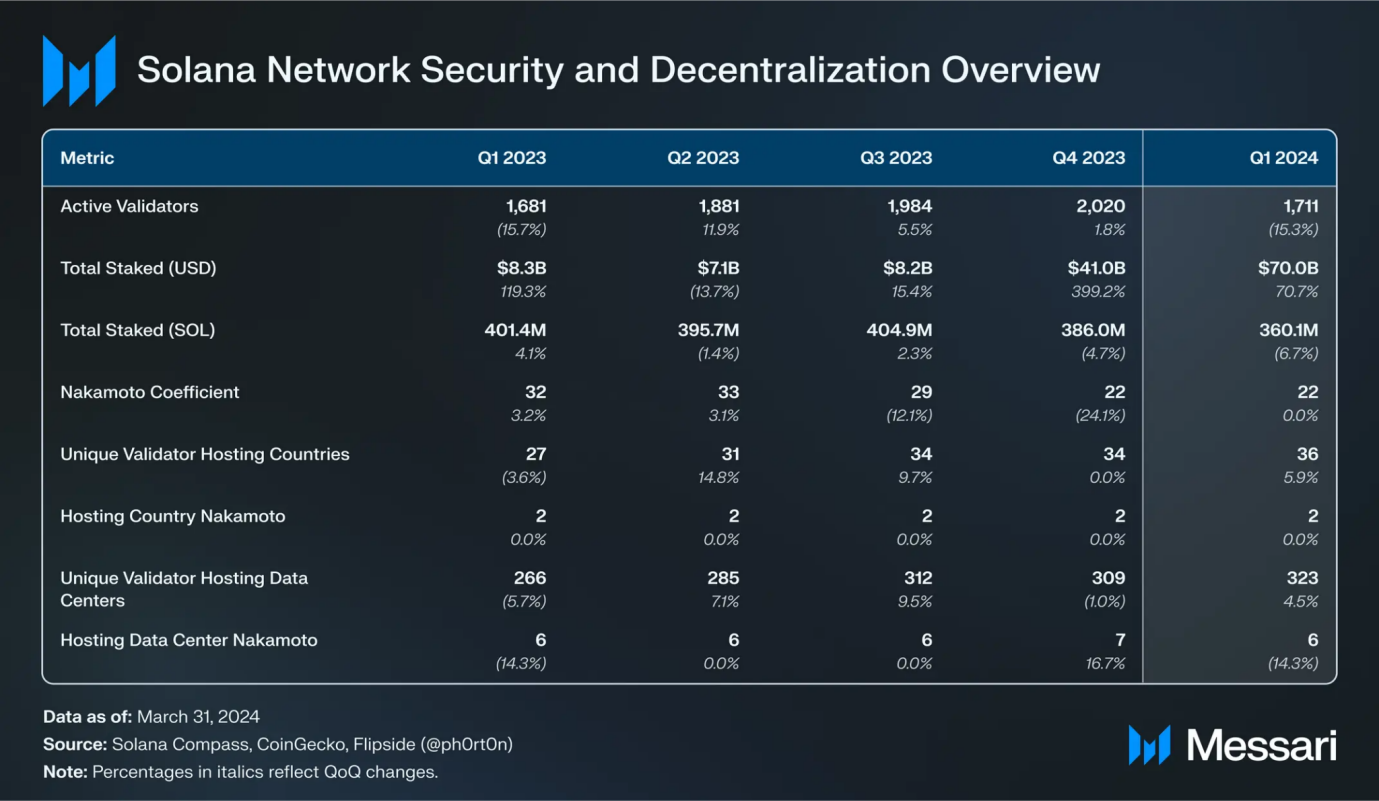
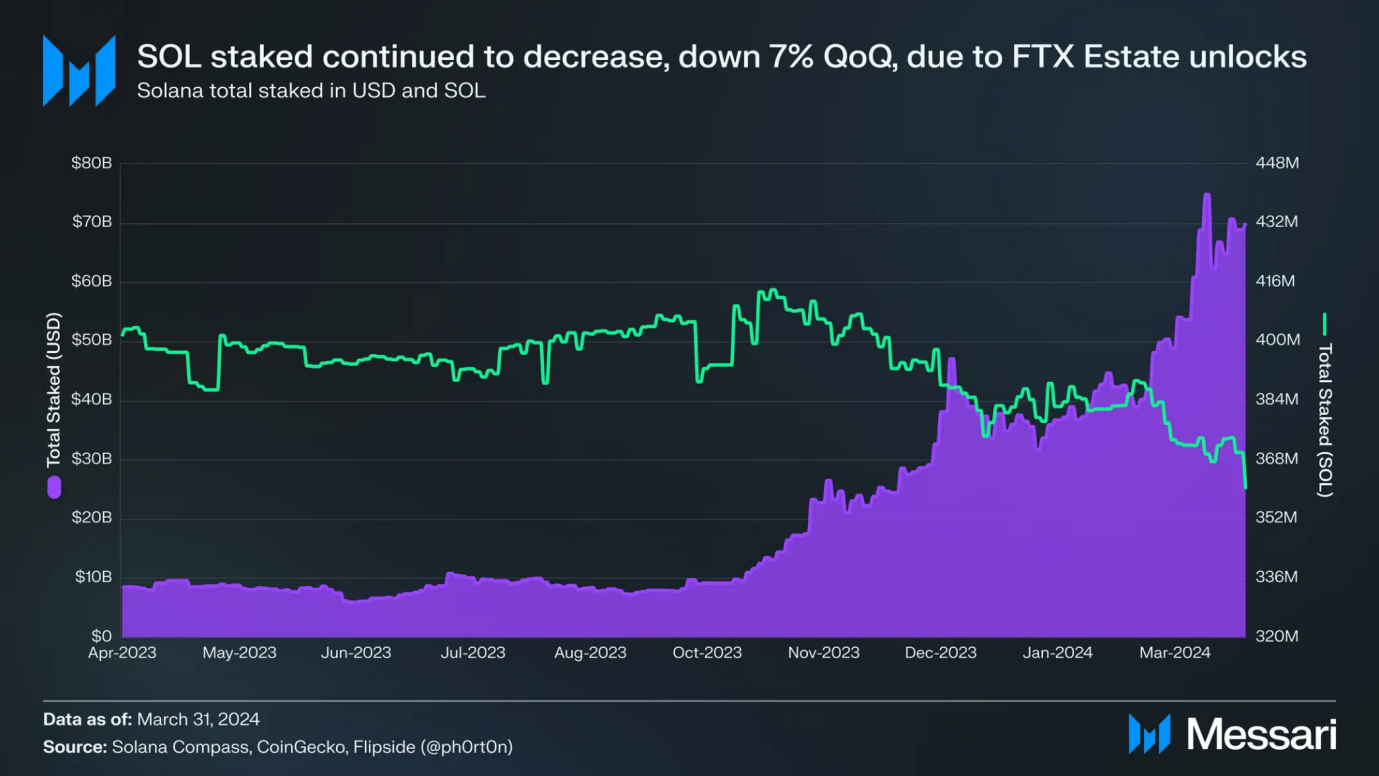
SOL staking ratio declined for the second consecutive quarter, down 7% quarter-over-quarter. This drop was primarily due to FTX Estate unstaking upon token unlocking. However, thanks to the rising SOL price, the total value staked in USD increased 71% quarter-over-quarter to $70 billion, ranking second across all networks, behind only Ethereum.
Performance, Upgrades, and Roadmap
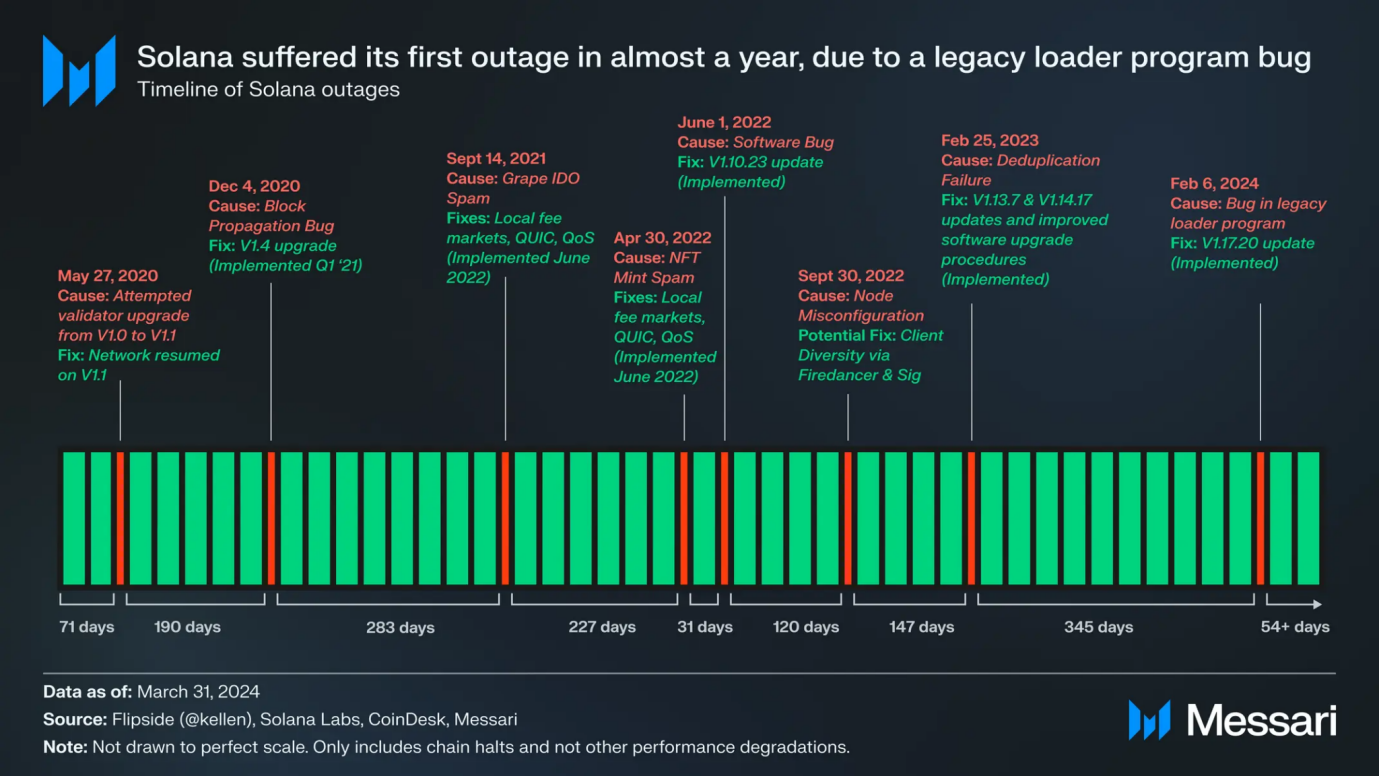
On February 6, Solana experienced its first network outage in nearly a year, lasting about five hours due to a bug in a legacy loader. This bug had previously been identified on Solana’s devnet, but the fix had not yet been implemented.
However, the Solana network remained stable. Despite increased network usage causing congestion issues that degraded user experience, identified problems and potential solutions include launching a transaction scheduler and upgrading the network.
The most notable development this quarter was Token Extensions. Token Extensions are part of the new SPL token standard, providing token issuers with a set of configurable features. While similar functionalities can be achieved on other networks, they currently require developers to build infrastructure or license proprietary environments.
Ecosystem Analysis
DeFi
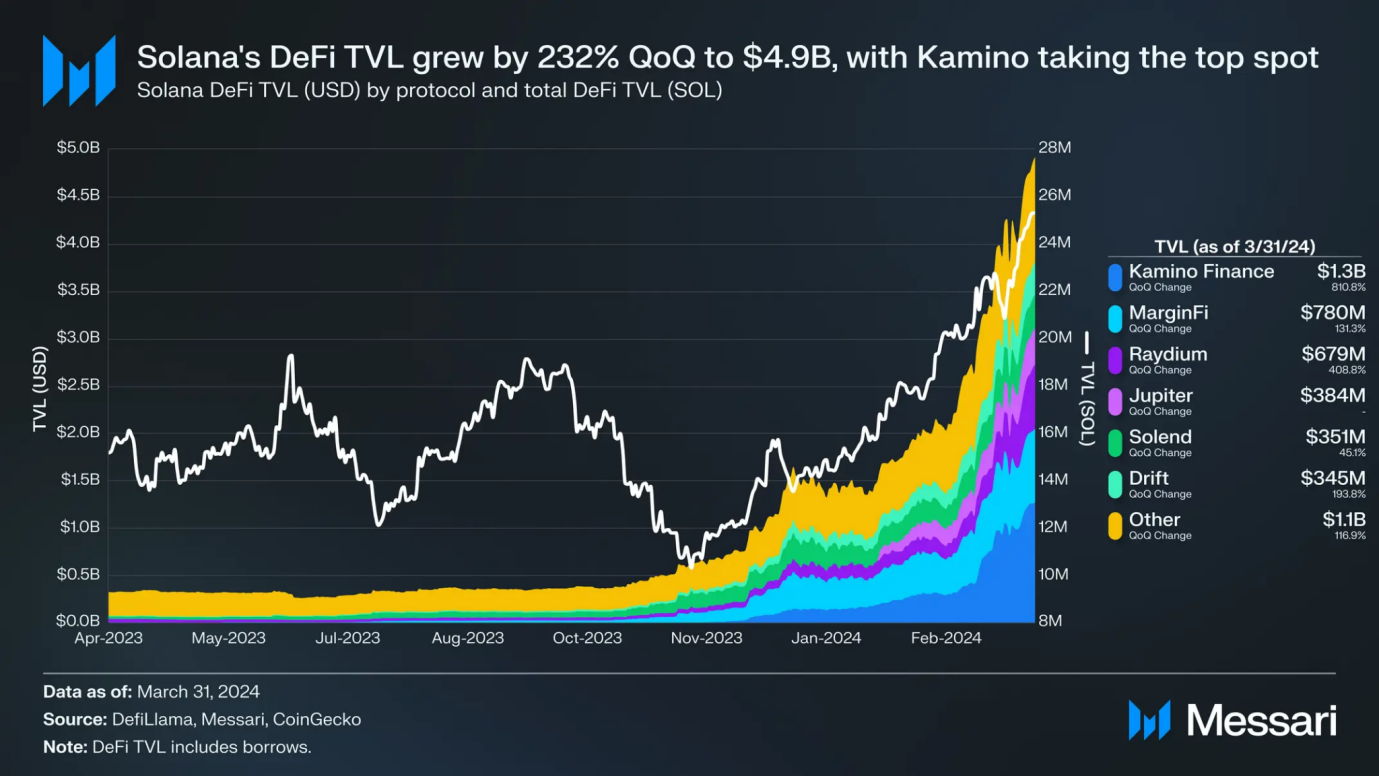
Solana DeFi TVL grew 232% quarter-over-quarter to $4.9 billion, ranking fourth across all networks. Kamino, a lending and yield protocol, jumped from Solana’s fourth-largest protocol to the top TVL position. Its lending protocol attracted nearly $1.3 billion in TVL by quarter-end, an 811% increase quarter-over-quarter.
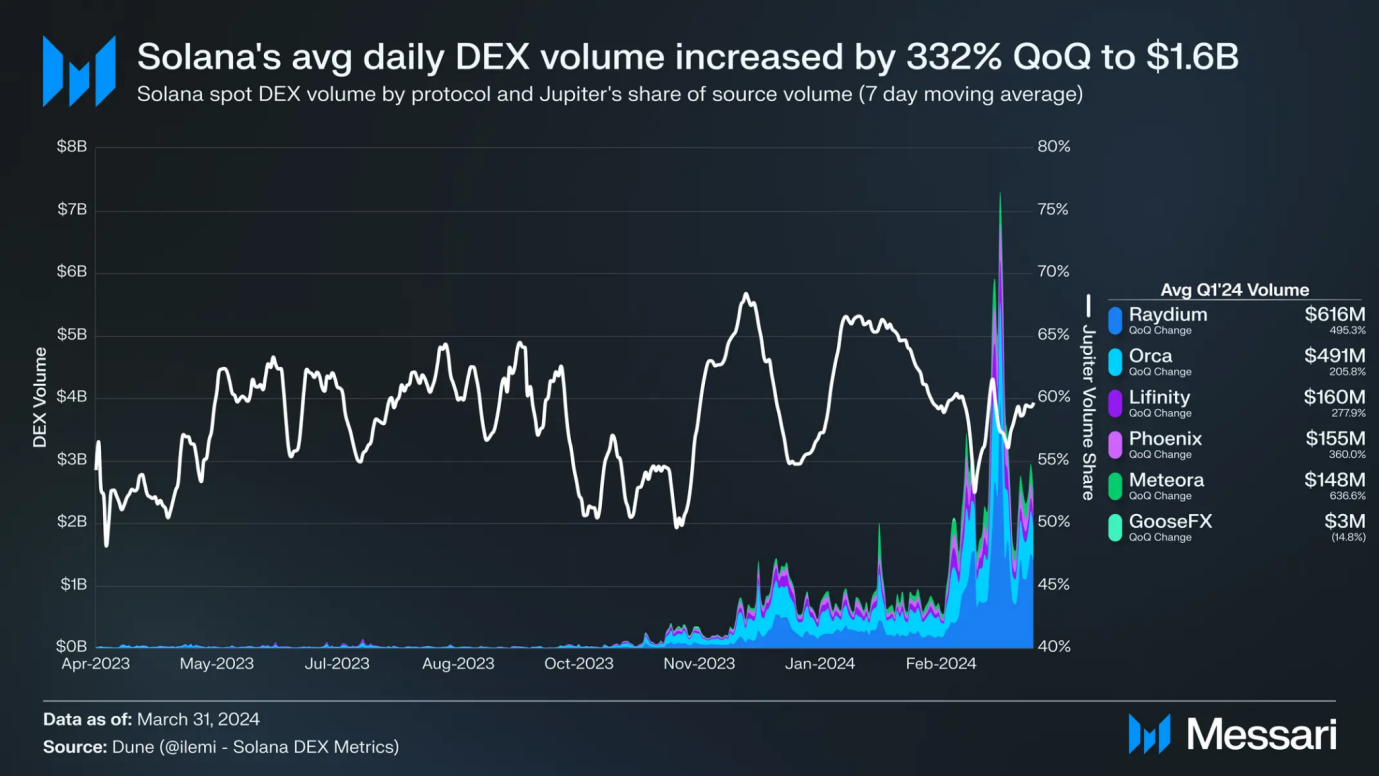
DeFi trading volume continued to grow, with average daily spot DEX volume increasing 319% quarter-over-quarter to $1.5 billion. This growth was primarily driven by memecoin trading. SLERF and BOME ranked seventh in trading volume. Other memecoins in the top 15 by volume included BONK and WEN.
Telegram bots have become popular trading venues for retail users. Daily active addresses for Solana Telegram bots surged 573% quarter-over-quarter to 45,000. Approximately 5% of total quarterly trading volume came from Telegram bots, more than doubling quarter-over-quarter.
BONKbot is the highest-volume Solana Telegram bot, averaging $37 million in daily trading volume. The bot charges a 1% fee, used to buy back BONK and distribute it to various parties, including burning (10% of fees).
In mid-March, BONKbot launched its upgraded version, Valhalla. Trojan on Solana went live at the end of January, averaging nearly $14 million in daily trading volume, and released Bolt Pro in March. Other Telegram trading bots include FluxBot, SolTradingBot, and Banana Gun.
Over 59% of spot DEX trading volume was routed through Jupiter aggregator. Jupiter launched its native token JUP at the end of January. Since launch, Jupiter Perps has averaged $328 million in daily trading volume. Drift, another major player on Solana, maintained strong momentum. In Q4, Drift’s daily revenue grew approximately tenfold, and in Q1, it increased sixfold to $142 million. At the end of January, Drift launched a points program, which concluded in March ahead of its token launch. In mid-March, Drift introduced its pre-market product, starting with Wormhole’s W, rewarding early participation in yet-to-be-launched tokens.

Following last quarter’s 21% growth, Solana’s stablecoin market cap increased 55% quarter-over-quarter to $2.8 billion, ranking fifth across all networks. This growth was entirely driven by USDC, whose market cap on Solana surged 111% quarter-over-quarter to $2 billion. Solana now holds the second-largest amount of USDC, trailing only Ethereum.
Liquid Staking
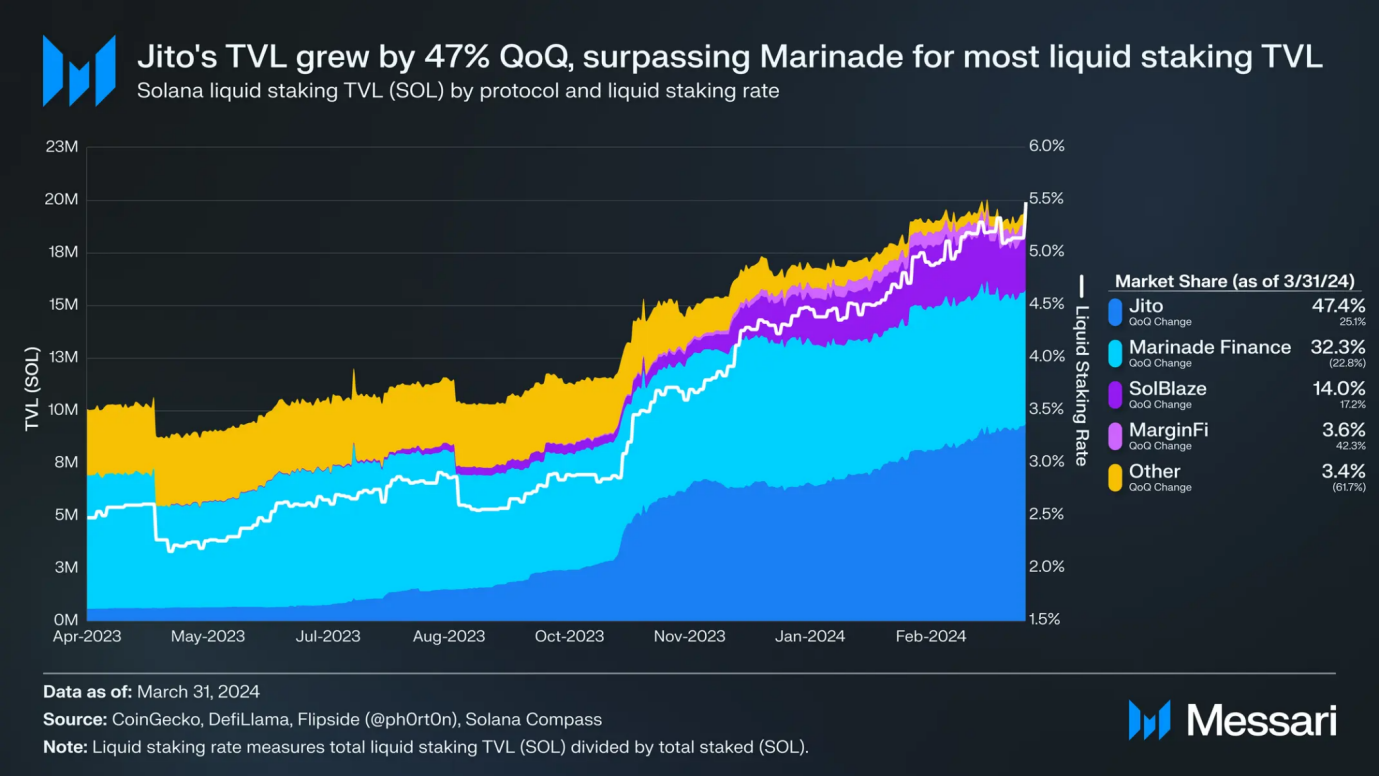
Solana’s liquid staking ratio increased 27% quarter-over-quarter to 5.5%. Jito, the leading liquid staking protocol, continued to dominate growth. Jito’s TVL rose 47% quarter-over-quarter to 9.4 million SOL, surpassing Marinade to claim the top spot. By quarter-end, Jito held nearly 50% of the liquid staking market share. Marinade Liquid’s TVL declined 9% quarter-over-quarter to 6.4 million SOL. Blaze’s TVL increased 38% quarter-over-quarter.
NFT
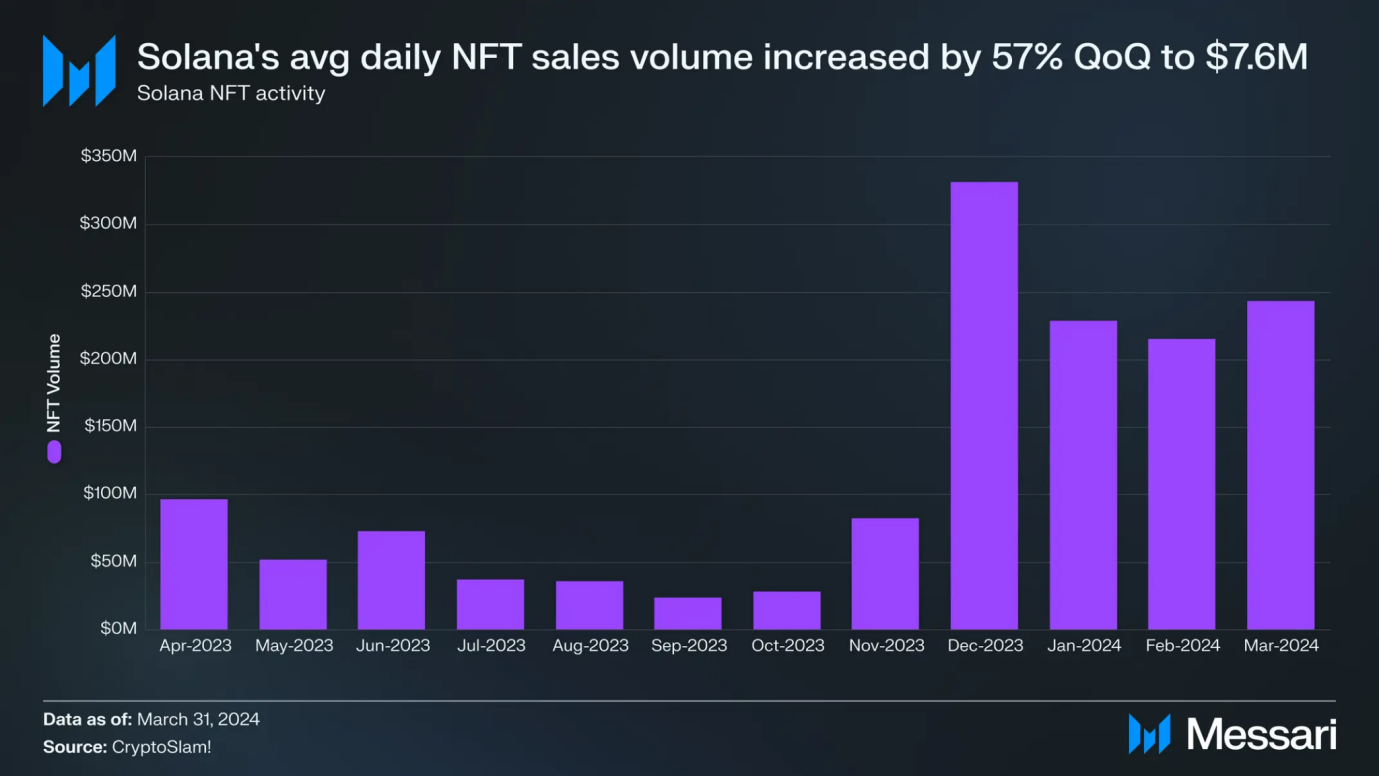
Average daily NFT trading volume increased 57% quarter-over-quarter to $7.6 million. After surpassing $331 million in total volume in December 2023, growth reversed in January and February, but rebounded again in March 2024.
In the NFT marketplace sector, Tensor’s market share increased 9% quarter-over-quarter to 71%. Magic Eden’s market share continued to decline, dropping 18% quarter-over-quarter to 25%.
DePIN
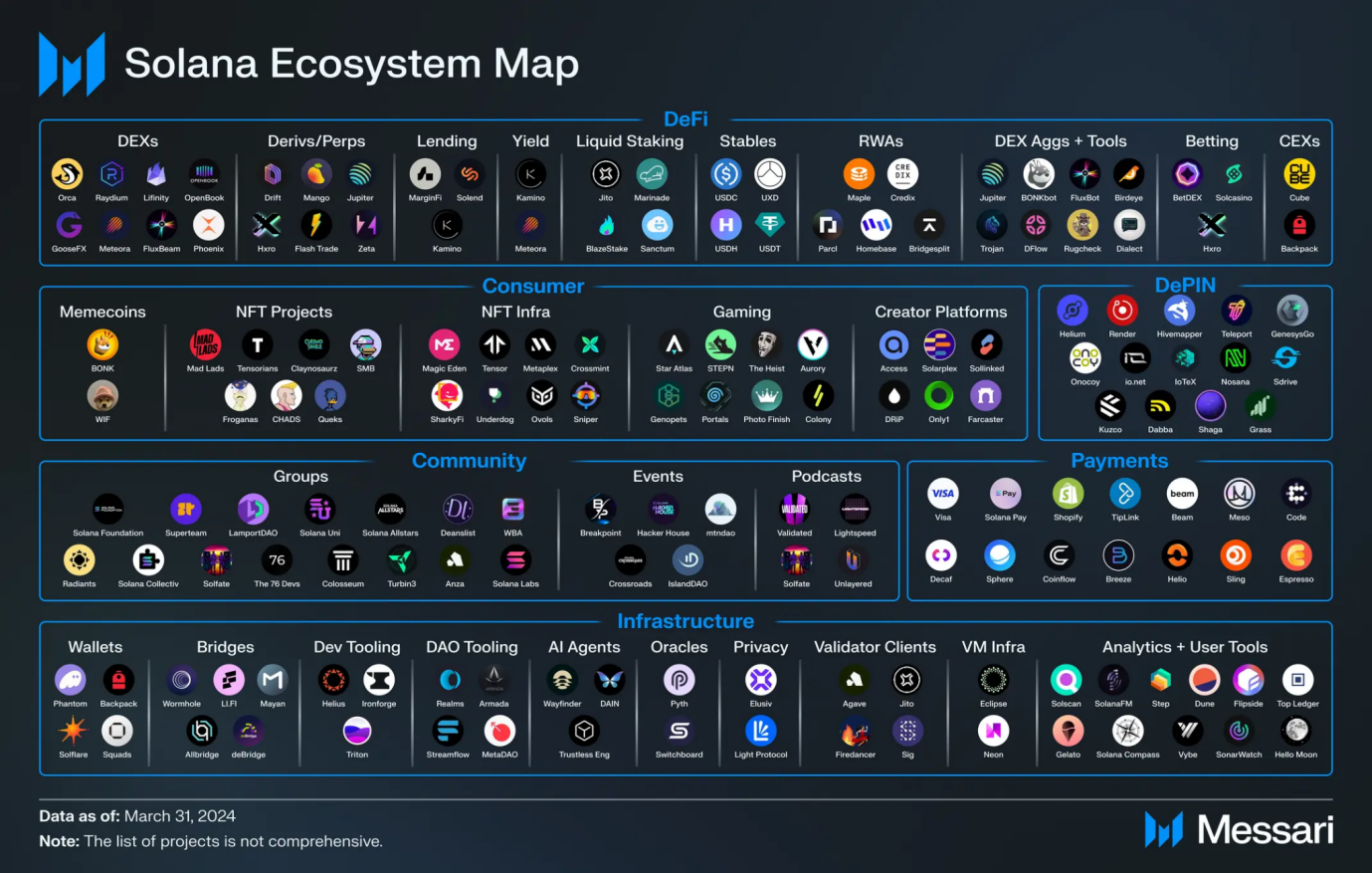
Solana is emerging as a hub for DePIN applications, hosting projects such as Helium, Hivemapper, Render, Teleport, and GenesysGo. Notable events in Q1 included the collaboration between Helium Wi-Fi and Telefonica, and Io.net’s fundraising and launch program.
Fundraising
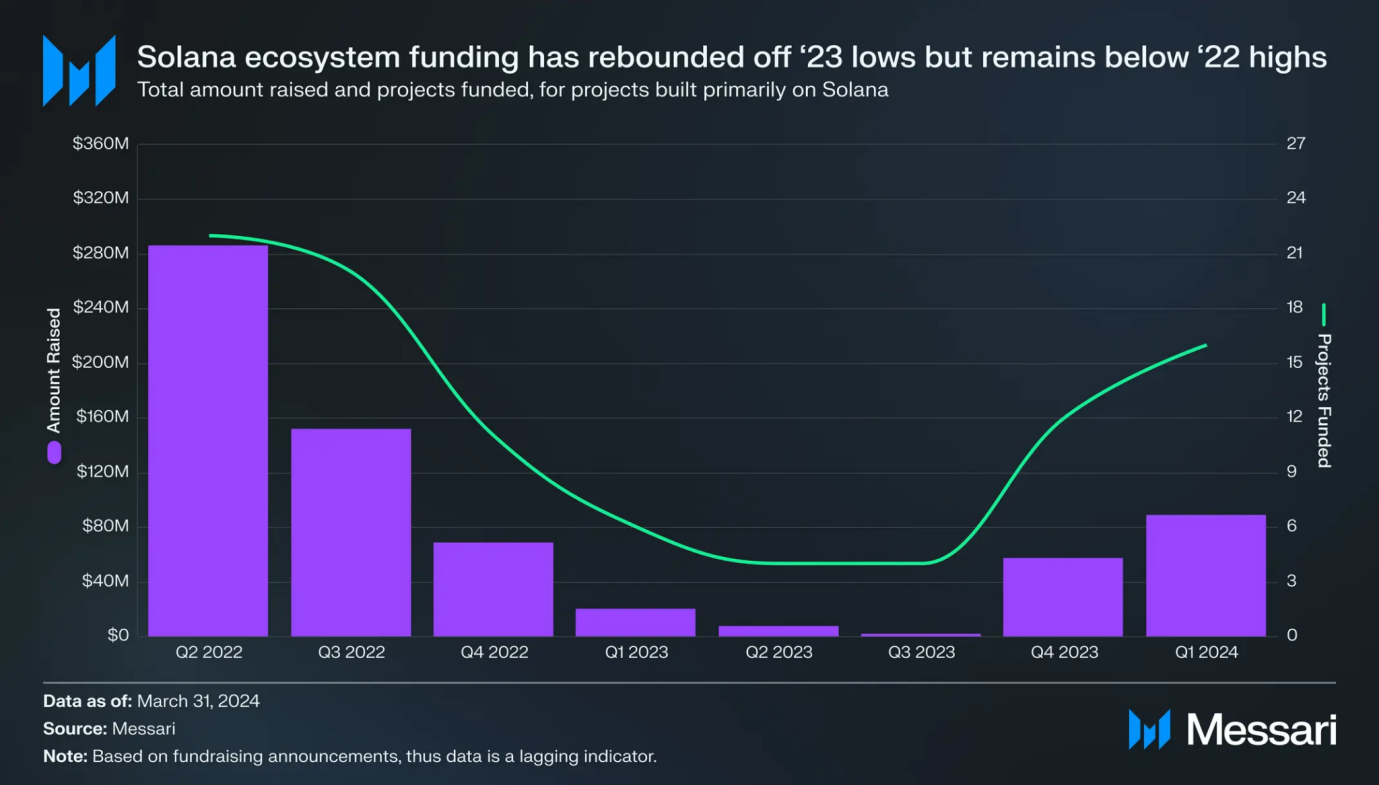
After a prolonged bear market, fundraising within the Solana ecosystem is rebounding. Sixteen projects primarily built on Solana announced multiple funding rounds in Q1, raising a total of $89.2 million. Combined with Q4 2023, 25 projects raised $146.3 million, compared to just seven projects raising $9.6 million in the two prior quarters.
Summary
Following strong performance in 2023, Solana continued growing in 2024. It has become a primary hub for retail and memecoin traders, with average daily spot DEX trading volume increasing 319% quarter-over-quarter to $1.5 billion. Solana also made significant strides in institutional support with the launch of Token Extensions, offering token issuers a suite of configurable features.
However, increased network activity has led to congestion issues, which are being addressed through upcoming network upgrades, a new scheduler, and fee market improvements.
After a prolonged bear market, investment in Solana-based projects is heating up. Projects built on Solana raised $89.2 million in Q1, exceeding the total raised in 2023 by $2.5 million. The Solana ecosystem is also becoming more decentralized. Former Solana Labs engineers and executives launched Anza, a developer marketplace, while the former head of growth at the Solana Foundation initiated Colosseum, a growth organization.
Join TechFlow official community to stay tuned
Telegram:https://t.me/TechFlowDaily
X (Twitter):https://x.com/TechFlowPost
X (Twitter) EN:https://x.com/BlockFlow_News
 Messari