








Arthur Hayes: How will the crypto market perform around the Bitcoin halving?
TechFlow Selected TechFlow Selected
Arthur Hayes: How will the crypto market perform around the Bitcoin halving?
Halving will push up Bitcoin's price in the medium term; however, the price trend before and after may be negative.
 Navigating Web3 tides with focused insights
Author: Arthur Hayes, Founder of BitMEX
Translation: Deng Tong, Jinse Finance
Ping, ping, ping—that’s my phone alerting me to fresh overnight snowfall at various ski resorts in Hokkaido. While this sound brought me immense joy in January and February, by March it only brought FOMO.
I’ve left Hokkaido in early March for the past few ski seasons. My recent experience tells me that Mother Nature starts warming things up around March 1st. I’m a fair-weather skier who only enjoys the driest, deepest powder. Yet this season saw a dramatic shift. A brutal warm spell in February melted away the snowpack. Cold weather didn’t return until the end of the month. But then March turned cold again, delivering 10 to 30 centimeters of fresh snow each night. That’s why my phone keeps pinging.
Throughout March, I sat in various hot and humid Southeast Asian countries, foolishly checking the app over and over, regretting my decision to leave the slopes. The milder April weather has finally arrived, and with it, my FOMO has ended.
As readers know, my skiing experiences serve as metaphors in my macro and crypto trading playbook. I previously wrote that the termination of the U.S. Bank Term Funding Program (BTFP) on March 12 would trigger a global market crash. BTFP expired, yet the anticipated vicious selloff in crypto did not occur. Bitcoin decisively broke above $70,000, peaking near $74,000. Solana continued rising alongside various dog and cat memecoins. My timing was off—but just like the ski season, March’s unexpectedly favorable conditions won’t repeat themselves in April.
While I love winter, summer brings its own joys. With the arrival of summer in the Northern Hemisphere, I reallocate my time to tennis, surfing, and kiteboarding. And thanks to the policies of the Federal Reserve and Treasury, summer will also bring a fresh wave of fiat liquidity.
I’ll briefly outline my mental framework explaining how and why risk asset markets will experience extreme weakness in April. For those brave enough to short crypto, the macro setup is favorable. While I won’t go fully short the market, I’ve already closed out several shitcoin and memecoin positions at full profit. From now through May 1st, I’ll remain in a non-trading zone. I aim to return in May with dry powder ready, positioned for deployment at the true start of the bull market.
The Scammers
The Bank Term Funding Program (BTFP) ended weeks ago, yet no real stress has emerged among U.S. non-Too-Big-to-Fail (TBTF) banks. This is because the high priests of scam finance have a bag of tricks involving secret money printing to bail out the financial system. I’ll peek behind the curtain and explain how they expand the supply of fiat dollars—supporting broad crypto rallies until year-end. While the end result is always money printing, the process isn’t without periods of slowing liquidity growth, which act as negative catalysts for risk markets. By closely examining these tricks and estimating when the next rabbit will be pulled from the hat, we can anticipate windows where free markets are temporarily allowed to function.
Discount Window
The Federal Reserve and most other central banks operate a tool called the discount window. Banks and other covered institutions needing funds can pledge eligible securities to the Fed in exchange for cash. Currently, the discount window accepts only U.S. Treasuries (UST) and mortgage-backed securities (MBS).
Suppose a bank is screwed up because a bunch of Pierces and baby boomer puppets run it. The bank holds USTs bought at $100 but now worth $80. It needs cash to meet deposit outflows. Instead of declaring bankruptcy, the insolvent shitbank can use the discount window. It swaps $80 worth of UST for $80 in dollar bills, since under current rules, banks receive the market value of pledged collateral.
To phase out BTFP and eliminate its associated stigma without increasing bank failure risks, the Fed and U.S. Treasury now encourage distressed banks to use the discount window. However, under current collateral terms, the discount window isn’t as attractive as the recently expired BTFP. Let’s revisit our earlier example to understand why.
Recall that UST value fell from $100 to $80, meaning the bank has $20 in unrealized losses. Initially, the $100 UST was backed by $100 in deposits. But now the UST is worth $80; thus, if all depositors flee, the bank faces a $20 shortfall. Under BTFP rules, banks received the face value of underwater USTs. This meant $80 worth of UST could be exchanged for $100 in cash when delivered to the Fed—restoring solvency. But the discount window only provides $80 for $80 worth of UST. The $20 loss remains, leaving the bank still insolvent.
Given that the Fed can unilaterally alter collateral rules to equalize treatment between BTFP and the discount window, greenlighting the latter for a distressed banking system allows ongoing covert bank bailouts. In essence, the Fed solved the BTFP problem: the entire underwater UST and MBS balance sheet of the U.S. banking system (estimated at $4 trillion) will be supported via printed money through the discount window whenever needed. This is why I believe no non-TBTF bank was forced into bankruptcy after BTFP ended on March 12.
Bank Capital Requirements
Banks are frequently required to fund governments issuing bonds at yields below nominal GDP growth. But why would private, profit-seeking entities buy something offering negative real yields? They do so because bank regulators allow them to purchase government bonds with little or even zero down payment. When banks holding insufficient capital buffers against their government bond portfolios inevitably collapse—as inflation emerges and bond prices fall with rising yields—the Fed allows them to use the discount window as described. Thus, banks prefer buying and holding government bonds rather than lending to businesses and individuals who need capital.
When you or I borrow money to buy anything, we must post collateral or equity to cover potential losses. That’s prudent risk management. But if you’re a vampire squid zombie bank, the rules are different. After the 2008 Global Financial Crisis (GFC), global bank regulators attempted to force banks worldwide to hold more capital, aiming to create a more robust and resilient banking system. The regulatory framework codifying these changes is known as Basel III.
The problem with Basel III is that government bonds aren’t treated as risk-free. Banks must allocate a small amount of capital against their massive sovereign bond portfolios. These capital requirements proved problematic during times of stress. During the March 2020 market crash, the Fed issued a decree allowing banks to hold USTs without collateral backing. This enabled banks to step in and warehouse trillions in USTs—risk-free, at least from an accounting perspective.
After crisis conditions eased, the UST Supplementary Leverage Ratio (SLR) exemption was reinstated. Predictably, as UST prices fell due to inflation, banks collapsed due to inadequate capital buffers. The Fed rescued them via BTFP and now the discount window—but this only covers losses from the last crisis. At current unattractive high prices, how can banks scale up and absorb even more bonds?
In November 2023, the U.S. banking system loudly declared that Basel III forced them to hold more capital against their government bond portfolios, making it impossible for Bad Gurl Yellen to push more bonds onto them. Therefore, concessions must be made, as there are no other natural buyers for U.S. debt given negative real yields. Here’s how banks politely expressed their precarious position:
Demand from some traditional buyers of U.S. Treasuries may have weakened. Since last year, assets in bank securities portfolios have been declining, with banks holding $154 billion less in U.S. Treasuries compared to a year ago.
The Powell-led Fed once again saved the day. During a recent U.S. Senate banking hearing, Powell suddenly announced banks would not face higher capital requirements. Recall that many politicians had called for increased capital to prevent a repeat of the 2023 regional banking crisis. Clearly, banks lobbied hard to block these increases. They had a strong argument—if you, Bad Gurl Yellen, want us to buy shitty government bonds, we can only profit via infinite leverage. Banks worldwide manage various types of governments; the U.S. is no exception.
Adding icing to the cake, the International Swaps and Derivatives Association (ISDA) recently sent a letter advocating for USTs to be exempted from the SLR I discussed earlier. Essentially, if banks aren’t required to make any down payment, they can hold trillions in USTs, financing future U.S. deficits on an ongoing basis. I expect the ISDA proposal will be accepted as the U.S. Treasury ramps up debt issuance.
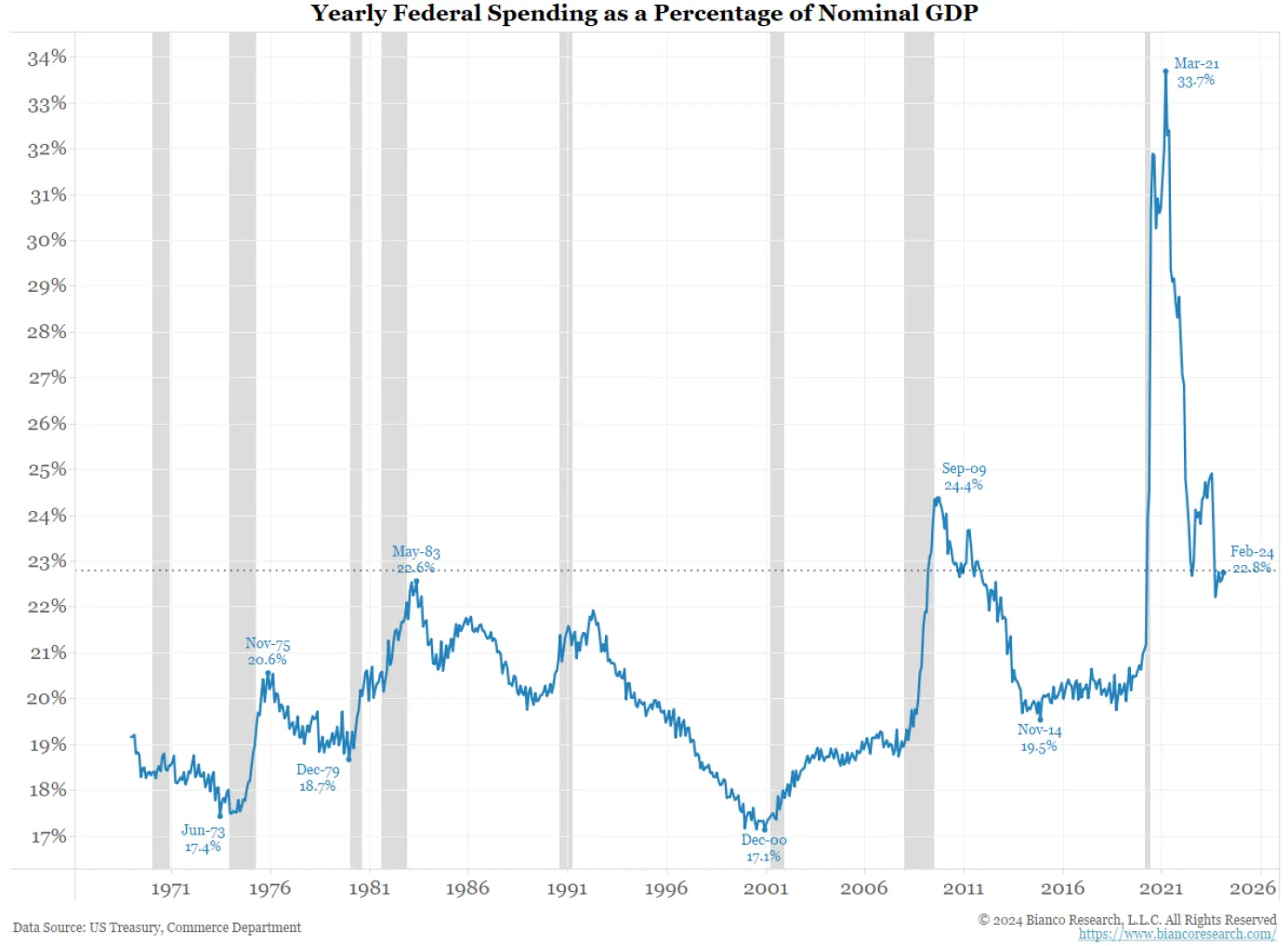
This excellent chart from Bianco Research clearly illustrates the extent of U.S. government waste, evidenced by record-high deficits. The two recent periods of elevated deficit spending were driven by the 2008 Global Financial Crisis and the baby boomer-dominated pandemic lockdowns. The U.S. economy is growing, yet the government continues spending as if in recession.
In summary, easing capital requirements and the potential future exemption of USTs from SLR represent a stealth form of money printing. The Fed doesn’t print directly; instead, the banking system creates credit money out of thin air to buy bonds, which then appear on their balance sheets. As always, the goal is to ensure government bond yields don’t rise above nominal GDP growth. So long as real interest rates remain negative, equities, cryptocurrencies, gold, and other assets will continue rising in fiat-denominated prices.
Bad Gurl Yellen
My article “Bad Gurl” delves into how the U.S. Treasury, led by Bad Gurl Yellen, increased issuance of short-term Treasury bills (T-bills) to drain the trillions sitting in the Fed’s reverse repo facility (RRP). As expected, the decline in RRP coincided with rallies in stocks, bonds, and crypto. Now that RRP has dropped to $400 billion, the market wonders what the next source of fiat liquidity boosting asset prices will be. Don’t worry—Yellen isn’t done yet. She’s shouting, “Loot is about to drop.”
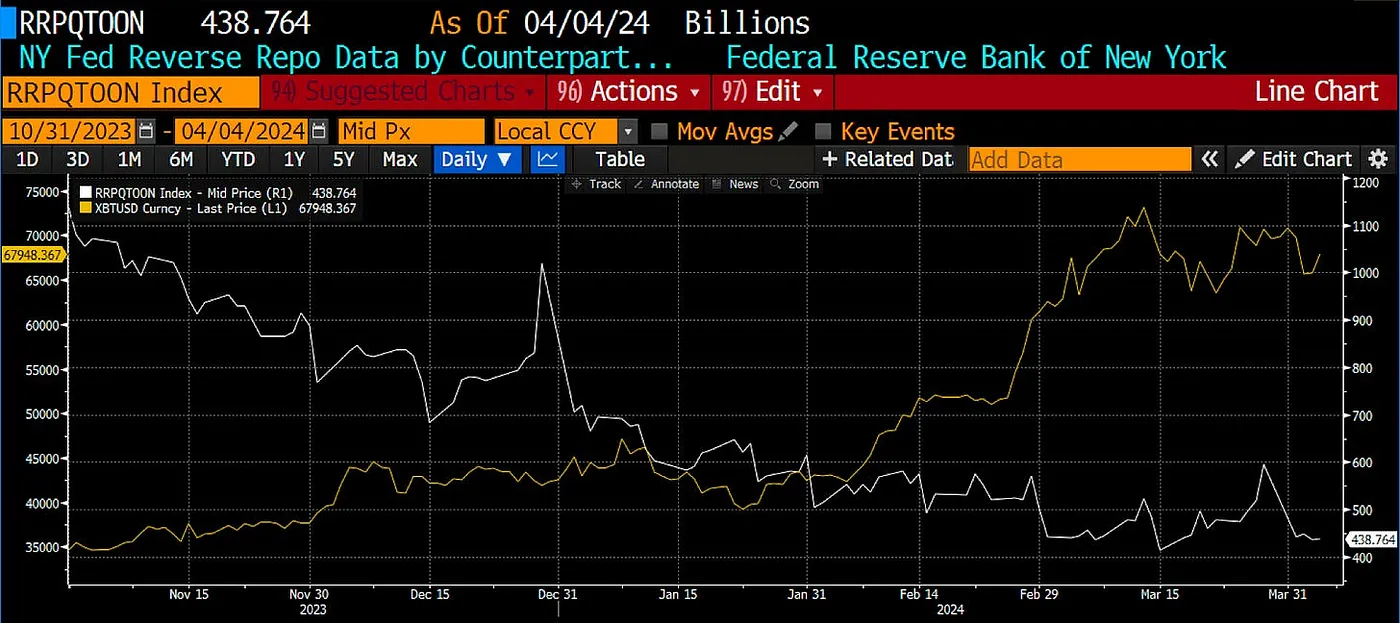
RRP balance (white) vs. Bitcoin (yellow)
The flow of fiat funds I’ll discuss centers on U.S. tax receipts, the Fed’s Quantitative Tightening (QT) program, and the Treasury General Account (TGA). The timeframe in focus runs from April 15 (tax deadline for the 2023 fiscal year) to May 1.
Let me offer a quick guide on their positive or negative impacts on liquidity to help clarify what these three factors mean.
Tax receipts remove liquidity from the system. This happens because taxpayers must pull cash out of the financial system—by selling securities, for example—to pay taxes. Analysts expect tax receipts for the 2023 fiscal year to be high, due to substantial interest income received and solid stock market performance.
QT removes liquidity from the system. As of March 2022, the Fed has allowed about $95 billion in USTs and MBS to mature each month without reinvesting the proceeds. This shrinks the Fed’s balance sheet, reducing dollar liquidity. However, what matters isn’t the absolute level of the Fed’s balance sheet, but the pace of its decline. Analysts like Joe Kalish of Ned Davis Research expect the Fed to reduce QT by $30 billion per month at its May 1 meeting. As the pace of balance sheet shrinkage slows, the deceleration of QT becomes positive for dollar liquidity.
When TGA balances rise, they drain liquidity from the system; when they fall, they add liquidity. The Treasury increases TGA when receiving tax payments. I expect TGA balances to rise significantly above the current ~$750 billion level following April 15 tax processing. This is negative for dollar liquidity. Don’t forget this is an election year. Yellen’s job is to help her boss, President Joe Biden, win re-election. That means doing everything possible to boost the stock market, make voters feel wealthy, and credit Bidenomics’ slow-motion “genius” for the outcome. Once RRP eventually hits zero, Yellen will spend down the TGA, likely injecting an additional $1 trillion of liquidity into the system—giving markets another lift.
The volatile period for risk assets is April 15 to May 1. During this window, tax receipts drain liquidity, QT continues at its current faster pace, and Yellen hasn’t yet begun drawing down the TGA. After May 1, QT slows, and Yellen gets busy writing checks to inflate asset prices. If you’re a trader looking for the perfect moment to establish bold short positions, April is your best shot. After May 1, it’s back to business as usual—asset inflation orchestrated by the financial shenanigans of the Fed and U.S. Treasury.
Bitcoin Halving
The Bitcoin block reward is expected to halve around April 20. This is widely seen as a bullish catalyst for crypto markets. I agree it will push prices higher over the medium term; however, price action before and immediately after could be negative. The narrative that halvings are good for crypto prices is deeply entrenched. When most market participants agree on an outcome, the opposite often occurs. That’s why I believe Bitcoin and crypto prices will broadly collapse around the halving event.
Given that the halving occurs when dollar liquidity is tighter than usual, this will amplify the potential for a violent selloff in crypto assets. The timing further reinforces my decision to stay out of trading until May.
So far, I’ve taken full profits on my MEW, SOL, and NMT positions. The proceeds are now deposited into Ethena’s USDe and staked to earn substantial yield. Before Ethena, I held USDT or USDC earning nothing while Tether and Circle captured all the Treasury yields.
Can the market overcome my bearish bias and keep rallying? Yes. I remain bullish on crypto overall, so I welcome being wrong.
Do I really want to look at my most speculative shitcoin positions while walking the two-step at Token2049 Dubai? Absolutely not.
So I dumped them.
No need to feel sad.
If the dollar liquidity scenario I outlined above unfolds, I’ll be even more confident mimicking various shits. If I miss out on a few percentage points of gains but completely avoid portfolio and lifestyle damage, that’s an acceptable outcome. With that, I bid you farewell. Remember to wear your dancing shoes—we’ll see you in Dubai to celebrate the crypto bull run.
Join TechFlow official community to stay tuned
Telegram:https://t.me/TechFlowDaily
X (Twitter):https://x.com/TechFlowPost
X (Twitter) EN:https://x.com/BlockFlow_News
 Arthur Hayes









