
The garbage transaction paradox: Why do your Solana transactions always fail?
TechFlow Selected TechFlow Selected
The garbage transaction paradox: Why do your Solana transactions always fail?
To get one's own transaction packed, one must send more spam transactions than others, thus exacerbating the vicious cycle.
 Navigating Web3 tides with focused insights
Author: nishil
Translation: Frank, Foresight News
Many users may still be unaware of why their transactions on Solana have been failing recently.

Let’s start with the basics—when a user initiates a transaction, one of three things typically happens:
-
The transaction executes successfully without any errors;
-
The transaction fails—for example, gas fees are paid but an error occurs during execution. This usually happens when conditions aren’t met, such as attempting to mint a token that has already sold out or when slippage exceeds set thresholds due to price volatility;
-
The transaction never reaches its destination—it doesn't appear anywhere, meaning it hasn't reached the "Block Leader" (Foresight News note: the validator responsible for processing transactions during a given time slot). This is exactly what many users are currently experiencing, and this is a network-layer issue, not a consensus or execution-layer problem.
You might be wondering, what exactly is the network layer?
Don’t worry—we’ll soon discuss these undelivered transactions and why they are now the primary cause of Solana’s congestion. But first, let's focus on failed transactions because it's important to understand why failed transactions aren’t the main issue.
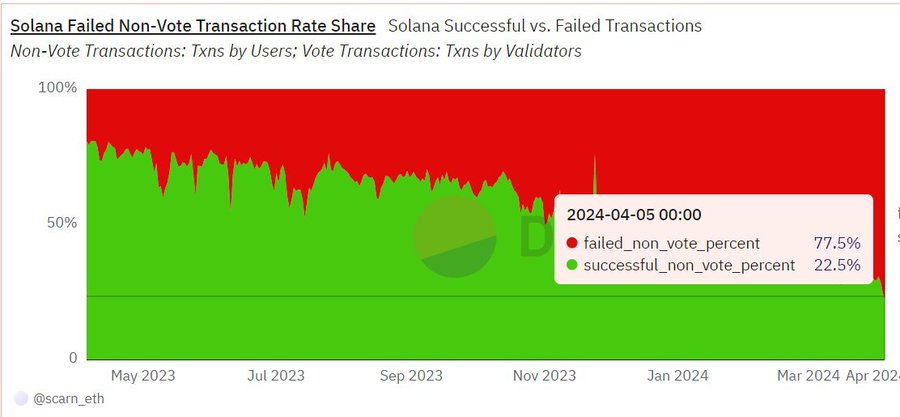
If you look closely, you might be surprised to learn that only about 8% of these failed transactions come from real users; the rest are failed arbitrage attempts by bots. Arbitrageurs flood Solana with spam transactions because the cost is negligible compared to the potential profit from a single successful trade.

For instance, they can send thousands of spam transactions daily, costing them just hundreds of dollars (due to Solana’s low fees), while a single successful transaction could earn them up to $100,000.
Therefore, it's crucial to recognize that these failed transactions don't indicate a problem with Solana’s activity level—Solana is operating as designed. These failures simply result from bots submitting transactions that fail to meet execution conditions, and they are not the main reason behind the current poor user experience on Solana.
In fact, Solana’s transaction failure rate has hovered around 50% since last November. If you revisit the success vs. failure chart I mentioned earlier, you’ll see that this isn’t new behavior.
Now, let’s turn to the primary cause of Solana’s recent congestion—“undelivered transactions.” As previously noted, these transactions fail to reach the “Block Leader” and are discarded due to network-layer issues.
The network layer refers to the communication layer of the internet responsible for transmitting data packets between connections—examples include TCP (Transmission Control Protocol), UDP (User Datagram Protocol), and QUIC (designed by Google).
Recently, Solana upgraded to QUIC as its network layer, which helps establish connections between users and “Block Leaders.” Because Solana produces blocks continuously and lacks a mempool, lost connections mean transactions won’t be written into blocks.

QUIC allows “Block Leaders” to disconnect or rate-limit certain users based on specific criteria. Thus, during periods of high chain demand, “Block Leaders” can drop certain connections. This new architecture prevents Solana from halting entirely when network activity spikes—even if the network becomes extremely congested, at least it keeps running.
So you might ask, if QUIC is so well-designed, why is Solana performing so poorly now?
The issue lies in the fact that while “Block Leaders” can now limit connections, the logic determining *which* connections to limit is poorly implemented and flawed.
To better understand, imagine each “Block Leader” normally handles X number of concurrent connections. During peak activity, however, they begin receiving 10 to 100 times more connection requests…

At this point, “Block Leaders” must choose which connections to drop. The problem? Connections are currently dropped randomly—not based on clear rules (e.g., dropping all connections with fees below X).
This means to get your transaction included, you essentially need to send more spam than others. And since multiple bots flood the network with connection requests, it becomes increasingly difficult for regular users to establish connections and complete transactions.
This is the core of the current problem. Teams like Firedancer, Anza, and Solana are actively working on fixing the network layer, and patches are being rolled out gradually. Some major fixes are reportedly expected within the coming weeks.
Will this solve everything? Will Solana take off again? Not quite. There are three key reasons why the road ahead remains long:
-
There’s no guarantee how effective current fixes will be in preventing future congestion—the real test comes only when they’re deployed at scale;
-
Jump Crypto’s Firedancer may indeed resolve these issues, but it won’t launch until late this year;
-
The spam transaction problem reflects deeper flaws in Solana’s transaction economics, which currently cannot prevent malicious actors from abusing the network with spam.
Join TechFlow official community to stay tuned
Telegram:https://t.me/TechFlowDaily
X (Twitter):https://x.com/TechFlowPost
X (Twitter) EN:https://x.com/BlockFlow_News
 @_nishil_