IO.NET Under the "AI + DePin" Concept: A Perspective from the History of AI Development
TechFlow Selected TechFlow Selected
IO.NET Under the "AI + DePin" Concept: A Perspective from the History of AI Development
io.net focuses on aggregating GPU resources for AI and machine learning companies, aiming to deliver services at lower costs and with faster delivery times.
 Navigating Web3 tides with focused insights
Author: Fishery, Core Contributor of Biteye
Editor: Crush, Core Contributor of Biteye
Community: @BiteyeCN
*Approximately 6000 words, estimated reading time: 12 minutes
io.net is a decentralized AI computing platform built on Solana, developed by IO Research. In its latest funding round, it reached a $1 billion FDV valuation.
In March this year, io.net announced a $30 million Series A funding round led by Hack VC, with participation from Multicoin Capital, 6th Man Ventures, Solana Ventures, OKX Ventures, Aptos Labs, Delphi Digital, The Sandbox, and Sebastian Borget of The Sandbox.
io.net focuses on aggregating GPU resources for AI and machine learning companies, aiming to deliver services at lower costs and faster turnaround times. Since launching in November last year, io.net has grown to over 25,000 GPUs and has processed more than 40,000 compute hours for artificial intelligence and machine learning companies.
io.net’s vision is to build a global, decentralized AI computing network that creates an ecosystem connecting AI and machine learning teams and enterprises with powerful GPU resources worldwide.
Within this ecosystem, AI computing resources become commoditized, eliminating resource shortages for both suppliers and consumers. In the future, io.net will also offer access to the IO Model Store and advanced inference capabilities such as serverless inference, cloud gaming, and pixel streaming.
01 Business Background
Before diving into io.net's business logic, we need to understand the decentralized computing sector from two angles: one being the evolution of AI computing, and the other reviewing past cases of decentralized computing.
Evolution of AI Computing
We can trace the trajectory of AI computing through several key milestones:
1. Early Machine Learning (1980s – Early 2000s)
During this period, machine learning methods focused on simpler models such as decision trees and support vector machines (SVM). These models had relatively low computational demands and could run on personal computers or small servers available at the time. Datasets were small, and feature engineering and model selection were central tasks.
Timeline: 1980s to early 2000s
Computing Requirements: Relatively low; met by personal computers or small servers.
Hardware: CPU-dominated computing resources.
2. Rise of Deep Learning (2006 – Present)
In 2006, the concept of deep learning was reintroduced, marked by research from Hinton and others. Subsequently, the successful application of deep neural networks—especially convolutional neural networks (CNN) and recurrent neural networks (RNN)—signaled a breakthrough in the field. This phase saw a significant increase in computational demands, particularly when processing large datasets like images and speech.
Timeline:
ImageNet Competition (2012): AlexNet's victory in this competition was a landmark event in deep learning history, demonstrating deep learning’s immense potential in image recognition for the first time.
AlphaGo (2016): Google DeepMind’s AlphaGo defeating world Go champion Lee Sedol was arguably AI’s most iconic moment so far. It not only showcased deep learning’s capabilities in complex strategy games but also proved its ability to solve highly intricate problems.
Computing Requirements: Significantly increased, requiring more powerful resources to train complex deep neural networks.
Hardware: GPUs began to emerge as essential hardware for deep learning training due to their superior parallel processing capabilities compared to CPUs.
3. Era of Large Language Models (2018 – Present)
With the emergence of BERT (2018) and GPT technologies (from 2018 onward), large models began to dominate the AI landscape. These models typically have billions to trillions of parameters, demanding unprecedented levels of computational power. Training them requires massive numbers of GPUs or specialized TPUs, supported by substantial power and cooling infrastructure.
Timeline: 2018 to present.
Computing Requirements: Extremely high, requiring large-scale GPU or TPU clusters supplemented by supporting infrastructure.
Hardware: Beyond GPUs and TPUs, specialized hardware optimized for large machine learning models began to appear, such as Google’s TPU and Nvidia’s A and H series.
Over the past 30 years, AI’s demand for computing power has grown exponentially. Early machine learning required modest computation, deep learning significantly increased those demands, and large AI models have pushed these requirements to new extremes. We have witnessed remarkable improvements in both the quantity and performance of computing hardware.
This growth is reflected not only in the expansion of traditional data centers and improved GPU performance but also in the high entry barriers and lucrative return expectations, which have intensified public competition among internet giants.
Traditional centralized GPU computing centers require substantial upfront investment—expensive hardware purchases (e.g., GPUs), data center construction or leasing, cooling systems, and maintenance personnel.
In contrast, projects like io.net’s decentralized computing platform enjoy clear cost advantages in setup, significantly reducing initial investment and operational expenses, making it feasible for small teams to develop their own AI models.
Decentralized GPU projects leverage existing distributed resources without requiring centralized investment in hardware and infrastructure. Individuals and businesses can contribute idle GPU resources to the network, eliminating the need for centralized procurement and deployment of high-performance computing resources.
Secondly, in terms of operational costs, traditional GPU clusters require ongoing maintenance, electricity, and cooling expenses. Decentralized GPU projects distribute these costs across nodes, thereby reducing the operational burden on any single organization.
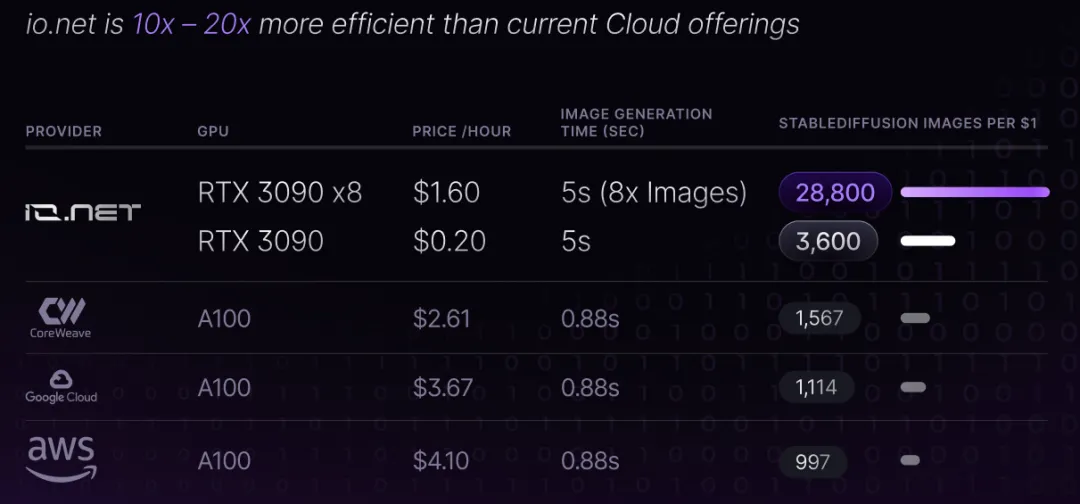
According to io.net’s documentation, io.net drastically reduces operating costs by aggregating underutilized GPU resources from independent data centers, cryptocurrency miners, and other hardware networks like Filecoin and Render. Combined with Web3 economic incentive strategies, this gives io.net a major pricing advantage.
Decentralized Computing
Looking back, there have been notable successes in decentralized computing projects—even without economic incentives—that attracted widespread participation and produced significant results. For example:
Folding@home: Initiated by Stanford University, this project uses distributed computing to simulate protein folding processes, helping scientists understand disease mechanisms—particularly diseases related to misfolded proteins such as Alzheimer’s and Huntington’s. During the COVID-19 pandemic, Folding@home mobilized vast computing resources to aid coronavirus research.
BOINC (Berkeley Open Infrastructure for Network Computing): An open-source software platform supporting various volunteer and grid computing projects across fields including astronomy, medicine, and climate science. Users can contribute idle computing resources to participate in diverse scientific initiatives.
These projects not only demonstrate the feasibility of decentralized computing but also reveal its enormous potential.
By mobilizing society-wide contributions of unused computing resources, computational capacity can be dramatically enhanced. When combined innovatively with Web3 economic models, even greater cost efficiency becomes possible. Web3 experience shows that a well-designed incentive mechanism is crucial for attracting and retaining user engagement.
Introducing incentive models can foster a mutually beneficial community environment, further driving business scale expansion and creating a positive feedback loop that accelerates technological advancement.
Thus, io.net can attract broad participation by introducing incentive mechanisms, encouraging users to collectively contribute computing power and form a powerful decentralized computing network.
The synergy between Web3 economic models and the potential of decentralized computing provides strong momentum for io.net’s growth, enabling efficient resource utilization and cost optimization. This not only fosters technological innovation but also delivers value to participants, allowing io.net to stand out in the competitive AI landscape with significant growth potential and market opportunity.
02 io.net Technology
Clusters
A GPU cluster connects multiple GPUs via a network to form a collaborative computing cluster, greatly enhancing the efficiency and capability of handling complex AI tasks.
Cluster computing not only accelerates AI model training but also strengthens the ability to process large-scale datasets, making AI applications more flexible and scalable.
In traditional internet-based AI model training, large-scale GPU clusters are always required. However, shifting this cluster computing paradigm to a decentralized model introduces a series of technical challenges.
Compared to traditional internet companies’ AI computing clusters, decentralized GPU cluster computing faces additional issues—nodes may be spread across different geographical locations, leading to network latency and bandwidth constraints that can affect data synchronization speed between nodes and thus overall computing efficiency.
Moreover, maintaining data consistency and real-time synchronization across nodes is critical to ensuring accurate computation results. This necessitates the development of efficient data management and synchronization mechanisms by decentralized computing platforms.
Additionally, managing and scheduling dispersed computing resources to ensure effective task completion remains a key challenge for decentralized cluster computing.
io.net addresses these challenges by integrating Ray and Kubernetes to build a decentralized cluster computing platform.
Ray, as a distributed computing framework, directly handles executing computing tasks across multiple nodes. It optimizes data processing and machine learning model training, ensuring tasks run efficiently across nodes.
Kubernetes plays a key management role in this process, automating the deployment and management of containerized applications, ensuring computing resources are dynamically allocated and adjusted based on demand.
Together, Ray and Kubernetes create a dynamic and elastic computing environment. Ray ensures computing tasks are efficiently executed on appropriate nodes, while Kubernetes guarantees system stability and scalability, automatically handling node additions or removals.
This synergy enables io.net to deliver consistent and reliable computing services in a decentralized environment, meeting diverse user needs in both data processing and model training.
Through this approach, io.net not only optimizes resource usage and reduces operating costs but also enhances system flexibility and user control. Users can easily deploy and manage computing tasks of various scales without worrying about underlying resource configurations and management details.
This decentralized computing model, powered by the robust capabilities of Ray and Kubernetes, ensures io.net’s efficiency and reliability when handling complex and large-scale computing tasks.
Privacy
Given that decentralized cluster task allocation operates in far more complex environments than centralized data center clusters—and considering that data and computing tasks transmitted over networks introduce additional security risks—decentralized clusters must prioritize security and privacy protection.
io.net enhances network security and privacy by leveraging the decentralized nature of mesh private network channels. In such networks, the absence of a central hub or gateway significantly reduces single points of failure; even if some nodes fail, the entire network remains operational.
Data travels along multiple paths within the mesh network, making it difficult to trace sources or destinations and thereby enhancing user anonymity.
Furthermore, techniques such as packet padding and timing obfuscation (Traffic Obfuscation) help obscure data flow patterns, making it harder for eavesdroppers to analyze traffic or identify specific users or data streams.
io.net’s privacy mechanisms effectively address privacy concerns by jointly creating a complex and variable data transmission environment, making it difficult for external observers to extract useful information.
Meanwhile, the decentralized structure avoids the risk of all data flowing through a single point. This design not only improves system robustness but also reduces vulnerability to attacks. Together, multi-path data transmission and traffic obfuscation strategies provide an extra layer of protection for user data transfers, enhancing the overall privacy of the io.net network.
03 Economic Model
IO is the native cryptocurrency and protocol token of the io.net network, designed to meet the needs of two main groups within the ecosystem: AI startups and developers, and computing power providers.
For AI startups and developers, IO simplifies payment processes for cluster deployment, making transactions more convenient. They can also use IOSD Credits—pegged to the US dollar—to pay transaction fees for computing tasks on the network. Every model deployed on io.net requires a small IO transaction for inference.
For suppliers—especially GPU resource providers—IO tokens ensure fair compensation for their contributed resources. Whether earning direct income from GPU rentals or passive rewards from participating in network model inference during idle periods, IO tokens reward every contribution made by GPUs.
Within the io.net ecosystem, IO tokens serve not only as a medium of payment and incentive but also as a key governance instrument. They make every stage—from model development and training to deployment and application development—more transparent and efficient, ensuring mutual benefits among participants.
In this way, IO tokens not only incentivize participation and contribution within the ecosystem but also provide a comprehensive support platform for AI startups and engineers, advancing the development and application of AI technologies.
io.net has invested heavily in its incentive model to ensure a virtuous cycle throughout the ecosystem. The goal is to establish a direct hourly rate, denominated in USD, for every GPU card on the network. This requires a clear, fair, and decentralized pricing mechanism for GPU/CPU resources.
As a two-sided market, the core of the incentive model lies in addressing two major challenges: lowering the high cost of renting GPU/CPU computing power—a key metric for expanding AI and ML computing demand—and alleviating the shortage of GPU nodes available for rent from cloud service providers.
Therefore, on the demand side, considerations include competitor pricing and availability to offer competitive and attractive options in the market, with dynamic pricing adjustments during peak hours and periods of resource scarcity.
On the supply side, io.net targets two key markets: gamers and crypto GPU miners. Gamers typically possess high-end hardware and fast internet connections but usually own only one GPU card. Crypto GPU miners, on the other hand, have large quantities of GPU resources, though they may face limitations in internet connection speed and storage space.
Thus, the computing power pricing model incorporates multidimensional factors such as hardware performance, internet bandwidth, competitor pricing, supply availability, peak-hour adjustments, commitment-based pricing, and geographic differences. Additionally, optimal profitability when hardware is used for other proof-of-work mining must also be considered.
In the future, io.net plans to release a fully decentralized pricing solution and develop a benchmarking tool similar to speedtest.net for miners’ hardware, building a completely decentralized, fair, and transparent market.
04 Participation Methods
io.net has launched the Ignition campaign, the first phase of its community incentive program, aimed at accelerating the growth of the IO network.
The program features three entirely independent reward pools.
-
Worker Rewards (GPU)
-
Galaxy Mission Rewards
-
Discord Role Rewards (Airdrop Tier Role)
These three reward pools are completely independent. Participants can earn rewards from each pool separately and do not need to link the same wallet to each pool.
GPU Node Rewards
For already connected nodes, airdrop points are calculated from November 4, 2023, until the end of the campaign on April 25, 2024. At the conclusion of the Ignition campaign, earned airdrop points will be converted into airdrop rewards.
Airdrop points consider four factors:
A. Job Hours Done Ratio (RJD): Total duration employed from November 4, 2023, until the end of the campaign.
B. Bandwidth (BW): Nodes are classified by bandwidth speed ranges:
Low: Download speed 100MB/s, upload speed 75MB/s.
Medium: Download speed 400MB/s, upload speed 300MB/s.
High: Download speed 800MB/s.
C. GPU Model (GM): Determined by GPU model, with higher-performance GPUs earning more points.
D. Uptime (UT): Total successful runtime from initial Worker connection on November 4, 2023, until the campaign ends.
Note: Airdrop points are expected to be viewable by users around April 1, 2024.
Galaxy Mission Rewards (Galxe)
Galaxy mission link: https://galxe.com/io.net/campaign/GCD5ot4oXPAt
Discord Role Rewards
These rewards will be overseen by io.net’s community management team and require users to submit their correct Solana wallet address on Discord.
Users will receive corresponding Airdrop Tier Role levels based on their contributions, activity, content creation, and participation in other activities.
05 Conclusion
Overall, io.net and similar decentralized AI computing platforms are opening a new chapter in AI computing. While they face challenges in technical implementation complexity, network stability, and data security, io.net has the potential to fundamentally transform AI business models. As these technologies mature and the computing community expands, decentralized AI computing may become a key force driving AI innovation and democratization.
Join TechFlow official community to stay tuned
Telegram:https://t.me/TechFlowDaily
X (Twitter):https://x.com/TechFlowPost
X (Twitter) EN:https://x.com/BlockFlow_News
 @BiteyeCN