HTX Ventures: Why BounceBit Could Become a New Bitcoin Ecosystem Solution?
TechFlow Selected TechFlow Selected
HTX Ventures: Why BounceBit Could Become a New Bitcoin Ecosystem Solution?
As one of the leading investors in BounceBit, HTX Ventures firmly believes that BounceBit can effectively meet real market demands through its centralized custody model built on standard sidechains.
 Navigating Web3 tides with focused insights
With the approval of BTC spot ETFs, major global institutions and individuals are continuously increasing their BTC holdings, driving up the price of BTC, which has now entered the top ten globally ranked assets by market capitalization. In this market cycle, BTC inscriptions and BTC scaling have emerged as two highly watched niche sectors. The exploration of diversified yield opportunities within the BTC ecosystem is capturing the attention of the crypto market.
Then, what solution will become the optimal approach to address issues such as Bitcoin asset yield generation, network confirmation delays, lack of smart contracts, and high gas fees?
Currently, in enhancing Bitcoin's ecosystem vibrancy, two main solutions dominate: Layer 2 and sidechains.
As one of the investors in BounceBit’s $6 million funding round, HTX Ventures, views BounceBit and its CeFi+DeFi product model as a potentially innovative solution to unlock the Bitcoin ecosystem and enable broader applications. This research report dives deep into BounceBit, outlining its product design philosophy and HTX Ventures’ investment rationale.
HTX Ventures is Huobi HTX’s global investment arm, integrating investment, incubation, and research to identify the world’s most outstanding and promising teams. To date, HTX Ventures has supported over 200 projects across multiple blockchain sectors, with select high-quality projects already listed on Huobi HTX exchange.
What is BounceBit?
BounceBit is a BTC restaking chain specifically designed for Bitcoin. Its constructed BTC restaking infrastructure provides a foundational layer for various restaking products, secured by regulated custodianship from Mainnet Digital and Ceffu. It utilizes a hybrid PoS mechanism combining BTC and BounceBit for validation.
BounceBit addresses trust concerns around underlying BTC assets through multi-party custody, creating BBTC for DeFi interactions on the BounceBit mainnet. Native BTC assets are used to participate in low-risk arbitrage strategies across various centralized exchanges. Furthermore, under the hybrid token staking mechanism, staking BBTC and BB (BounceBit’s native token) generates LSD tokens, enabling users to earn node staking rewards and restaking yields.
By combining centralized custody with a sidechain architecture, BounceBit aims to resolve long-standing trust issues associated with sidechains while revitalizing the BTC ecosystem. This integration reduces transaction fees and unlocks BTC’s financial potential, enabling its application across DeFi, gaming, social platforms, and beyond.
How does BounceBit work?
BounceBit’s product design is highly sophisticated, as illustrated below:

BounceBit operation mechanism and revenue sources diagram
Users can deposit various types of on-chain Bitcoin assets into the BounceBit protocol, which is jointly managed by an MPC wallet operated by BounceBit, CEFFU, and Mainnet Digital, resolving trust mechanism challenges and ensuring user asset security.
● Through Ceffu’s MirrorX and other Over-the-Counter Exchange Solutions (OES), users can securely access deep liquidity from exchanges and generate returns via diversified trading strategies, while funds remain safely held in the on-chain MPC wallet. This wallet technology significantly reduces single point of failure (SPOF) risks by splitting private keys into multiple parts. Additionally, since user funds are not actually stored on any centralized exchange but mirrored through Ceffu, counterparty risk is minimized.
● BounceBit collaborates with a series of asset managers with long-term positive performance records, executing trades via MirrorX. All these asset managers primarily employ funding rate arbitrage as their core trading strategy—a risk-free method that capitalizes on interest rate differentials between markets.
● On the other hand, after transferring native assets to BounceBit, users receive newly minted B-Token assets. Taking BTC as an example, when users deposit BTC, they receive BBTC, an asset operating on the BounceBit mainnet. Currently, this asset supports two primary on-chain activities: first, participating in node staking under BounceBit’s hybrid staking model using BBTC and BB, where the generated LST tokens can be further restaked to amplify staking returns; second, BBTC can be used in various DeFi interactions on-chain. BounceBit has also launched BounceClub, a platform for developers and users, allowing participants to enhance BTC asset yield potential through diverse DeFi and yield-generating activities on the BounceBit mainnet.
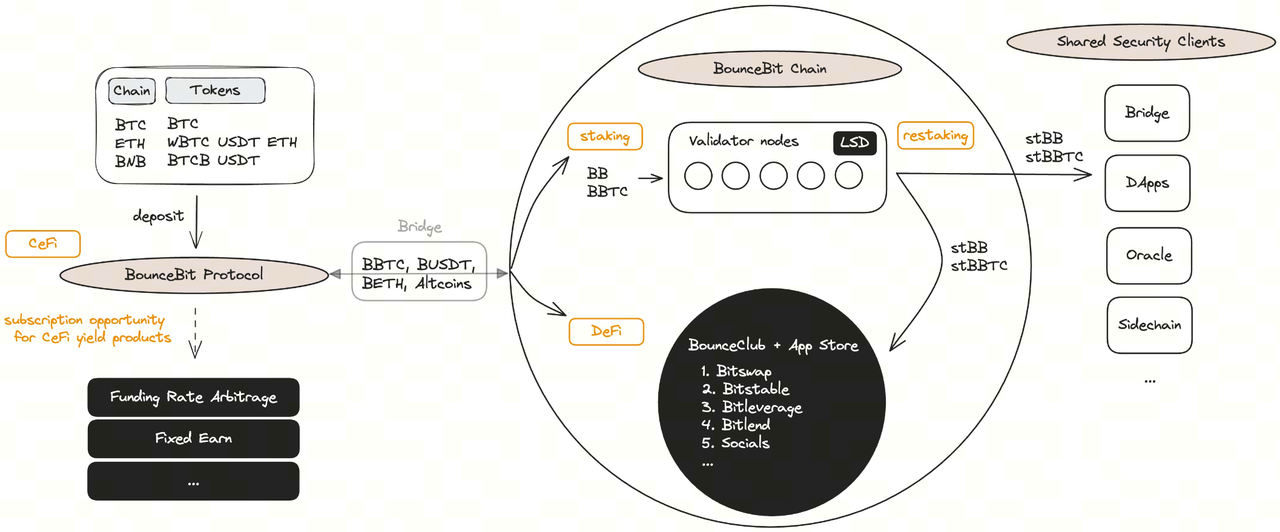
BounceBit Product Design Concept
Source: https://x.com/bounce_bit/status/1771481179683692656?s=46&t=ODDW1eIwucwwKwUR-9MGBg
In terms of revenue sources, participation in BounceBit’s staking and on-chain financial activities enables users to earn returns from multiple channels:
● CeFi yields earned from native assets held in centralized exchange sub-accounts.
● DeFi yields earned from on-chain interactions on BounceBit.
● Staking rewards and restaking yields from staking BBTC and BB, along with subsequent restaking of issued LST tokens.
In summary, BounceBit ensures asset security through multi-party custody while offering diversified yield-generation mechanisms.
Why did HTX Ventures invest in BounceBit?
HTX Ventures, as one of BounceBit’s key investors, firmly believes that BounceBit can effectively meet real-world market demands through its centralized custody model built upon a standard sidechain.
BounceBit’s core objective is to solve challenges related to Bitcoin asset yield generation, inefficient utilization of idle BTC, lack of innovation, and high gas fees. Its fundamental goal is to provide diversified income streams, thereby mitigating the limitations posed by Bitcoin’s absence of smart contract functionality. Current solutions to enhance the BTC ecosystem primarily include Layer-2 and sidechain technologies.
Layer-2 solutions mainly execute Bitcoin transactions off-chain to improve transaction speed. Current Layer-2 approaches fall into two categories: state channels and rollups. A typical state channel project is the Lightning Network, but its functional scalability is very limited—currently focused on improving peer-to-peer transaction speeds and unable to support Ethereum-level smart contract deployment. For rollup-based Layer-2 solutions, due to issues with underlying code and signature verification, Bitcoin Layer-2 cannot achieve sufficient trust guarantees because ledger rollbacks cannot be verified by the mainnet. A potentially viable path forward may involve building upon the new Taproot protocol, upgrading Bitcoin via BIP proposals, having miners update base-layer code to support OP/ZKP verification and miner-computed execution—but achieving full rollup functionality remains a long-term endeavor.
Sidechains, by contrast, function as entirely independent blockchains. Typically, they map Bitcoin from the mainnet to the sidechain by issuing new representative assets. While sidechains generally offer better processing speeds, they operate independently in terms of trust verification and consensus, creating inherent trust and security vulnerabilities. There is also a higher risk of malicious behavior by project teams, which could compromise the safety of mapped assets. This is precisely why most sidechains face challenges in accumulating TVL.
BounceBit tackles some of Bitcoin’s ecosystem challenges by establishing an independent PoS layer-one chain using a unique approach. Within this framework, nodes secure the chain by staking both BTC and BounceBit tokens. The linkage between BounceBit and BTC is established at the asset level, rather than the protocol level.
By integrating centralized custody with sidechain technology, BounceBit seeks to overcome the consensus and trust deficiencies of traditional sidechains. In the current landscape, this hybrid model of centralization and decentralization may offer a pragmatic compromise to address technical and trust-related barriers. BounceBit’s design philosophy and team background give it a competitive edge, opening space for exploring new opportunities.
Looking Ahead
With the approval of BTC spot ETFs, major global institutions and individuals continue to increase their BTC holdings, pushing BTC prices higher—now ranking among the top ten assets worldwide by market cap. Meanwhile, in this market cycle, BTC inscriptions and BTC scaling are two highly watched niche sectors. Recent progress in BTC has excited the market, drawing greater attention to the BTC ecosystem, with developers and market participants jointly exploring expanded use cases and yield opportunities around BTC.
As a CeFi+DeFi product, BounceBit demonstrates notable innovation in its product model. By combining centralized and decentralized mechanisms and introducing a tri-party custody system into its trust architecture, it creates new EVM-compatible on-chain assets to unlock the financial utility of native BTC—an approach that may represent a novel solution for the future Bitcoin ecosystem.
HTX Ventures believes there will be increasing technological advancements and breakthroughs in the BTC ecosystem, accompanied by a growing number of ecosystem projects—an exciting and promising prospect for the entire crypto market. At this stage, BounceBit’s CeFi+DeFi mechanism shows strong potential for TVL growth, paving the way for diversified yield exploration within the BTC ecosystem.
*Special thanks to BounceBit for their support in the preparation of this article.
About HTX Ventures
HTX Ventures is Huobi HTX’s global investment division, integrating investment, incubation, and research to identify the world’s most exceptional and promising teams. As a pioneer in the blockchain industry for over a decade, HTX Ventures drives cutting-edge technological innovation and emerging business models, providing comprehensive support—including fundraising, resources, and strategic consulting—to partner projects in building a sustainable blockchain ecosystem. To date, HTX Ventures has backed more than 200 projects across diverse blockchain sectors, with select high-performing projects already listed on Huobi HTX. Additionally, HTX Ventures is one of the most active fund-of-funds (FOF) investors, partnering with leading global blockchain funds such as Bankless, IVC, Shima, and Animoca to co-develop the blockchain ecosystem.
Join TechFlow official community to stay tuned
Telegram:https://t.me/TechFlowDaily
X (Twitter):https://x.com/TechFlowPost
X (Twitter) EN:https://x.com/BlockFlow_News
 @Ventures_HTX