Conversation with MyShell Co-founder Ethan Sun: How is MyShell bringing Crypto X AI experiences to millions?
TechFlow Selected TechFlow Selected
Conversation with MyShell Co-founder Ethan Sun: How is MyShell bringing Crypto X AI experiences to millions?
The incentive model is applied to reinforcement learning to create truly great products, and this is where my MyShell truly excels.
 Navigating Web3 tides with focused insights
Hosts: Tommy & Santiago, The Delphi Podcast
Guest: Ethan Sun, Co-founder of MyShell
Background
In this episode, Tommy and Santiago interview Ethan Sun, co-founder of MyShell, a platform for the decentralized AI consumer layer. They discuss the evolution of AI over the past decade, the importance of consumer-facing applications, and the potential for AI to enhance everyday life.
Ethan explains how MyShell empowers creators to easily build AI experiences, the role of incentives within the platform's ecosystem, the future of AI agents, and the potential of personalized AI companions. They also explore MyShell’s future outlook, competition, scalability challenges in the AI-crypto space, MyShell’s ultimate vision, and the critical role of creators on the platform.
Highlights from the conversation:
Tommy: Hello everyone, welcome back to the Delphi Podcast. I'm your host, Tommy. Today I'm joined by my co-host Santiago, a close friend, prolific investor, and an amazing person.
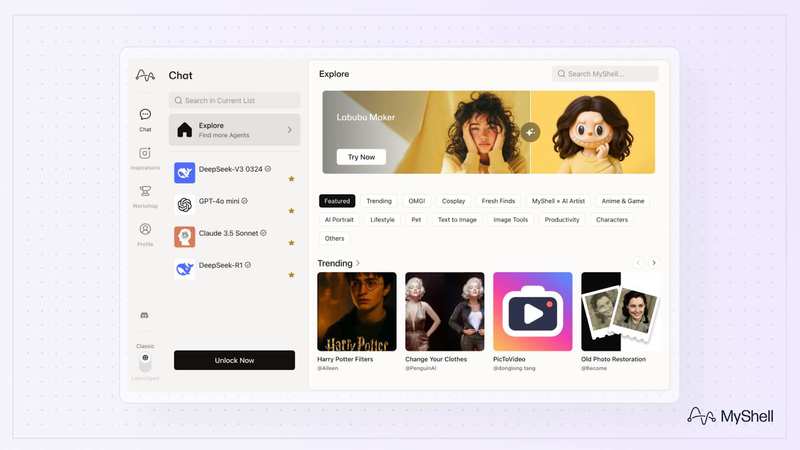
Today, we're excited to have Ethan from myshell.ai joining us as our guest. MyShell is a decentralized full-stack platform for discovering, creating, and staking AI-native apps, utilities, chatbots, and more.
Ethan: I'm Ethan, co-founder of MyShell. I've been in the AI industry for about 10 years since 2013. Back then, when people talked about deep learning or AI, they were mostly referring to convolutional neural networks. But now everything has changed—it's all about Transformers, even computer vision. Over the past decade, I’ve focused on AI research in computer vision, deep learning, and robotics. We've truly witnessed the transformation of the AI industry. Previously, AI was mainly used to improve things like facial recognition—more business-oriented use cases. But now, for the first time, AI can directly interact with humans. The technological progress over the last ten years has been astonishing.
People always ask what innovation looks like. But from my perspective, why not build something that I or my friends would actually use? That matters more to me because every technology should improve human daily life. That’s why we started from a consumer-first angle—it's more concrete and meaningful. If there’s an AI app that can automate meeting scheduling or manage calendars, it genuinely makes life easier. I think that would be huge.
Creating AI Experiences Easily on MyShell
Tommy: Ethan, can you walk us through what it's like to create an AI Agent on MyShell?
Ethan:
We empower creators in our ecosystem to use multiple models—not just large-scale ones—because our creators can access many content categories. As you mentioned, the first category is Agents. An agent isn’t just defined by conversational tags; it has its own unique personality. For example, someone might have a very distinctive voice—like Tommy, you have a recognizable voice, so if I hear it, I can immediately identify you. All these vocal characteristics can be realized via voice calls as a unique feature we provide. Beyond characters, there’s also a lot of educational content because personalized learning experiences are important—different people learn differently.
For instance, I learned most of my English during high school while spending a lot of time playing World of Warcraft, because that was how I wanted to communicate with others. In such cases, different people may want to learn a new language but care about different topics. Yet the standard way of language learning is the same for everyone. Considering the possibility of customization,
AI-powered learning experiences can be crucial or highly effective for different individuals to understand and acquire new languages. Additionally, there are many interactive AI-driven games with various adventure types or mechanics. So in my view, there are numerous unique and diverse content categories,
such as companion characters, chatting with your favorite game characters, customized language learning experiences, or even coding education. What we really want to enable is for people to build across all categories based on highly personalized needs.
Tommy: It’s easy to create AI experiences on MyShell, right?
Ethan:
Yes, from a creation standpoint, eliminating the need for coding is central to lowering the barrier for non-technical users to become developers. Our core idea is to integrate as many AI models as possible—large models, image models, even video models—so people can experiment with different models as building blocks.
Users can try various models as modular components to see which ones deliver desired functionalities. Our toolkit simplifies how people assemble different model types. For example, in the case you mentioned, there are many models capable of handling conversations. We also have RAG (Retrieval-Augmented Generation), which can directly convert GitBook documentation of projects—ours or others—into real-time retrievable vector databases. All these features are made accessible to anyone who wants to build their desired application or practical use case in a simple, no-code way.
Application of Incentive Models in AI
Santi: Cryptocurrency excels at incentives—that’s fundamentally why I find this interesting. You start with Bitcoin, then Ethereum with smart contracts offering greater expressiveness. Much of this is achieved through financialization. DeFi is a prime example.
What’s particularly exciting about MyShell’s approach is applying similar incentive models to reinforcement learning through human feedback. Why does cryptocurrency need to exist in the AI space?
Gemini: It proves you want more agents and autonomy over model control and verification of what models are doing. Companies like Google and Gemini are very opinionated. So there may be growing market awareness and demand for something more credibly neutral—something you can control.
But perhaps more importantly, using crypto-economics to create better incentive mechanisms. I think we’re entering the era of crypto applications because infrastructure has matured enough to horizontally scale consumer apps. Can you imagine a world where hundreds or thousands of developers use MyShell to deploy their own applications in a low-code or no-code way?
Santi: I believe even the best product needs strong incentives to drive adoption. Many of my early conversations with Ethan were about how to design those incentives. I think that’s both the real challenge and opportunity.
Play-to-earn got some things right. But the games we saw in the last cycle weren't engaging enough to sustain in-game economies. So I’m really excited to see incentive models applied to reinforcement learning—to create genuinely great products, like AI tools—that fulfill specific user needs. That’s where MyShell truly shines.
Ethan: Yes, I think most existing crypto consumer projects rely on potential airdrops or token payments as traditional marketing expenses to acquire users. In our case, our token economic model focuses on incentivizing the supply side—meaning rewarding creators who build models and generate content on the platform. It’s like an app store. Initially, it doesn’t make sense to incentivize users to use apps. But it does make sense to incentivize developers to contribute diverse, high-quality apps. That’s exactly what our incentives do first—motivating creators to use modules to build AI apps.
It also encourages the open-source AI community to contribute their models—whether image generation models, certain stylistic models, or text-to-speech models. All incentives are usage-based because in our system, only when users engage with an app do we generate new points for creators and for AI contributors whose models are used in the app. I believe only after establishing this supply-side incentive and points system does it begin to make sense to offer minor incentives to end users.
Because in this era, as Santi said, users interact with content and provide human feedback as part of potential training data, which can iteratively improve models over time. As we know, large models are pre-trained on all internet data—Reddit, Wikipedia, and other sources. After pre-training, we get a model that can talk to humans. But it doesn’t yet understand human preferences. When more people engage in conversations with models, we can assess whether those interactions are engaging around specific topics. Thus, we gather implicit engagement data indicating whether humans enjoy the conversation or what their preferences are. This implicit or explicit human-AI interaction data can be used to further fine-tune models, enabling AI to generate more favorable responses for humans.
So I believe users are actually contributing data in a way that improves the system or produces better outcomes. Therefore, the entire incentive mechanism will kickstart by motivating more people to build content others love, and as content becomes valuable and usable, more users will engage with it. Over time, their generated data will further improve the content. This is how incentives function in AI scenarios. In generative AI, this presents a massive opportunity—the first time where broader user participation directly enhances content quality.
Web2 vs Web3
Tommy: Ethan, what do you see as MyShell’s long-term differentiation from the GPT Store?
Ethan:
Yes, I think the main differences between GPT Store and MyShell today lie in two areas. First, on GPT Store, you can only use models provided by OpenAI. On our platform, you now have access to around 100 different models, with greater modality diversity.
There are outstanding contributors in the open-source domain on Hugging Face and GitHub who have developed superior or more comprehensive models. We want our creators to access these so they have more options than GPT Store for building content.
The second part revolves around the creator economy—we deeply value creators’ work. That’s why we introduced the points system and incentives. Looking ahead, we don’t just want to incentivize chatbots—we aim to treat AI applications seriously. Current chatbots feel like ping-pong: we ask questions, AI responds. But if you think about mobile apps we use daily, they’re more complex—multiple functions, views, videos, buttons, maps, etc. General-purpose app development is our goal and what we aim to empower creators to achieve.
So it’s not just about AI capabilities. It’s about simplifying the process of creating interactive intelligent apps so anyone can do it. Even more exciting—if anyone can build mobile-app-level applications in a no-code or local environment—the entire creation process will be recorded on our platform.
Santi: So Ethan, who do you see as MyShell’s competitors? Another crypto project? Or OpenAI?
Ethan:
I think our real competitor is still OpenAI. Because OpenAI essentially builds two products. First, foundational models—they co-develop them. Second, the GPT Store, where they also want creators to build more consumer-facing applications on top of their models.
For us, we also have a research team dedicated to open-source models—we’ve open-sourced OpenVoice and MeloTTS, and will release more open-source foundational models. We believe open source is the way forward. We want to help the open-source community compete with centralized players. The second thing we’re doing is building a competitor to the GPT Store for makers.
We believe cryptocurrency could be the key to winning this battle because building epic AI applications isn’t as straightforward as building a creator economy around articles, images, or even videos. In those media forms, usually only one creator works—only writers write novels, only photographers take pictures. Creation is relatively simple. But in AI applications, it’s complex. Entire apps are built collaboratively, in a permissionless way. For example, AI researchers develop models but don’t know who will use them or for what purpose. MyShell allows creators to select multiple models and chain them together—for instance, to create the voice of an English teacher in a fun way. A personalized education app requires multiple models: a large English model, a speech model, and visual learning materials with images. So it uses three models.
Therefore, if the app is used, owners of all three models should receive rewards. It’s more like a DeFi system. Developers build DApps, and behind each DApp, multiple protocols serve different components—lending, swapping, or other modules.
Coordinating interests among multiple app components is indeed complex. Fairly rewarding everyone is even harder. I believe crypto has already demonstrated its ability to handle complex DeFi systems. The same approach might be the solution to managing the complexity of rewarding all participants.
Crypto’s Impact on Open Source
Tommy: Ethan, you and your team must have a fairly fundamental view on OpenAI itself, right? Yesterday I saw OpenAI released Elon Musk’s email saying OpenAI will never be open—you’ll never know the weights, models, parameters, etc.
Ethan: I think this touches on how commercial companies can be built while simultaneously embracing open source, and why it makes sense for businesses to open-source all internal models. In our view, the open-source AI community is underestimated. Many excellent researchers and builders open-source their models and publish them on Hugging Face and GitHub. Now, small startups are freely using these models to build commercial apps, but the original authors get nothing. Big companies do the same. But in our case, we deeply value open-source contributions. We’ll help creators host these open-source models on our platform. If a creator uses an open-source model to build something users love, our incentive system can also reward the open-source contributor.
Santi: Ethan, what you just said might be the strongest, clearest argument for why crypto is needed. People forget that at a very basic level, crypto is about redistributing economic value to creators. “Creator” sounds vague, but in open-source systems, they’re called contributors or developers. We know open-source systems foster stronger innovation—like compound effects of creativity. In traditional web environments, the problem with open source is lack of subsidy and monetization difficulty. Even Tim Berners-Lee, who invented the web, isn’t a billionaire. Historically, only a tiny fraction at the top application layer captured value. HTTPS has no monetization mechanism. So we’re in this unbalanced state where giants like Google and Facebook dominate. As you pointed out, all these developers and open-source contributors aren’t being compensated.
Excitement and Concerns About Crypto + AI
Santi: Final question—we’d like to hear your general thoughts on AI and crypto. There are many opportunistic projects in crypto—just hype. How do you view that? Besides MyShell, what excites you most about crypto AI? And what excites you least?
Ethan:
Yes, what excites me is that crypto can truly unify underutilized resources—like decentralized distributed computing. Data centers have high bandwidth and stability, but consumers and developers struggle to access them because there’s no unified service layer. I believe crypto and distributed computing concepts can truly solve today’s GPU shortage. The second part is using crypto to incentivize creative economies—whether for models or applications. Owners of each subnet can set tasks they want to incentivize—model building, pre-training, fine-tuning, or data collection.
What’s less exciting to me is whether we actually need on-chain verifiable inference. I struggle to see the necessity of verifiability—for example, if a user is just chatting casually with their AI companion, why verify it? In fact, verifying such interactions costs five times more than the actual computation. It might make sense in transactional contexts, but that would be prohibitively expensive.
Whether a prediction is wrong or the model is fake—I see many projects centered around verifiability. But the real bottleneck for practical, scalable adoption is the cost of generating these verifiable proofs.
Finally, thank you both for your support. I believe we’re truly entering an era of mass-market consumer applications in crypto, driven by AI. Founders and users of Web2 and Web3 startups are now on equal footing. So we have a real, full opportunity to shape the future.
Join TechFlow official community to stay tuned
Telegram:https://t.me/TechFlowDaily
X (Twitter):https://x.com/TechFlowPost
X (Twitter) EN:https://x.com/BlockFlow_News
 @PodcastDelphi