SMOLE Launch Turns Surprise into Nightmare, MEME Presale Hype Collapses Across the Board — Time to Return to Value
TechFlow Selected TechFlow Selected
SMOLE Launch Turns Surprise into Nightmare, MEME Presale Hype Collapses Across the Board — Time to Return to Value
The return rate of presale meme projects might not even be as good as buying a lottery ticket. It's time to stop and return to value.
 Navigating Web3 tides with focused insights
Author: Frank, PANews
On March 17, crypto artist Dekadente (Twitter ID: @0xDekadente) posted the following message on Twitter:
"Solana Memecoin presale is now live!
Send SOL to:
BL1gBdtuYRYSepKKpoy1GCNSmS1JeGSiNb7tdB2HQzor
Minimum 1 SOL. 50% for presale and 50% for LP. All SOL will be converted into LP, and the LP tokens will be burned. RT for reward multiplier and receiving address. Ends in 24 hours!"
This tweet received over 4.8 million views, and the address raised 169,982 SOL tokens—worth more than $32 million—from this fundraising campaign.
In the following days, the project failed to launch its token or distribute airdrops as promised. It wasn't until the afternoon of March 21 that the project's token, SMOLE, was hastily launched.
An Artistic Performance Full of Panic, Not Surprise
Presales of memecoins have recently become a popular trend on Twitter, first initiated by Darkfarms, the creator of the Pepe meme image "Darkfarms." On March 10, Darkfarms attempted to launch a new memecoin called BOME (BOOK OF MEME) with an initial fundraising goal of 500–600 SOL. However, fan enthusiasm pushed the total amount raised to 10,131 SOL. Darkfarms then deposited all funds into the liquidity pool, creating what was arguably the most liquid memecoin at the time. This move sparked widespread discussion and approval, and the BOME token surged approximately 577x within days. After this wealth-generation effect, more and more crypto artists and KOLs began imitating this presale model, leading to 9,943 memecoins being launched on the Solana blockchain by March 15.
Dekadente is the creator of the NFT projects CryptoCheems and DystoPunks. Over the past 180 days, CryptoCheems has seen only one transaction completed on OpenSea, peaking at 2.77 ETH in 2021 and most recently selling for 0.15 ETH. Clearly, neither CryptoCheems nor DystoPunks are breakout NFT collections, but this hasn't stopped their creator, Dekadente, from thriving in this new wave of memecoin presales.
According to Dekadente’s tweets: “Many people asked me to create a memecoin on Solana because my first NFT collection was a meme.” He then conducted a poll on Twitter, with 73.4% voting in favor of launching a memecoin presale.
Dekadente’s presale imposed no limits on the number of tokens sent—only a 24-hour window. In fact, he actively encouraged users to send multiple transactions or large amounts of SOL.
“Someone just sent over 1,700 SOL—a small transaction,” Dekadente wrote.
For several days after the presale ended, Dekadente claimed he was unable to add the LP pool on Raydium, which delayed both the token launch and airdrop distribution. This caused growing concern among community members, especially since such voluntary contributions offer little legal protection.
A Human Experiment Ultimately Defeated by Human Nature
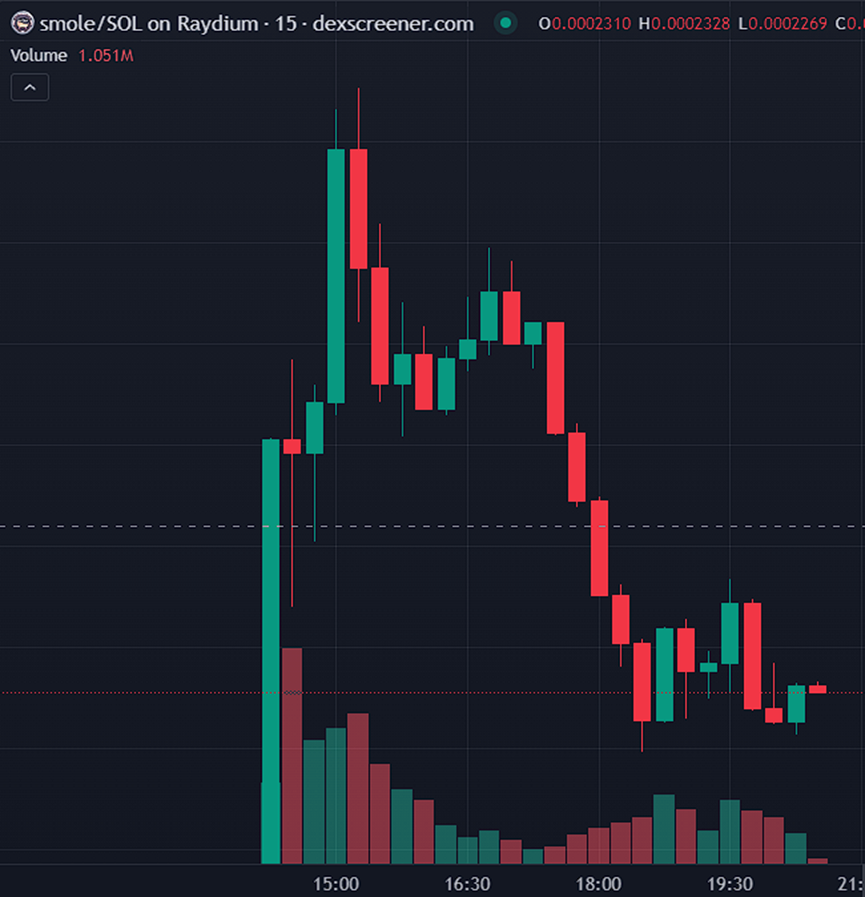
After listing, SMOLE failed to replicate the success of earlier memecoin presales. It briefly doubled in price upon opening before immediately crashing. Its market cap peaked at an astonishing $220 million, placing it among the top 20 memecoins by market cap. If it had matched BOME’s performance (a 100x increase), its valuation could have exceeded $10 billion. Unfortunately for hopeful investors, SMOLE dropped back to near its launch price within about four hours of trading—essentially going flat or slightly below.
That said, those who sent money to Dekadente were relatively lucky—the artist at least didn’t disappear with the funds.
But another group of users weren’t so fortunate. Many fundraising projects vanished immediately after collecting funds, leaving investors with nothing.
On March 17, a project called Solbot announced a presale and received support and retweets from multiple verified Twitter accounts, ultimately raising 2,870 SOL. The team deposited 1,717 SOL into the liquidity pool, after which the project’s Twitter account was suspended. The token briefly spiked before rapidly collapsing; by March 21, it had fallen over 99% from its peak. The remaining 1,153 SOL (valued at $217,000) still sits untouched in the project’s wallet, with no further communication.

Similar cases have been numerous in recent days. Due to the lack of effective regulation, most losing investors quietly accept their losses and continue hoping to hit the jackpot with another presale. According to ZachXBT’s incomplete statistics, 33 projects on Solana collectively raised 796,000 SOL ($149 million) in this cycle. As of March 20, nearly half of these projects had yet to fulfill their promise of launching tokens. Solana co-founder Toly shared ZachXBT’s data, urging investors to stop participating in such activities.
A Mockery of Value Investors?
Behind the noise, perhaps it’s time to objectively examine the essence of this memecoin presale trend.
Looking at the ever-evolving fundraising methods in crypto, directly sharing an address and asking users to send funds has become the simplest way to raise capital. Trust is no longer built on whitepapers, project roadmaps, or impressive teams—something that deeply frustrates many genuine product-focused development teams.
The reason behind this may not indicate that trust has become cheaper to establish. Rather, it reflects the broader crypto industry’s lack of a trustworthy environment. For users—especially those active in memecoin trading—it might seem better to blindly bet on a long-shot opportunity with minimal odds of massive returns, rather than participate in a well-packaged project with limited allocation that may ultimately underperform.
Previously, thousands of memecoins were launched daily across blockchains, almost none backed by any authority, relying solely on users’ speculative instincts. Thus, this new wave of presales actually adds a layer of perceived credibility (at least some KOL endorsement), even if there’s a risk of rug pulls, since there’s still someone identifiable to blame. Fundamentally, users are placing small bets against the influence of KOLs. In a way, it feels like a mockery of project teams who painstakingly craft narratives and branding.
Does this mean such simple and crude memecoins are better choices for users?
The answer is likely no.
Looking back at this presale frenzy, we find that among the 12,787 tokens launched on Solana between March 12 and March 21 (per dexscreener data), only a few—notably BOME and SLERF—delivered strong returns. The rise of these two tokens was largely accidental: BOME because it started the trend, and SLERF due to its founder accidentally burning the supply. As the hype fades, nearly all presale tokens have sharply corrected. Aside from early investors, latecomers have little chance of profit.
Participating in presale memecoins is essentially an extremely low-probability speculation—an extreme expression of FOMO and speculative sentiment in crypto—and the expected return may even be worse than buying a lottery ticket.
One user tweeted something thought-provoking:
"Crypto presales:
SOL raised $2 million in 2020
BNB raised $15 million in 2017
Ethereum raised $18 million in 2014
In 2024, a random Twitter user raised $32 million"
Ten years later, Ethereum’s market cap has reached $430 billion. But in just one month, today’s viral presale coins may already be forgotten.
Join TechFlow official community to stay tuned
Telegram:https://t.me/TechFlowDaily
X (Twitter):https://x.com/TechFlowPost
X (Twitter) EN:https://x.com/BlockFlow_News
 PANews