Exploiting transaction farming? Choosing Huobi HTX may be better than BackPack
TechFlow Selected TechFlow Selected
Exploiting transaction farming? Choosing Huobi HTX may be better than BackPack
The crypto market never lacks yield opportunities; what matters is interacting to earn airdrop rewards and securing them in your wallet.
 Navigating Web3 tides with focused insights
Over the past month, BackPack has become a hot topic across major crypto communities.
The reason lies in Backpack's announcement on its official social media channels that it launched a trading volume points system on February 14, stating that users’ ranking within this points system will serve as a key reference for future large-scale marketing campaigns—such as airdrop eligibility or participation in new project Launchpools.
This news quickly ignited interest in Backpack. Crypto users have rushed to generate trading volume on the Backpack exchange, believing that failing to participate could mean missing out on the next big wealth opportunity.
What Is Backpack?
Backpack Exchange was co-founded by Can Sun, former general counsel of FTX, and Armani Ferrante, former software developer at Alameda Research. It has obtained a VASP license from Dubai’s Virtual Assets Regulatory Authority (VARA). Leveraging zero-knowledge proof reserves (zk-proofs), multi-party computation (MPC) custody, and low-latency order execution technology, Backpack aims to deliver a more secure and transparent trading experience.
In November 2023, Backpack partnered with Pyth Network for its first airdrop event, which has now concluded. Although the campaign lasted only about a week—from announcement to completion—it generated significant buzz and wealth effects throughout the crypto community.
Frenzied Trading: Is It Still Worth Participating?
Data shows that since Backpack launched its account trading volume points system on February 14, trading volume has surged—reaching $5.7 billion in transaction value within just five days. According to the latest data from Coingecko, Backpack’s trading volume exceeded $1.3 billion on March 14 alone.
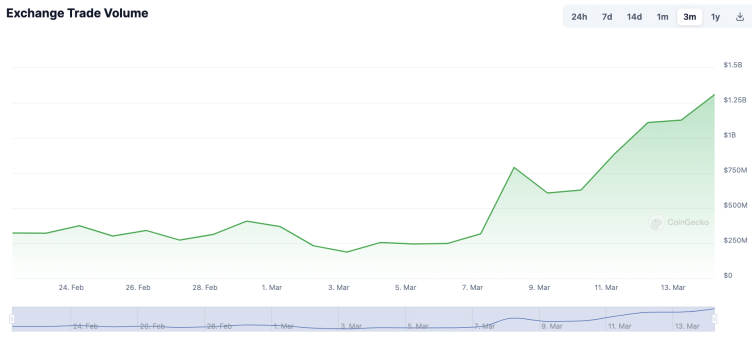
With such intense competition, is Backpack still worth farming? And is the rumored $10 million airdrop credible?
From an analytical standpoint, on public blockchains, gas fees are consumed and primarily collected by the blockchain or protocol side. Therefore, it’s not uncommon for blockchain projects to distribute hundreds of millions in rewards. However, Backpack operates on the Solana blockchain ecosystem, where gas fees are extremely low. The main cost incurred by traders is slippage, which does not go to the exchange. As an exchange, Backpack’s primary goal is to attract more users to experience and adopt its trading platform—but why would it spend massive amounts of money rewarding farmers who will simply leave after the campaign ends?
It's well known that top-tier exchanges like Huobi HTX and Binance typically allocate around $15 million for their launchpad prize pools. Does Backpack, a relatively new exchange, really have the resources to offer something significantly larger?
Moreover, for farmers, it remains unclear whether large-volume traders receive higher bonuses while small-volume traders get penalized ("reverse farmed"), or if smaller participants enjoy broader distribution while larger ones are disadvantaged—or whether rewards are directly tied 1:1 to trading fees paid.
Beyond this uncertainty, Backpack Exchange itself previously experienced an incident where its website went offline. Its overall security and reliability can only be fully assessed once it enters stable, public operation. Additionally, Backpack officials have stated that the current trading points campaign will continue long-term, potentially lasting beyond one quarter or even longer. This adds further uncertainty to any strategy focused on generating trading volume for potential airdrops.
Actionable Advice: Secure Profits Early
The crypto market never runs short of opportunities to farm rewards; what matters most is actually receiving airdrop rewards and securing them in your wallet.
Take Huobi HTX as an example: On March 15, it officially launched a trading mining campaign open to all users, offering a daily prize pool worth 100,000 USDT. This allows users to enjoy negative-fee trading while earning substantial rewards. Notably, rewards in $HTX tokens earned through the trading mining program come with no vesting or lock-up restrictions, allowing users to withdraw them at any time.
Reportedly, Huobi HTX introduced trading mining to enhance user trading experience, reduce trading costs, and help users grow their assets. During the campaign, all spot trading fees from the BTC/USDT pair will be used to repurchase and burn $HTX tokens, effectively reducing the circulating supply and supporting sustained value appreciation of $HTX.
Indeed, Backpack Exchange’s initial wealth-generation effect has captured the attention of the crypto community. However, the market may care more about how it learns from the collapse of FTX to build a more trustworthy and transparent crypto ecosystem. Without solid asset security, even the most enticing wealth-generation narratives will leave investors skeptical—especially given the team’s strong ties to the former FTX.
Huobi HTX remains committed to providing users with secure and convenient trading services, aiming to deliver tangible incremental returns, boost platform activity and prosperity, and promote broader adoption and development of cryptocurrencies.
Join TechFlow official community to stay tuned
Telegram:https://t.me/TechFlowDaily
X (Twitter):https://x.com/TechFlowPost
X (Twitter) EN:https://x.com/BlockFlow_News