
Interpreting Coinbase's Research Report: Crypto x AI, a Transactional Illusion Lacking Real Demand
TechFlow Selected TechFlow Selected
Interpreting Coinbase's Research Report: Crypto x AI, a Transactional Illusion Lacking Real Demand
Even if encrypting X AI is fraught with difficulties, it doesn't prevent trading around the technology narrative.
 Navigating Web3 tides with focused insights
Author: TechFlow
The AI sector’s popularity needs no elaborate explanation, with new projects emerging across various niche areas.
Yet amid surging token prices and AI becoming a buzzword cure-all, has crypto truly accelerated AI development?
Earlier this month, Coinbase released a market intelligence report titled "The Cryptocurrency AI Mirage", delivering an unpopular yet undeniable counter-narrative:
"We generally believe that decentralization alone is not sufficient to confer competitive advantage for AI products."
Harsh as it sounds, this perspective doesn’t fundamentally shake investment positions or enthusiasm. But broad perspectives lead to better judgment. Understanding top-tier institutional analysis can help assess how long the current "AI sector trading frenzy" might last.
TechFlow has reorganized the original English report into a concise summary below.
Key Takeaways
- The intersection between artificial intelligence and cryptocurrency is broad but poorly understood. We believe different subsectors within this space present vastly different opportunities and timelines.
- Decentralization alone does not inherently provide a competitive edge for AI products—they must also match centralized alternatives in key functional aspects.
- Our contrarian view: due to intense industry attention, the value potential of many AI tokens may be overstated, and numerous AI tokens may lack sustainable demand drivers in the near to medium term.
- AI-related crypto tokens often perform well on the back of AI market headlines—even showing positive price movements on days when Bitcoin trades lower.
Decentralization: A Self-Fulfilling Delusion?
Crypto-based AI projects often emphasize a politically correct ideal: making AI (models) more decentralized and democratic.
This creates a common misconception—that today's AI landscape is highly centralized, forcing users to rely solely on models from a few dominant corporations.
But reality tells a different story.
Coinbase highlights one of the most important trends in AI—a persistent culture centered around open-source models.
Hugging Face, a prominent AI community collaboration platform, has made over 530,000 models publicly available—including large language models (LLMs), image generators, and video models—from major players like OpenAI, Meta, and Google, as well as independent developers. Some open-source language models even outperform state-of-the-art proprietary models in throughput.
In short, open-source and commercial models already compete meaningfully. A vibrant open-source ecosystem coexists with a fiercely competitive commercial sector—this isn't a fully closed, monopolistic environment.
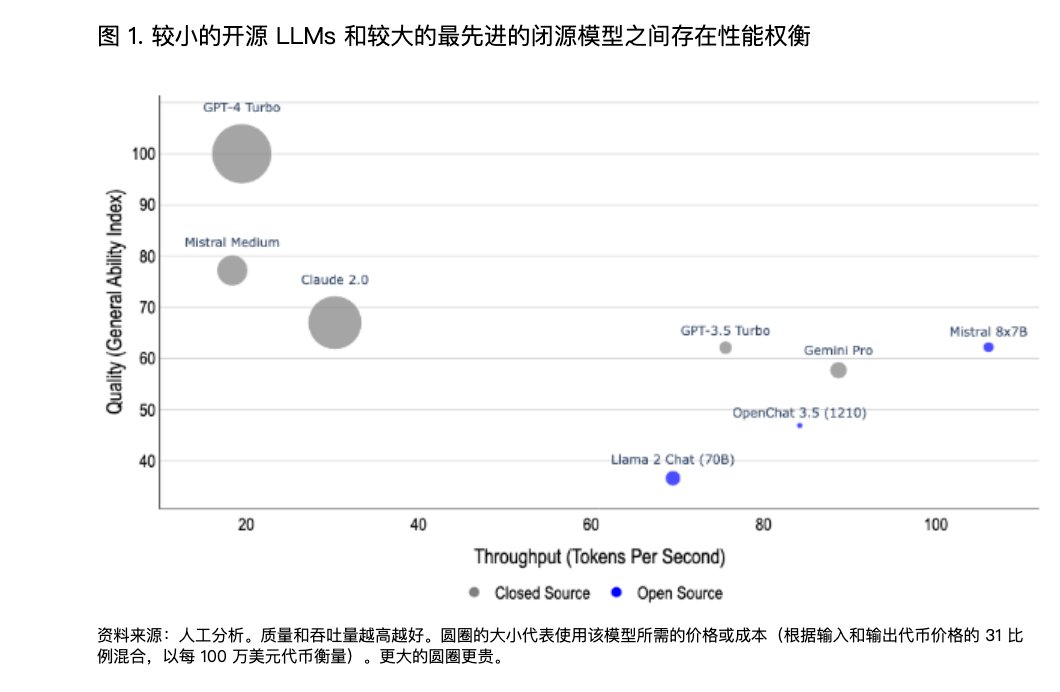
Therefore, Coinbase argues:
The oft-touted “decentralization solves X problem” as a universal remedy for AI remains premature. It presumes a centralization problem that may not actually exist.
In reality, competition among numerous companies and open-source initiatives has already achieved significant decentralization across technological and business dimensions in AI.
Due to their decision-making and consensus mechanisms, truly decentralized protocols progress slower than centralized counterparts—technically and socially. This could hinder efforts to balance decentralization with product competitiveness at this stage of AI development.
Promising Business Cases, But Long Road Ahead
Coinbase divides the convergence opportunities between crypto and AI into two categories:
-
Using AI products to improve the crypto industry—such as generating human-readable transaction descriptions, enhancing blockchain data analytics, or leveraging on-chain model outputs within permissionless protocols;
-
Using crypto to disrupt the AI industry—aiming to transform traditional AI pipelines through decentralized computing, validation, identity, etc.
For the first category, Coinbase expresses support.
For the second, it remains skeptical—believing such efforts face tough battles against broader market and regulatory forces. Yet this is precisely where most crypto projects focus their narratives. The report further breaks this down into four application areas:
-
Data collection, storage, and engineering;
-
Model training and inference;
-
Verifying model outputs;
-
Tracking model outputs.
However, many projects across these four areas will face significant challenges in the near term—including insufficient demand and fierce competition from centralized firms and open-source solutions.
-
On data:
Existing centralized data markets are already bridging gaps between providers and consumers. Decentralized data marketplaces are squeezed between open-source data directories and enterprise-grade competitors. Without legal frameworks, purely decentralized data markets must build standardized interfaces and pipelines, verify data integrity and configurations, and overcome cold-start problems for their products.
-
On storage:
Owners of proprietary datasets often have strict security and compliance requirements. Currently, there is no regulatory pathway for hosting sensitive data on decentralized storage platforms like Filecoin and Arweave.
A rough comparison with the "big three" cloud providers (AWS, Google Cloud Platform, Microsoft Azure) is incomplete—dozens of lower-cost cloud companies are also competing by offering cheaper base server racks.
Decentralized products competing directly with traditional and open-source rivals will need more time to advance.
-
On model training and inference:
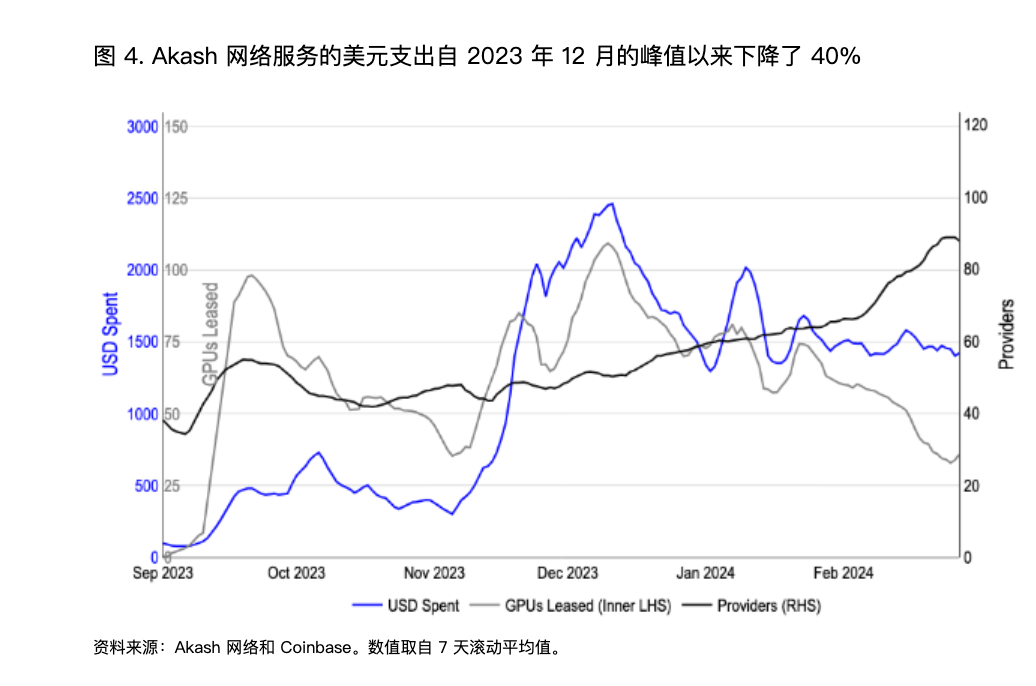
While projects like AKT have seen rapid usage growth, fees paid to the network have actually declined since their December 2023 peak—because supply of available GPUs exceeds demand growth for these resources.
In other words, actual demand may simply not be that high.
If supply growth consistently outpaces demand growth, where will sustained, usage-driven demand for native tokens come from?
Additionally, technically, decentralized computing solutions face bandwidth limitations. Fully realizing the vision of decentralized computation will be a difficult journey.
-
On model output verification:
For example, crypto projects like Bittensor aim to evaluate outputs across categories using algorithmic methods.
But as open-source models become smaller and more accessible, such solutions may struggle with demand. In a world where models can be downloaded and run locally—and content integrity verified via established file hashing/checksum methods—the role of crypto-based trustless verification becomes less clear.
Overall, the report concludes that while the business case for crypto x AI is promising, the path forward is long and arduous. It will take sustained long-term development before these projects secure a meaningful foothold.
Trading Narratives: News Is Price
In crypto markets, technology isn’t the end goal—it’s often a vehicle to attract attention and liquidity.
Thus, despite the hurdles facing crypto x AI, trading based on technological narratives continues unabated.
Since Q4 2023, many AI tokens have outperformed both Bitcoin and Ethereum, as well as major AI stocks like Nvidia and Microsoft.
The report suggests this is because AI tokens typically benefit from strong correlations with both broader crypto market momentum and specific AI-related news headlines, with WLD being the clearest example:
-
The release of World ID 2.0 on December 13, 2023, went largely unnoticed;
-
But after Sam Altman promoted Worldcoin on December 15, WLD surged 50%;
-
OpenAI’s release of Sora on February 15, 2024, caused the price to nearly triple;
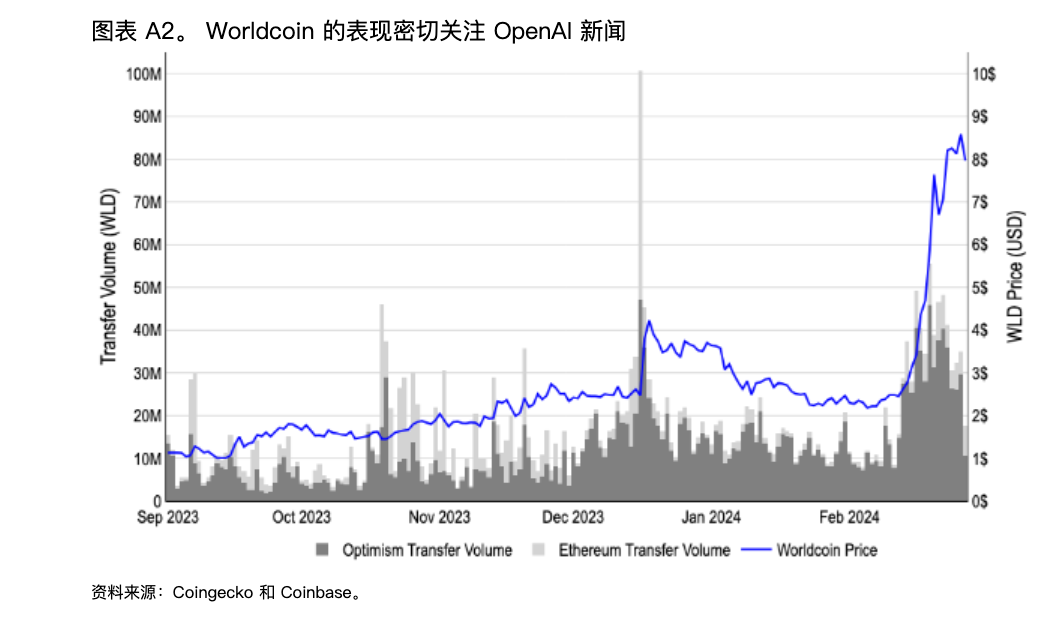
This explains a recent phenomenon: even as Bitcoin prices fall, AI-centric tokens may still experience upward price swings—resulting in bullish moves during bearish Bitcoin periods.
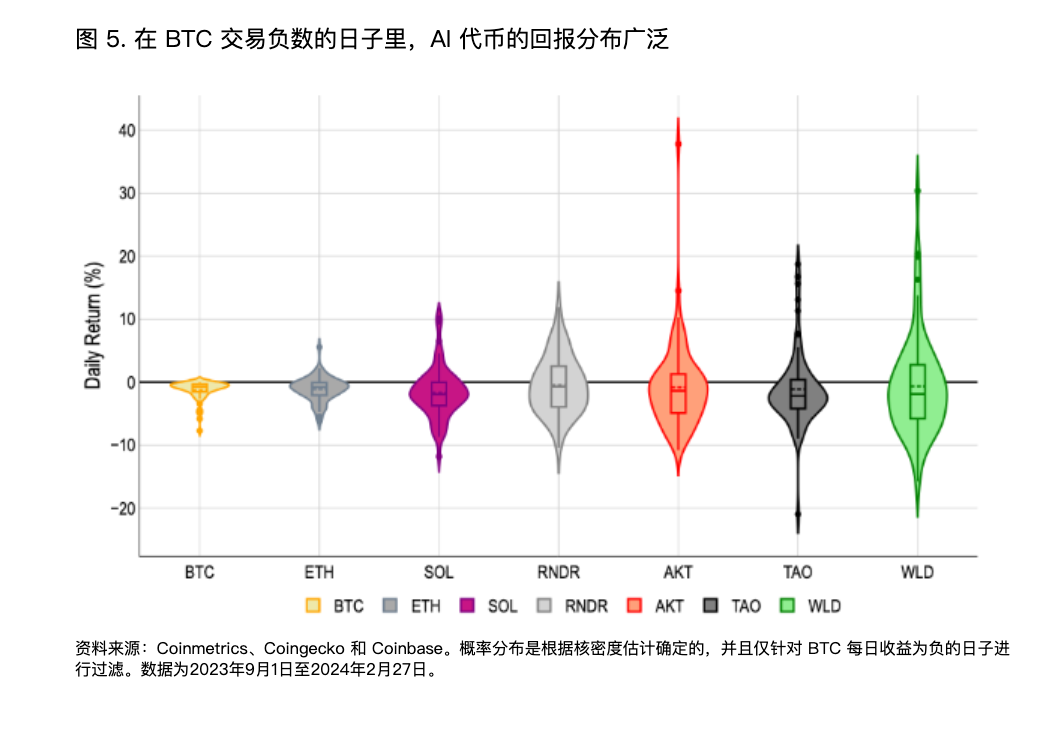
Overall, the report finds that recent AI-themed trading lacks many sustainable, near-term demand drivers. With unclear adoption metrics, current trading resembles meme-driven speculation—which may not last.
A constructive crypto market combined with strong performance in the AI sector may sustain the AI narrative for some time. But ultimately, a token’s price will converge with its underlying utility—the open questions are how long this takes, and whether utility will rise to meet price, or vice versa.
The decentralized AI future envisioned by much of the crypto industry is far from guaranteed.
Therefore, Coinbase advises caution—navigating this market prudently, and digging deeper into how crypto-based solutions can genuinely offer superior alternatives.
Failing that, one should at least understand the logic behind prevailing trading narratives—to identify pockets of certain returns amid the crypto x AI hype.
Join TechFlow official community to stay tuned
Telegram:https://t.me/TechFlowDaily
X (Twitter):https://x.com/TechFlowPost
X (Twitter) EN:https://x.com/BlockFlow_News
 深潮TechFlow