








Reinterpreting the Cross-Ecosystem Interconnection of the "Niche Public Chain" TON
TechFlow Selected TechFlow Selected
Reinterpreting the Cross-Ecosystem Interconnection of the "Niche Public Chain" TON
Telegram's monthly active users have surpassed 900 million, with a valuation exceeding $30 billion, and it is considering an IPO.
 Navigating Web3 tides with focused insights
Author: Lydia Wu
Introduction: Decoupling the Classical Public Chain Paradigm
The numbers on DefiLlama and CoinMarketCap seem to definitively label TON as a "dark horse public chain"—consistently ranking among the top 20 by market cap, yet rarely cracking the top 100 in 24-hour trading volume; with a TVL peaking at only $53M, it fails to enter the top 50 chains; its MC/TVL ratio reaches an astonishing 293—33 times that of Ethereum.
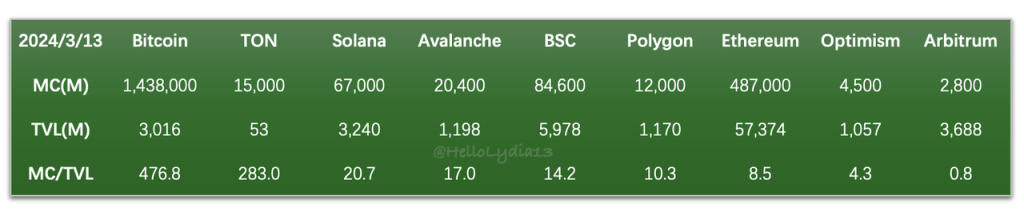
Source: DefiLlama, CoinMarketCap
Over recent months, rollups and modularity have decoupled Ethereum’s definition of what constitutes a blockchain. The narrative of “first-class” versus “second-class” chains has weakened, markets have accepted Blast for merely bearing a chain’s name, and recognized AO for functioning as a chain under a network’s guise.
This shift accelerates the potential long suppressed by TON's perceived "non-traditional" status. Market understanding of TON begins not by fitting it into classical, TVL-centric narratives, but rather by incorporating user-side metrics such as daily and monthly active users.
Recently, Telegram founder Durov told the Financial Times that Telegram has surpassed 900 million monthly active users, is valued at over $30 billion, and is considering an IPO. Compared to Meta’s 3 billion MAUs and $1.3 trillion market cap, Telegram’s valuation stands at just 1/40th. Telegram’s user base is concentrated in Asia, Europe, South America, and the Middle East, exhibits strong retail characteristics, and has robust peer-to-peer payment demand—making it an ideal Web3 adoption cohort. As Telegram continues growing, if TON succeeds in onboarding 30% of Telegram’s users within the next 3–5 years, it could credibly support its current valuation.
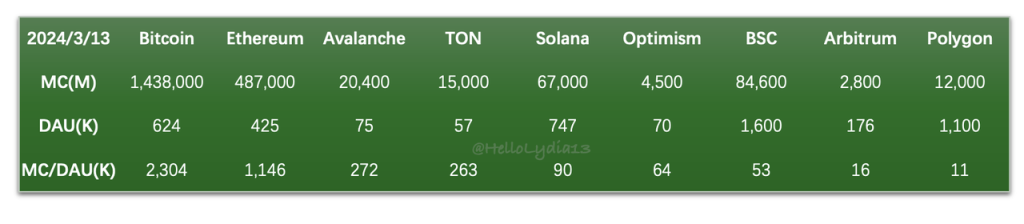
Source: DefiLlama, CoinMarketCap, Nansen, Token Terminal
A New Paradigm for Web3 Creation: Content Packaging and Value Transfer via Telegram
Splitting Distribution Models: Telegram Opens Up the Web2 Growth Market
In a piece last year, I outlined three stages of the Web3 creator economy. Stage 1 follows the simplest "blockchain plus" logic—centralized content creation paired with Web3 distribution (primarily through NFTs). This remains mainstream today, although NFTs are increasingly used as pre-token speculative instruments rather than creative mediums.
This year, experiencing the TON ecosystem has led me to realize that, along the same attention-driven traffic paths, NFTs’ functions of content packaging, rights assignment, and governance might be more naturally replaced by a "channel-ad-payment" system. Friend.tech was an intermediate example of this idea—packaging chat groups as assets—but suffered from limited content scalability and unsustainable economics.
Compared to many NFT and SocialFi projects struggling to find use cases for their assets, the TON ecosystem built on Telegram offers a far more accessible product experience and value network for Web2 developers, creators, and users. By layering atop an existing social network, it further splits the Web3 distribution model into Web2 business models + middleware wallets + Web3 settlement—lowering both cognitive and operational barriers while expanding creators’ revenue streams (e.g., ad sharing).
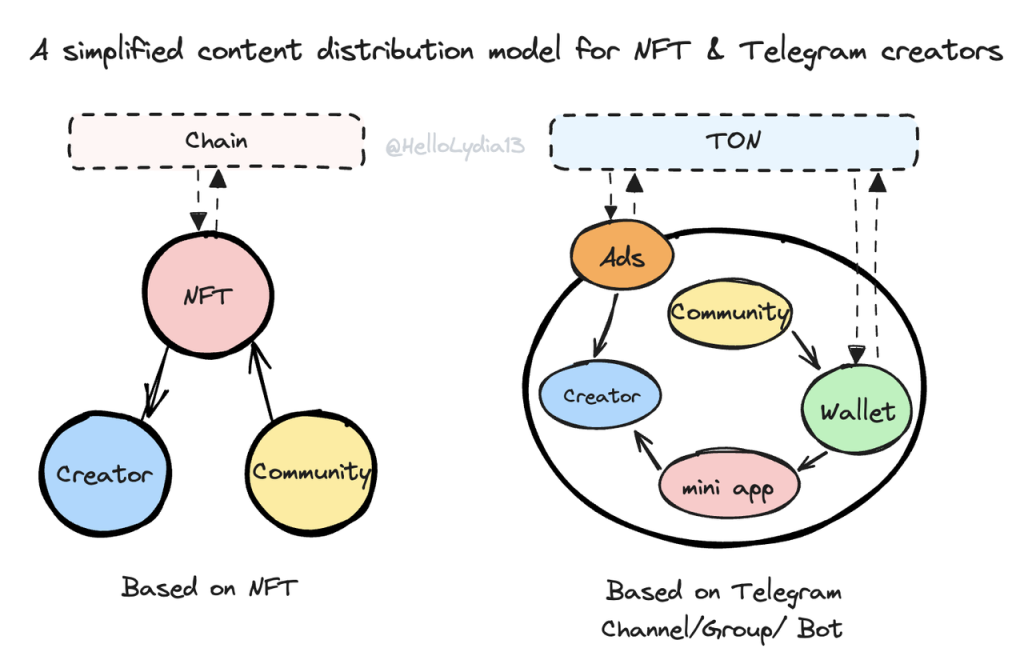
Source: Lydia @Mint Ventures
From Content to Services: Trading Bots Driving Web3 User Conversion
WeChat, Web2’s super app, expanded its ecosystem from content to services via official accounts and mini programs. Telegram follows a similar path, reinforcing its position as a mobile traffic gateway through business accounts and service bots—among which trading bots are particularly popular with crypto users.
The trading bot sector has grown rapidly since 2023, standing out as one of the few products during the bear market with real demand and cash flow. After the bear-to-bull transition, the sector’s revenue-generating power intensified—top protocols like Banana Gun and Unibot now generate over $200,000 in daily revenue. Currently, aside from a handful deployed on websites or Discord, most trading bots interact through Telegram.
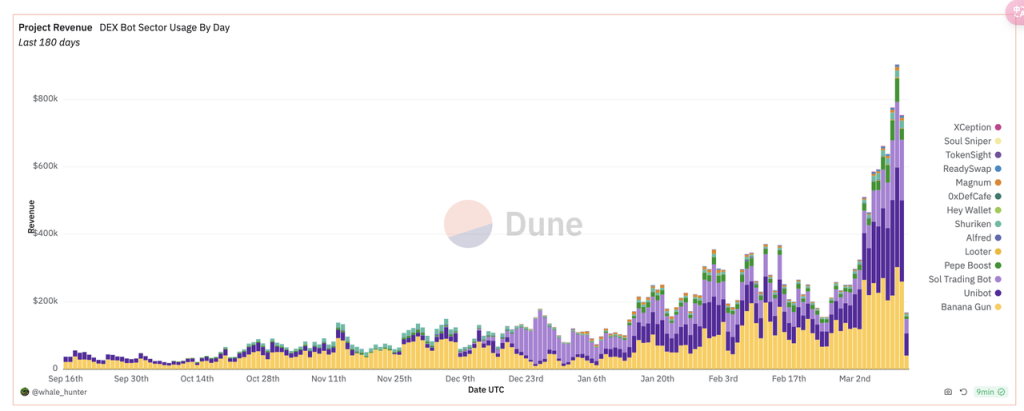
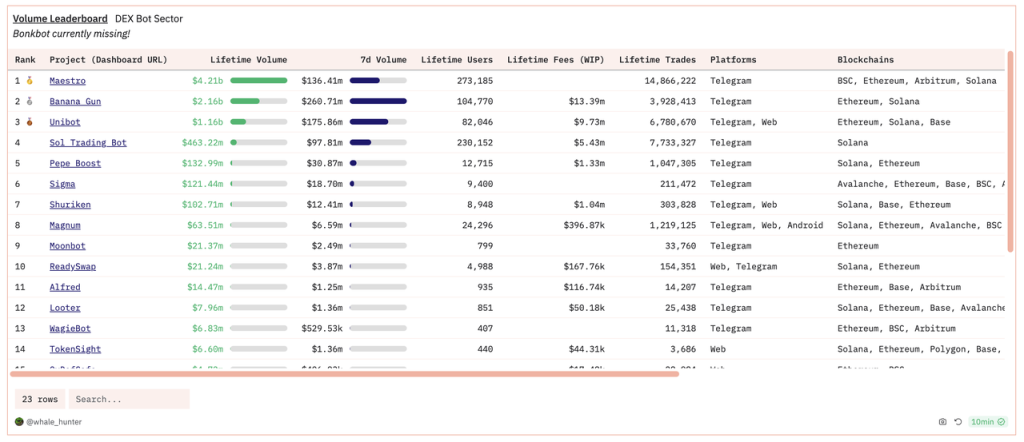
Source: https://dune.com/whale_hunter/dex-trading-bot-wars
Currently, trading bot transactions have little direct connection to TON—they primarily leverage Telegram’s bot interface to access Ethereum and Solana. However, the popularity of bots significantly aids TON’s market education and user mindset development. As crypto users grow accustomed to this new interaction model, psychological friction toward adopting other non-trading TON-native products drops sharply. Combined with a robust on-chain identity system and integrated payments, TON could theoretically build a self-consistent content packaging and value transfer framework.
Exploring the Marketplace Model: TON’s Bot Universe and Mini App Store
Many current TON ecosystem products appear as simple Telegram bot gateways linked to H5 web pages, accompanied by chaotic, fast-scrolling Telegram groups—a scene resembling a bustling, almost disorderly marketplace.
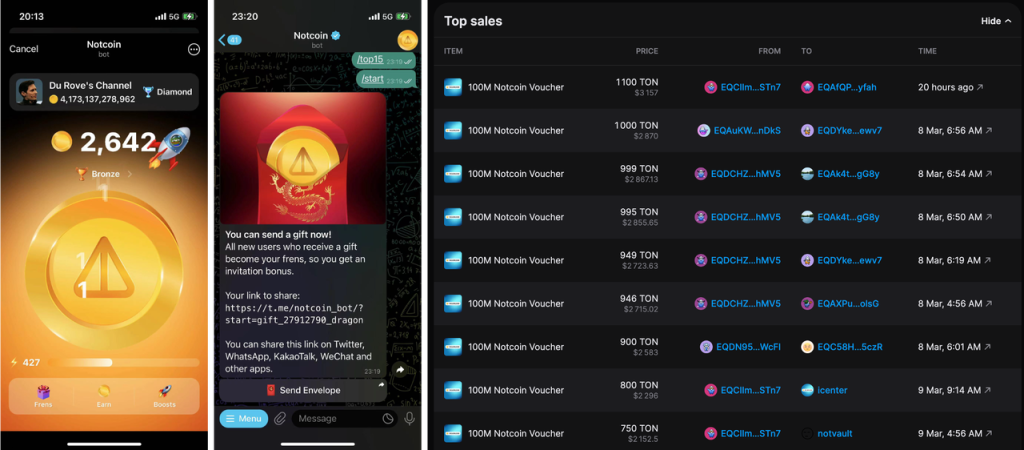
In the meme project Notcoin, players simply tap coins on screen to earn points, join teams led by influencers (like Telegram’s Durov), or send “red packets” to friends for referrals. Thanks to its mindless gameplay and viral spread, Notcoin attracted 5 million players within a week and now boasts over 26 million players and 1 million X (Twitter) followers. In early pre-market trading, the highest recorded transaction was 110 million shares bought for 1,100 TON (~$4,521).
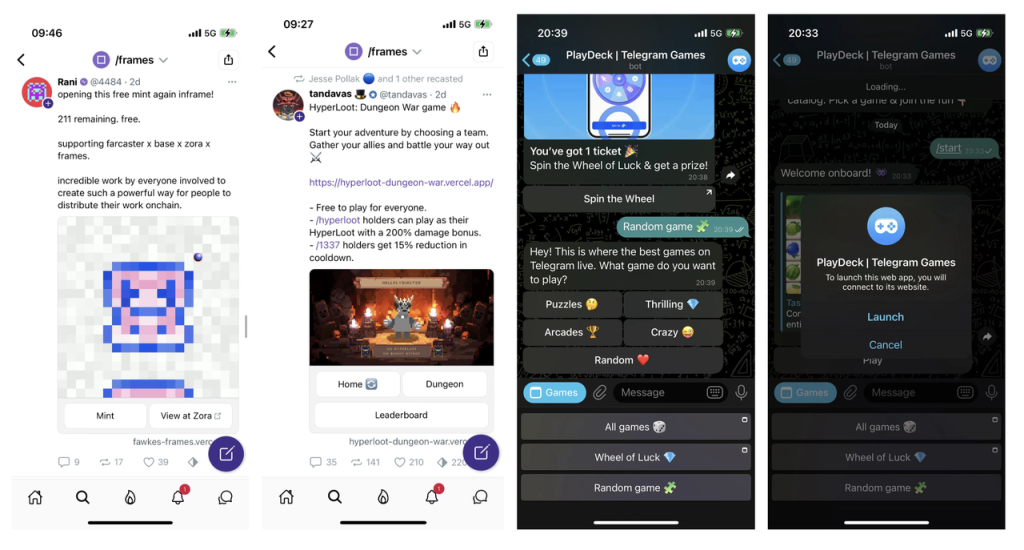
Farcaster, beloved by crypto influencers, launched its Frames feature in January 2024, hailed as a “remarkable innovation.” Yet on mobile devices—where traffic density is higher—the experience falls short. While users can perform basic swaps or mints, any slightly complex interaction—even a simple game—is challenging within a small iframe occupying less than a third of the screen.
Less discussed is how Telegram and TON have already achieved near-seamless transitions from chat windows to semi-native apps, with bot-triggered applications loading even faster than WeChat mini programs.
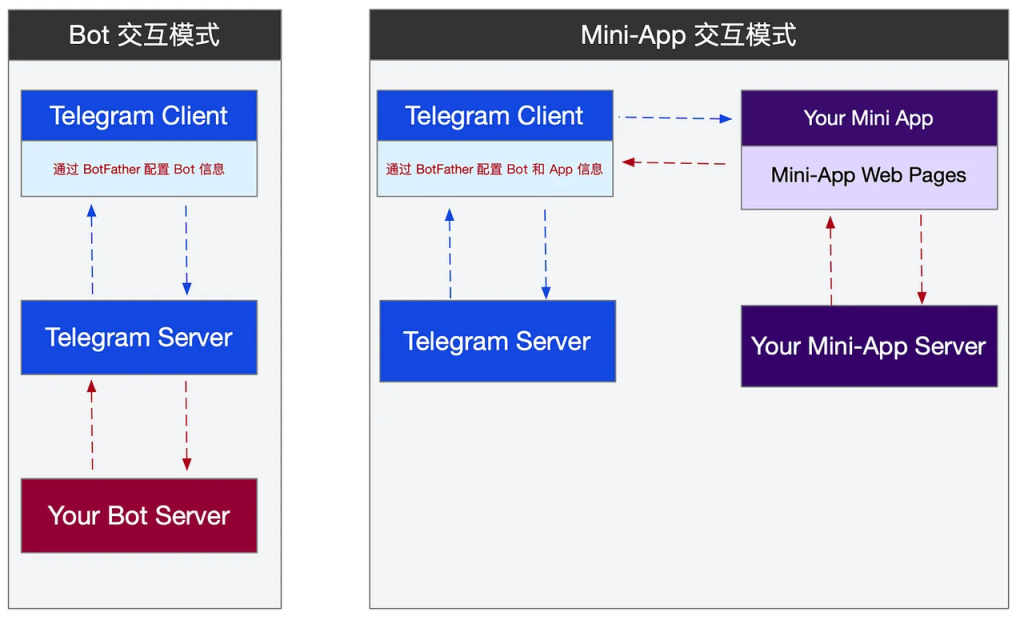
Telegram launched its Bot API in June 2015 with restrictions: no customizable UI and client-server communication routed indirectly. Trading bots built on this architecture aren’t standalone apps but proxy interfaces, resulting in slower response times and difficulty supporting parallel interactions.
In April 2022, Telegram introduced Mini Apps, allowing full control over UI and enabling direct client-server communication. Mini Apps offer smoother interactions, greater composability, and seamless integration with infrastructure like wallets—making them ideal for diverse Web3 deployments, potentially replacing all mobile web experiences.
After the launch of Mini Apps, bots didn’t disappear—they evolved into “gatekeepers,” serving as the first touchpoint linking multiple Mini Apps.
Source:TON x Fans | TON Enthusiasts
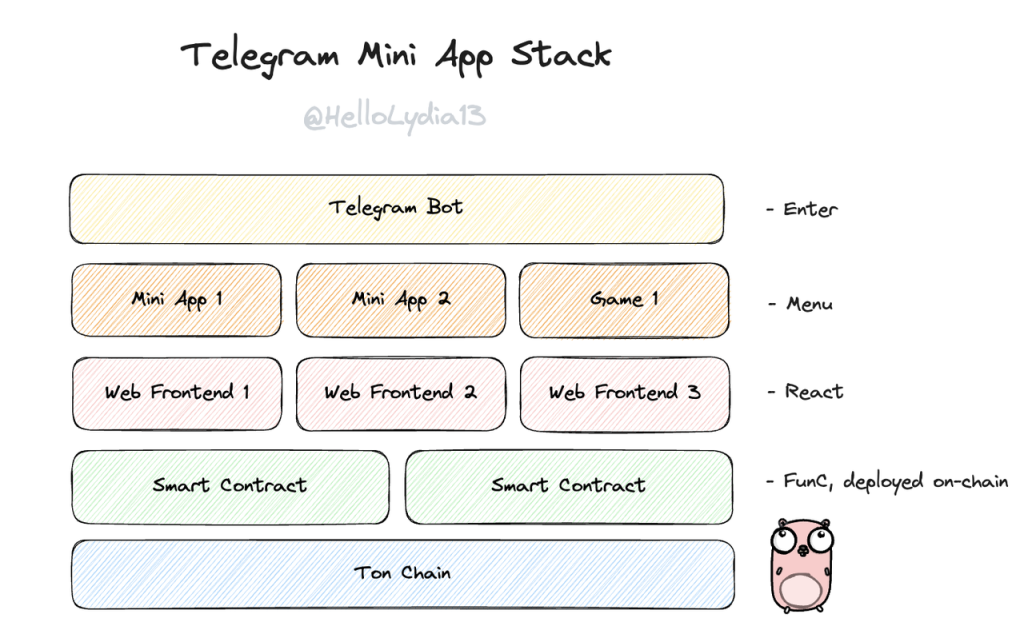
Source: Lydia
Setting up a bot or mini app on Telegram is currently straightforward. Users can quickly configure a bot via Q&A in the @BotFather channel, or try a virtual ordering demo via @DurgerKingBot.
Differentiated On-Chain Experience: Highlights of the TON Ecosystem
Lightweight Gaming
In an era of abundant blockchain performance, playing a game on an Ethereum L2, Solana, or BSC makes little difference in user experience. But for highly social games (like card or party games), the ability to instantly share and form teams in Telegram—or wait for random matches with strangers—creates vastly different engagement levels.
Tap Fantasy, originally an MMORPG on Facebook, attracted over 700,000 players after launching on BSC and Solana. In August 2023, as the first IDO project on TonUP—the first launchpad in the TON ecosystem—its token $MC sold out within half an hour. In November 2023, Tap Fantasy officially launched its TON-based version, published by Web3 gaming incubator Pluto. Within three months, player count exceeded 600,000, with over 16,000 on-chain users. Thanks to a well-functioning in-game economy, the $MC/TON exchange rate rose from 0.2 to 1.
Pluto’s newly incubated game Catizen is an AI-integrated metaverse cat-raising game. It began closed beta testing on March 7, 2024, amassing over 160,000 players and 13,000 on-chain users in five days. Catizen has also partnered with $FISH, a leading meme token in the TON ecosystem, planning an airdrop to $FISH holders post-testing.
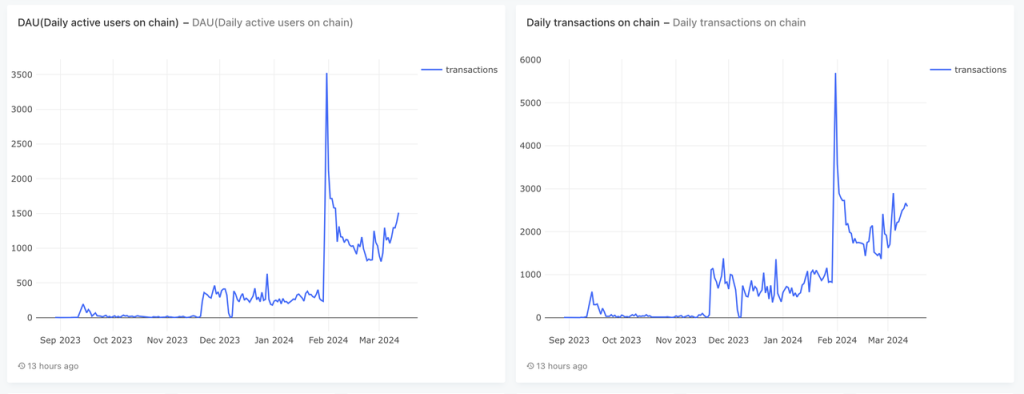
Source: Tap Fantasy TON version dashboard
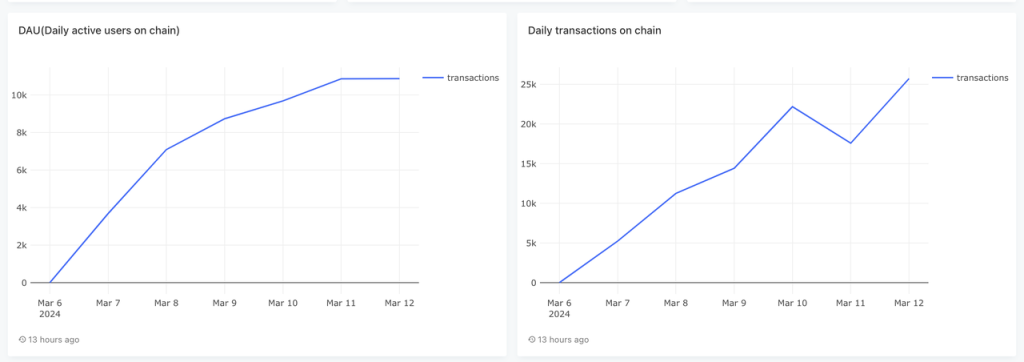
Source: Catizen dashboard
Social Inscriptions and Memes
As a new asset issuance method emerging this cycle, the Bitcoin inscription ecosystem is beginning to spill across chains—an experimental trend. TON’s inscription ecosystem integrates Telegram’s frontend and built-in wallet, improving usability while simultaneously deterring bots and sybil attacks.
-
$NANO: The first TON20 inscription, generating 20 million interactions and 36,000 unique minting addresses in the TON ecosystem
-
$GRAM: Named after the original token of the SEC-halted Telegram Open Network, first deployed, minted, and transferred entirely via Telegram mini app frontend
-
$TONOT: Broke $NANO’s record with 61,000 unique minters and 57,000 holders, supports conversion between inscriptions, NFTs, and tokens, with future plans including in-game currency, DID, and staking mining
Meme assets were long barren on the "underdog chain" TON, and crypto users lacked a window into the ecosystem—until Notcoin broke through.
-
$NOT: Notcoin will airdrop its $NOT token at the end of March or early April, with pre-market trading already underway on Getgems, TON’s NFT marketplace
-
$REDO: Inspired by a hand-drawn sketch of Telegram founder Durov during a protest, currently the highest market cap meme in the TON ecosystem
-
$FISH: Ton Fish is the first social meme in the TON ecosystem, now held by over 18,000 users
-
$TPET: A meme from the Ton Fish ecosystem, fair launch ongoing until March 26, set to be the main token for the game Ton Pet: Tik Ton, with $FISH and NFT holders eligible for airdrops
Multi-Chain Liquidity Launchpad
XTON is the first multi-chain liquidity launchpad in the TON ecosystem, with team members from the TON Foundation. XTON will complete mainnet launch and token sale in Q1, starting its first project in Q2. Aligned with XTON’s vision, the TON ecosystem may soon bridge traffic between Web2 social giants and the Web3 EVM world.
Conclusion: Toward an Interconnected Future
Since March, news that Telegram will use TON to settle ad revenue, Binance listing U-margined futures, and Telegram’s IPO considerations have triggered a rapid two-stage surge in TON’s price, alongside visibly increased on-chain activity.
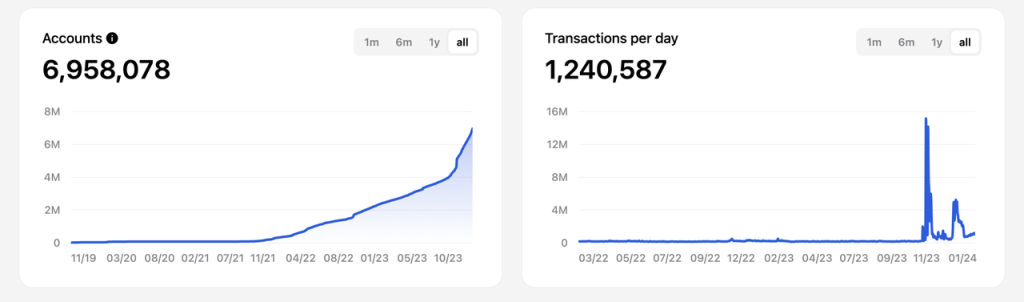
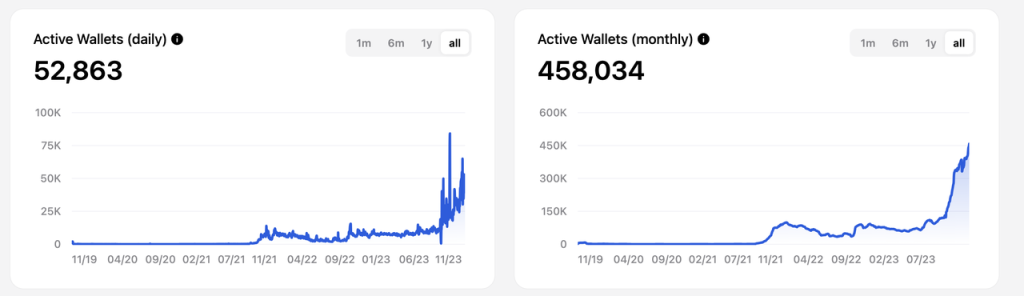
Source: https://www.tonstat.com/
Reviewing TON’s roadmap since 2018—from Telegram’s initial proposal to community takeover, from launching the first cross-chain bridge to gradually maturing infrastructure—its resilience and vitality are striking. In 2024, TON is prioritizing stablecoins, cross-chain bridges, and Asian markets. We look forward to TON becoming a truly open network connecting different regions, ecosystems, and applications—and each of us may catch a glimpse of the long-promised blockchain future.
*All data in this article is accurate as of March 13, 2024
Join TechFlow official community to stay tuned
Telegram:https://t.me/TechFlowDaily
X (Twitter):https://x.com/TechFlowPost
X (Twitter) EN:https://x.com/BlockFlow_News
 Mint Ventures


