Elixir: The Modular DPoS Network Backed by Arthur Hayes — How to Engage Before Mainnet Launch?
TechFlow Selected TechFlow Selected
Elixir: The Modular DPoS Network Backed by Arthur Hayes — How to Engage Before Mainnet Launch?
Currently, you can interact by running nodes, earning points, providing liquidity for DEXs integrated with Elixir, and more.
 Navigating Web3 tides with focused insights
Author: Nianqing, ChainCatcher
Editor: Marco, ChainCatcher
Recently, the modular DPoS network Elixir announced it has raised $8 million in a Series B funding round, co-led by Mysten Labs and Maelstrom Capital — operated by Arthur Hayes' family office — with participation from Manifold, Arthur Hayes, Amber Group, GSR, and Flowdesk.
According to the RootData page, Elixir was founded in 2022 as a modular DPoS liquidity network enabling anyone to directly provide liquidity to order books, bringing liquidity to long-tail crypto assets and allowing exchanges and protocols to bootstrap their ledger liquidity. Elixir previously completed a $2.1 million seed round in January last year and a $7.5 million Series A round in October, with investors including prominent firms such as Hack VC, NGC Ventures, and FalconX.
Beyond its recurring fundraising news, Elixir has remained relatively low-key within Chinese communities, drawing limited attention—primarily because, unlike order book DEXs like dYdX or Vertex, Elixir serves as an underlying liquidity layer and infrastructure provider for these projects. Its previous testnet versions offered few direct user interaction opportunities.
However, alongside disclosing its latest funding round, Elixir recently unveiled a new product called Apothecary. Apothecary is a points-tracking system that allows users to earn points (called "potions") and rewards by depositing assets and referring new users, helping track their contributions to the network ahead of the mainnet launch on August 15.
What Makes Elixir Stand Out?
Traditional financial markets have long relied on centralized intermediaries to provide liquidity, where institutions and hedge funds optimize exchange liquidity using advanced trading strategies and algorithms. However, entrusting funds to centralized entities carries inherent risks. As a result, DeFi has been exploring decentralized order book models—systems enabling traders to transact directly with each other, leveraging mathematical models and liquidity pools to facilitate token pair trading.
Ideally, order book models can address issues like low capital efficiency and high slippage prevalent in AMMs while preserving trading flexibility and asset decentralization. In practice, however, order book DEXs work best in markets with large token supplies like Bitcoin and Ethereum. For less liquid markets and long-tail assets with shallow supply-demand depth, they often suffer from excessively wide spreads that prevent trades from executing.
According to its official website, Elixir aims to allow anyone to directly provide liquidity to order books, particularly boosting liquidity for long-tail crypto assets. How does this vision become reality? Elixir opens up trading pairs to retail users (as well as institutions and market makers), subsidizes APYs, and attracts more participants to directly supply liquidity to order books via the network. Elixir can be cross-chain composited with other projects, allowing order book DEXs to integrate Elixir into their core infrastructure.
On one hand, order book DEXs can share the liquidity provided by Elixir as foundational infrastructure, enhancing trading experience. On the other hand, ordinary users typically struggle to provide liquidity on order book DEXs, limited to manually placing orders. With Elixir, users can automatically place buy and sell orders at high frequency, earning liquidity fees. This way, providing liquidity on order book DEXs becomes as convenient as using AMMs.
From a network architecture perspective, Elixir’s order book operates almost equivalently to Uniswap v2’s x*y=k curve, which helps establish liquidity and narrow bid-ask spreads on order books, offering risk and return profiles very similar to AMM LP positions. The network achieves DPoS consensus on exchange orders.
Additionally, its infrastructure resembles Arbitrum’s security model, with fraud proofs published on the Ethereum mainnet. Notably, Elixir also integrates public data from various exchanges—including centralized ones—to ensure low-latency updates of trades, positions, and order books, maintaining consistency across exchange order books.
In terms of ecosystem development, Elixir has already integrated with over 30 DEXs. Since order book models require cheap and high-frequency transactions, they demand blockchains with high throughput. Most of these projects belong to high-throughput, low-gas L1 and L2 ecosystems such as Sui, Sei, Starknet, Arbitrum, Blast, and Injective, including platforms like Vertex, RabbitX, NFTPerp, Orderly Network, and dYdX.
Currently, Elixir plans to issue its native token ELX, although the tokenomics have not yet been disclosed. According to the project, ELX will serve two primary purposes: first, for node and validator staking to secure network safety; second, as a governance token for community decision-making.
How Can Users Engage?
Founded in 2022, Elixir has launched two testnet versions and is preparing to roll out its v3 testnet—the final testnet before the mainnet launch in August. Currently, users can interact with the network by running nodes, earning points, or providing liquidity to DEXs integrated with Elixir.
1. Run a Node / Validator
Elixir currently has 13,563 nodes worldwide, and users can earn rewards by operating nodes. However, the team has paused node registration for Testnet v2 in preparation for the v3 release. Users can apply to run nodes once v3 launches.
Link: https://docs.elixir.xyz/running-an-elixir-validator
2. Apothecary: Earn Points
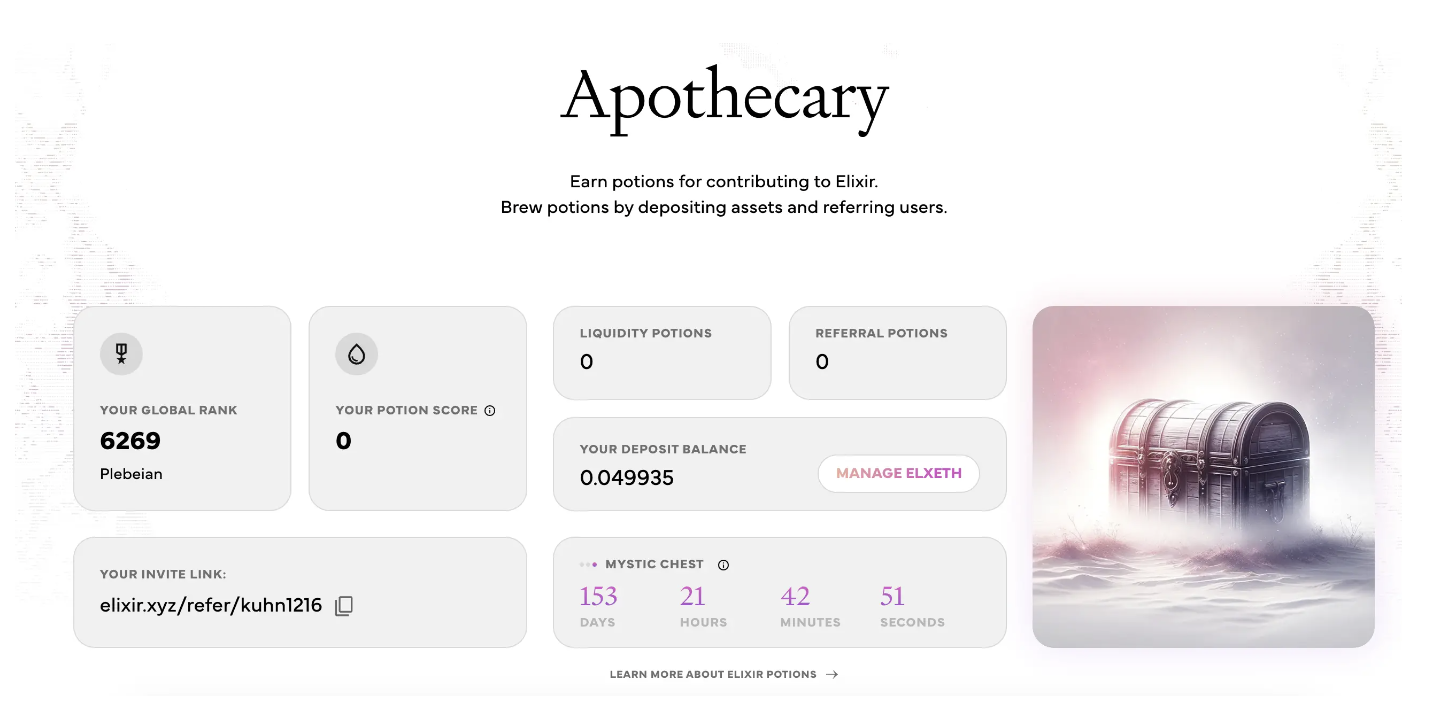
Launched on March 12, Apothecary is a comprehensive points-tracking tool that monitors user contributions to the network, integrations, elxETH minting, referrals, and more. Running nodes and trading on Elixir-integrated exchanges also earns points ("potions").
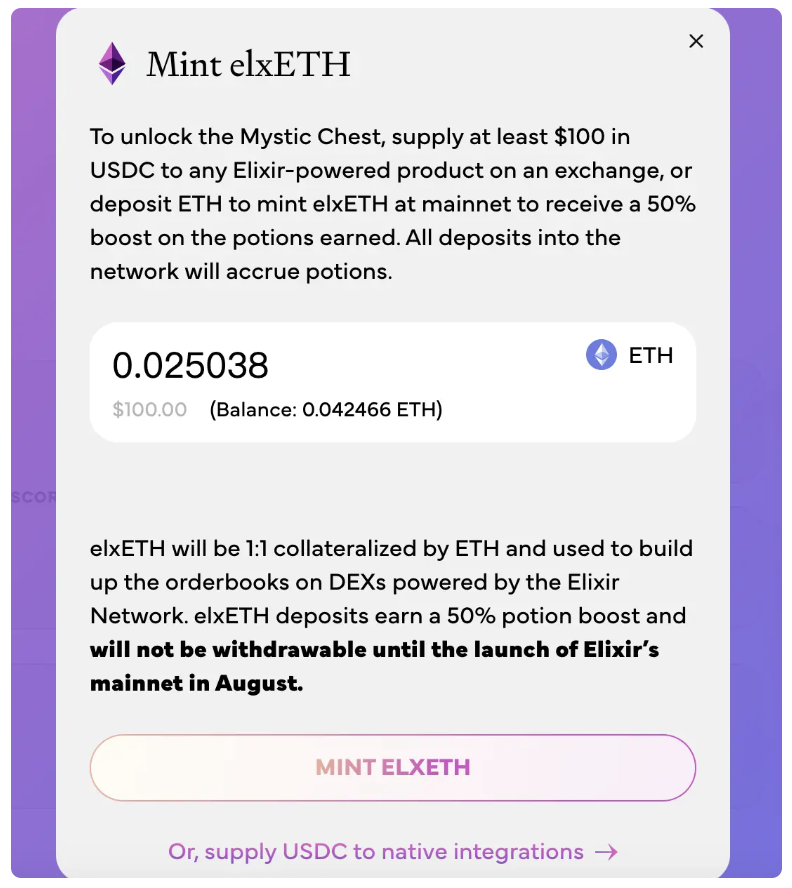
As shown in the image, users can unlock a mystery chest by depositing at least $100 worth of ETH to mint elxETH. elxETH is a native yield-bearing token backed 1:1 by ETH, which will become a cross-chain LP token upon mainnet launch, powering order book liquidity for exchanges. Deposited assets are locked by the protocol and used to provide liquidity for Elixir-supported products and DEXs. After the mainnet launch on August 15, users will be able to withdraw their assets and claim rewards from the chest. If they choose not to withdraw, the assets will automatically start earning rewards from exchanges.
The amount of assets deposited determines the number of points earned, and inviting new users to deposit also generates additional points.
Link: https://www.elixir.xyz/apothecary
3. Provide Liquidity to Elixir-Integrated DEX Products
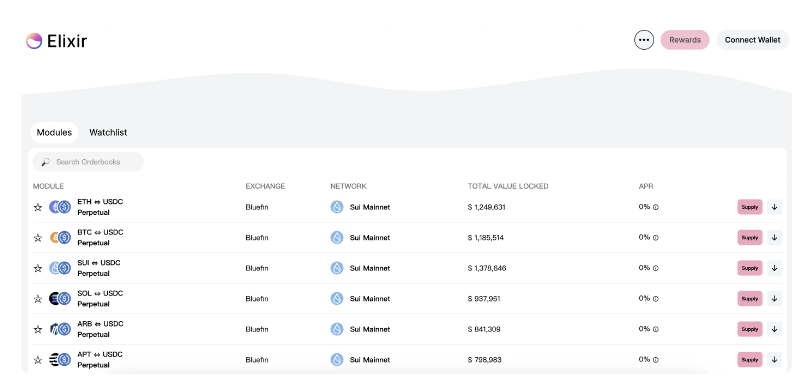
Users can also earn points by depositing more than $100 in assets on exchanges within the Elixir ecosystem. However, minting elxETH on the mainnet offers 50% more points compared to this method.
Currently, Elixir supports over 50% of Bluefin’s order book liquidity, over 20% on Vertex, and over 40% on RabbitX. Native integrations with dYdX, Hyperliquid, Orderly, and over 30 others are also upcoming.
Link: https://agg.elixir.xyz/
Join TechFlow official community to stay tuned
Telegram:https://t.me/TechFlowDaily
X (Twitter):https://x.com/TechFlowPost
X (Twitter) EN:https://x.com/BlockFlow_News
 ChainCatcher 链捕手