








How Elixir Connects Billion-Dollar Institutional Assets to DeFi by Partnering with Old Money
TechFlow Selected TechFlow Selected
How Elixir Connects Billion-Dollar Institutional Assets to DeFi by Partnering with Old Money
With more traditional financial giants like BlackRock entering the space, the demand for and development of institutional-grade DeFi will accelerate rapidly.
 Navigating Web3 tides with focused insights
Preface
In 2025, the crypto industry continues advancing toward the future long anticipated by the market. Looking back from this hopeful present, one cannot help but marvel at how transformative 2024 was for crypto. This transformation is not only reflected in the institutional breakthrough of spot Bitcoin ETFs fueling a "crypto bull run," but also in traditional financial institutions' fundamental shift in attitude toward crypto technology—directly impacting market sentiment and pricing. The victory of Trump, known for his pro-crypto stance, in the year-end election further injected strong confidence into the market.
Amid this wave of transformation, the most eye-catching development has been BlackRock—the world’s largest asset management firm—and its moves in the crypto space. Its on-chain money market fund, primarily invested in U.S. Treasury bills—the BlackRock USD Institutional Digital Liquidity Fund (short for BUIDL Fund)—has surpassed $530 million in规模, with its operations now extended across multiple networks including Aptos and Arbitrum. The convergence of DeFi and RWA is gradually becoming an undeniable trend.
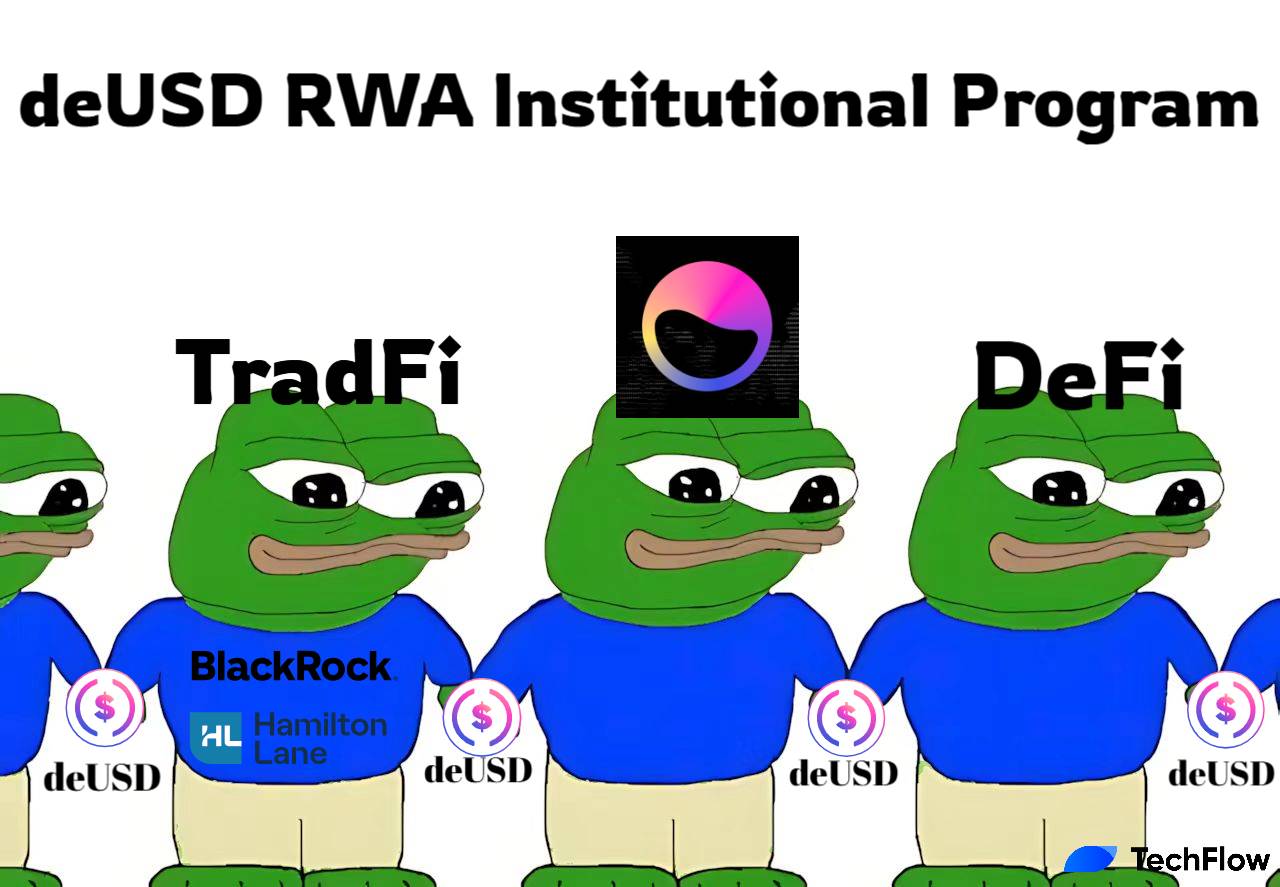
Recently, building on this trend, BlackRock has launched new initiatives: the BUIDL Fund has formed a tripartite collaboration with digital securities platform Securitize and DeFi infrastructure layer Elixir to launch the deUSD RWA Institutional Program, bridging over $1 billion in institutional-grade RWA assets into the DeFi ecosystem.
Elixir, serving as the bridge between BlackRock and the DeFi world, is more than just an “asset tokenization platform”—it represents a complete infrastructure layer. Its core product, deUSD, aims not only to solve the issue of on-chain liquidity for institutional-grade assets but also to explore a new path where TradFi and DeFi can innovate together while ensuring asset security. Perhaps this attempt will pave a new viable route for DeFi.
This article will analyze BlackRock's latest move and Elixir’s pivotal role as foundational infrastructure, exploring DeFi’s evolving direction under current market trends and illustrating the innovative pathway through which traditional financial-grade assets are entering the DeFi赛道.
How Do Institutions Enter DeFi? How Does This deUSD RWA Work?
Of course, BlackRock isn’t the only major asset manager participating in the deUSD RWA Institutional Program. The framework also supports other assets such as Hamilton Lane’s SCOPE Fund. With large institutions actively extending their reach, the key challenge lies in achieving full on-chain liquidity while ensuring asset security. Elixir and Securitize address these critical aspects through innovative technical architecture.
Dual-Track Design: Perfect Integration of Yield and Liquidity
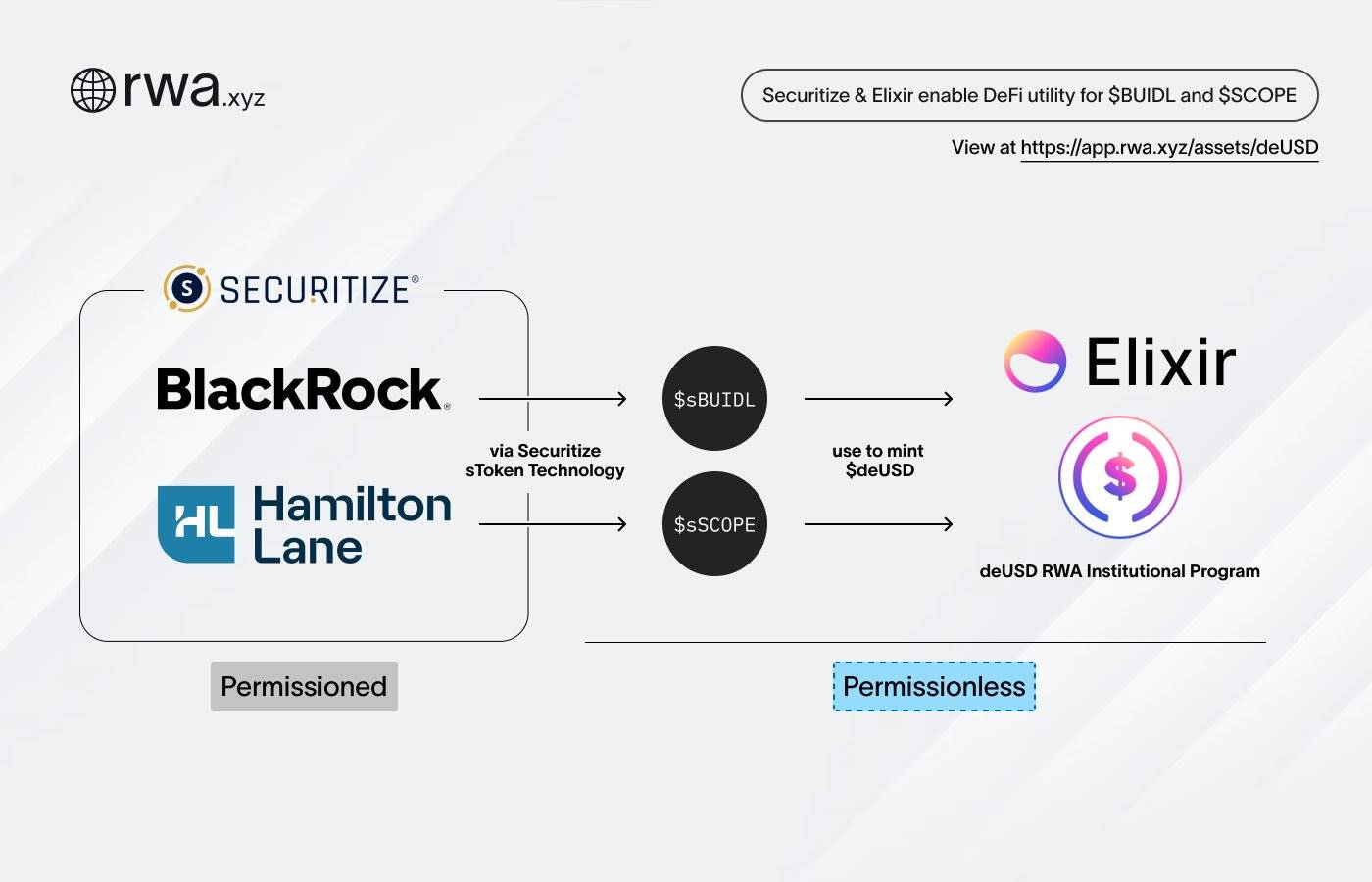
Through the unique two-layer architecture of the deUSD RWA Institutional Program, traditional finance’s permissioned environment is seamlessly connected with DeFi’s permissionless ecosystem.
Permissioned Environment: The Starting Point of Asset Tokenization
At the first layer, BUIDL and SCOPE funds undergo initial tokenization via Securitize’s “sToken” technology. Based on the ERC-4626 standard, traditional financial assets are converted into $sBUIDL and $sSCOPE tokens. Securitize’s permissioned environment ensures compliance throughout the tokenization process, providing necessary regulatory safeguards for institutional participants.
Permissionless Environment: Extending DeFi Innovation
After tokenization, assets enter Elixir’s permissionless environment—the second layer of the system. Here, holders of $sBUIDL and $sSCOPE can simultaneously:
-
Use their tokens to mint deUSD and gain liquidity within the DeFi ecosystem
-
Continue earning stable yields from underlying assets (e.g., U.S. Treasury bills)
-
Engage in broader DeFi applications without affecting their original yield rights
The brilliance of this dual-layer architecture lies in its complete risk isolation:
Clearly, Elixir designed deUSD RWA with risk isolation at its core. The standardized interface of the ERC-4626 vault provides a unified framework for asset valuation and risk monitoring. Through a sophisticated mechanism that decouples yield rights from liquidity, the operations at the DeFi interaction layer are entirely separated from the underlying assets (such as Treasury yields from BUIDL). Smart contracts ensure the independence of yield rights—even if volatility occurs on the DeFi side, the safety of the underlying assets remains unaffected.
-
Separation of yield rights and liquidity: Original yield flows remain unchanged at the Securitize level
-
Separation of environments: Permissioned environments ensure compliance; permissionless environments enable DeFi innovation
-
Separation of risks: Even if fluctuations occur on the DeFi side, the security of the underlying RWA assets is not compromised
Why Has Elixir, Favored by BlackRock, Become the Backbone of This Entire Chain?
Elixir’s endorsement by traditional financial giants like BlackRock is no accident.
Through deep collaboration with BlackRock and Securitize, Elixir has demonstrated mature institutional-grade service capabilities. The project team consists of seasoned professionals from top-tier investment banks such as Goldman Sachs and Morgan Stanley, deeply understanding the operational needs and compliance requirements of traditional financial institutions.
With extensive experience in DeFi infrastructure, Elixir smoothly offers comprehensive support across the entire lifecycle of asset management. From being a “DeFi liquidity aggregator” to becoming a “one-stop RWA liquidity solutions provider,” this bridge connecting TradFi and DeFi proves remarkably robust.
Building Institutional-Grade Infrastructure
For institutional users entering DeFi, it’s essential not only to meet strict demands for security and compliance but also to ensure sufficient scalability and interoperability. Based on a profound understanding of institutional needs, Elixir has built a comprehensive solution.
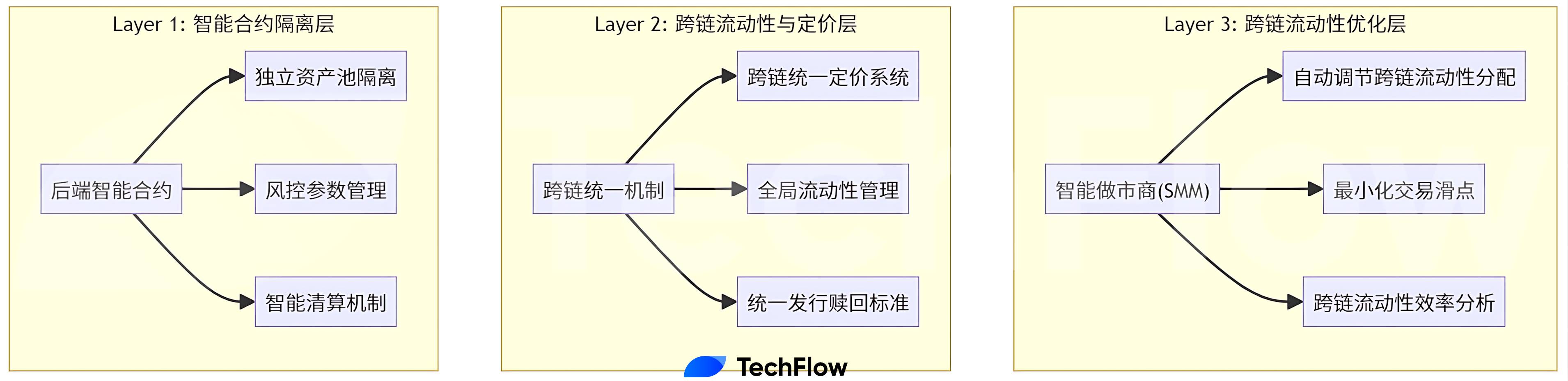
Three-Layer Security Architecture of deUSD
The first layer is the asset isolation layer, where smart contracts fully isolate institutional assets. Each institution’s asset pool has independent risk control parameters and liquidation triggers, ensuring that a single institution’s risk event does not affect overall system stability.
The second layer is the cross-chain liquidity and pricing layer. deUSD implements a unified issuance and redemption mechanism across chains, maintaining consistent pricing and liquidity management regardless of which chain the underlying asset resides on.
The third layer is the cross-chain liquidity optimization layer. Using a Smart Market Maker (SMM) algorithm, it automatically adjusts the distribution of deUSD liquidity across different chains, minimizing slippage during cross-chain transfers. This innovation enabled deUSD to achieve over $800 million in stable trading volume over the past three months.
Cross-Chain Interoperability Architecture
Additionally, to support broader institutional adoption in the future, Elixir leverages its expertise in cross-chain technology. It is already live on major networks including Ethereum, Arbitrum, Avalanche, and Sei, with plans to integrate ecosystems like Movement, Optimism, and Polygon. A unified cross-chain bridge interface ensures both flexibility in cross-chain choices and efficiency in capital interoperability for institutions.
Through deeply optimized technical implementation, Elixir has successfully established an institutional-grade RWA infrastructure that is both secure and highly efficient. However, the true value of technological innovation must ultimately be demonstrated through real-world applications. After closely examining deUSD—the core asset of this collaboration—it becomes clear that the system’s design philosophy aligns perfectly with the current realities faced by institutional users in DeFi. From asset management to ecosystem collaboration, from single-chain deployment to cross-chain integration, deUSD exemplifies what “institutional-grade” DeFi infrastructure truly means through its unique technical advantages.
The Notable Synthetic Asset: deUSD
If Elixir’s technical architecture is the skeleton of the entire system, then deUSD is the heart pumping lifeblood through it. As the core asset of the system, deUSD’s design is inherently “stable.”
deUSD is a fully collateralized, yield-bearing synthetic dollar backed by Elixir Network. Its core innovation lies in establishing a delta-neutral position by staking stETH and taking short positions in perpetual ETH contracts, while simultaneously earning yield through MakerDAO’s USDS Treasury protocol.
Compared to traditional synthetic assets, deUSD offers three distinct advantages:
-
Full Decentralization
A robust validator network is at the core of the Elixir protocol. Comprising over 13,000 independent nodes distributed globally, each node participates in transaction validation and consensus mechanisms. This decentralized validator network eliminates any single point of control, protecting the protocol from centralized interference and ensuring transparency and security.
-
Innovative Risk Management
Anyone can mint deUSD by collateralizing stETH. For every stETH deposited, an equivalent short position in ETH is opened in the market. Additionally, these short positions capture positive funding rates, generating extra yield for deUSD.
When funding rates turn negative, deUSD dynamically adjusts its asset composition based on the balance of the OCF (Over-Collateralization Fund, supporting deUSD’s value) to maintain price stability.
-
Ecosystem Integration
By integrating high-quality resources across Elixir’s ecosystem, deUSD abstracts products and exchanges from various public blockchains into a single yield-generating asset. This reduces operational complexity for deUSD holders across different blockchains and exchanges, making asset management easier and converting more institutions and individuals into potential liquidity providers. deUSD acts like a universal pass within Elixir’s cooperative ecosystem—users need only deUSD to participate in staking and interactions across multiple platforms and chains, fulfilling multi-chain needs through Elixir.
Unlike many stablecoins, deUSD maintains its peg not through 1:1 USD reserves or centralized issuance, but via innovative financial engineering and decentralized mechanisms. This design not only improves capital efficiency but also makes the integration of TradFi and DeFi more authentically “Crypto Native.”
DeFi Partnerships for Liquidity Provision
BlackRock’s recent move—a symbolic entry of “old money” into crypto—effectively demonstrates deUSD’s practicality: combining safety with yield, offering sophisticated financial players the best of both worlds.
Within the DeFi ecosystem, where it naturally excels, deUSD has even greater room to grow.
Through deep integration with leading DeFi protocols, deUSD creates a comprehensive liquidity provisioning system for institutional users. Supported by the liquidity optimization layer, institutions can engage in more complex DeFi strategies while ensuring asset security, achieving superior returns.
Take Curve, the liquidity hub for deUSD, as an example:
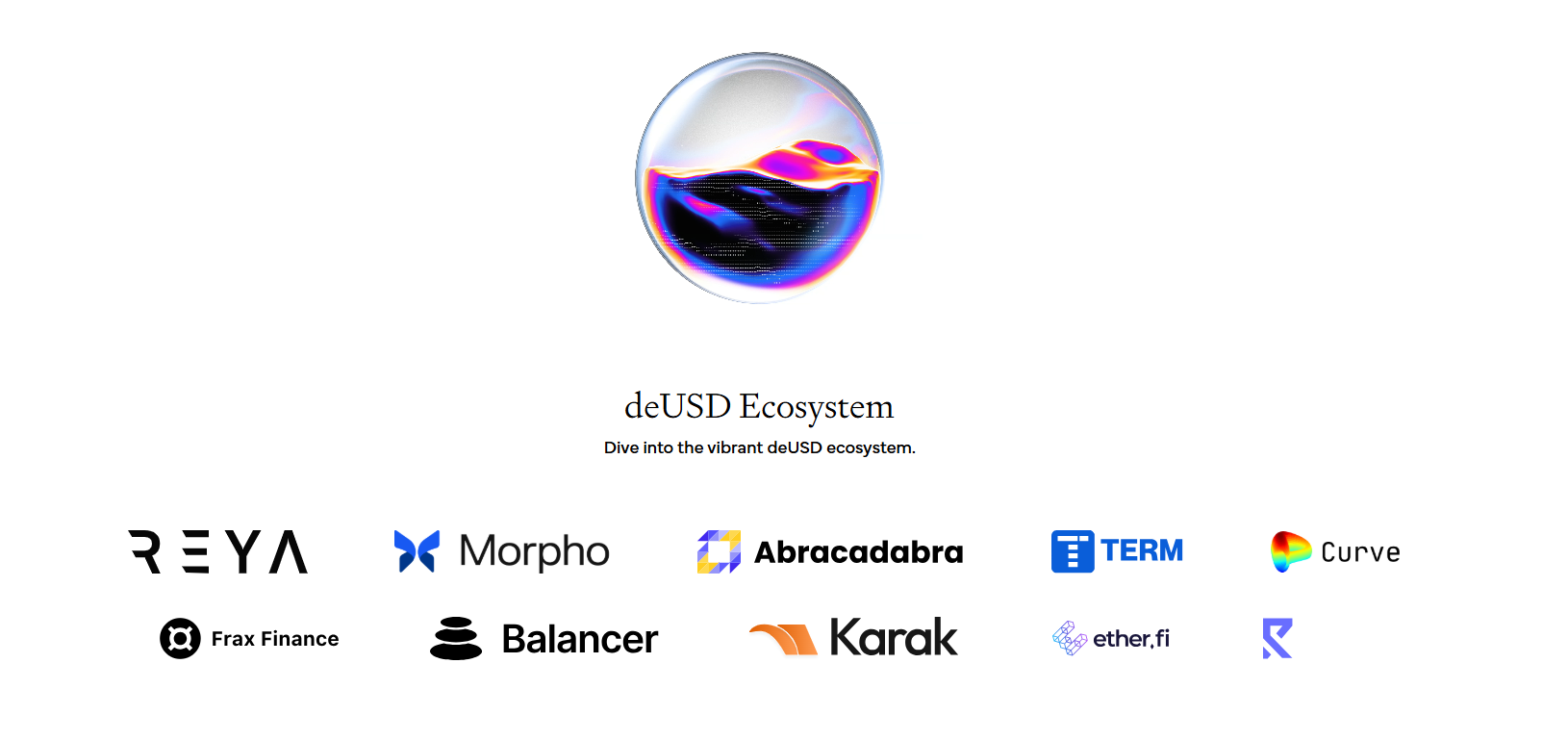
Curve can deeply absorb the substantial institutional liquidity flowing in from RWA assets—users can deploy deUSD/USDC, deUSD/USDT, deUSD/DAI, and deUSD/FRAX into four primary liquidity pools on Curve deUSD Pool. LPs earn trading fees and enjoy additional layered rewards through the Curve & Elixir Apothecary: Elixir offers base liquidity providers on Curve up to 5x Elixir Potions yield, and staking LP tokens yields up to 10x points. This preferential treatment for RWA-driven liquidity maximizes layered DeFi yields.
Elixir vs Ethena: Two Paths to Institutional-Grade DeFi
Coincidentally, as the sector heats up, Ethena has also partnered with Securitize to launch USDtb, a stablecoin backed by BlackRock’s BUIDL Fund. With both targeting institutional-grade DeFi, do Ethena and Elixir collide?
Although both Elixir and Ethena pursue the integration of TradFi and DeFi, they take distinctly different paths:
Different Sector Focus
Ethena: Focused on the Stablecoin Sector
Ethena follows a relatively focused development path. It uses BlackRock’s BUIDL as the core backing asset to launch the stablecoin USDtb. This model features:
-
Backed by a single asset
-
Simpler operational model with manageable risk
Elixir: Building a Complete Ecosystem
In contrast, Elixir adopts a more comprehensive and systematic approach:
-
Creating a full RWA-DeFi infrastructure
-
Supporting diverse financial product innovation
-
Building an open ecosystem
Technical Architecture
From a technical standpoint, the two projects employ different architectural designs.
Ethena’s Technical Approach:
-
Uses a direct asset-backed model
-
Minting and redemption mechanisms are relatively simple
-
Focuses on the security and reliability of the stablecoin
Elixir’s Technical Solution:
-
Builds a multi-layered asset management system
-
Enables cross-chain asset interoperability
-
Supports innovation and expansion of complex financial products
Market Positioning
Ethena positions itself as an institutional-grade stablecoin issuer, emphasizing:
-
Simple and intuitive product design
-
High security
Elixir, on the other hand, positions itself as an RWA-DeFi infrastructure provider, highlighting:
-
Completeness of the ecosystem
-
Scalability of products
-
Diversity of institutional services
The divergent paths taken by these two projects offer fresh perspectives on the evolution of institutional-grade DeFi. Whether to pursue specialization or platformization depends on a project’s strengths and market demand. Balancing innovation with practicality while ensuring security remains key.
Conclusion
BlackRock’s latest move is far more than a simple asset tokenization experiment—it marks the beginning of deep integration between TradFi and DeFi. Through Elixir’s technological innovation and Securitize’s compliant infrastructure, we see a mature institutional-grade infrastructure layer that properly balances asset security and compliance while unleashing the unique innovative power of crypto, proving that DeFi is no longer just an isolated playground for crypto enthusiasts.
From the BUIDL Fund to the deUSD RWA Institutional Program, and further to deep integration with DeFi platforms like Curve, this innovative path clearly demonstrates the feasibility of combining institutional and crypto assets. The contrasting approaches of Elixir and Ethena provide valuable reference models for the entire industry.
Undoubtedly, as more traditional financial giants like BlackRock enter the space, institutional-grade DeFi will accelerate. RWA will evolve beyond mere conceptual hype. The new benchmark for projects in this cycle will be whether they can meet the stringent requirements of institutional users while preserving crypto-native principles. Elixir’s实践无疑 offers the market a promising development blueprint.
Join TechFlow official community to stay tuned
Telegram:https://t.me/TechFlowDaily
X (Twitter):https://x.com/TechFlowPost
X (Twitter) EN:https://x.com/BlockFlow_News
 深潮TechFlow






