Dialogue with Gollum: Understanding Ethereum's Endgame—Has Ethereum Truly Won?
TechFlow Selected TechFlow Selected
Dialogue with Gollum: Understanding Ethereum's Endgame—Has Ethereum Truly Won?
Layer1+Layer2, non-state space, evolution of transaction paradigms.
 Navigating Web3 tides with focused insights
Guest: Gulu
Source: ChainFeeds
The Dencun upgrade is scheduled for March 13. As a pivotal milestone in Ethereum's development journey, this upgrade introduces EIP-4844, which will significantly enhance the efficiency of Ethereum L2 networks. By introducing a new data structure called blob-carrying transactions, it enables higher throughput and lower costs for Rollups on Ethereum.
In this context, ChainFeeds invited Ethereum OG Gulu to discuss key topics within the Ethereum ecosystem, including perspectives on blockchain architecture, the importance of decentralization in blockchain development, and the potential evolution of DeFi, stablecoins, and value storage.
Gulu is the Chinese translator of the Ethereum whitepaper and participated in the original Ethereum crowdsale. He also founded the blockchain education platform Bibox (later rebranded as "bihu") and the multi-chain smart wallet MYKEY, and currently serves as an evangelist for DeGate.
Key Takeaways:
1) The endgame for the blockchain industry is modular blockchains—Layer1 + Layer2—with potential emergence of Layer3;
2) Blockchain provides a “non-state space” that fosters global financial infrastructure, enabling any user to transact freely via private keys and giving rise to unforeseen applications;
3) When underlying infrastructure no longer faces throughput constraints, blockchain trading paradigms will shift, with order book models likely becoming dominant.
Blockchain Endgame: Modular vs. Monolithic – Which Wins?
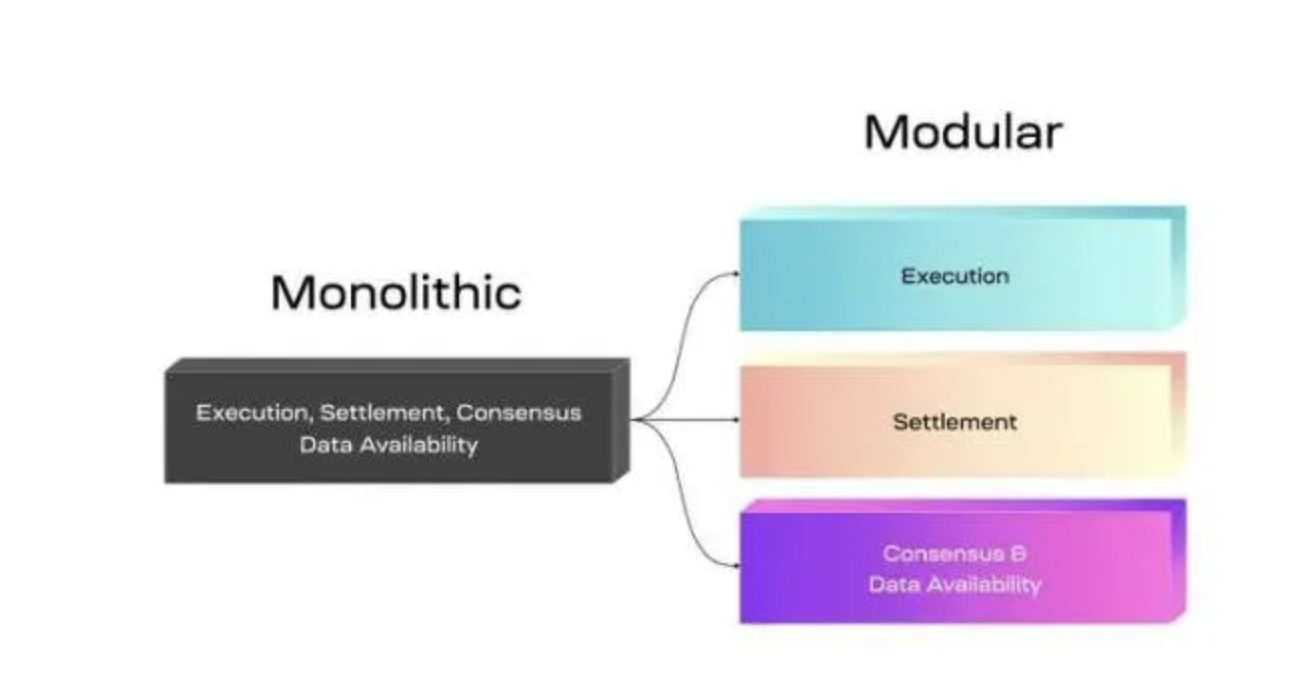
Debates between modular and monolithic blockchain architectures continue unabated, with each camp convinced of its superiority. Twitter feeds are filled with arguments over cost, speed, degree of decentralization, and scalability. In this Spaces session, Gulu shared his perspective, asserting that the ultimate trajectory of the blockchain industry lies in modular blockchains—specifically the combination of Layer1 and Layer2—and elaborated on this view from two angles: gas cost and level of decentralization.
Gas Cost
In a monolithic blockchain, every consensus node must validate every transaction in each block. This means that during periods of high transaction volume, each node bears enormous computational load. For instance, if demand reaches 100,000 transactions per second, every consensus node would need to process all 100,000 TPS—a near-impossible burden.
In contrast, Gulu believes modular blockchains offer significantly lower gas costs. Taking Ethereum’s Rollup-centric scaling roadmap as an example, Layer1 provides security and data availability, while Layer2 handles actual transaction processing, eventually leading to most application activity occurring on Layer2. Gulu illustrated this: suppose there are 50 Layer2 chains, each handling 2,000 TPS; together, they achieve 100,000 TPS across the ecosystem, with final validation occurring on Layer1 nodes. This model is far more economical because not every node needs to recompute every transaction—only verify compressed proofs at a fraction of the hardware cost. Furthermore, after the Cancun upgrade, Layer2 usage of blob data will become extremely cheap, potentially reducing data-layer gas fees by an order of magnitude or even two. Overall, considering both operational and gas costs, Layer2 solutions could see at least an 80% reduction in gas expenses.
Degree of Decentralization
From a decentralization standpoint, monolithic blockchains may end up with only a dozen or fewer active nodes, likely operated by centralized data centers. In such a scenario, governments or other powerful entities could exert control over these nodes, thereby interfering with the network’s operation and undermining its core principle of independence. Using Bitcoin as an example, authorities might restrict issuance or manipulate transaction rules. Gulu argues that under these conditions, blockchains lose their fundamental value—sovereignty. Thus, monolithic designs may fail to achieve true decentralization and leave the ecosystem vulnerable to attacks.
Conversely, in a modular architecture, Layer2 does not possess strong sovereignty. The design intentionally limits Layer2 autonomy, placing ultimate authority back on Layer1. While Layer2 retains some governance flexibility, final control rests with Layer1. Gulu emphasizes that this structure preserves the decentralization of the entire Layer1 network. For example, Arbitrum has achieved trustless and permissionless properties—core ideals of decentralized systems.
On Blockchain’s ‘Non-State Space’: Trust, Scalability, and Financial Revolution
Historically, the term “non-state space” refers to regions before state formation, where large areas existed outside national control, forming vast territories inhabited by tribal or pre-state communities. In these spaces, freedom and autonomy emerged precisely due to the absence of centralized rule. Early states typically extended no further than about 48 kilometers in radius—the maximum effective reach of governance.
Mapping this concept onto blockchain, we arrive at what can be called a digital “non-state space”—a domain independent of nation-state systems. This space offers decentralization, self-sovereignty, and freedom, allowing individuals full control over their data and assets. Like historical non-state zones, blockchain creates a distributed network of nodes without central authority.
Gulu points out that Bitcoin was the first application embodying this blockchain “non-state space,” perfectly aligning decentralized technology with monetary use cases. Subsequently, more flexible applications built on blockchain emerged—DeFi, NFTs, lending platforms—all fundamentally leveraging this sovereign, uncensored environment. So why build on blockchain? What advantages does this “non-state space” offer? Gulu breaks it down:
-
Trust: Blockchain applications increase user trust through transparency and immutability. For example, token issuance contracts are publicly verifiable on-chain, allowing anyone to audit their logic and supply;
-
Scalability Potential: As Gulu mentioned in his article “Endgame Analysis (Part 1): Ethereum Is Winning,” blockchain’s non-state space is evolving into a global financial hub encompassing Bitcoin, Ethereum-based DeFi, decentralized exchanges, collateralized loans, stablecoins, and more—offering users broader financial services;
-
Product-Market Fit: Gulu highlights stablecoins as having particularly strong product-market fit within this non-state space, especially for cross-border payments. Unlike costly traditional remittance systems, blockchain enables low-fee, fast transfers, facilitating seamless global economic activity;
-
Dollarization Wave: Although the U.S. dollar enjoys strong global consensus, geopolitical boundaries slow its adoption. However, with wider blockchain adoption, a second wave of dollarization may emerge, enabling dollar-denominated assets to thrive within the blockchain’s non-state space;
-
Asset Tokenization: Gulu finds the idea of asset tokenization inherently compelling. Blockchain enables real-world assets to go on-chain, expanding use cases. For example, digitizing property deeds as NFTs allows them to serve as collateral, unlocking accessible lending services. Long-term, on-chain asset representation is a promising frontier that will spawn numerous innovations.
Evolution of Blockchain Trading Paradigms
As an evangelist for DeGate, a ZK Rollup-powered order book DEX, Gulu also shared insights on the future of exchanges during the discussion.
DeGate is a trustless, permissionless decentralized order book protocol built on ZK Rollup within the Ethereum ecosystem. It officially launched on mainnet on January 9 this year. To date, it has reached a TVL of $64.67 million, with cumulative trading volume exceeding $200 million.
Gulu emphasized the critical role of decentralized trading in the blockchain ecosystem. He noted that once blockchain throughput supports 100,000 TPS, on-chain transactions will become the cheapest and most convenient option for users. Currently, high gas fees limit applications like DeFi, forcing most trading activity onto centralized exchanges. But Gulu believes that as chain capacity increases, more transactions will move on-chain. This transition will take time, but once infrastructure bottlenecks disappear, order books will become the dominant exchange paradigm.
He added that early decentralized exchanges on blockchain, such as EtherDelta, were actually based on order books. However, rising gas fees with increased user activity made full order book execution inefficient. This led to the rise of AMMs (Automated Market Makers), whose main advantage is gas efficiency. Yet, AMMs suffer from poor capital efficiency compared to traditional models. Gulu notes that major institutions like NYSE and SSE use order books precisely because they offer superior flexibility, capital efficiency, and support for complex algorithmic strategies via APIs.
Additionally, Gulu summarized DeGate’s key features:
-
Self-Custody: Like all DEXs, users retain control of their private keys and assets—no entity can freeze or access funds without permission;
-
Order Book Trading: Offers better user experience, higher capital efficiency, and greater flexibility;
-
Permissionless Listing: Users can list any ERC20 token compatible with the protocol by simply paying gas fees;
-
Decentralized Grid Trading: Similar to Uniswap V3, users provide liquidity within specified price ranges, and the protocol automatically executes buy-low-sell-high trades to capture spread profits;
-
Decentralized Dollar-Cost Averaging (DCA): Allows users to set recurring intervals for buying or selling assets, smoothing out market volatility;
-
Free Order Placement: No gas fees or trading fees are charged for placing orders.
💡 To hear more of Gulu’s thoughts on Ethereum, decentralization, and application scenarios, click here to listen to the full session.
Join TechFlow official community to stay tuned
Telegram:https://t.me/TechFlowDaily
X (Twitter):https://x.com/TechFlowPost
X (Twitter) EN:https://x.com/BlockFlow_News
 @ChainFeedsxyz