Web3 Sector Butcher: Who Is "Tie Shun"?
TechFlow Selected TechFlow Selected
Web3 Sector Butcher: Who Is "Tie Shun"?
Although Iron Smooth has been active for just over a year, it has profoundly influenced—and even disrupted—three sectors: the NFT trading market, NFT lending, and Ethereum L2.
 Navigating Web3 tides with focused insights
Author: Terry, Baicai Blockchain

The crypto world never lacks legendary stories—from Hayden Adams, the "unemployed youth" who couldn't code but launched Uniswap upon entering Web3 (see "Uniswap’s Father: The Unemployed Youth Who Couldn’t Code But Hit a Home Run at First Bat"), to Andre Cronje (AC), the "King of DeFi," single-handedly launching and popularizing dozens of major projects. Stories of technical geniuses shaking up entire sectors—or even the whole crypto industry—are not rare.
However, Pacman, founder of Blur—better known by his Chinese name “Tieshun”—is undoubtedly the most prominent rising star over the past year.
Yet unlike Hayden Adams or AC, Tieshun has been active for just over a year but has already profoundly impacted—and even disrupted—three key sectors: NFT trading markets, NFT lending, and Ethereum L2s, earning him the title of "Web3's strongest catfish."
01 Who is Tieshun?
In October 2022, the NFT marketplace Blur officially launched (with an $11 million seed round led by Paradigm). Although platforms like LooksRare and x2y2 had previously attempted vampire attacks on OpenSea—which had long delayed issuing a token—by leveraging tokenomics incentives, their efforts were largely ineffective, failing to shake OpenSea’s dominant market position.
It wasn’t until Blur emerged that the entire NFT trading landscape was completely overturned—nearly single-handedly causing OpenSea’s valuation to plummet by 90% from its peak of over $13 billion, forcing it to consider selling itself (see "$10 Billion Market Cap Burst: Will Arrogant OpenSea Regret It?"):
From day one, Blur introduced three killer features: zero trading fees (compared to OpenSea’s 5%), transparent Airdrops, and freely adjustable royalties—all of which went viral in the community and helped accumulate initial users.
Blur then further leveraged expectations around token Airdrops to incentivize users to aggressively list and trade assets, continuously expanding its advantages in liquidity and trading depth, quickly surpassing OpenSea in overall user experience.
By early 2023, Blur had replaced OpenSea as the new market leader. As the "catfish" in the NFT trading space, it injected much-needed dynamism into a previously stagnant market structure.
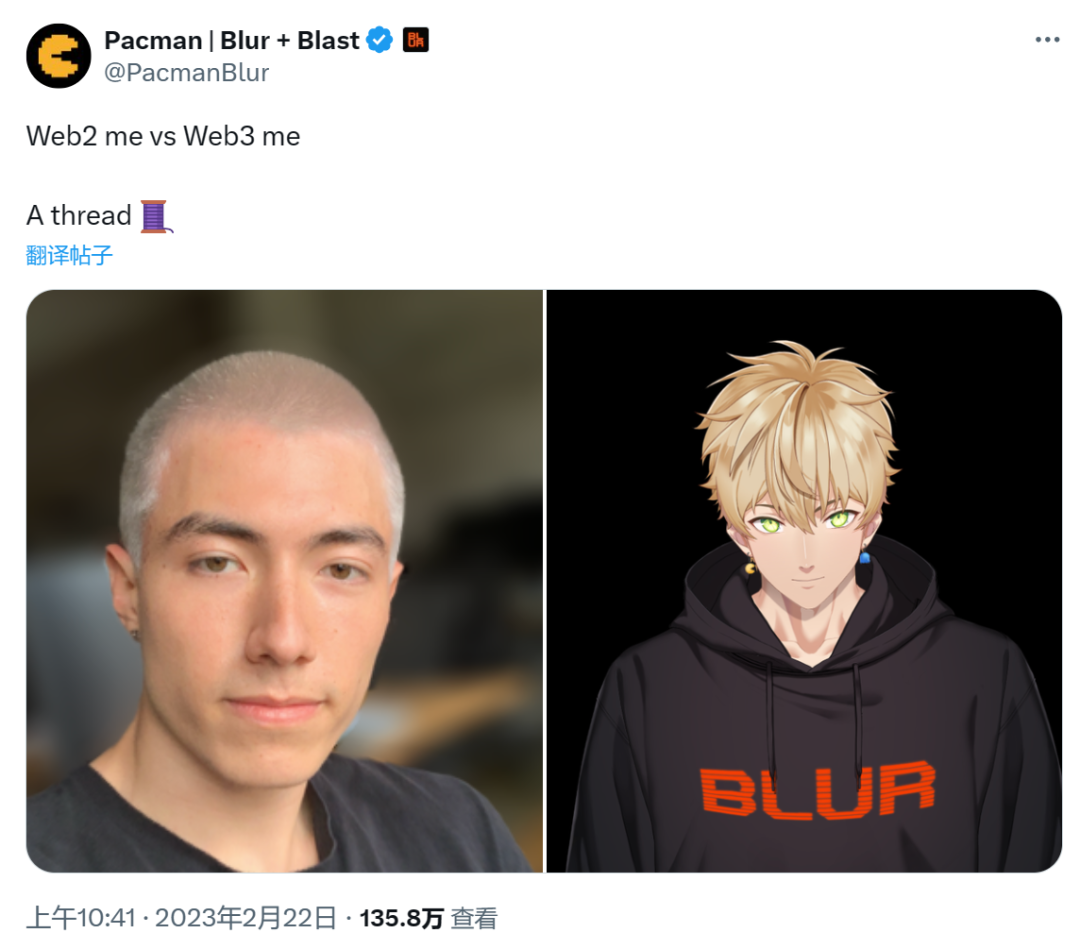
Against this backdrop, on February 22, 2023, Pacman—the previously anonymous founder of Blur—revealed his background via Twitter:
He dropped out of high school and college twice, joined the renowned startup accelerator Y Combinator at age 17, later studied mathematics and computer science at MIT, and received the Thiel Fellowship created by billionaire Peter Thiel.
As a serial entrepreneur, Blur is his third startup and second in the crypto space—his first being Namebase, a company already sold to Namecheap.
He also mentioned that when building Blur, he debated whether to use his real identity or remain anonymous, discussing the matter with Anish Agnihotri of Polychain Capital. Ultimately, Anish convinced him with the argument: “You can go from anonymous to public, but not the reverse,” leading Pacman to choose anonymity initially.
However, Pacman did not directly disclose his real name; industry insiders instead pieced together clues from social media connections and uncovered his suspected real name as Tieshun Roquerre (thus giving rise to the nickname “Tieshun”).
02 Top-Tier “Wall-Breaker” in NFT and L2 Sectors
As noted earlier, what sets Tieshun apart from other crypto founders like Uniswap’s creator is his relentless innovation across multiple sectors through new products—after launching Blur in 2022 and disrupting the NFT trading market, he didn’t stop there, going on to launch Blend and Blast, each wreaking havoc in their respective domains.
In April 2023, Blur officially launched Blend, stirring up the NFT lending market and introducing fresh dynamics into NFT-backed loans and liquidity.
As a peer-to-peer perpetual lending protocol, Blend supports any collateral—including NFTs—without relying on oracles, has no loan maturity date, allows borrowing positions to remain open indefinitely until liquidation, and uses market-determined interest rates.
Like Blur, Blend gained explosive traction—within just two weeks, it lent out more than 50,000 ETH, rapidly becoming the leading player in the NFT lending space.
After Blast unveiled its points-based Airdrop campaign, it successfully spearheaded a new wave of capital land-grabbing, making the pursuit of potential ecosystem projects a focal point for the community.
Then in November 2023, Tieshun struck again, setting his sights on Ethereum L2s with the launch of Blast—once again using a transparent Airdrop strategy. Leveraging three killer features—staking yield, Airdrop expectations, and an invite-only model—Blast achieved over $500 million in TVL within five days, surpassing star L2 projects like zkSync, Starknet, and Linea.
Notably, at that time, Blast hadn’t even launched its mainnet, nor did it have any DApps for users to interact with. Yet its TVL kept breaking milestones, attracting a staggering $2.3 billion in funds within just over three months—an insane growth rate.
Earlier this month, Blast finally launched its mainnet, announcing that 50% of its Airdrop allocation will go to Blast Points (users), while the remaining 50% will be distributed to Blast Gold (DApps).
Overall, Tieshun stands out as a top-tier “wall-breaker” across mature sectors:
-
NFT Trading Sector: Blur dethroned the long-dominant OpenSea, becoming one of the mainstream NFT marketplaces;
-
NFT Lending Sector: Blend has surpassed $5 billion in total transaction volume, establishing itself as the undisputed leader;
-
L2 Sector: Blast’s TVL has exceeded $2.5 billion. According to L2Beat statistics, it now ranks behind only Arbitrum ($14.4 billion) and Optimism ($8.1 billion), ahead of Starknet, zkSync, and other L2s, securing a spot among the top three L2s.
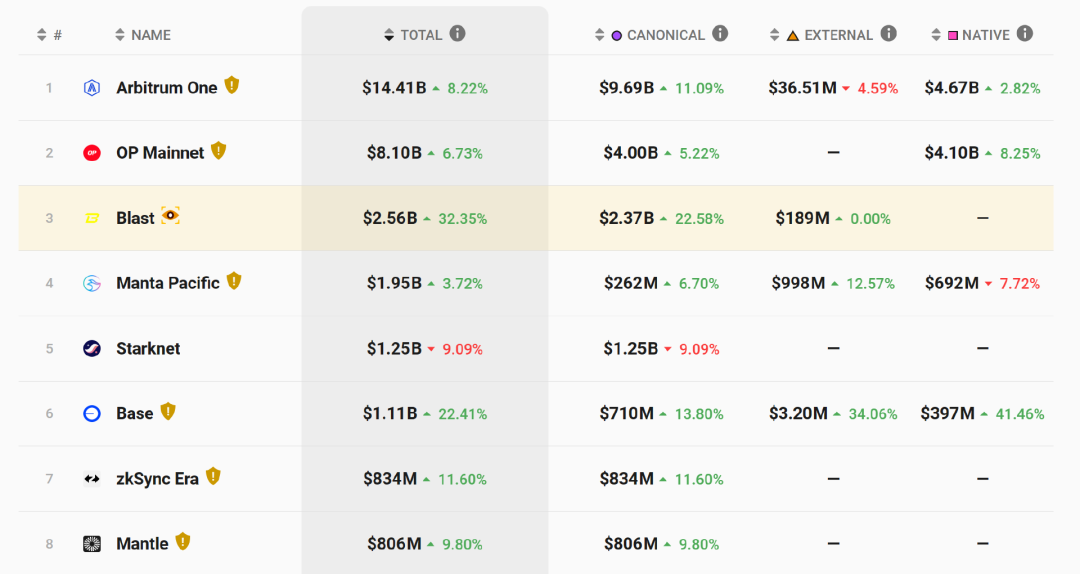
Image source: L2Beat
03 Is the “Web3 Pinduoduo” Strategy Right or Wrong?
In many ways, Tieshun is using a mature Web2-style product strategy to deliver a form of “dimensional reduction attack” against typical Web3 products:
Transparent Airdrops, traffic-centric thinking, and engineered liquidity—these strategies have remained consistent from Blur to Blend and now to Blast.
Even his first crypto venture, Namebase, foreshadowed the auction-style listing mechanics and Airdrop tactics now seen in Blur and Blast. This suggests that Tieshun’s success stems from a coherent product philosophy built upon years of entrepreneurial experience.
In interviews, Tieshun once said that part of Blur’s growth strategy was inspired by Taobao—but personally, I find “Web3 Pinduoduo” a more fitting label, especially given Blast’s “Airdrop expectation + social virality” model, which essentially replicates Pinduoduo’s marketing playbook within Web3:
Similar to WeChat’s “Invite Friends to Chop Prices,” Blast’s launch sparked a wave of invitation-code tweets across social media, achieving remarkable reach and growth speed.
Even Blast’s controversial points system and withdrawal mechanism—bonus multipliers favoring new users and a 14-day waiting period after withdrawing funds to the mainnet—echo Pinduoduo’s logic of “new users get bigger discounts” and “the last penny trick.”
Thus, Tieshun’s strength may lie in his deep understanding of proven Web2 internet marketing tactics and his ability to skillfully adapt them to Web3, enabling him to dominate existing Web3 products—identifying market pain points, leveraging Airdrop expectations to attract user traffic and liquidity, and steadily compounding his competitive advantage to achieve reversal.
04 Summary
If Blur succeeded by addressing market pain points and innovating in execution, then Blast is almost darkly humorous—a brand-new L2 with zero applications, driven purely by Airdrop speculation, achieving such results in mere months.
Do dApps choose L2s because of better efficiency, or does superior L2 performance enable better dApps? Blast has sparked intense community debate on L2 efficiency versus application development. Its novel approach disrupts traditional L2 growth models and may pave a new path: prioritize TVL first, then build applications.
From another perspective, Tieshun is truly a standout figure in Web3 product design and marketing. Which sector will he disrupt next? Stay tuned.
Join TechFlow official community to stay tuned
Telegram:https://t.me/TechFlowDaily
X (Twitter):https://x.com/TechFlowPost
X (Twitter) EN:https://x.com/BlockFlow_News
 白话区块链
白话区块链