How to view Bitcoin Magazine's "three rules" for Layer 2?
TechFlow Selected TechFlow Selected
How to view Bitcoin Magazine's "three rules" for Layer 2?
What is your view on the current state of the Bitcoin ecosystem and Bitcoin Magazine's definition of Layer 2?
 Navigating Web3 tides with focused insights
Interviewer: Wuyue, Geek web3
Guests: Kevin He, former Web3 Technical Lead at Huobi Group; Faust, founder of Geek web3
The two guests discussed the current state of the Bitcoin ecosystem, their views on the Layer2 definition proposed by Bitcoin Magazine, and their own criteria for evaluating what constitutes a true Bitcoin Layer2. (Note: These opinions represent only the personal viewpoints of the two guests and do not reflect the editorial stance of Geek web3 as a media organization.)
Introduction: Early 2024 could be described as the Warring States era of Bitcoin Layer2. Within just a few months, over 60 teams in the Bitcoin ecosystem have launched projects branding themselves as Layer2 solutions. With no authoritative voices to provide clarity, there is currently no clear or systematic standard for determining what should or shouldn't qualify as a Layer2.
This ambiguity and disorder, while offering absolute freedom to developers and startups, has also enabled widespread narrative inflation and concept-hijacking.

(Text in image machine-translated from the original English article by Bitcoin Magazine)
At this chaotic and restless moment, Bitcoin Magazine—leveraging its status as a relatively authoritative media outlet within the Bitcoin community—has put forward a simple definition framework for Bitcoin Layer2. Unsurprisingly, this framework carries strong "Bitcoin-native" characteristics and differs significantly from the mainstream understanding of Layer2 in the Ethereum community. The core points of Bitcoin Magazine's proposal include three main principles:
1. Use Bitcoin as its native asset: Bitcoin Magazine argues that a Layer2 should use Bitcoin as its primary token or accounting unit (Native Token), as well as the currency used to pay gas fees.
If a Layer2 project issues its own token, it should be backed by bitcoin. (This explanation is somewhat vague—some interpret this as referring to inscription-based assets like BRC-20.)

2. Use Bitcoin as the settlement layer: A Layer2 must provide users with an exit mechanism allowing them to withdraw their assets back to Layer1. This withdrawal mechanism can be trustless, or it may involve certain trust assumptions.
(This seems to imply that there must be a bridging relationship between Layer2 and Layer1, or some form of asset mapping between L1 and L2. Cross-chain bridges or withdrawal mechanisms don’t necessarily need to be fully trustless, but the standard doesn’t specify exactly how trust-minimized such mechanisms should be. Under this criterion, protocols like inscription systems, off-chain indexing protocols, or the original RGB protocol might not qualify as Layer2.)

3. Dependence on Bitcoin: If Bitcoin were to completely fail, the Layer2 should also collapse—"when the lips are gone, the teeth are cold." If a so-called "Layer2" continues operating even when Layer1 goes down, then it cannot truly be considered a Bitcoin Layer2.

Beyond these "three rules," Bitcoin Magazine also explicitly excludes protocols like CounterParty and Ordinals—asset layers built atop Bitcoin without independent blockchain structures—from being classified as Layer2. It further notes that certain "parasitic layer" protocols fail to meet some of the conditions for Bitcoin Layer2.
However, Bitcoin Magazine does not clearly define which protocols fall under the category of "parasitic layer" (which may include the RGB protocol), leaving many uncertain about the full implications of their position.
After releasing this framework, Bitcoin Magazine quickly sparked widespread discussion—including responses from founders of projects like the Stacks sidechain. Onekey’s official Chinese Twitter account observed these influential Western KOLs and found that opinions on Bitcoin Magazine’s stance were deeply divided, with many expressing opposition.
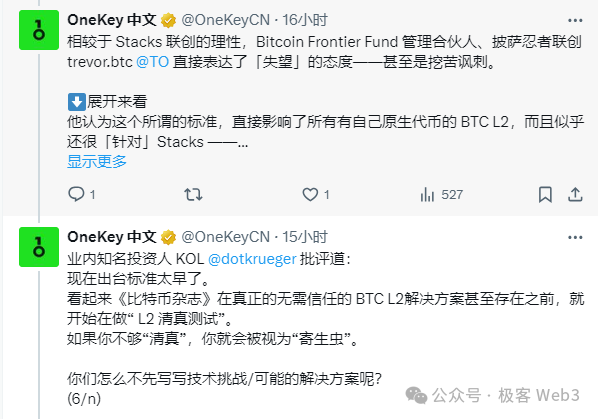
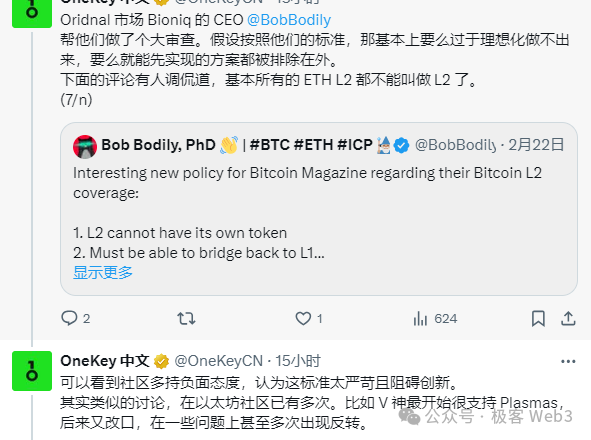
Regardless of subjective positions or the validity of the proposed definition, Bitcoin Magazine—as a prominent voice in the Bitcoin ecosystem—has taken a historic step: publicly initiating broad debate around the definition of Bitcoin Layer2, prompting both support and resistance from various stakeholders.
This feels reminiscent of August 2023, when Dankrad of the Ethereum Foundation boldly declared on Twitter: “If you’re not using Ethereum for data availability, you’re not a Layer2.” Barring unforeseen developments, public discourse on how to define Bitcoin Layer2 will intensify in the coming months until a temporary consensus emerges among professionals.
Driven by deep interest in Bitcoin Layer2 and modular blockchain narratives, Wuyue, Research Lead at Geek web3, invited Kevin He, former Web3 Technical Lead at Huobi Group, along with Faust, founder of Geek web3, for a private online discussion. This article summarizes the key takeaways from that conversation, aiming to demystify the standards for defining Bitcoin Layer2.
I
Main Content: 1.Wuyue: Right now, the Bitcoin ecosystem resembles America’s Wild West in the 19th century. Many treat Bitcoin Layer2 as gold, and startup teams act like feverish gold prospectors clinging tightly to the wealth-generation hype. From your perspectives, what is the current state of the Bitcoin Layer2 landscape? What are your overall thoughts on today’s Bitcoin ecosystem?
Faust: In my view, the current Bitcoin Layer2 space shows signs of chaos and disorder—there is no consensus on what defines a Layer2 or on objective evaluation criteria. Take the Chinese-speaking community as an example: VCs investing in Bitcoin, project teams building Layer2s, and OGs who’ve lived through multiple market cycles all hold vastly different views. Some tech purists believe only UTXO-based programming models uphold Bitcoin’s “orthodoxy,” viewing EVM as heresy; others argue that unless a system inherits strong security directly from Bitcoin, it can’t be called a Layer2.
Of course, traders focused on short-term gains and technologists focused on architecture see Bitcoin Layer2 very differently. Some KOLs have even claimed that centralized exchanges qualify as Bitcoin Layer2s—Sun Yuchen went so far as to declare Tron a Bitcoin Layer2. Others insist Bitcoin Layer2 should be judged by different metrics than Ethereum Layer2, going as far as claiming Bitcoin Layer2 will surpass Ethereum Layer2, using this subjective theory to promote their preferred narratives.
These examples are just the tip of the iceberg. The trend of self-defining standards and self-promotion is widespread. Ultimately, all such “theories” must withstand scrutiny from experts. Many current claims about Bitcoin Layer2 lack logical coherence.
Moreover, there is a clear divide between Eastern and Western communities. In Western circles—especially among North American and European practitioners—there is direct and frequent communication, with a stronger emphasis on technical depth compared to Eastern counterparts. More importantly, OGs from the Bitcoin community, the Ethereum Foundation, Celestia Foundation, and other professional entities wield far greater influence in the West than in the East, contributing significantly to divergent value systems.
In contrast, the Chinese-speaking community remains relatively insular, fragmented, and siloed, lacking one or more technically rigorous organizations capable of driving unified narratives. While this fosters freedom, it also breeds confusion.
That said, this situation has both pros and cons. When it comes to technical understanding of Bitcoin Layer2, we clearly observe differences between Eastern and Western communities. But as the saying goes, "technology is precious, but wealth creation is equally valuable." Technology matters, but so does economic impact. If so many people accepted Blast despite its technical shortcomings, I don’t think we should dismiss a Layer2 solely based on technical imperfections. In the end, what really counts is the value these projects bring to the market and the broader industry.
Kevin He: Thank you for the question—Faust has already articulated things quite clearly. Let me add a few personal thoughts: The current Bitcoin ecosystem can best be described as “a hundred flowers blooming.” As for Bitcoin Layer2, it’s a time of many heroes vying for dominance—a true naval race.
Against the backdrop of Bitcoin’s ongoing halving cycle, the ecosystem has naturally evolved. A variety of asset protocols built on Bitcoin have emerged, shattering the long-held belief that Bitcoin cannot easily issue new assets. This has led to an explosion of digital assets. Asset proliferation inevitably drives demand for applications, and given Bitcoin’s inherent limitations—high cost and slow speed—there is urgent need for BTC Layer2s to support these application demands.
From a market perspective, several projects have gained early momentum and attracted attention across both Eastern and Western communities. Technically speaking, however, definitions and security standards for Bitcoin Layer2 remain undefined, requiring more contributors to help build community-wide consensus.
II
2. Wuyue: Thank you both for your insightful comments. What are your thoughts on the recent “three rules” proposed by Bitcoin Magazine regarding Bitcoin Layer2—an issue that has sparked widespread debate? Do you find their proposed criteria reasonable? Many in the Western community seem critical of this move.
Faust: Honestly, the three standards proposed by Bitcoin Magazine are imprecise and appear ideologically driven rather than technically grounded, failing to achieve community consensus and thus unsuitable as objective benchmarks for evaluating Layer2s.
I suspect their intention was to set strict boundaries, but they realized the diversity among Bitcoin Layer2s makes it hard to create a universal framework. Yet wanting to assert authority at this pivotal moment, they resorted to a simplistic “three rules” approach (they did clarify in their article that the goal is to resist certain乱象 in the Bitcoin ecosystem). But such a blunt method fails to objectively assess Bitcoin Layer2s.
In contrast, the Ethereum Foundation has taken a more rigorous path—defining Layer2 from a technical standpoint, distinguishing between specific architectures like state channels, Plasma, and Rollups. Much of the Ethereum community also includes Validium and Optimium under the Layer2 umbrella.
This bottom-up, technology-first classification is clearer and more logically sound. For instance, state channels and Rollups operate very differently, with little overlap in features. The Ethereum community first groups them under Layer2, then develops detailed evaluation metrics specifically for subcategories like Rollup. This methodology is more mature.
But if you try to evaluate the entire Layer2 landscape using broad, one-size-fits-all metrics—as Bitcoin Magazine attempts—it becomes nearly impossible to develop fine-grained, universally applicable criteria. If it were up to me, I’d first clarify: Which technical categories count as Layer2—sidechains, sovereign rollups, independent blockchains (note: distinct from sidechains), zk-Rollups, OP-Rollups—and then apply granular assessments accordingly. Alternatively, if one insists on a high-level, fuzzy framework, I’d prefer to assess based on widely accepted industry fundamentals—such as censorship resistance, data availability (DA) design, and state transition verification methods. Start with security and functional extensibility, where evaluation methodologies are already well-established and broadly agreed upon.
Bitcoin Magazine’s proposal, however, lacks prior industry consensus and is heavily infused with ideological bias—particularly the first rule: Layer2s must use Bitcoin as their native token, and any issued tokens must be “backed by bitcoin.”
Even the Ethereum Foundation—which maintains ETH price stability as one of its goals and exhibits centralizing tendencies—would never state such a requirement so bluntly. Perhaps Bitcoin Magazine wants to discourage opportunistic teams from rushing to launch tokens, hence this stipulation. But in reality, issuing a token doesn’t change what the native asset is, and the phrase “backed by bitcoin” is itself confusing and undefined.
My position is clear: standards should be rooted in technical reasoning, not ideology. On this front, Ethereum’s L2BEAT sets a strong precedent—evaluating Layer2s based on censorship resistance, DA reliability, state validation mechanisms, and contract ownership. That framework can be adapted for modular blockchains in ecosystems like Celestia, and broadly applied to assess the security of Bitcoin Layer2s.
But defining Layer2 from an ideological angle—as Bitcoin Magazine does—is too subjective. It’s akin to debating whether American or Soviet political systems were superior—such debates often devolve into partisan name-calling. Technical evaluations, by contrast, are far more tractable.
I believe we should focus first on less controversial, consensus-friendly dimensions, such as assessing security risks and functional completeness of Layer2s, or identifying vulnerabilities in asset protocols. Approaching the topic this way leads to more objective and rigorous outcomes. Attempting to define Layer2 from an ideological foundation is not something Bitcoin Magazine—or anyone else—should undertake (except perhaps Satoshi).
Interestingly, Bitcoin Magazine’s CEO mentioned plans to hire someone from L2BEAT to study Bitcoin Layer2 evaluation frameworks. They’ll likely soon adopt or reference some of L2BEAT’s work.
Kevin He: First, I want to commend the editors at Bitcoin Magazine for their courage and initiative. Proposing and enforcing standards in such a contentious environment inevitably invites criticism and requires tremendous effort to implement. Yet a healthy community needs people willing to take this role—just as we attempted months ago to spark discussions around classification and security standards within our community.
Second, regarding the standard itself, I personally believe:
1) It builds upon innovations like Ordinals and BitVM (without which the Bitcoin ecosystem might still be stagnant)
2) It represents a relatively broad and inclusive framework (an attempt to unite as many compatible forces as possible)
3) It lacks deeper discussion on fundamental security principles (i.e., the underlying rationale for why these three criteria matter)
Given our prior work in this area—mainly within Chinese-speaking circles—we plan to expand outreach to a broader global audience with our draft framework. We welcome collaboration—not least from Bitcoin Magazine—to co-develop shared understandings and advance community consensus on classification and security standards.
III
3. Wuyue: Both of your insights have been excellent. Now I’d like to ask the most crucial question: How should we define an objective evaluation standard for Bitcoin Layer2?
Faust: I’ve touched on this earlier: start from a technical perspective—security, functional completeness, and other engineering considerations—avoid ideological subjectivity, rely on established industry consensus, and refrain from inventing new concepts unnecessarily. Bitcoin Layer2 is essentially an extension of modular blockchains, state channels, and derivative off-chain asset protocols. We should build upon existing research in these areas.
Elements excluded from prior Layer2 evaluation frameworks weren’t omitted arbitrarily—they have reasons. We should avoid those pitfalls and follow proven paths instead of forcing innovation in uncharted swamps, where we risk getting stuck deeper with every step.
Kevin He: I believe promoting such a standard requires adherence to at least two foundational principles:
1) Respect Bitcoin’s traditions while embracing recent innovations (e.g., Ordinals/BitVM)
2) Learn from exploration and real-world experience in other ecosystems (e.g., Ethereum Layer2)
Based on these two pillars, we can develop a set of universal, objective, security-focused definitions. Through extensive discussion, iterative refinement, and community input, these standards can gradually mature. Defining Bitcoin Layer2 will require collective experimentation by many individuals and organizations. In the end, the market will naturally select the most reasonable, widely accepted standard—one embraced not only by professionals but by common sense. Only through open, decentralized selection can we arrive at the right answer.
Join TechFlow official community to stay tuned
Telegram:https://t.me/TechFlowDaily
X (Twitter):https://x.com/TechFlowPost
X (Twitter) EN:https://x.com/BlockFlow_News
 @godrealmx
![In-depth Analysis of Trade[XYZ]: How Were 92 Markets and 98% HIP-3 Trading Volume Established?](https://upload.techflowpost.com/upload/images/20260716/20260716061117965147.jpeg?x-oss-process=image/resize,p_50/quality,q_80)