GokuShow Interview with Chris Gu, CEO of Yuliverse and Veteran Investment Banker
TechFlow Selected TechFlow Selected
GokuShow Interview with Chris Gu, CEO of Yuliverse and Veteran Investment Banker
The smartest players struggle to truly embrace consensus because they find it hard to give up their own interests in the face of money.
 Navigating Web3 tides with focused insights
About GokuShow:
GokuShow is a talk show dedicated to interviewing Web3 entrepreneurs, initiated by Web3 content creator GoKu (@Gokunocool). It aims to provide a stage for all Web3 founders to showcase themselves and share their behind-the-scenes stories—making it a warm and authentic program.
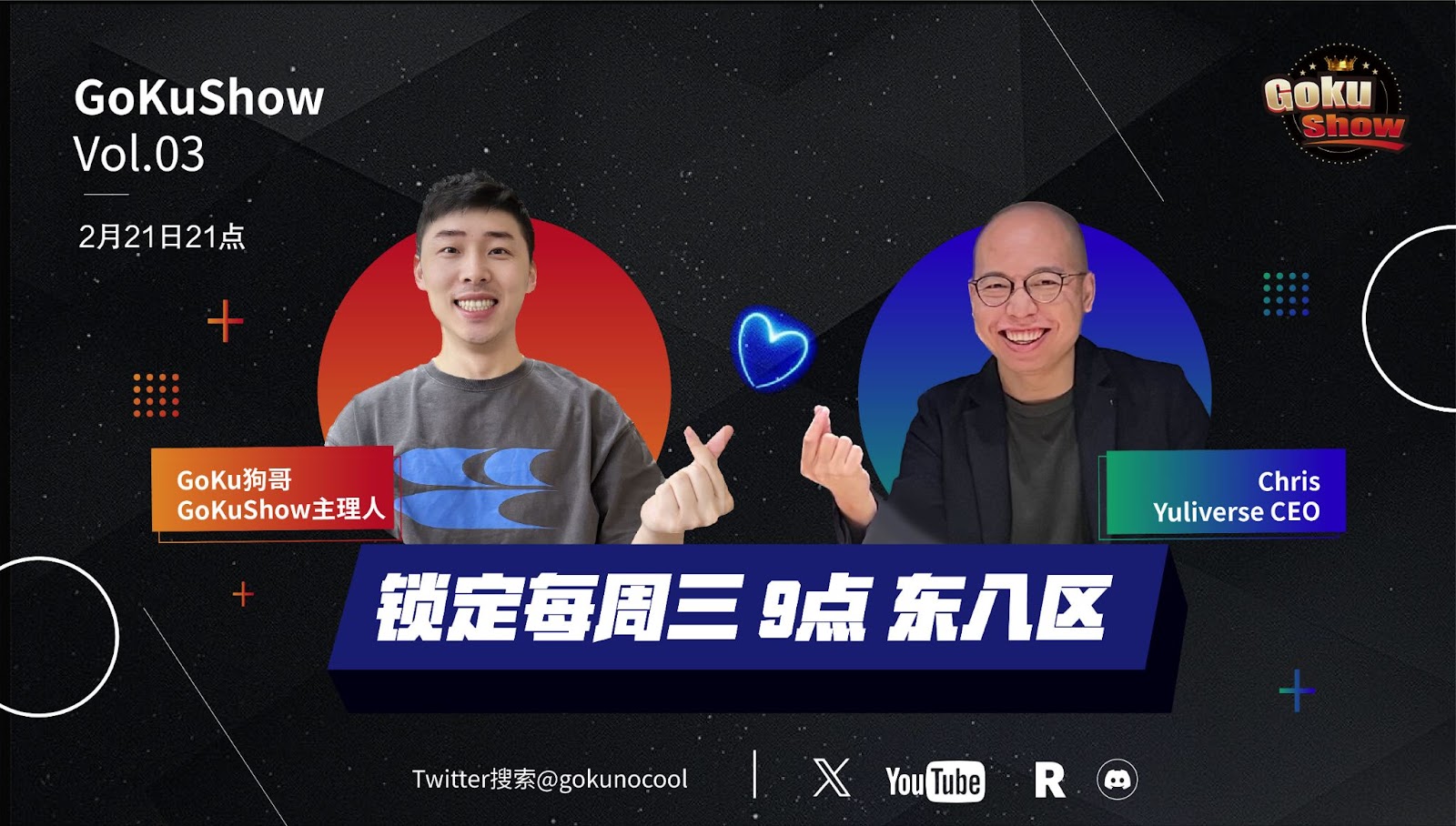
Host: GoKu
Guest: Chris Ancient Two
Project: Yuliverse
“Pokémon Go of the Web3 world,” “leading IRL metaverse game,” “Top 3 blockchain game in Japan,” “backed by star investors including LIF Capital, Animoca Ventures, and Hong Kong Cyberport”… Chris, CEO of Yuliverse—a project shining with all these accolades—and known as “Ancient Two Master,” joins Episode 3 of GokuShow. From being a high-earning investment banker forced to transition into Web3 entrepreneurship, to launching a Web3 superstar game with extremely low user onboarding barriers, from having no prior understanding of Web3 operations to building a community larger than its Twitter following, Chris shares his insights and reflections from within the industry.
Highlights:
-
Cold start your project bottom-up, starting from community building
-
Mainstream blockchain games, including previous P2E projects, mostly adopt mining machine models. However, unlike physical mining rigs that require power and are prone to damage, virtual mining machines avoid both issues, thus possessing perpetual longevity.
-
The core solution to death spirals isn't recursive pyramid logic but “value transformation”—converting existing communities, users, and investors toward something more valuable, thereby expanding the market for that value.
-
Lacking structured marketing approaches, relying solely on channel promotion is insufficient. The best method remains using airdrops to gradually guide user participation, attracting and retaining them step by step. Mastering this strategy can increase your project’s success rate by 50%. Therefore, choosing the right channels combined with effective marketing strategies is key to success.
-
To maintain liquidity and enable cash-out when needed, volatility ratios must be set reasonably. This healthy adjustment framework is crucial—even if adjustments occur, the fundamental principles remain unchanged.
-
The smartest players struggle to truly embrace consensus because they find it hard to sacrifice personal gains for collective benefit.
-
In Web3, you can directly use your airdrop to attract users without any cash investment. This is one of Web3’s greatest advantages.
-
Collecting is a human desire. Early Web2 applications already tapped into this urge—examples include抢车位 (parking space grabbing) and 收菜 (harvesting crops). These gamified behaviors are highly sustainable, contrasting sharply with short-lived game cycles; gamification itself is an eternal process.
-
All I need to say is, ‘We’re the Web3 version of Pokémon Go,’ and people immediately understand how to play. This is critical—because if product onboarding is too complex or learning costs too high, user conversion becomes extremely difficult.
All content below comes from the live GokuShow conversation:
1. From Million-Dollar Investment Banking to Forced Web3 Entrepreneurship
GoKu: Can you briefly share your entrepreneurial journey?
Chris Ancient Two: Of course. I used to work in investment banking with a decent income. But after the pandemic hit, the market was severely impacted. Since I previously worked on IPOs, I noticed many domestic companies wanted to list in Hong Kong—especially biotech, tech, and internet firms. However, the pandemic caused financial statement issues and a sharp drop in business volume. The real estate company I was at also ran into trouble, so I started considering entrepreneurship. Having studied metaphysics, I sensed big changes coming in the next year—changes likely to be forced, such as layoffs. So I decided to take the leap. I invested in a location-based social app, transitioning from Web2 to Web3. That decision turned out to be lucky—otherwise, I might still be job hunting today.
GoKu: Why did you choose gaming as your sector?
Chris Ancient Two: I’ve always loved gaming—played for decades—from Age of Empires, CS, LoL, DOTA, to Nobunaga’s Ambition. Later, my fingers weren’t as agile, so I shifted to strategic games like Hearthstone. In 2018, I played across Chinese, Asian, and American servers. There are many TCG GameFi projects in Web3 like Illuvium and Skyweaver—collectible card games where each card has trading value. I don’t play card games to collect cards—I play for fun, to relax. But learning TCGs has a high barrier because you have to master the entire system.
GoKu: You're a bit like Ding Lei from NetEase—you build what you personally enjoy, deeply immersing yourself. How did you come up with Yuliverse?
Chris Ancient Two: I was originally a small investor, but post-pandemic that became unsustainable. We restructured the team and pivoted to Web3. We were strong in Web2, so product iteration was fast—we launched our app on both Apple and Google stores quickly. Although app development is costly, we used native code, writing separate versions for Android and iOS—our technical execution was solid. But we knew nothing about Web3. Initially, we outsourced smart contract development, but quality was poor. So we spent three months diving deep into blockchain ourselves, and eventually built everything in-house.
GoKu: You've raised from several star investors—including support from the Hong Kong government. Before securing funding, were you operating on self-funded capital?
Chris Ancient Two: Yes. If we had entered this space a year earlier, we wouldn’t have struggled so much. On the flip side, maybe if funds had been easier to raise back then, we wouldn’t have worked as hard. When we first started fundraising in early-mid 2022, Luna collapsed, followed by FTX. We began approaching investors around April–May 2022 and only closed the round in early 2023. This period coincided with Token2049—so the entire fundraising took nearly 10 months. During this time, we completed product development, established a seed community, achieved cold start, and captured the first wave of traffic via NFT free mints and early adopters.
2. Project Cold Start: Founder’s Journey and Strategic Insights
GoKu: What should one do during a project’s cold start phase?
Chris Ancient Two: We had no prior connections—we came from Web2 with zero resources. If you already have some Web3 network, BD can help secure initial seed users. But we grew purely through community.
There are two main paths for cold starts: First, bottom-up, starting with community. This gives you more opportunities and time to experiment and learn. Each product feature must be tested against product-market fit and aligned with user personas. The biggest difference between Web3 and Web2 products is the user base—here, users are not just consumers but also investors. So you must center your design around the economic model, not build the product first. The economy drives the product, not the other way around. Second, if you’re experienced and have run multiple projects before, going top-down may work better. In Web3, these two approaches tend to succeed—the worst case is being stuck in between.
GoKu: Let me emphasize this—many projects get it wrong. Even if you have Web3 connections and know many channels and communities, if your project doesn’t grow organically from the ground up, without deep community engagement, without a strong slogan or memorable tagline, then your brand identity, PR, and even product quality will suffer. You can pay for hot channels and gain visibility, but you won’t retain users. You need a consensus—whether it's a token launch or founder’s personal brand—then bring in channels at the right moment. Many teams spend tens of thousands of dollars blasting every global KOL and GameFi community, yet end up forgotten.
GoKu: Did you go through that “in-between” phase?
Chris Ancient Two: Yes, roughly from July to October last year. We spent a lot of time learning, didn’t make money—NFTs were mostly user-generated, no monetization from NFTs, fully fair launch. This made price expectations hard to manage. Had we not launched a governance token later, the whole project and investment might have collapsed. It was trial and error—valuable learning. By November, we seized the opportunity and launched our first airdrop. Our Twitter followers grew from 180k to nearly 500k. No third-party platforms—we ran our own website airdrop. Discord users now near 300k—actually more than Twitter.
Having someone with investment banking experience on the team is advantageous—they know how to manage investor relations. Ideally, that person should be a founder or co-founder; otherwise, communication with investors becomes difficult. Equally important is integrity—beyond skills, teamwork and trust are essential.
GoKu: Any painful stories during your cold start?
Chris Ancient Two: Anyone who’s done a cold start knows the pain. Once you solve cold start, the rest follows. Use limited resources wisely. I really admire a blogger, Crypto v, founder of the Three Plate Theory, which categorizes token economies into Ponzi, mining dividend schemes, and mutual aid pools. You must clearly define which model your product uses—everything should revolve around it, and your narrative must serve it. Most mainstream blockchain games, including past P2E projects, use mining rig models. But compared to physical miners—which need electricity and degrade over time—virtual miners lack these drawbacks, giving them perpetual life. In July last year, Stepn gave NFTs a lifespan, inspired by this concept.
GoKu: Let me clarify here. First, if a project intends to profit-share with retail users via tokens, it risks violating SEC securities regulations—this structure suits gray-market operations only. Legitimate projects using such models often attract SEC scrutiny once they scale, as it violates securities law—not just an NFT issue.
Second, mining without wear-and-tear means users extract value unilaterally from the economic model, creating sustainability challenges—it heavily depends on constant new user inflow. The core to solving death spirals isn’t recursive stacking but “value transformation”—redirecting existing community, users, and investors toward higher-value activities, expanding the value market. You’ll notice many small, beautiful projects eventually evolve out of necessity, growing larger. Conversely, overly ambitious projects from day one often shrink under pressure. Hence, I recommend keeping the scope small early on—build the initial community first, then expand.
GoKu: Is Yuliverse’s monthly cost very high?
Chris Ancient Two: About $130K/month for a team of 40+, operating in Malaysia and Hong Kong. We use structured marketing—cross-industry collaborations, joint campaigns with different companies and projects.
Planning and execution are vital in project operations. Typically, we schedule work plans one and a half to two months ahead to ensure smooth progress. As one phase ends, we prepare the next. In early stages, 80% of technical effort should support market expansion and operations—not just product development. If the product team focuses only on building while ignoring user acquisition, incentives, and frameworks, failure is inevitable. Early on, design the full user conversion funnel, integrating NFT or token issuance with product incentives to ensure smooth promotion and retention. This holistic planning significantly increases success chances and ensures steady growth.
GoKu: In the Web3 world, selecting quality channels is crucial. Why do people prefer Twitter over YouTube? Why, despite TikTok’s massive user base, do creators post on Twitter? Because Twitter is fundamentally an information feed platform, while TikTok is short-video. Visually, they differ in information fragmentation—Twitter’s content is even more fragmented than TikTok’s. If your project can’t retain users, all resource investments become futile. Without structured marketing, channel promotion alone is insufficient. The best approach remains using airdrops to gradually engage users, drawing them in step by step. Mastering this strategy boosts your project’s success odds by 50%. Thus, combining proper channels with effective marketing is key to success.
3. Airdrop Is Crucial When Designing Tokenomics
GoKu: Could you elaborate more on tokenomics?
Chris Ancient Two: It splits into two types: long-term sustainable development, or short-term “pump-and-dump” rug pulls. For long-term growth, you must clarify funding sources, track fund flows after entering the platform, and determine user payout ratios.
Also, to maintain liquidity and allow cash-outs when needed, volatility ratios must be set rationally. Such a healthy adjustment framework is essential—even if details change, core principles stay. Otherwise, risk control becomes impossible. Avoid running out of funds without knowing where profits come from. In Web2, actuaries are vital in game companies—predicting asset value fluctuations and potential behavioral triggers within specific timeframes.
With Web3’s rise, demand for such roles grows—actuaries earning over a million RMB annually are no longer rare. Thus, game designers with strong math skills should actively embrace Web3 and seize this opportunity. Deep understanding and correct application of tokenomics positively impact long-term project success.
GoKu: I recall at the end of 2022, we discussed how GameFi could escape death spirals. The debate was intense, and we proposed solutions—one being building a points platform first, then conducting airdrops. Everyone understood account mechanics clearly, so the issue could be resolved.
I’ve always believed dual-token models carry huge pressure—small mistakes lead to major flaws. Moreover, the smartest players struggle to embrace consensus because they can’t easily sacrifice financial self-interest. But you must show charisma—only by demonstrating charm does consensus become truly compelling. This is why many Web2 teams face adaptation challenges upon entering Web3.
Most importantly, these teams don’t understand asset promotion. The breakout effect and consensus boost from a star asset cannot be measured by ad spend. If you successfully promote your core asset—even for just 20 days—the whole world will know your project. Asset promotion and influence are therefore critical to GameFi success.
Chris Ancient Two: From a top-down view, every listed token economy in Web3 must reserve airdrops. It acts like a user funnel, capturing the largest possible audience upfront. These users become your airdrop recipients—stakeholders. They may then explore your product; otherwise, you risk losing them entirely. So airdrops replace Web2 practices like spending cash on traffic acquisition, user purchases, and conversions. In Web3, you attract users directly with airdrops—no cash required. This is one of Web3’s biggest advantages.
However, before airdropping, consider how each level of the user funnel forms. Only by clarifying every funnel stage can you better attract and convert users. Thus, reserving airdrops is a critical step in Web3.
GoKu: How did you decide on the LBS (Location-Based Service) angle?
Chris Ancient Two: Several reasons. First, we chose this product form because we had relevant foundation and experience. Second, I’d played similar products before and read an article titled “Collecting is a Human Primitive Desire.” Imagine when gaming—you see a treasure chest, you instinctively open it; or spot a door, you want to enter. This behavior isn’t different from squirrels gathering acorns—it stems from human nature. Collecting is a human desire. Early Web2 apps already satisfied this—like抢车位 and 收菜. Gamified behavior is highly sustainable, unlike short game lifecycles—gamification is an eternal process.
Another reason: we picked the most universally understood game as reference—Pokémon Go. With 150 million global users, converting just 1% would give us 1.5 million users—an enormous number in Web3. All I need to say is, “We’re the Web3 version of Pokémon Go,” and people instantly grasp how to play. That’s crucial—high product barriers or steep learning curves make user conversion extremely hard. Based on these considerations, we finalized this product direction.
Join TechFlow official community to stay tuned
Telegram:https://t.me/TechFlowDaily
X (Twitter):https://x.com/TechFlowPost
X (Twitter) EN:https://x.com/BlockFlow_News
 @gokunocool