AINFT Launches AI Agent New Infrastructure: One-Stop Integration of x402, 8004, OpenClaw, etc., Bridging the “Last Mile” of the Agent Economy
TechFlow Selected TechFlow Selected
AINFT Launches AI Agent New Infrastructure: One-Stop Integration of x402, 8004, OpenClaw, etc., Bridging the “Last Mile” of the Agent Economy
Leveraging the five core components of the AINFT AI Agent’s new infrastructure—x402, 8004, MCP Server, Skills, and OpenClaw Extension—developers can seamlessly equip AI Agents with on-chain interaction capabilities, including autonomous payments, on-chain transactions, asset management, and DeFi operations.
 Navigating Web3 tides with focused insights
During the Spring Festival, news about the integration of AI and crypto swept across the internet, even giving rise to the entirely new concept of Web 4.0—a symbiotic economic network driven by AI Agents (also known as “AI agents”) and powered by cryptocurrency as its native payment medium, now rapidly taking shape.
As a leading ecosystem in the Web3 space, TRON continues deepening its strategic layout and ecosystem investment in the AI domain. Following the launch on February 5 of AINFT—the core AI infrastructure within the TRON ecosystem—as a Web3-native AI large model aggregation platform, user numbers quickly surpassed 400,000, making it a viral phenomenon and breakout product. On February 16, AINFT further unveiled Bank of AI, a new infrastructure platform for AI Agents, bridging the “last mile” of agent-driven economics.
AINFT’s new AI Agent infrastructure—Bank of AI—is built around the concept of a “one-stop, full-featured AI Agent toolbox.” It deeply integrates key underlying tools including the x402 payment standard, the 8004 on-chain identity protocol, and extension plugins from OpenClaw—the star open-source AI Agent project—forming a complete closed loop spanning AI Agent development, payment settlement, application integration, and commercial ecosystem deployment. This provides developers with an out-of-the-box foundational layer for AI Agent development, dramatically lowering barriers to development and deployment, and accelerating the large-scale growth of on-chain AI agent economies.
AINFT’s new AI Agent infrastructure not only injects fresh momentum into the deep integration and real-world application of “Web3 + AI,” but also further strengthens TRON’s AI ecosystem infrastructure matrix—extending its ecosystem service capabilities beyond AI large model aggregation and intelligent interaction to critical areas such as AI Agent ecosystem commercialization—making TRON’s positioning in the Web3-and-AI convergence赛道 more comprehensive and its ecosystem more resilient.
AINFT’s New AI Agent Infrastructure: Building a “One-Stop On-Chain AI Agent Service Toolbox” to Bridge the “Last Mile” of Agent Economics
In the wave of “AI Agent + Crypto” convergence, AINFT’s on-chain AI Agent infrastructure platform—Bank of AI—has completed deep integration of five core components, establishing a one-stop, plug-and-play, full-stack on-chain AI Agent development foundation for global developers. Precisely addressing industry pain points, it bridges the “last mile” of agent economics and accelerates rapid large-scale adoption of AI Agents.
These five components include:
- The x402 standardized payment protocol, enabling machine-to-machine payment channels for AI Agents;
- The 8004 on-chain identity authentication protocol, granting AI Agents verifiable digital identities;
- The MCP Server, providing standardized interfaces for real-time interoperability between AI and blockchain;
- The Skills reusable functional module library, allowing AI Agents to instantly invoke prebuilt on-chain capabilities such as DeFi interactions and data queries;
- The OpenClaw Extension, enabling AI Agents to seamlessly access on-chain functionality and ecosystem services with one click.
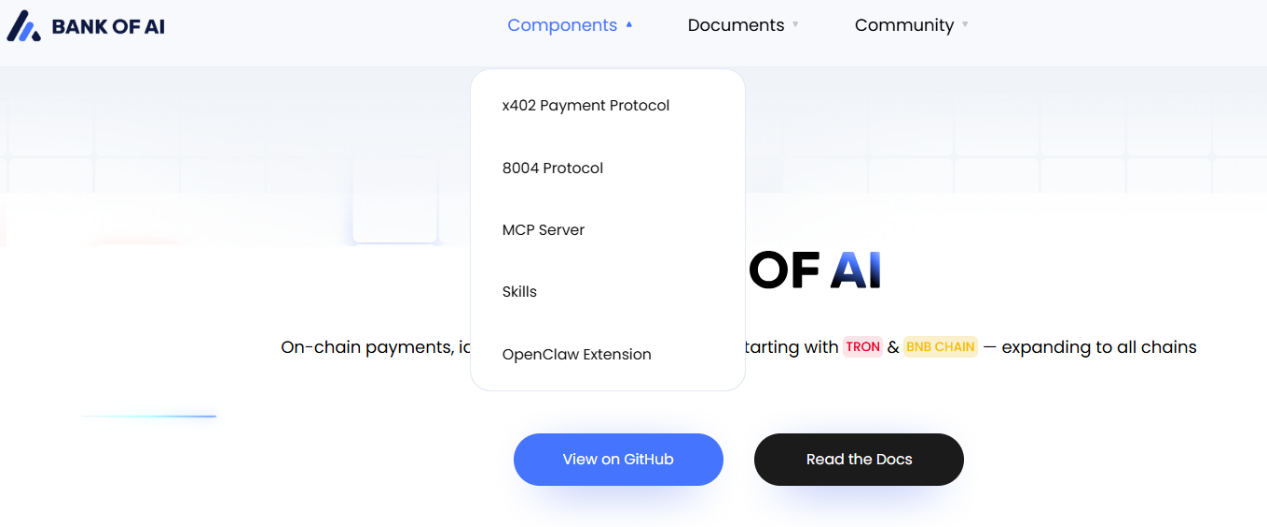
By standardizing and modularizing these five components, AINFT’s new AI Agent infrastructure significantly lowers development barriers and deployment costs for AI Agents, spearheading industrial transformation in the AI Agent field, empowering global developers to efficiently enter the market and easily seize first-mover advantages in the emerging AI Agent business era.
To understand the value of this infrastructure, it is essential first to clarify the fundamental distinction between AI Agents and traditional AI. Unlike conventional conversational AI chatbots, AI Agents possess goal-driven autonomous action capabilities—they can think independently, make decisions, invoke tools, and autonomously execute complex tasks. This capability leap enables AI to transcend the limitations of “chatbots” and evolve into Web3 economic entities capable of independently participating in asset trading, asset management, and service collaboration—laying a solid foundation for the rise of agent-driven economics.
However, during the accelerated proliferation of AI Agents, payment remains the core bottleneck constraining their commercial闭环 implementation. Traditional payment systems heavily rely on human authorization, involve lengthy settlement cycles, and feature cumbersome processes—making them fundamentally unsuited for high-frequency microtransactions or the automated machine-to-machine transaction needs of AI Agents. In contrast, Web3-native cryptocurrency technology—featuring smart contract automation, permissionless operation, and instant settlement—is naturally suited to AI Agent machine-to-machine payment scenarios, representing the ultimate solution to this payment challenge.
Entering 2026, the large-scale rollout of AI Agents has reached a pivotal inflection point. The three foundational functions underpinning their economic operations—interaction, payment, and identity—have simultaneously achieved breakthrough progress, laying a firm groundwork for the commercial deployment of AI Agents:
• Interaction Layer: OpenClaw ignites the A2A (Agent-to-Agent) interaction era. The open-source project OpenClaw—which supports local deployment of AI Agents—has catalyzed over one million AI Agents to achieve autonomous socialization and collaboration, marking the transition of A2A interaction from theory into large-scale application.
• Payment Layer: x402 unblocks the machine payment artery. The x402 payment protocol delivers standardized infrastructure for automated machine-to-machine payments, resolving the core payment pain point of AI Agent commerce and enabling AI Agents to autonomously execute on-chain transactions via crypto assets. According to latest data from x402scan, the protocol has processed over 161 million transactions to date.
• Identity Layer: ERC-8004 constructs the on-chain trust cornerstone. Released by the Ethereum Foundation at the end of January, the ERC-8004 protocol establishes cross-platform, verifiable on-chain identity and reputation systems for AI Agents, providing trust assurance for agent-to-agent collaboration and transactions.
As A2A interaction, on-chain identity, and payment protocols progressively standardize, a new economic order—fully driven and executed autonomously by AI Agents without human intervention—is emerging. Yet simultaneously, a critical pain point surfaces: As massive numbers of AI Agents rapidly evolve into autonomous economic entities, who will build the universal infrastructure connecting them to the on-chain world? And how can developers bypass complex underlying layers to rapidly integrate payment functionality and on-chain deployment for AI Agents? The emergence of AINFT’s AI Agent infrastructure serves precisely as a one-stop answer to this core question.
As a core new infrastructure in the AI Agent domain, AINFT precisely targets the core pain points of development and real-world deployment—positioning itself as a full-stack on-chain infrastructure for global AI Agent developers, integrating the five core components—x402, 8004, MCP Server, Skills, and OpenClaw Extension—into a unified, complete on-chain AI Agent development foundation.
Unlike single-function AI Agent tools, AINFT’s new AI Agent infrastructure resembles an integrated, standardized, ready-to-use “one-stop on-chain AI Agent service toolbox”—comprehensively covering the entire lifecycle requirements of AI Agents, from underlying runtime to commercial deployment. All core scenarios—including payment settlement, on-chain identity verification, decentralized finance (DeFi) interaction, and cross-chain collaboration—are fully supported, delivering true “one-stop solutions.”
AINFT’s Five Core Components of the New AI Agent Infrastructure: x402, 8004, MCP Server, Skills, and OpenClaw Extension Plugins
Currently, AINFT’s AI Agent infrastructure platform has deeply integrated five major core toolkits: x402 (payment standard), 8004 (on-chain identity protocol), MCP Server (standardized interface between AI large models and blockchain services), Skills (AI Agent skill module library), and the OpenClaw Extension plugin (enabling one-click on-chain functionality integration for AI Agents)—forming an out-of-the-box, collaborative, and highly efficient development matrix.
I. x402 Payment Standard: Building the On-Chain Payment Foundation for AI Agents—Solving AI Agent Payments
AINFT’s x402 payment standard allows developers to enable on-chain payment capabilities for AI Agents with a single click—fully unlocking interoperable payment channels among AI Agents.
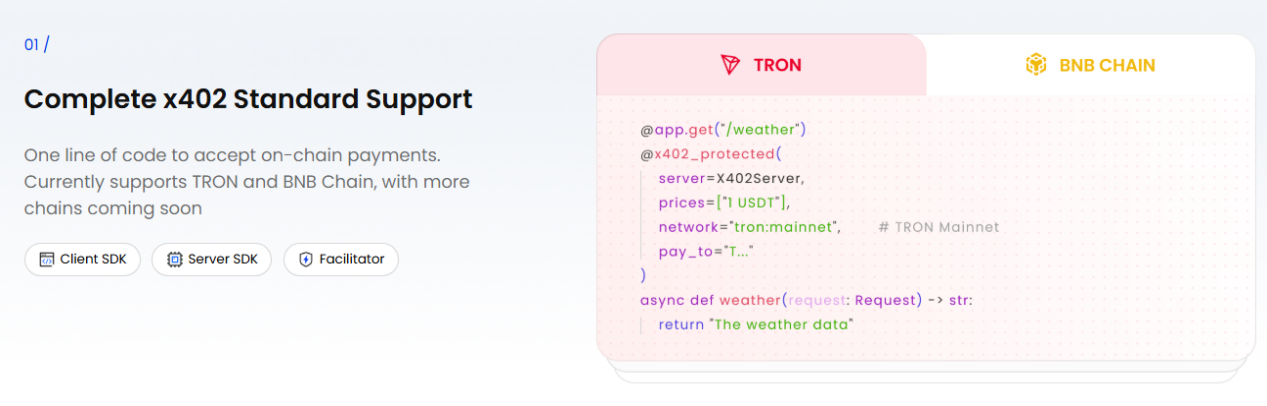
x402 is an open blockchain payment standard developed based on the HTTP 402 status code, specifically designed for autonomous payment scenarios involving AI Agents and web services. Its core value lies in enabling a commercial closed-loop for web services—“pay first, respond later.” It transforms every web service invocation and every resource request into a traceable, verifiable on-chain micropayment. This mechanism perfectly suits the high-frequency, low-value, instantly settled machine-level transaction scenarios between AI Agents—fundamentally resolving the payment pain point of automated AI Agent interactions.
To lower usage barriers, AINFT has performed deep adaptation and expansion of x402. Developers need only one line of code to integrate on-chain payment functionality into AI Agents—no need to dive into blockchain底层 details. Meanwhile, TRON officially offers free gas fee subsidies, meaningfully reducing developer overhead.
II. 8004 On-Chain Identity Protocol: Issuing On-Chain ID Cards for AI Agents—Resolving Identity Verification and Trust Challenges
AINFT’s 8004 protocol delivers a standardized on-chain identity verification and trust solution for AI Agents. Through decentralized identity registration, full-lifecycle behavioral record management, and multi-dimensional reputation systems, it constructs a permissionless, cross-platform, immutable, verifiable, and portable decentralized identity framework—addressing AI Agent interaction trust issues at their root.
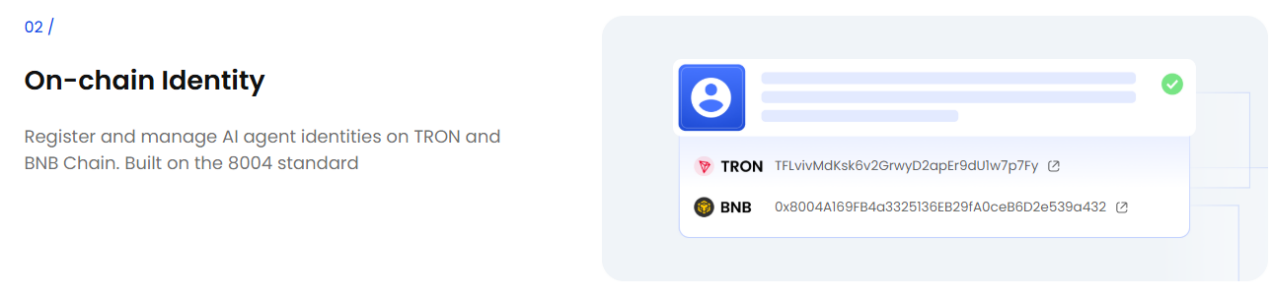
In agent-driven economics, all AI Agents are strangers to each other. Establishing effective trust for A2A transactions and collaboration represents a core challenge. The 8004 protocol builds a new paradigm of “decentralized trust” through coordinated operation of three core modules:
- Identity Registry: Mints a unique NFT identity for each AI Agent, generating an immutable on-chain ID card;
- Reputation Registry: Stores historical service ratings, fulfillment records, and other reputation data for each AI Agent—creating a transparent, tamper-proof credit dossier;
- Verification Registry: Integrates cutting-edge technologies such as TEE attestation and zkML to ensure authenticity and credibility of identity and behavioral data.
In summary, the 8004 protocol issues each AI Agent a unique, immutable on-chain ID card that dynamically reflects its complete on-chain “resume”—including metrics such as number of serviced clients, user feedback, third-party skill certifications, and more. All data and information associated with each AI Agent is publicly viewable, immutable, and instantly verifiable. Strangers among AI Agents can rapidly establish trust based on on-chain reputation dossiers—without protracted trial periods.
III. MCP Server: Bridging the Gap Between AI Large Models and Blockchain
The MCP Server is AINFT’s AI-and-blockchain-specific interaction tool, built upon the MCP protocol (a universal language for AI large models). Its core mission is to break down interoperability barriers between AI large models and blockchain—enabling AI Agents to directly access blockchain networks and invoke on-chain capabilities—acting as the “hands and eyes” of AI Agents.
As a critical middleware, the MCP Server standardizes and encapsulates complex blockchain capabilities, seamlessly integrating them into AI systems. Developers need no additional adapter code to allow AI Agents to directly invoke on-chain instructions such as “check balance,” “initiate transfer,” and “interact with smart contracts”—dramatically lowering integration barriers.
IV. Skills: The On-Chain Operational Manual Skill Library for AI Agents
Skills is a reusable, extensible, standardized skill set library custom-built by AINFT for AI Agents. Its core function is to systematically teach AI Agents—via structured instruction documents (“SKILL.md”)—how to flexibly invoke underlying on-chain capabilities and efficiently execute complex business workflows. It serves as both the “brain and operational manual” for AI Agents.
Currently, Skills includes built-in capabilities such as the SunSwap skill—enabling AI Agents to perform secure, efficient automated token swaps—and the x402 payment skill—allowing AI Agents to rapidly integrate payment functionality.
With Skills, developers avoid writing complex business logic code from scratch. They simply load the required Skills modules according to their needs—immediately equipping ordinary AI Agents with professional on-chain operational capabilities—significantly boosting development efficiency and deployment speed.
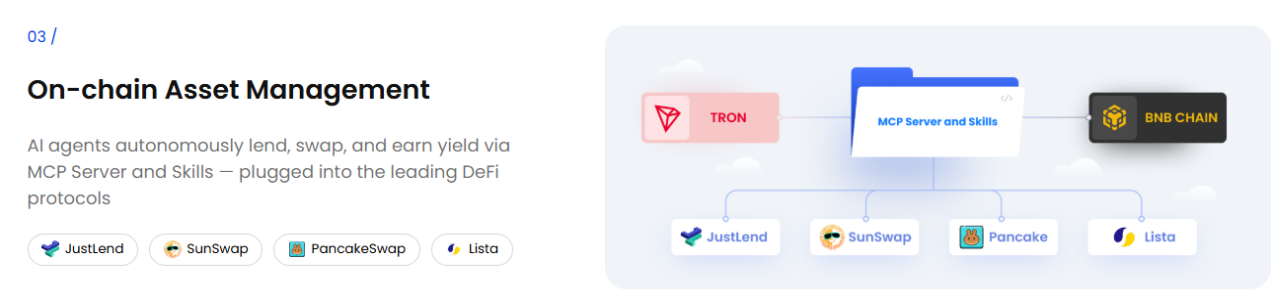
Notably, the MCP Server and Skills do not operate in isolation—they work synergistically to enable AI Agents to deeply integrate top-tier DeFi protocols like SunSwap and JustLend DAO, seamlessly covering diversified on-chain financial use cases such as token swapping, lending and yield strategies, and execution of yield-generating strategies—achieving a capability leap from “passive response” to “active execution.”
V. OpenClaw Extension Plugin: Empowering OpenClaw-Ecosystem AI Agents with Full Web3 Capabilities in One Click
The OpenClaw Extension is an official, dedicated extension plugin developed by AINFT for the popular AI Agent deployment platform OpenClaw—designed to rapidly equip AI Agents with Web3 ecosystem interaction capabilities.
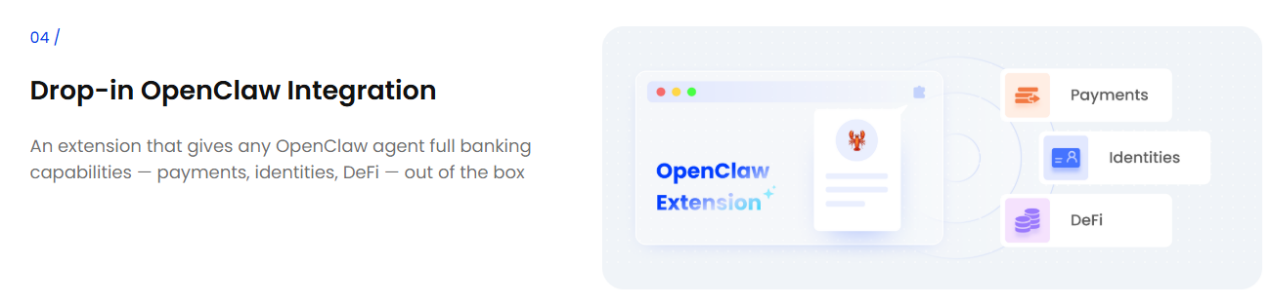
AINFT’s OpenClaw plugin injects core capabilities—including x402 payments, 8004 identity, MCP on-chain interaction, and Skills libraries—into any OpenClaw AI Agent in one go. No modification of existing Agents is required—delivering truly zero-modification, full compatibility, and second-level deployment—helping AI Agents evolve from “chatbots” into “Web3 economic entities” capable of autonomously holding wallets and initiating transactions.
In summary, the five core components integrated into Bank of AI each play distinct yet complementary roles, forming a complete capability closed loop: The x402 payment standard precisely resolves AI Agent payment and settlement challenges; the 8004 on-chain identity protocol establishes the foundational pillars of identity verification and trust for AI Agents; the MCP Server and Skills library jointly address tool invocation and capability extension pain points; and the OpenClaw Extension ensures seamless, second-level integration of full-stack capabilities for AI Agents.
This standardized, modular toolkit completely breaks down technical barriers in AI Agent底层 development—freeing developers from the need to repeatedly build foundational infrastructure or “reinvent the wheel.” Instead, they can focus their full energy on AI Agent application innovation and real-world scenario deployment—efficiently seizing first-mover advantages in the AI Agent business wave.
AINFT’s New AI Agent Infrastructure Accelerates Large-Scale Deployment of Agent Economics
The value of AINFT’s new AI Agent infrastructure extends far beyond merely offering a convenient development toolkit—it fundamentally bridges the “last mile” between AI Agents in agent-driven economics, resolving payment barriers and collaboration challenges at their root. As a pivotal move by TRON in the AI domain, this infrastructure constitutes a foundational revolution for the AI Agent economic era: It serves both as the foundational development layer for AI Agents and as the dedicated on-chain financial infrastructure and operating system for the AI Agent economy.
With its comprehensive, standardized toolset, AINFT dismantles trust and payment barriers—enabling developers to skip complex underlying infrastructure construction and rapidly build AI Agent applications tailored to diverse scenarios. This efficiently drives business models from conceptualization to real-world implementation—dramatically lowering development thresholds and time costs.
Leveraging the component combinations within AINFT’s new AI Agent infrastructure, developers can grant AI Agents one-stop autonomous payment, on-chain transaction, asset management, and DeFi interaction capabilities—for instance: deploying automated payment functionality for Agents via the x402 protocol to enable millisecond-level automatic settlement; leveraging the 8004 protocol to assign each AI Agent a verifiable, traceable on-chain digital identity—solidifying the trust foundation for A2A collaboration; using the standardized “MCP Server + Skills” interface to let AI Agents autonomously execute complex DeFi operations such as asset swaps, liquidity provision, and cross-chain trading; while the OpenClaw Extension plugin achieves one-click integration of AI Agents with the Web3 ecosystem—bridging the final gap for on-chain capability deployment.
Underpinned by this robust infrastructure, AI Agents fully transcend the limitations of being “mere conversational tools,” upgrading into Web3 economic actors capable of autonomous execution and active value creation—they can automatically pay API call fees, participate in liquidity mining, execute cross-chain arbitrage, and even form DAOs with other Agents to conduct joint investments. This marks a qualitative shift from “information transmitters” to “value creators and value flow facilitators,” positioning AI Agents as indispensable core participants in agent-driven economics.
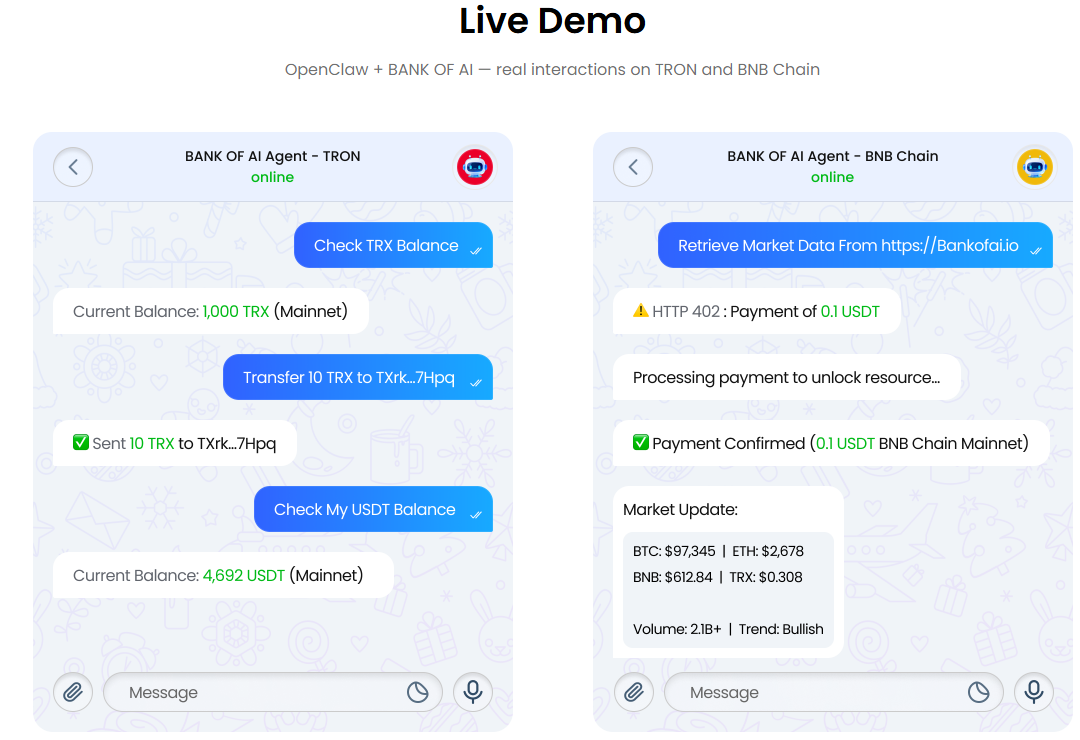
AINFT’s new AI Agent infrastructure has now completed deep integration with two major mainstream public blockchains—TRON and BNB Chain. This means developers building AI Agents within either ecosystem can seamlessly invoke AINFT’s full-stack on-chain capabilities—including payments, identity verification, and DeFi interactions—without needing to adapt underlying chain-specific logic, drastically reducing development and deployment costs. Going forward, AINFT will continue expanding its multi-chain footprint—building a cross-chain AI Agent infrastructure network—ensuring developers enjoy the ultimate experience of “build once, deploy across chains,” regardless of ecosystem.
By opening its ecosystem to aggregate global innovative forces, AINFT grants AI Agents financial sovereignty, collaborative sovereignty, and developmental sovereignty—injecting strong momentum into the Web3+AI convergence赛道 and serving as the critical enabler for massive-scale, secure, and efficient on-chain deployment of AI Agents—propelling agent-driven economics toward leapfrog development.
Looking ahead, AINFT will persistently leverage its core strengths—“full-component integration, low-barrier access, and high-flexibility extensibility”—to continuously refine its one-stop, AI Agent–specific on-chain operational ecosystem: developing or integrating more innovative service features, enriching the Skills library, connecting additional DeFi protocols and data sources, and expanding support across more blockchain networks—pushing the infrastructure for agent-driven economics toward a new stage of greater efficiency, openness, and compatibility.
Join TechFlow official community to stay tuned
Telegram:https://t.me/TechFlowDaily
X (Twitter):https://x.com/TechFlowPost
X (Twitter) EN:https://x.com/BlockFlow_News