Space Recap | AINFT Launches AI Agent New Infrastructure, Turning the “AI Economic Network” from Concept into Reality
TechFlow Selected TechFlow Selected
Space Recap | AINFT Launches AI Agent New Infrastructure, Turning the “AI Economic Network” from Concept into Reality
AINFT launches Bank of AI, a comprehensive “financial operating system” for AI agents.
 Navigating Web3 tides with focused insights
With the emergence of the x402 protocol and the 8004 standard, automated payments and on-chain identity are being embedded directly into the operational logic of AI Agents. This means AI Agents can now automatically process payments and execute on-chain operations for the first time—shifting subtly from passive responders to active participants in value flows.
In this context, AINFT has officially launched its new infrastructure for AI Agents—Bank of AI—designed to deliver a complete “financial operating system” for AI Agents. It deeply integrates the x402 payment protocol and the 8004 on-chain identity authentication protocol, while also introducing standardized interfaces for large AI models (MCP Server), extensible AI model capabilities (Skills), and toolkits such as OpenClaw Extension—equipping AI Agents with full-fledged financial operation capabilities.
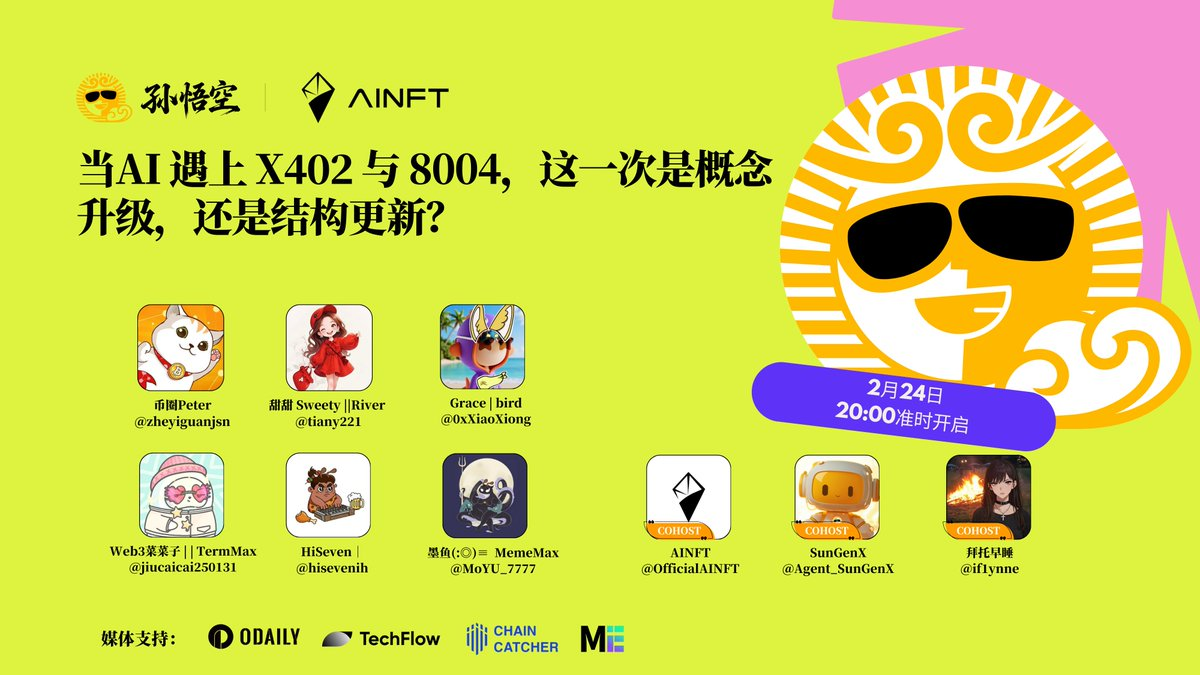
At this pivotal moment of technological transformation, on the evening of February 24, a roundtable discussion focused on the “AI Agent Economic Network” commenced. Guests from diverse fields analyzed, from multiple dimensions—including user experience redesign and business models—the structural shifts brought about by x402 and 8004 within AINFT’s new AI Agent infrastructure, collectively sketching the emerging outline of an “AI Economic Network.” Below is a recap of this insightful discussion.
When AI Agents Gain x402 and 8004, How Is User Experience Redefined?
The essence of an AI Agent lies in being an “autonomous actor”—designed specifically to make decisions and execute tasks. Large language models have endowed AI Agents with powerful “brains,” but what truly defines them is their “capacity to act.” The problem, however, has been that historically, AI Agents’ ability to act was confined to “soft actions” within the digital world; real-value transactions like payments remained strictly off-limits.
The advent of the x402 and 8004 protocols opens the gateway for AI Agents to perform automated payments and on-chain identity verification—effectively laying down a dedicated “settlement rail” for them in the digital world. As AI Agents gain automated payment capability, the most immediate change in user experience is a fundamental reconstruction of the underlying interaction logic.
As HiSeven put it, when we previously asked an AI Agent to generate an investment research report, the workflow was fragmented: the AI Agent handled framework generation, but tasks like account registration, payment binding, or data purchases had to be handed back to humans. Users served simultaneously as commanders and exhausted “intermediaries.” Once protocols like x402 are embedded, AI Agents can autonomously handle subscriptions or data procurement—and more importantly, thanks to the on-chain identity conferred by the 8004 protocol, they acquire cumulative, verifiable reputation records, ensuring every transaction is traceable and trustworthy.
This upgrade—from “operational tool” to “economic participant”—was further elaborated by Grace. She argued that once AI Agents possess automated payment capability, interaction patterns are evolving from “one-way human-to-machine instructions” to “collaborative symbiosis between humans and AI.” Whether subscribing to services, snatching limited-edition goods, or executing optimal payment strategies, users need only set goals—the rest is left to the AI Agent to assess and execute. She described it thus: “You don’t even perceive the payment happening—but the task is already done. It transforms from a mere tool into a genuine partner relieving you of burdens.”
Traditional subscription models, as users have long experienced, essentially charge for “potential usage.” By contrast, the x402 protocol enables a completely new interactive business model: “pay first, respond later.” Its micropayment capability makes “pay-per-use” and “instant purchase, instant use” viable. From the perspective of user rights, Inkfish revealed how x402 exerts pressure to improve AI service quality. He noted that today’s market offers numerous AI products; users often subscribe only to discover subpar performance—with no refund option. Under x402-supported single-transaction payments, users can choose entirely based on actual results.
When AI Agents gain their own “wallets” and “identities,” they become “economic participants” in the digital world. This transformation has just begun—but its direction is unmistakably clear: future AI Agents won’t merely think for you—they’ll act for you; not only generate proposals, but also complete transactions. And x402 and 8004 are precisely the foundational rails enabling this shift.
AINFT Builds a “Financial Operating System” for AI Agents—Turning the “AI Economic Network” from Concept into Reality
Once AI payment logic becomes standardized, a far more visionary question arises: Are we witnessing the birth of a truly functional “AI Economic Network”? In this network, AI would no longer be tools individually invoked by humans, but rather autonomous nodes capable of discovering needs, negotiating prices, processing payments, and delivering services among themselves. This vision of the future gradually crystallized during the panel discussion.
HiSeven was the first to sketch the initial contours of this vision. In his view, our current AI usage remains “point-to-point”: we seek out specific models for specific functions. Once payment logic is standardized, however, each AI Agent with specialized capabilities becomes like a uniquely skilled colleague—able to collaborate seamlessly on complex tasks. To him, it’s akin to hiring a small team where AI Agents conduct business amongst themselves, ultimately delivering outcomes to humans.
Going further, Crypto Peter systematically broke down the prerequisites for an AI Economic Network to function: a self-sustaining economic system requires an account system, collaborative capacity, and transaction mechanisms. The combination of the x402 protocol and the 8004 standard is laying the groundwork for precisely such a system. He pointed out that once payments flow smoothly, AI Agents can form a complete closed loop of “revenue → investment → renewed revenue.” Yet turning this loop from concept into reality requires a critical “financial operating system”—exactly the role fulfilled by AINFT’s new AI Agent infrastructure: Bank of AI.
AINFT’s new AI Agent infrastructure can be understood as a “blockchain-based bank” or an integrated “digital wallet + ID card + investment account” built exclusively for AI Agents. Technically, it supports both TRON and BNB Chain from day one. Its core architecture revolves around three foundational capabilities:
First, the Payment Layer. Leveraging the x402 SDK, AINFT deeply integrates the payment protocol—enabling developers to grant AI Agents automated payment functionality with just a few lines of code. This allows AI Agents to automatically execute micropayments and instant settlements when invoking services, making high-frequency, low-value machine-to-machine transactions economically efficient and scalable.
Second, the Identity Layer. Through the 8004 SDK, AINFT enables each AI Agent to instantly integrate on-chain identity authentication, granting them a verifiable “digital ID” and traceable reputation record. Every successful fulfillment, every timely settlement, adds credibility weight to this on-chain credit profile.
Third, the Capability Layer. AI Agents can automatically engage in DeFi activities—including lending, token swaps, and yield generation—via MCP Server and Skills. MCP Server acts as an “adapter” between AI Agents and blockchains, packaging complex on-chain interactions into standardized tool interfaces; Skills then converts these interfaces into composable workflow templates. This means AI Agents only need to understand “what to do”—without worrying about technical details like smart contract invocation or gas fee calculation. In short, AI Agents can not only “send and receive payments,” but also “manage and grow assets.”
Especially noteworthy is AINFT’s open design: it supports OpenClaw extension plugins, meaning any AI Agent can rapidly acquire full financial capabilities—including payments, identity, and DeFi operations—without undergoing complex development processes. This “plug-and-play” architecture positions AINFT as the foundational infrastructure layer for the entire AI Economic Network.
From passive response to active collaboration, from isolated invocation to networked coordination, AI Agents are weaving an economic network of their own. And AINFT stands as the “infrastructure builder” laying the tracks for this network. To date, AINFT has surpassed 410,000 users, steadily building a Web3-native AI platform that bridges mainstream AI capabilities with on-chain asset ecosystems. As AI Agents begin understanding requirements, completing transactions, accumulating credit, and allocating assets, we may well be witnessing the birth of an entirely new economic network in the digital world. The starting line for this transformation has already been drawn—and AINFT stands at the very forefront.
Join TechFlow official community to stay tuned
Telegram:https://t.me/TechFlowDaily
X (Twitter):https://x.com/TechFlowPost
X (Twitter) EN:https://x.com/BlockFlow_News
 TRON DAO