Space Recap | When Trading Returns On-Chain: Decoding the Core Logic of the New-Cycle DeFi Ecosystem
TechFlow Selected TechFlow Selected
Space Recap | When Trading Returns On-Chain: Decoding the Core Logic of the New-Cycle DeFi Ecosystem
As the market refocuses on the fundamental value of DeFi, this article provides an in-depth exploration of the key elements for building a sustainable DeFi ecosystem, using SUN.io as a case study to illustrate how transparency, collaboration, and efficiency can drive liquidity toward achieving an endogenous cycle.
 Navigating Web3 tides with focused insights
As market narratives gradually fade, the industry's focus is returning to fundamentals: trading activities continue to settle on-chain, and liquidity is beginning to break free from short-term incentives, moving toward a healthier, endogenous cycle. In this transition, the key question of the current cycle becomes clear: what kind of system can truly hold value and retain users?
Against this backdrop, DeFi—particularly decentralized exchange systems—has once again become central to discussions. This is not merely a rotation of trends, but a structural shift in driving logic. It also marks a pivotal stage for the SUN.io ecosystem, transitioning from an innovative concept into a genuine financial and trading protocol capable of sustaining and circulating liquidity.
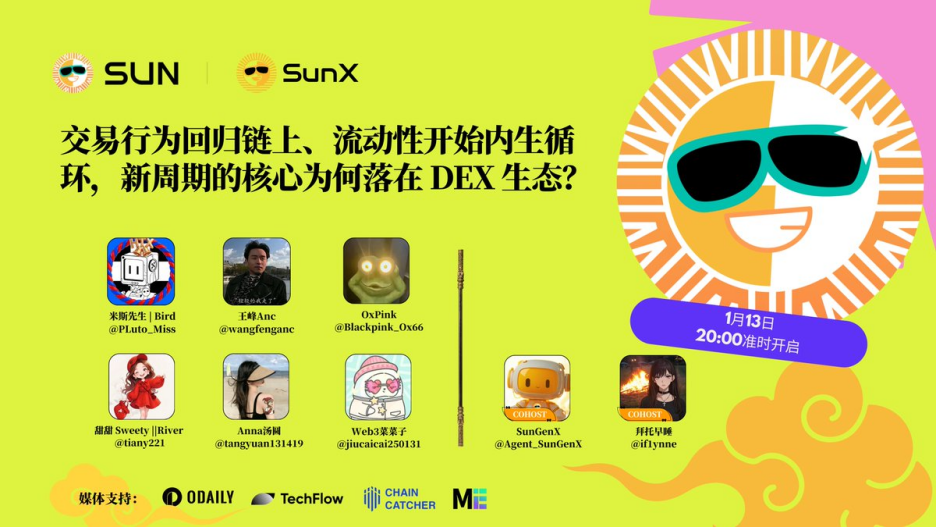
This edition of the SunFlas Roundtable hosted an in-depth dialogue with multiple industry observers and builders centered on the theme: “With trading behavior returning on-chain and liquidity entering an endogenous cycle, why does the core of the new cycle lie within the DEX ecosystem?” Diverse perspectives converged and reinforced one another, forming a shared consensus that the market is shifting from narrative-driven to structure-driven development. The discussion also provided deep insights into how SUN.io can build a sustainable financial protocol ecosystem. Below are the key takeaways from the conversation.
When the Tide Recedes: Why Is the Market Refocusing on the Fundamental Value of DeFi?
During the Space discussion, guests unanimously agreed that DeFi’s return to the center of market discourse stems from the industry’s shift away from emotion- and narrative-driven dynamics toward a renewed appreciation for sustainable, verifiable on-chain financial structures.
Tian Tian pointed out that the overall contraction of market liquidity has made investors more focused on “real value.” She observed that current on-chain trading volumes have significantly declined, with capital no longer blindly chasing short-term hype. Instead, greater attention is being paid to projects that demonstrate real trading activity, actual settlement, and genuine user demand. In her view, DeFi’s core mission lies precisely in reliably migrating traditional financial functions onto the blockchain through trustworthy smart contracts, thereby establishing a foundation capable of continuous operation even in capital-scarce environments.
OxPink described this transformation as a “return to value.” He noted that once market enthusiasm fades, projects sustained solely by stories and subsidies quickly fall by the wayside. Industry attention naturally shifts to systems capable of stable trading and settlement regardless of market conditions. As a result, the competitive logic undergoes a fundamental change: from competing on storytelling ability to competing on who can deliver real trading depth and settlement reliability.
Mr. Mi affirmed this trend from the perspective of market participants. He said even yield farmers now pay closer attention to a project’s core fundamentals and user experience, making it increasingly difficult for narrative-based projects to gain traction. Current discussions have shifted toward structural issues such as capital efficiency, protocol revenue, and risk management. He believes DeFi is reverting to its essence as a transparent, verifiable, and sustainable financial infrastructure—projects that consistently generate fee income during bear markets and withstand repeated market tests will naturally reclaim the spotlight during periods of calm.
In summary, the retreat of capital and market sentiment has effectively completed a natural process of filtering and value discovery. Industry focus has moved beyond surface-level price fluctuations and short-term stories, delving into the most fundamental aspects of on-chain financial systems: reliability, sustainability, and real utility. DeFi’s “resurgence” is, in fact, the market’s renewed recognition of its long-term role as crypto’s foundational infrastructure amid cyclical volatility.
Building a Sustainable Ecosystem: Decoding SUN.io’s Development Path
As the discussion deepened, participants converged on a clear consensus: the market’s driving logic is undergoing a fundamental shift—from “narrative-first” to “structure-first.” A healthy ecosystem capable of weathering cycles must be built on real demand, transparency, trustworthiness, and efficient collaboration. The benchmark for excellent trading systems has likewise evolved—from conceptual novelty to stable, seamless, and reliable user experiences. This dual evolution points directly to the central challenge of DeFi’s new phase: sustainability.
Overall, a sustainable, cycle-resilient ecosystem rests on three foundational pillars:
Transparent and Trustworthy Infrastructure
Wang FengAnc emphasized that the underlying logic of an ecosystem must be clear and verifiable—this is the starting point of all trust. Web3 Caicaizi added that transparent on-chain settlements and auditable transaction behaviors are prerequisites for fund security and ecosystem health. Any “black box” operations will inevitably expose fundamental flaws over time.
A Collaborative Network Driven by Real Demand
The guests unanimously agreed that artificially inflated prosperity driven by short-term incentives cannot last. A healthy ecosystem requires genuine trading demand and deep liquidity as its engine, enabling a sustainable flywheel of revenue and growth. Moreover, organic product integration and deep community governance form the skeleton of ecosystem evolution, ensuring efficient expansion during bull markets and internal resilience during bear markets.
Capital Efficiency Centered on User Experience
Mr. Mi approached the issue from the most direct user perspective, noting that ease of use has become the baseline for user retention. This manifests concretely in extreme execution efficiency (low slippage, high fill rates) and smooth, stable interactions. At a deeper level, the extent to which capital can be efficiently and repeatedly utilized within the ecosystem—rather than sitting idle—determines the system’s long-term appeal and liquidity depth.
This collective industry consensus on sustainability is systematically reflected and implemented in SUN.io’s development trajectory.
In building transparent and trustworthy infrastructure, SUN.io strictly adheres to the principle of on-chain verifiability. All trading and liquidity rules are defined and executed by smart contracts, allowing users to trace the flow and state changes of funds. This complete on-chain transparency serves as the first cornerstone of trust.
Furthermore, SUN.io extends this principle to ecosystem governance by formally establishing the decentralized community organization SUN DAO. Comprised of SUN token holders, SUN DAO makes decisions on key proposals through secure and transparent on-chain voting mechanisms, truly realizing co-construction, co-governance, and shared benefits. As a result, the governance process itself operates within a publicly verifiable and transparent framework.
In driving real demand and building a collaborative network, SUN.io has successfully developed a multi-scenario protocol matrix. Its core product ecosystem includes: SunSwap, a decentralized exchange; SunPump, a fair launch platform for meme coins; SunX, a decentralized perpetual futures trading platform; SunCurve, a stablecoin exchange tool; and AI-powered toolkits SunAgent and SunGenX.
These products do not exist in isolation—they are organically interconnected through carefully designed mechanisms: SunSwap provides core liquidity and spot trading; SunPump introduces nascent assets with community consensus; SunX meets advanced user needs for leverage and hedging; SunCurve ensures efficiency and stability for fundamental stablecoin exchanges. The integration of AI tools further lowers barriers to participation and enhances capital efficiency through intelligent strategies. This inter-product synergy creates a reinforcing loop of mutual traffic referral and functional complementarity, enabling seamless circulation of capital and users across the ecosystem based on their needs, collectively forming a self-reinforcing, continuously expanding collaborative network.
Ultimately, all structural efforts by SUN.io in transparent infrastructure and collaborative networks serve one core goal: delivering a trustworthy, seamless user experience and creating highly efficient capital circulation pathways. The evolution of its product suite clearly demonstrates that true moats are not short-term incentive metrics, but rather the stable, practical value that emerges when on-chain verifiability, scenario synergy, and technical execution efficiency are seamlessly integrated—this is SUN.io’s direct response to the “structure-first” era.
Notably, SUN.io recently signaled a major update via its official X account, announcing an upcoming Chinese brand upgrade and a new brand identity. This move signifies a new phase in its ecosystem development and reflects its determination to strengthen strategic coherence and brand recognition in building global decentralized financial infrastructure.
As highlighted in this discussion, the market’s profound shift from narrative to structure is transforming DeFi ecosystems from mere trading venues into foundational infrastructures that carry value and trust. Their core mission is no longer simply offering the concept of “decentralization,” but building transparent, efficient, and sustainable liquidity circulation systems. When trading behavior truly returns on-chain, protocols that achieve systematic excellence in verifiability, collaborative networks, and user experience will naturally emerge as the central hubs and value carriers of liquidity in the new cycle.
Join TechFlow official community to stay tuned
Telegram:https://t.me/TechFlowDaily
X (Twitter):https://x.com/TechFlowPost
X (Twitter) EN:https://x.com/BlockFlow_News