Interview with Bitget Wallet's New COO: Our Focus is on New Assets and New Opportunities
TechFlow Selected TechFlow Selected
Interview with Bitget Wallet's New COO: Our Focus is on New Assets and New Opportunities
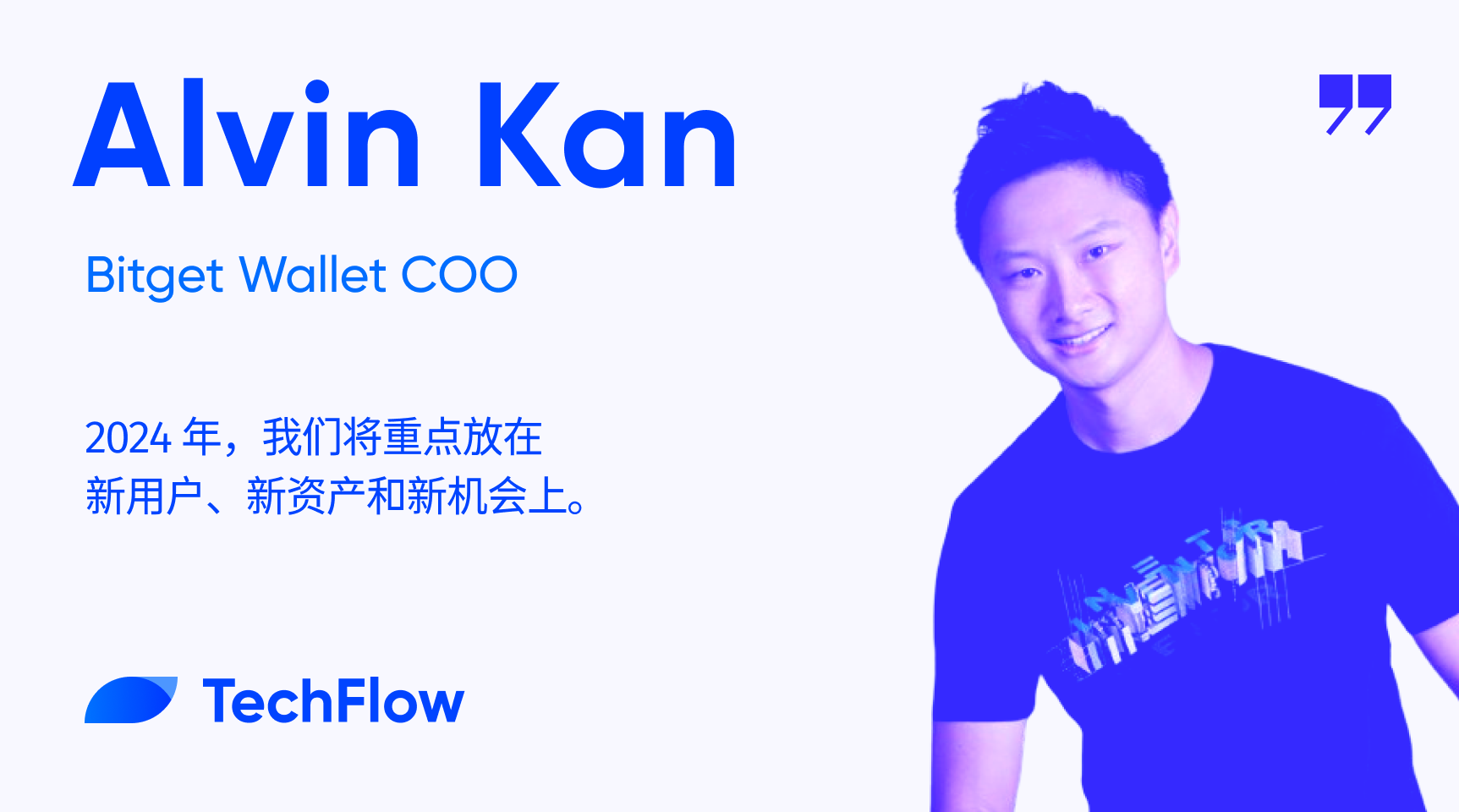
"In 2024, we will focus on new users, new assets, and new opportunities." – Alvin Kan, COO of Bitget Wallet
 Navigating Web3 tides with focused insights
Written by: Sunny and Zolo, TechFlow
Guest: Alvin Kan, Bitget Wallet

In March 2023, Bitget completed its acquisition of BitKeep and officially rebranded it as Bitget Wallet in August of the same year. This upgrade marked a new strategic direction—focusing on on-chain asset trading. Bitget Wallet offers seamless access to asset management, multi-chain swaps, NFT trading, DApps, staking, and Launchpad features, while supporting MPC wallets, cross-chain inscription minting, smart market data, and more. The integration bridges centralized finance (CeFi) and decentralized finance (DeFi), backed by a $300 million user protection fund to enhance security.
At the end of last year, Alvin Kan joined the Bitget Wallet team as Chief Operating Officer (COO). Prior to this role, Alvin spent nearly a decade at LinkedIn, leading the company’s APAC data team and contributing to its strategic development across Asia. He later joined Binance as Head of Ecosystem Growth for BNB Chain, followed by a position at Sei Labs as Regional Lead for Asia. In this exclusive interview, Alvin shares his insights into the evolution and competitive landscape of the Web3 market, along with his strategic vision for Bitget Wallet in 2024.
From LinkedIn to Falling Down the Crypto Rabbit Hole
TechFlow: Having accumulated extensive experience in Web2 companies—including your time at LinkedIn and later at Binance—could you walk us through your journey into the world of cryptocurrency?
Alvin:
That gives away my age a bit. I worked at LinkedIn for over nine years and was among the first employees in Singapore, as well as an early member of the APAC team. That experience wasn’t just part of my career—it was deeply tied to my personal growth. At LinkedIn, we created opportunities for professionals, expanded their networks, and helped improve their careers and lives. It taught me how impactful it can be to shape emerging industries.
Around that time, topics like Web3, crypto, and the future of the internet started gaining traction. I found myself increasingly drawn to them and began diving deep into learning. After careful consideration, I decided to make the shift. One key reason? It reminded me of the early days at LinkedIn. Back then, explaining what LinkedIn was felt like introducing a completely new concept—we sometimes had to describe it as “Facebook for professionals” to help people understand. Similarly, Web3 presents the same kind of challenge today, but that’s exactly what sparked my curiosity. I recognized the revolutionary potential and immense promise behind the technology.
So, I wanted to be an early participant in this transformative journey.
TechFlow: You spent nearly 10 years at LinkedIn—you must have seen its ups and downs. Do you think LinkedIn could eventually disappear and be replaced by a decentralized alternative?
Alvin:
I don’t think displacing a major Web2 company is easy. LinkedIn delivers tremendous value because these professional networks are deeply entrenched. For example, with over 1 billion members, LinkedIn enjoys powerful network effects and economies of scale that are extremely difficult to replicate. Additionally, the user experience offered by Web2 technologies remains a significant advantage—current Web3 products still lag far behind in usability.
Nevertheless, it is entirely possible to build a decentralized network co-owned and co-created by professionals.
But it will take time. My view is that directly competing with platforms like LinkedIn may not be the best approach. Instead, we should rethink incentive structures and focus on the unique value we can deliver to users. This requires adapting and innovating for the future of Web3 to discover new paths and solutions.
Bitget Wallet: Meeting User Demand for Early Opportunities
TechFlow: After leaving Binance and Sei, you chose to join Bitget Wallet. Can you tell us about Bitget Wallet and what sets it apart from other wallets in the crowded market?
Alvin:
As a decentralized Web3 wallet, Bitget Wallet has attracted over 15 million global users and built a large, active community. Our key strength lies in offering the industry’s most comprehensive ecosystem support.
Currently, Bitget Wallet supports over 100 major public chains and hundreds of EVM-compatible chains, along with hundreds of thousands of crypto assets. This greatly simplifies the user experience—through a single wallet, users can interact with the entire Web3 world, managing assets, trading tokens and NFTs, and engaging with DApp ecosystems.
Secondly, users can discover the latest assets and trading opportunities here. Our core Swap feature supports a wide range of public chains, aggregates numerous DEXs and cross-chain bridges, and offers rich token options. It also includes innovative features like gasless transactions and auto-slippage. We’ve developed Smart Market, which provides real-time cross-chain trend analysis, comprehensive multi-dimensional leaderboards, and insights into on-chain “smart money,” enhancing swap decisions. Recently, we launched full-chain inscription capabilities and upgraded our LaunchPad and Fair LaunchPool to help users participate earlier in new projects and gain access to new assets. Additionally, our Web3 exploration rewards platform, Task2Get, incentivizes users for interacting with multi-chain ecosystems.
On security, we’ve established a robust system with multiple layers of detection to secure every transaction and interaction. We offer MPC wallets, AA wallets, hardware wallet integration, and have audited core code for Swap and NFT marketplace protocols. We also share Bitget’s $300 million risk protection fund.
With the rapid evolution of Web3, new projects and assets emerge constantly. Users have a strong desire to get in early—and our mission is to fulfill that need.
Competitive Strategy: Embracing Globalization and Core Product Strengths
TechFlow: The Web3 wallet space is highly competitive. Given the challenges, what is your differentiated strategy, especially regarding regional adaptation? With varying user preferences across regions—some favor meme coin speculation, others prioritize staking—how do you adjust your strategy to maintain a competitive edge?
Alvin:
Let me start with globalization. Yes, markets differ significantly, and so do user needs. That’s why we adopt a global strategy, particularly focusing on product localization and community building to meet specific regional demands. We deploy local teams, use native languages and channels, recruit local ambassadors, and strengthen user education within local communities. While user preferences vary, ultimately they’re all seeking ways to earn and explore new DeFi opportunities—a truly global trend.
Regarding core product strengths, we focus on two fundamentals: delivering superior user experience compared to competitors, and enabling users to discover the newest assets and opportunities first.
Optimizing UX goes beyond simple interface tweaks. Reflecting on the evolution of wallets—from basic address creation, sending, and receiving—to the DeFi era, where wallets aggregate multiple DEXs, NFT markets, and protocols. Today’s wallets have evolved into one-stop Web3 gateways, enabling asset management, swaps, inscription and NFT minting, and full-chain ecosystem interactions. Innovations like MPC and AA wallets further enhance usability.
We strive for an exceptional product experience through broadest-possible ecosystem integration, full mainnet coverage, and a suite of supporting tools. When new assets or narratives emerge, we respond quickly and move fast. We continuously launch joint airdrops with promising mainnets and projects, new asset launches, and cross-chain inscription campaigns—ensuring our users get early access to valuable market signals and timely participation.
We must also act swiftly, detect shifts in industry narratives, and seize new opportunities. Speed itself can become a key competitive advantage.
TechFlow: Would you mind sharing your thoughts on competition with OKX Web3 and Binance Web3?
Alvin:
Indeed, exchanges launching wallets has become a market trend, as everyone anticipates that decentralized asset management and trading will likely become mainstream. Competition is intensifying, so maintaining our lead requires more than incremental innovation—we need long-term thinking and systemic upgrades.
First, Bitget Wallet has over five years of development and accumulated advantages in product functionality. Our deep ecosystem integration and solid wallet infrastructure place us at the forefront of the industry. We’re close to our users, understand their needs, and consistently evolve with market trends and emerging narratives.
Additionally, we differentiate ourselves by focusing on trading—specifically on new assets, new narratives, and new opportunities. We’ve continuously invested in building a trading-centric wallet, achieving high on-chain trading penetration. Our team is agile and responsive, highly sensitive to new market narratives and assets. We all recognize clearly that new assets remain the core driver of wealth creation in this industry.
Balancing long-term infrastructure refinement with short-term market responsiveness is essential to capturing the benefits of ecosystem growth.
Moreover, our wallet operates with strong independence—the app is separate from the exchange, emphasizing decentralization. For instance, when users log in via an MPC wallet, the authentication process is strictly isolated from the centralized exchange, minimizing risk exposure.
TechFlow: If Bitget Wallet’s competitive edge lies in catching trends, what tools do you use to track new assets?
Alvin:
Our team reacts quickly to market trends and has built an AI-powered information feed system that captures content from social media and other channels in real time, analyzes it instantly, and identifies new asset launches and trending movements. We also hold regular internal discussions to evaluate emerging narratives and assets, allowing us to make swift decisions on product strategy and market planning.
We also highly value community feedback and suggestions, which serve as invaluable resources for identifying market trends.
Last month, we launched a tool that tracks on-chain “smart money.” By analyzing on-chain data in real time, it delivers clear, timely trading signals and market insights to retail traders. Users can easily access this information on the mobile app, browsing “smart money” moves much like social media posts, monitoring real-time P&L, and learning from the strategies of professional investors and whales—unlocking new on-chain trading opportunities.
The Role of the COO at Bitget Wallet
TechFlow: Shifting back to you personally—since joining Bitget, how have you changed? What experiences and skills from your past roles are transferable to this new position? And how has your working style evolved?
Alvin:
First, I want to clarify that although Bitget Wallet merged with Bitget, our team maintains operational independence. Our team is lean and efficient, operating in many ways like a startup—which I really appreciate.
For me, as you mentioned, this is a very different role and comes with fresh challenges. Previously, my work primarily focused on enterprise clients (B2B), whether at LinkedIn or BNB Chain. Joining Bitget Wallet marks my first deep dive into consumer-facing (C2C) operations—an area I hadn’t explored much before. Of course, we still engage frequently with mainnet ecosystems, projects, and developers to explore collaboration opportunities.
In my previous B2B roles, customer feedback had a direct and immediate impact on our strategies. Those experiences equipped me with strong skills in strategic planning, market analysis, team leadership, and project management—all of which I now apply to Bitget Wallet’s daily operations and long-term growth. With the shift toward C-end users, we see faster feedback on campaign performance, requiring greater agility and responsiveness. I’m rapidly learning and adapting to this new business model, while also mastering the balance between addressing short-term challenges and pursuing long-term goals.
Distinguishing Short-Term Hype from Long-Term Trends
TechFlow: I believe distinguishing between short-term hype and genuine long-term trends is incredibly valuable. Perhaps having Bitget’s backing gives you a bird’s-eye view of the industry. Does this advantage help you better identify true trends versus fleeting fads?
Alvin:
We do refer to research reports for initial insights, but even more important is direct feedback from users and the market. We closely observe and collect community discussions, maintaining tight engagement with users—these interactions often provide early signals of market shifts.
Meanwhile, our team leverages collective knowledge and intuition to anticipate market developments.
TechFlow: Final question—what is your outlook or prediction for Web3 ten years from now?
Alvin:
Over the next decade, we’ll likely see shifting narratives. As current ones are validated or fade away, the Web3 ecosystem will mature. Many of today’s narratives revolve around the central question: “Which technologies will achieve mass adoption?”
These narratives are essentially technical hypotheses exploring which implementations offer better scalability or efficiency, potentially driving increased liquidity or faster scaling. The richness of current theories stems from the fact that we’re still in the early stages of the industry.
Take Ethereum’s scalability challenge—for example. Multiple Layer 2 solutions like ZK Rollups and Optimistic Rollups are being explored, each taking different technical approaches. In the next 5 to 10 years, these challenges may be resolved, possibly leading to consolidation among L2 solutions. But as solutions mature, new challenges will arise, demanding new theories and driving the evolution of narratives.
Download Bitget Wallet: https://web3.bitget.com
Join TechFlow official community to stay tuned
Telegram:https://t.me/TechFlowDaily
X (Twitter):https://x.com/TechFlowPost
X (Twitter) EN:https://x.com/BlockFlow_News
 深潮TechFlow