GokuShow Interview with Saku, Founder of Matr1x: Matr1x's Ceiling is to Transform the Integrated Industry Ecosystem
TechFlow Selected TechFlow Selected
GokuShow Interview with Saku, Founder of Matr1x: Matr1x's Ceiling is to Transform the Integrated Industry Ecosystem
The core of entrepreneurship is not what investors need, but what the industry needs.
 Navigating Web3 tides with focused insights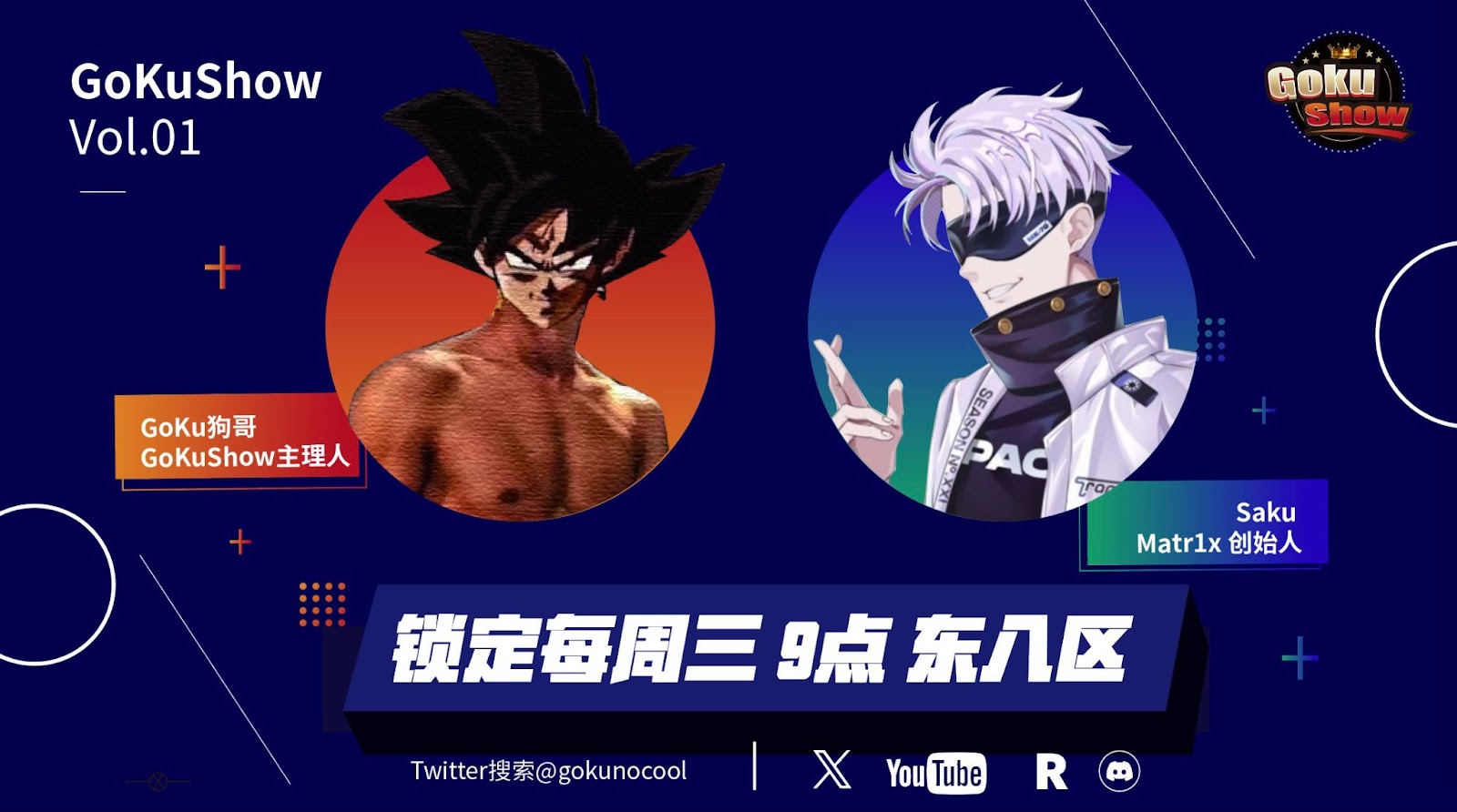
About GokuShow
GokuShow is a series dedicated to in-depth conversations with Web3 founders, initiated by Web3 influencer GoKu (@Gokunocool). It aims to provide a stage for all Web3 entrepreneurs to showcase themselves and share their behind-the-scenes stories—creating a warm, authentic program.
Video Link:
https://x.com/gokunocool/status/1753415876278378694?s=20
Host: GoKu
Guest: Saku
Project: Matr1x
Matr1x, having raised a total of $20 million in funding in 2022 and 2023, is a Web3 entertainment platform aiming to elevate its brand through self-developed premium games, third-party collaborations, game IP development, and global esports events. The platform features three major interconnected games—Matr1x FIRE (first-person shooter), Matr1x WAR (shooter + MMORPG), and Matr1x EVOLUTION (SOC)—to unfold an epic trilogy (Cyber Earth → Mars Colonization → Interstellar Exploration).
Since its inception, Matr1x has drawn significant attention with a star-studded investor lineup including Folius Ventures and SevenX as co-lead investors, alongside ABCDE Capital, Jambo, Initiate Capital, and Find Satoshi Lab. Notably, ABCDE Capital believes Matr1x could become the next Axie or StepN-level phenomenon in GameFi, capable of driving true mass adoption and breaking Web3 into the mainstream.
As an old friend of host GoKu, Saku, founder of Matr1x, joins the debut episode of GokuShow. A non-traditional Web3 entrepreneur, Saku brings deep experience from top-tier Web2 gaming companies and a bold vision to build a project that transcends industry ceilings. He embodies ambition, persistence, and long-term strategic foresight. Stepping beyond conventional thinking about Web3 gaming startups may offer fresh insights.
Key Highlights:
-
Web3 represents the only real chance for this generation of young people to leapfrog ahead
-
Everything we do is about solving problems—solve them within a business model and then uncover opportunities
-
To be first—only aim to be #1! Beyond #1, there’s no real opportunity
-
Use change to respond to all changes
-
If the pie is big enough, the interests of investors, community, and team can all be balanced
-
Failure isn’t the mother of success—success is
-
Never set limits—Matr1x’s ceiling is to transform and integrate the entire industry ecosystem
-
Maintain an “anti-fragile” mindset—once you’ve hit rock bottom, everything left is upward momentum
-
The core of entrepreneurship isn’t what investors want—it’s what the industry needs
The following content is derived from the live GokuShow interview:
1. From Senior Web2 Game Developer to Building a Web3 Entertainment Ecosystem
GoKu: You held a senior position in game development at a major Web2 company. Can you share your past entrepreneurial experiences and why you decided to start a venture in Web3?
Saku: I began exploring cryptocurrency back in 2013, participating in projects like Bitcoin and Litecoin. I developed a strong interest in both crypto and gaming, getting involved in various blockchain games, DeFi, and NFT activities.
At the same time, I was working on game R&D and operations at a major Web2 company—this was preparation for my eventual startup journey. My earliest entrepreneurial attempt was launching a secondhand textbook marketplace in school, driven by a desire to create something transformative. In 2018, I founded an overseas-focused game studio with a team of 100–200 people. Going from zero to one meant handling everything myself—renting offices, buying furniture, hiring staff, setting up financial systems—unlike in big companies where departments handle these things. Entrepreneurship is about rebuilding everything step by step. For me, it requires staying calm, focusing on problem-solving, and spotting opportunities to ensure survival. Everything we do is about solving problems under a business model, finding opportunities, and keeping the team alive. Matr1x is now gradually entering public testing and planning new product launches. I’m confident in its trajectory and remain committed to building a robust Web3 ecosystem.
This current venture with Matr1x is also a zero-to-one journey. Rather than calling it just a blockchain game, I prefer to see it as a Web3 entertainment platform encompassing IP, esports, and more—planning future entertainment products, financial services, and technical infrastructure to form a complete Web3 ecosystem.
GoKu: Before starting in Web3, your overseas game project was already relatively successful. What prompted your move into the Web3 space?
Saku: Entering Web3 was both a chance to prove myself and an opportunity for young people to break through. Founders should actively explore uncharted territories and ride emerging trends—venturing into areas others are hesitant or unfamiliar with—because that's often the path to real success.
2. Embracing Change, Aiming Only to Be #1
GoKu: You started perhaps as a retail investor (“韭菜”), closely following the industry and possibly profiting from investments, but eventually transitioned into building within it. What do you like most—and least—about this industry?
Saku: That’s a great question. Let me start with what I love most. The industry evolves extremely fast, and as a Gemini, I thrive on novelty and excitement. There’s so much possibility here—every two months, a new trend emerges. This constant change creates opportunities and potential, making it ideal for young people. Chatting in communities daily, there’s always a new opportunity around the corner. Every day demands learning something new, and I truly enjoy that. Each shift can be integrated into the Matr1x framework, reinforcing my belief in its vast potential. The key is we don’t limit ourselves—we act based on market needs, which means our growth potential is infinite. When someone reaches the peak in any field, they might feel further effort is meaningless. That’s what makes this industry fascinating—you’re never safe; newcomers can surpass you overnight.
GoKu: Recently, I saw a high-quality shooter game and briefly worried about Matr1x, but then realized Matr1x had already evolved beyond what I’d seen months ago. You’re constantly iterating, introducing new concepts, refreshing the platform daily.
Saku: That’s the only way—use change to counter all change.
GoKu: From a marketing perspective, once you’re #1, how do you prevent challengers from catching up? It feels like Matr1x might now be playing defense—and sometimes defense is the best offense. If your moat is deep enough, it becomes nearly impossible for others to follow. That’s why I only play #1—I don’t even look at #2 or #3.
Saku: Our internal motto is “to be first”—we only aim to be #1. In this industry, if you’re not #1, you essentially have no opportunity. Finance works the same way—#1 exchanges are tens or even hundreds of times larger than #2. Being #1 is the only goal, and the team must embody that pursuit. Without it, elimination is inevitable.
GoKu: I’ve recently been trying to reclaim that mindset—if I do something, I want to make it the best in the industry. You mentioned what you love most—what about frustrations? Coming from Web2 gaming, what aspects of Web3 bother you?
3. Hoping Web3 Gains Broader Recognition—Striving to Represent the Industry
Saku: When engaging with different sectors, our biggest concern is security. Whether farming, chasing inscriptions, or hunting airdrops—we need to feel secure and fulfilled. These are two values we emphasize in community management. Without security, Web3 investing becomes terrible. We worry about rug pulls or stolen assets, leading to distrust across the industry. That means we can’t operate in the open. So whether joining or building projects, providing a sense of security to the community is paramount.
Also, many refer to this space as “coin circles” or “places to harvest韭菜,” creating strong negative perceptions. We hope for broader recognition—that we have real tech, consensus, and applications. Though still early, we aim to generate meaningful value and write a significant chapter in global history. For miners and others in this field, we want them to feel proud, not ashamed—to represent Web3 openly. We want to better advocate for our own industry.
Ultimately, we aim to bring security and trust to Web3, helping more people understand and embrace the industry.
4. Creating Value Continuously—Keeping Capital, Team, and Community Aligned
GoKu: Matr1x has an exceptionally strong investor lineup. How do you balance the interests of investors, team, and community?
Saku: We believe only when the pie is large enough can everyone be satisfied. But this is difficult—dividing the pie fairly is hard. So our only solution is to keep creating value, demonstrating the team’s potential.
From the start, we identified shortcomings in existing games and wanted to change that. We saw potential to expand into a full Web3 entertainment platform—not just games, but IP, esports, and even public chains. We want people to see how the entertainment ecosystem can be rebuilt at the application layer, breaking industry ceilings. We’re doing things no one has tried before. Real value lies in deep integration between Web2 and Web3 technologies. Thus, our scope expands. We’re building a Web3 entertainment platform capable of housing all content and entertainment-related elements.
In practice, the greater your value creation, the more红利 everyone—users, investors, teams, communities—can enjoy. Balancing these interests requires one approach: relentlessly growing the pie. We issue NFTs not to profit from them, and even revenue from games gets reinvested into the market to maintain scale. This creates a closed loop: profits are recycled into the system, generating even more returns. If any part—team, investors, game, community—fails, conflict arises. So we must resolve issues continuously, ensuring the team stays on track creating value. We won’t launch tokens and run—we aim to operate transparently. Ultimately, we keep creating value so everyone benefits more.
GoKu: Every time we talk, I notice how much progress you’ve made. First, set ambitious goals. Second, the team must have ambition and commitment to long-termism. For example, Axie once outearned Honor of Kings—but not sustainably. That’s the difference between long-term and short-term teams. Finally, founders must stay focused on their vision, not swayed by markets or investors.
Saku: Are you asking how to handle investor feedback? Since we evolve quickly, we proactively share updates with investors. But by the time they grasp one update, we’ve already moved on. Fortunately, investors have been highly supportive—so far, almost no interference.
GoKu: I remember our first conversation—you told me how Stepn used App Store payments to buy shoes. I was shocked—they solved a Web3 problem with a non-Web3 method. Later, I became interested in “intent-centric” design. I think Matr1x does the same—focusing on user experience, tokenizing assets, centering gameplay models around users.
Saku: Exactly. At its core, players should feel secure and happy while gaming. If you’re constantly calculating ROI, it creates anxiety.
GoKu: Was fundraising smooth for you?
Saku: Not at all. Fundraising hinges on talent and perceived potential. Early on, we faced many setbacks—investors were skeptical of Web3. The gaming sector added another layer of doubt due to past failures. Many viewed Web3 as purely financial, making it hard to grasp. Initial fundraising was tough—we couldn’t prove ourselves. There’s a concept called “anti-fragility.” We started completely negative, at rock bottom—so the only way was up, like a reversed hook. We began fundraising in October 2021 and spent months securing funds. If you’re a star team with experience and hunger, in a hot sector, fundraising is easy. But back then, blockchain gaming was ahead of its time, and we were approaching a bear market. Timing matters—fundraise when you're peaking, not at your lowest. Now Matr1x is thriving—we must raise funds now. Don’t repair the roof when it’s raining.
GoKu: How important are investor relationships? Maybe you know someone who refers you. But ultimately, the product, people, and team must be strong for referrals to happen.
Saku: Investors fund you only if you can make them money—sustainably, and ideally offer more than just returns. Maintaining a strong reputation and good investor relationships is crucial. You need to show them infinite potential. We even have someone on the team dedicated to this.
GoKu: Many say star founders eventually launch funds. Top founder-led funds often outperform traditional VC funds. As a rising star founder, if you became an investor, what kind of projects would you back?
Saku: I’d probably cover Tier 1 (airdrops), 1.5, and Tier 2 together. I see three core logics in investing. First: does the story and sector have appeal? No matter how talented or hardworking someone is, choosing the wrong direction leads nowhere. For example, launching a smartphone today is tough—but a Web3 phone? That’s different. Sector choice is critical.
Second: assess the person. Founders with prior project experience develop unique logic. Those who’ve built Web3 projects understand markets, users, investors, and trading differently—especially liquidity, pricing, and market coordination. I once saw data showing founders ranked in the top 150 by token market cap achieved high returns after becoming fund managers—their market sensitivity is unmatched. Third: can the team mobilize influence? Can they rally a hundred people? Past performance and reputation reflect how the market has “voted” with their time and trust—such individuals possess rare charisma. We shouldn’t say failure breeds success—actually, success breeds success.
GoKu: What are Matr1x’s next steps? Any plans for token listing?
Saku: That’s sensitive, but yes—we’re actively working toward it, planning and advancing. But official announcements will come later.
GoKu: What do you envision for the future of Web3 gaming?
Saku: Web3 gaming and the application layer are entering a pivotal phase. The most crucial factor for a successful sector is collective desire for its success. Capital is flowing in, technological logic is maturing—this feels like 2013, when mobile internet faced skepticism. Yet we know mobile internet grew through continuous product innovation.
Similarly, Web3 gaming is seen as a gateway to mass adoption. Reports from Binance, OKX, and others highlight the app layer as a key investment focus for 2024–2025. Investors can target specific projects or tooling—game engines, ad networks, distribution platforms.
GoKu: What’s your take on the blockchain gaming community? For example, distribution platforms for chain games?
Saku: I think the chain game community is great. I’ve spoken with many teams in blockchain gaming and livestreaming. It’s a new frontier—the key is who has the energy and courage to shape the market. Only then can the industry advance. In my view, every category holds potential—it’s about who can effectively lead it.
GoKu: You’re absolutely right. Cryptocurrency once suffered from fragmentation and island effects, but now it’s increasingly converging with fiat. ETF approvals, custodial licenses—all these are making fiat-crypto channels similar. Meanwhile, PWA technology helps Web3 reach mobile users more easily, unlocking massive traffic. The rest depends on legal and institutional support.
GokuShow is currently recruiting compelling Web3 founders. Contact GoKu: GokuNoCool (search on WeChat)
[Disclaimer] The market involves risks. Investment requires caution. This article does not constitute investment advice. Readers should consider whether any opinions, views, or conclusions herein suit their individual circumstances. Investments made based on this information are at the reader’s own risk.
Join TechFlow official community to stay tuned
Telegram:https://t.me/TechFlowDaily
X (Twitter):https://x.com/TechFlowPost
X (Twitter) EN:https://x.com/BlockFlow_News
 @gokunocool