A Deep Dive into Farcaster: Why Is It Different This Time?
TechFlow Selected TechFlow Selected
A Deep Dive into Farcaster: Why Is It Different This Time?
Farcaster has no native token, no Ponzi scheme—it's just a good product built by great developers.
 Navigating Web3 tides with focused insights
Author: ZENECA
Translation: TechFlow
Recently, Farcaster has become a hot topic in the crypto space. However, there's clearly a lack of understanding about Farcaster from outsiders. I'm here to try to explain what Farcaster is.
I want to state upfront that I know many of you may feel utterly exhausted by "decentralized social" (DeSo) and "social finance" (SoFi), especially after what happened with Friend Tech over the past few months. As someone who wrote a 5000-word article on Friend Tech and told you it would almost certainly collapse, I hope I've earned enough of your trust and attention to now explain why Farcaster is different.
Friend Tech focused almost entirely on the financial aspect, only lightly touching on social and decentralization. Farcaster, on the other hand, focuses almost entirely on the social and decentralized aspects, with finance barely involved at all.
Farcaster has no native token, no Ponzi schemes—it’s simply a well-built product created by excellent developers.
So, what exactly is Farcaster? What is Warpcast? Why is it gaining so much attention now, and how can you get involved?
What Is Farcaster?
Farcaster is a fully decentralized social media protocol.
You might ask, what does “fully decentralized” mean?
In the words of co-founder Varun Srinivasan:
-
A social network achieves full decentralization if two users can find each other and communicate—even when the rest of the network attempts to stop them.
-
This means users must always be able to reach their audience, which is only possible if multiple developers can build clients on the network. If only one client exists, it could block communication between users.
Sounds great, right? It really is!
Imagine if Twitter were built on a decentralized protocol. Whenever you disliked how things worked—the ads you saw, the content shown to you, the terrible algorithm, or the money you paid monthly for Twitter Blue—wouldn’t it be great if someone could create a new client with the same users and content as Twitter, but with different approaches to ads, content, algorithms, and subscriptions?
Wouldn’t it be great if your account could never be banned?
Or, if you’re a developer or creator running a business on Twitter, Facebook, or YouTube, wouldn’t it be great if companies couldn’t arbitrarily remove your API access or change ad policies, thereby completely destroying your life’s work and leaving you powerless?
Wouldn’t it be great if you could be confident you’d never be suddenly abandoned like this?
This is essentially how Farcaster works.
Because the protocol is sufficiently decentralized, any developer can build applications that interact with it.
If you (as a user) don't like one client, you can try another, then another, and so on (I'll share some current clients for you to explore below). And if you truly hate them (but still want to use the protocol) and are determined enough, you can even build your own.
The existence of such a product is incredibly important!
Do you realize how much power large social media companies hold? How they influence our thoughts, opinions, emotions, elections, and everything else by changing what we see in our feeds? This is a huge, scary, dangerous problem.
Farcaster offers a solution. It provides a way to return power back into people’s hands instead of corporate ones. It does for social media what cryptocurrency did for finance (and other areas). Unsurprisingly, it uses blockchain as its foundation to achieve this.
This is real, lasting, decentralized social media—not a Ponzi factory like Friend Tech, but solid technology open for anyone to build upon, censorship-resistant and permissionless.
This is what truly sustainable decentralized social media looks like—not a Ponzi scheme factory like Friend Tech, but good technology, openly built, open for anyone to participate in and build upon. Censorship-resistant, permissionless. All the qualities we love about cryptocurrency, now applied to social media.
Decentralized social media is the future. It's inherently important and better for end users. Mass adoption will take time because, for most people, this concept still feels too complex and unfamiliar. But this is the future, and Farcaster is emerging as a strong contender to bring decentralized social media to the world.
One final note about Farcaster: One way it prevents massive spam is by requiring each account to pay a small fee to purchase storage space. Currently, it costs $7 per year. I’ve heard people say: “If Farcaster is so decentralized, why does Warpcast charge me a fee?” It’s worth noting that Warpcast currently subsidizes fees for users in around 20 countries globally, allowing many people to use it for free.
What Is Warpcast?
If you've heard of Farcaster, you've likely also heard of Warpcast. You're probably confused about the difference between them.
Simply put: Farcaster is the decentralized protocol; Warpcast is an application built on top of it.
Warpcast is just one of many applications built on the protocol, making it easy for people to use the protocol to communicate with each other.
Recently, there’s been a lot of discussion on Twitter about people complaining that Farcaster isn’t decentralized because some users face difficulties creating accounts on Warpcast.
That’s like saying Bitcoin isn’t decentralized because it’s hard to open an account on Coinbase.
Warpcast was built by the same team developing Farcaster and is currently the most popular client, so some confusion is understandable. But it remains a centralized company—a team of about 12 people building software to make it easier for all of us to interact with the underlying decentralized protocol.
Due to the app’s growing popularity, they’re experiencing some growing pains—that’s why some people run into issues when registering accounts. I believe things will stabilize soon (but if problems persist, you can always switch to a different app).
With that said, let’s look at some apps available to you right now.
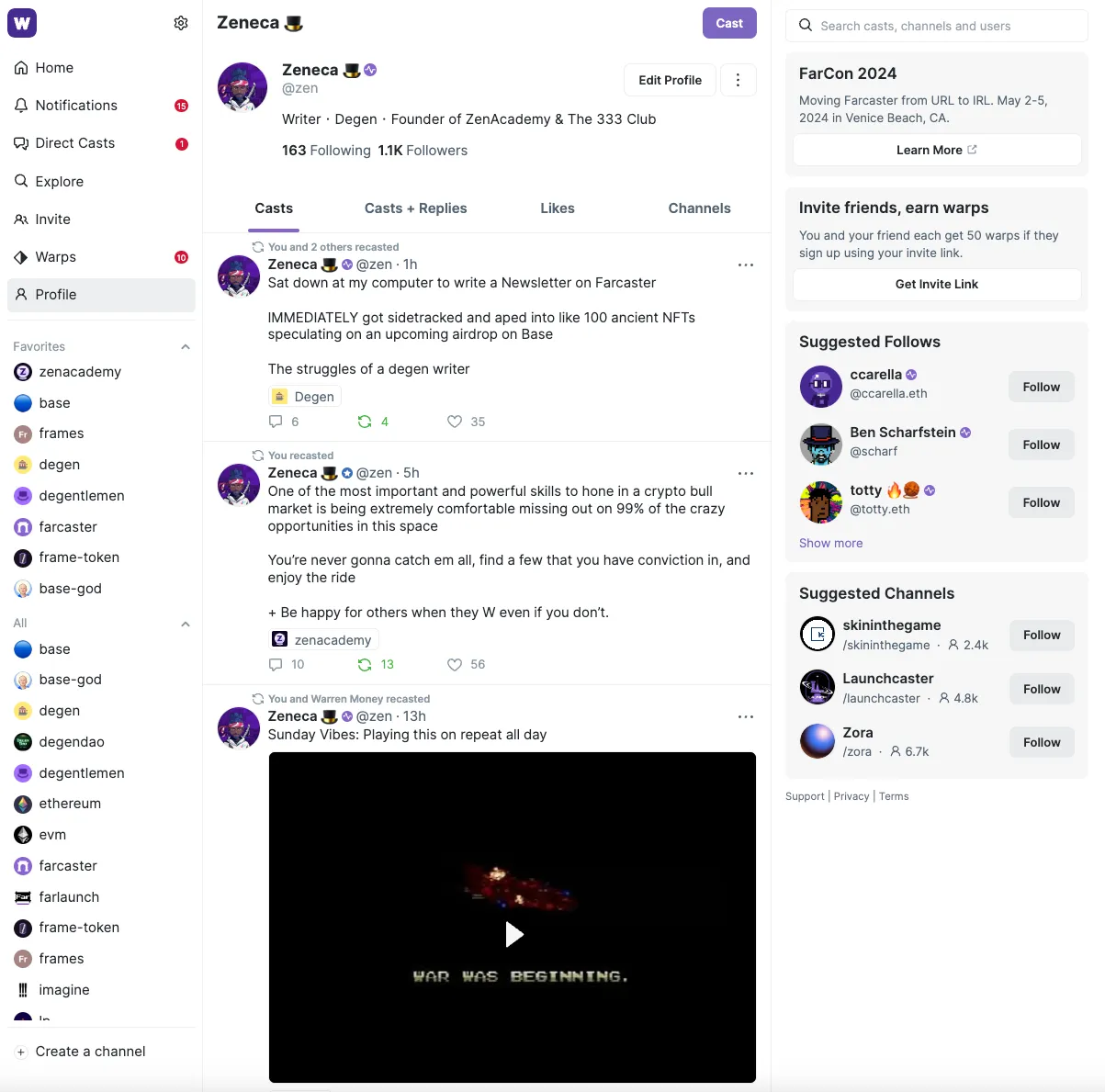
Starting with Warpcast, which is basically a clone of Twitter/X, making it familiar and comfortable for many. Here’s what my profile page looks like:
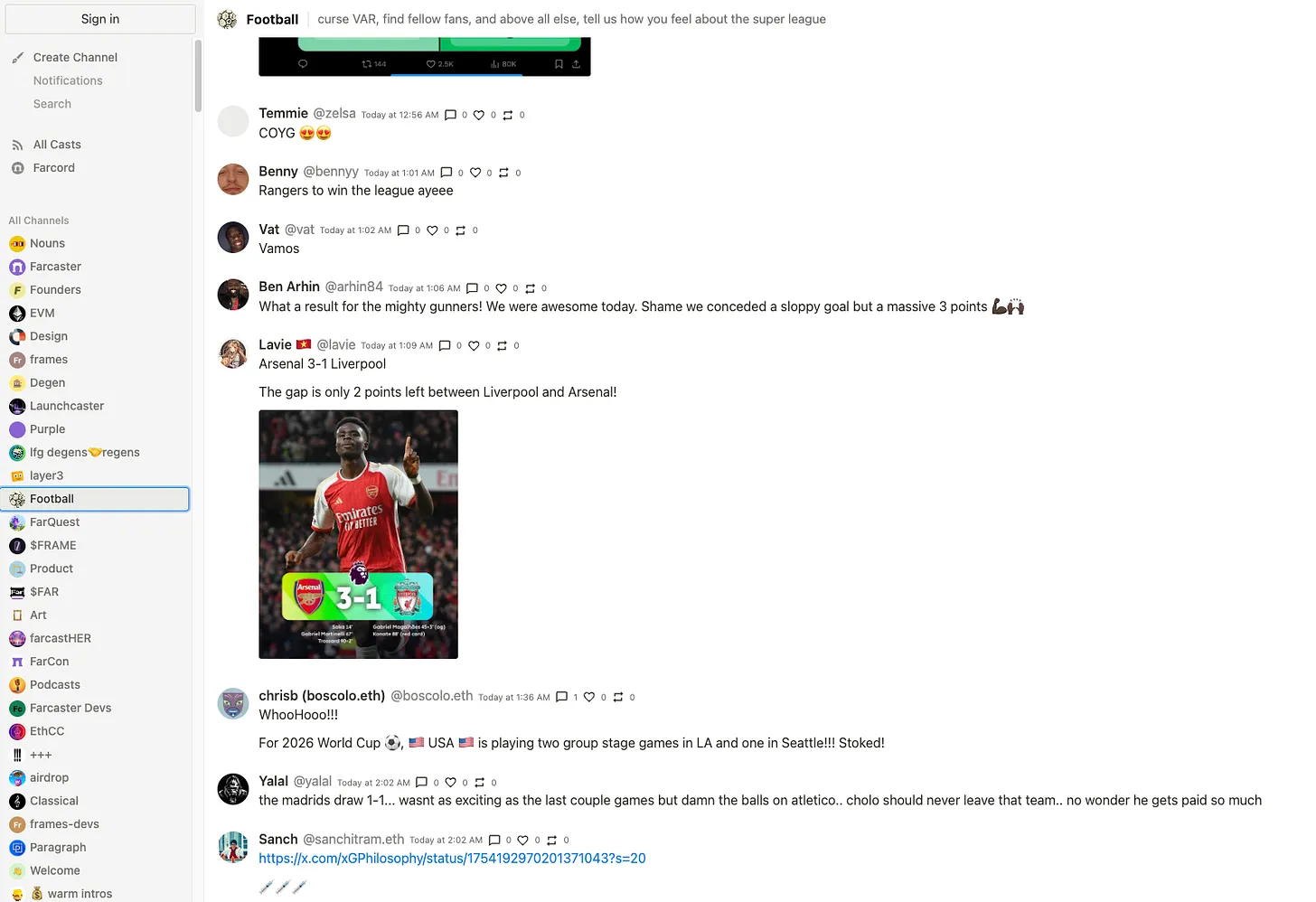
Here’s Farcord, a Discord-style app (remember, all these use the same account and the same content):
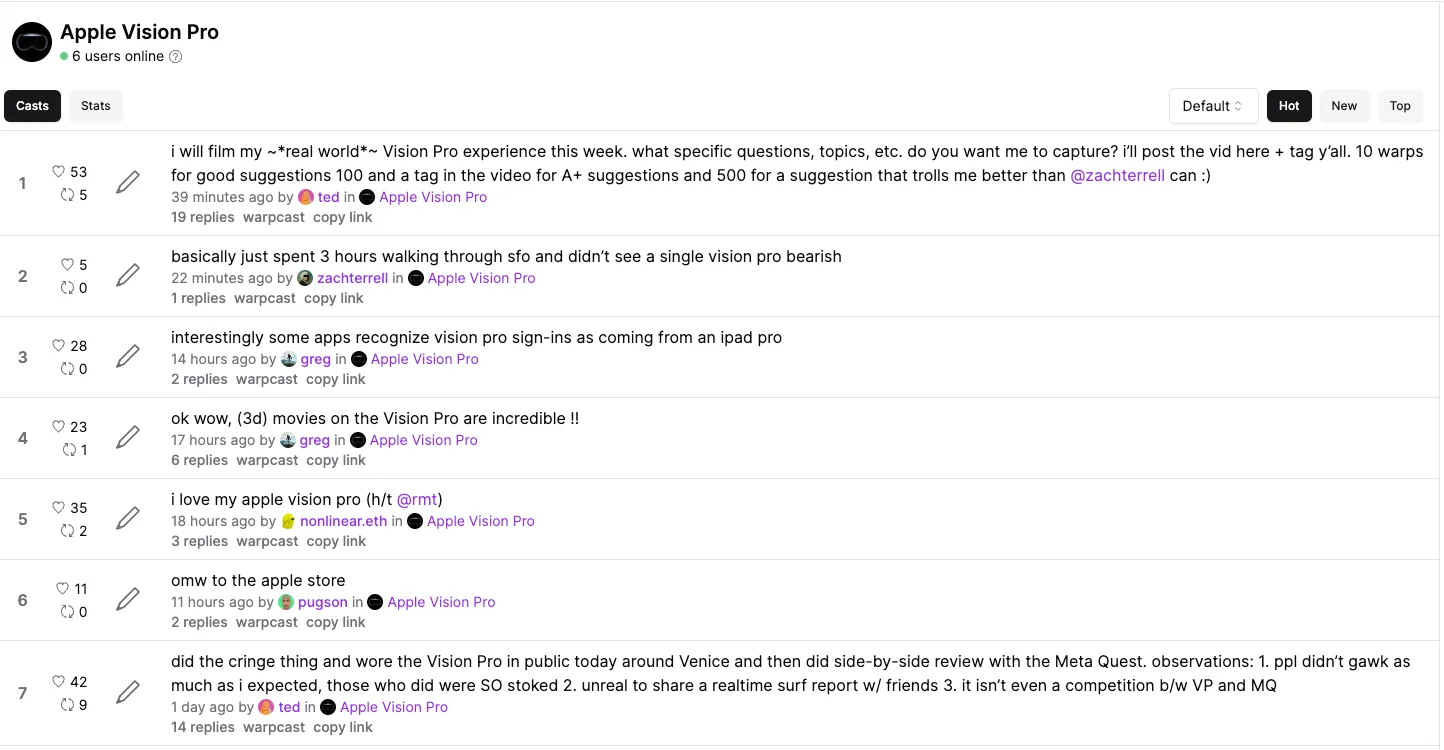
Here’s Flink, a Reddit-style app:
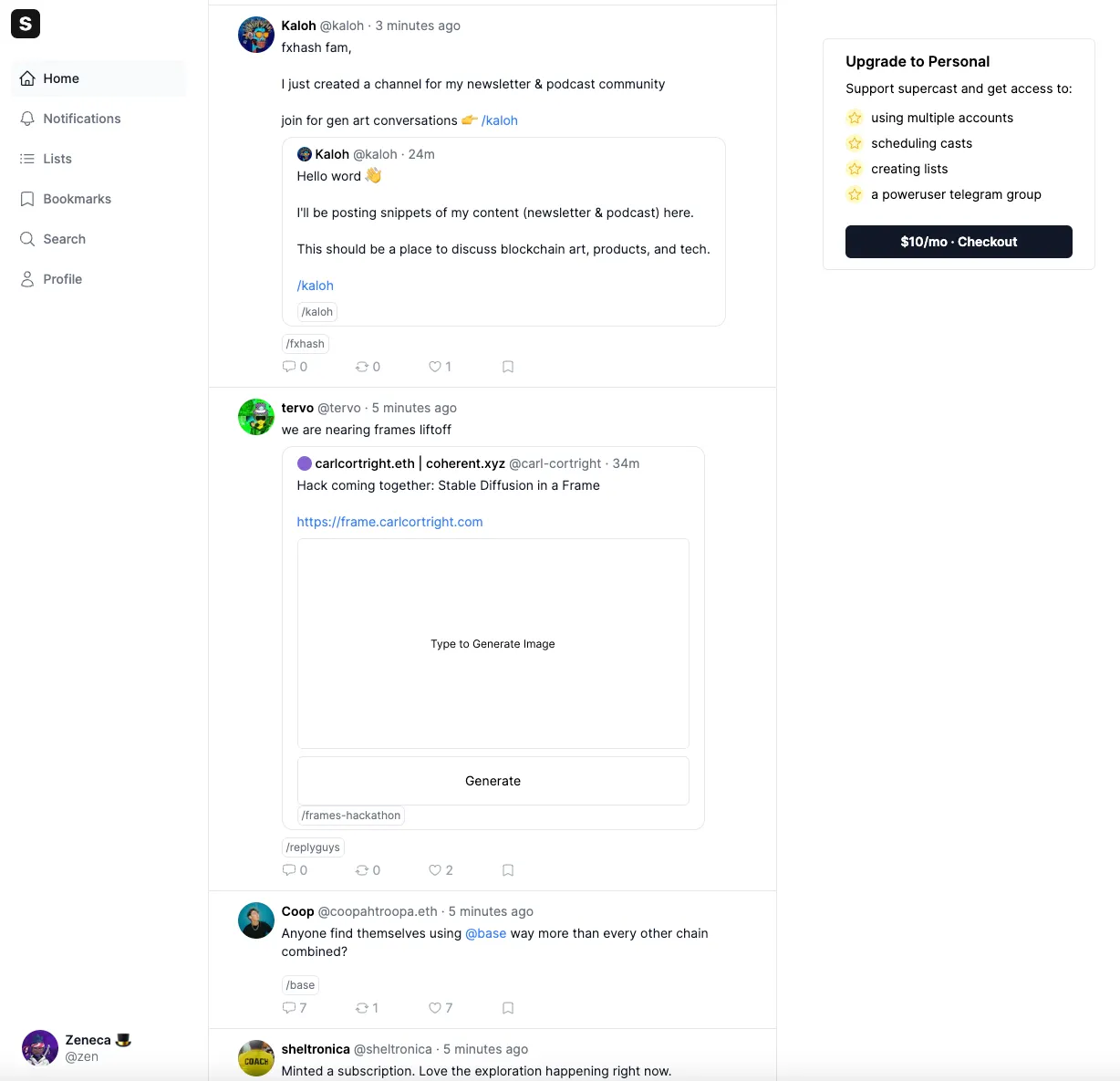
Here’s Supercast, another Twitter/X-style interface. Its key features include a reverse chronological feed by default showing posts from those you follow, plus a subscription model tailored for more advanced users:
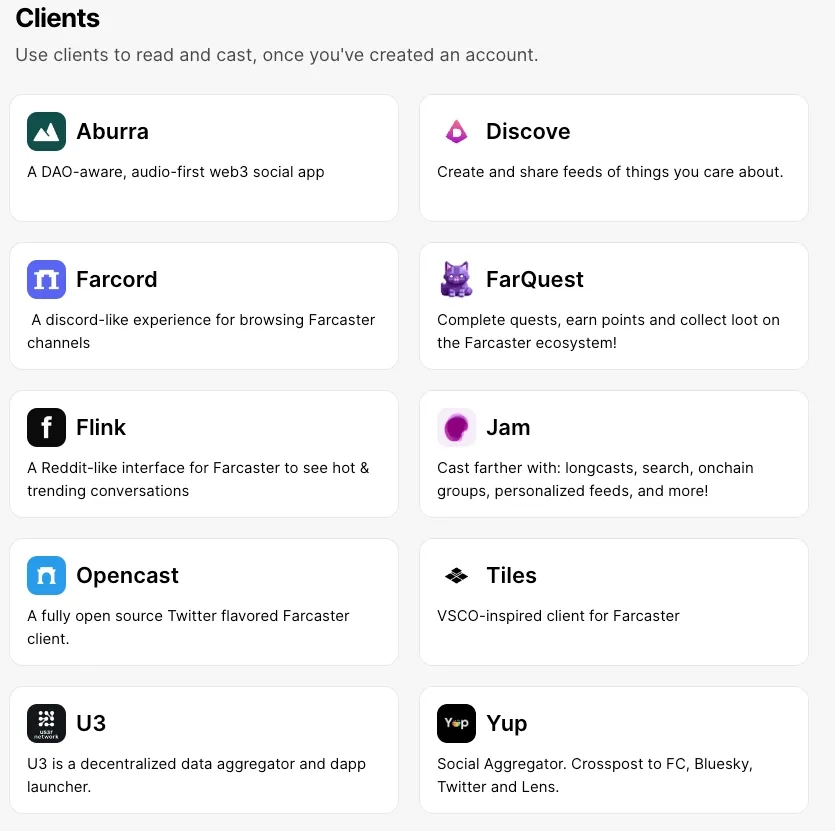
There are many more apps.
It’s thriving, developers are building, and from now on, things will only get better.
You might be thinking, “Okay, cool, but actually displacing existing social media platforms seems extremely difficult.”
You’re right—it absolutely is. I’m not sure the short-to-medium-term goal, plan, or even hope is to displace any platform, nor do I think it’s necessary. Twitter doesn’t need to die for Farcaster to succeed. We can live in a world with Facebook, Twitter, YouTube, Instagram, TikTok, Snapchat, and Farcaster. But how?
Again, quoting co-founder Varun Srinivasan:
-
Successful social networks are usually built around a new communications medium. Facebook had walls, Twitter had 140-character tweets, Snapchat had ephemeral messages. The possibilities enabled by decentralized identity, blockchain, and zk proofs are vast and numerous—there are likely many novel experiences waiting to be discovered. Decentralized social networks should explore these to attract users. Offering a product experience that doesn’t yet exist is far more compelling than cloning existing networks.
We’re still in the very early stages of Farcaster. If you can’t see how it might surpass X by merely being a clone of X, your imagination is too limited. That might not happen. Instead, it aims to become a social network in its own right—through novel and unique methods.
As the world increases its adoption of web3, we’ll see novel and exciting new approaches to decentralized social media.
Why So Hot Now?
Farcaster has existed since 2021. Launched by Dan Romero and Varun Srinivasan mentioned earlier, it has grown steadily and slowly, primarily attracting developers and hardcore crypto and decentralization enthusiasts.
Last week, they launched a feature called “Frames”:
-
Frames allow people to build small apps within casts
-
They’re essentially small interactive iframes embedded inside casts, hence the name. Like casts, handles, and channels, Frames work across any Farcaster client
-
Frames can support anything—from video games to voting, blockchain explorers, mints, purchases, prediction markets, and beyond
-
Frames are just a canvas—developers will figure out how to paint on them.
If you’re not a developer, this might seem minor—but the ability to build small apps directly within a social media platform/feed is actually groundbreaking. It unlocks tremendous creativity and innovation potential.
Frames quickly caught the attention of Crypto Twitter. Some Frames offer free mints—one-click minting directly from your feed. Others offer free token claims—one-click claiming directly from your feed, sending tokens straight to your connected ETH wallet.
If there’s one thing Crypto Twitter loves, it’s airdrops. If there’s another thing they love, it’s making money. Well, Farcaster has sparked attention and activity around both. Early protocol users have been richly rewarded, with many receiving token rewards worth four to five figures simply for being early active users.
And with that came increased user activity:
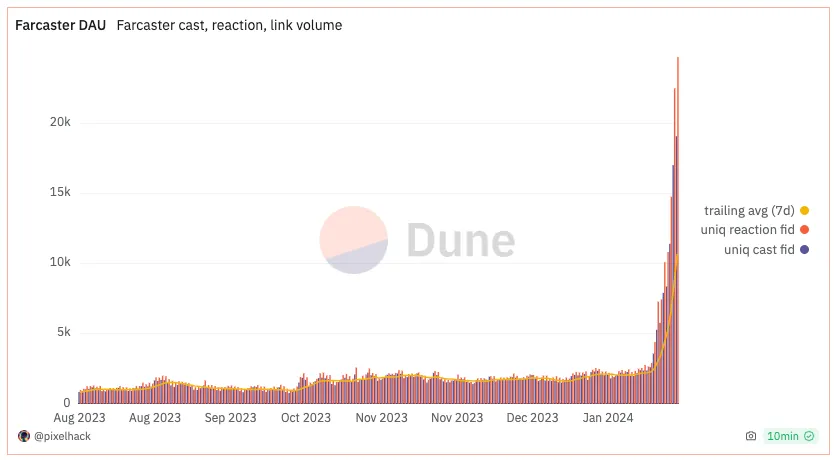
Regarding airdrops, the post below summarizes my feelings perfectly. It’s great to finally see airdrops rewarding genuine users rather than just airdrop farmers:
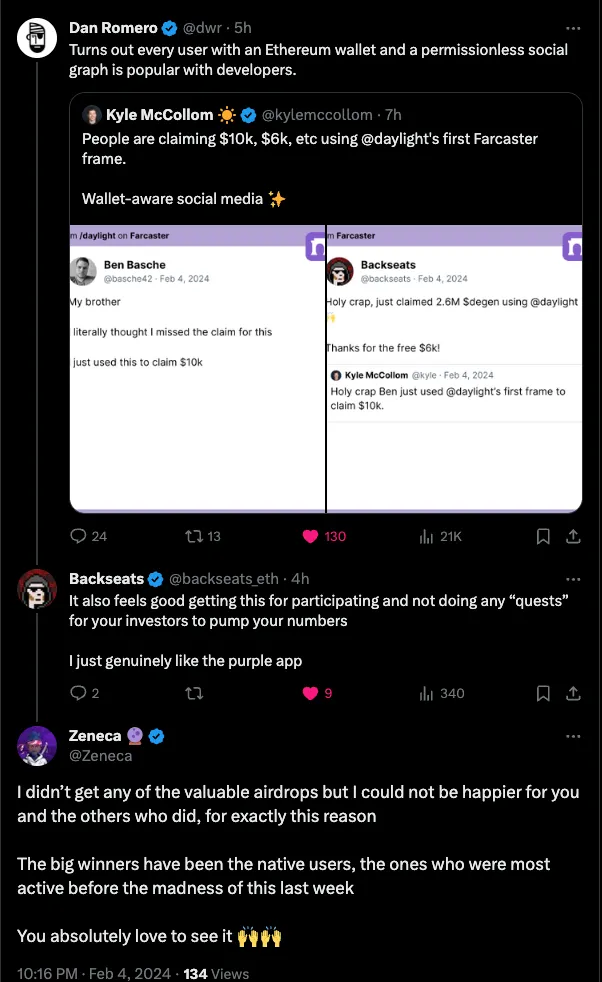
Frames attracted developers; speculation on tokens attracted degens.
Farcaster now has a vibrant community. It’s interesting, exciting, and feels genuinely great.
It appears $DEGEN (a token on Base Chain) is the token most people are choosing to speculate on. It’s not an official Farcaster token, nor is it VC-backed.
It was fairly distributed in a nice “bottom-up” way to protocol users. It’s a community token that has already airdropped to users and will continue doing so. If you want to learn how to participate, their website has more details.
One benefit of a permissionless protocol is that anyone can choose to integrate the token if they wish. With DEGEN, we’re already seeing NFT mints, exclusive airdrops for DEGEN holders, DAOs forming around the token, games built around it, and more.
It’s not just DEGEN having its moment—apparently, the entire Base (L2) ecosystem is flourishing due to Farcaster’s adoption. Developers, degens, and creators are all converging and interacting within the Farcaster ecosystem.
Another such community is Base God ($TYBG), whose first commandment is: You shall respect fellow community members, because all $TYBG and Base Gods holders are equal.
Their mission, the second commandment, is commendable: You shall be on-chain. Create content, tweets, on-chain apps, or anything else—and push it onto the chain. That is the way of the Onchain Disciple.
They’re educating people on how to transact on-chain and using memes to drive engagement. These lighthearted activities make something heavy and complex like decentralized social media fun and accessible to more people—not just developers.
Also, if there’s one thing I’ve learned as a crypto trader, it’s don’t fight them. I personally hold significant amounts of TYBG and DEGEN.
However, good things come with bad. It’s not all airdrops and roses. As you can imagine, countless users are now flooding into Farcaster trying to catch the next airdrop. The protocol is currently dealing with a lot of spam and noise. Fixes are underway as each client figures out how best to handle it.
At least, Warpcast is better today than yesterday thanks to some algorithmic adjustments.
If you don’t like it, there are many other clients to try.
How to Get Involved
I think the easiest way right now is through Warpcast. To create an account (via Warpcast), you need to download the app. Scan the QR code (or click here).
Depending on where you live, you may need to pay a small fee to get started. I know this is a barrier to entry, and for many people worldwide, it’s not trivial.
Once you have an account and log in, I recommend going to Settings → Connected Addresses → Connect, and linking one of your Ethereum addresses to your account. This will allow you to interact with Frames—for example, receiving NFT mints or token airdrops—and display NFTs on your profile.
I also suggest joining some channels and starting to interact with others. Follow your interests and connect with like-minded people. Good things often happen when people do this authentically. Here are some communities I recommend:
-
ZenAcademy, make sure to join the Zen community
-
Farcaster, a great first channel with lots of activity
-
Reply Guys, a friendly community welcoming newcomers from Crypto Twitter
-
Base, engage with the builder community on Base
-
The Yellow Collective, a club supporting and empowering artists and creatives
-
Degen, if you love meme coins and being a degen, this is the place for you
As you get more comfortable with Farcaster, check out some other apps built on Farcaster.
By now, I hope you understand. I hope you see why Farcaster is different from most other decentralized social attempts we’ve seen in crypto so far. Most importantly, Farcaster is not a Ponzi scheme!
Join TechFlow official community to stay tuned
Telegram:https://t.me/TechFlowDaily
X (Twitter):https://x.com/TechFlowPost
X (Twitter) EN:https://x.com/BlockFlow_News
 @Zeneca