Rollup Interoperability Protocol: The New Holy Grail in Modular Blockchain Primitives
TechFlow Selected TechFlow Selected
Rollup Interoperability Protocol: The New Holy Grail in Modular Blockchain Primitives
Interoperability between DApp rollups will become a market necessity.
 Navigating Web3 tides with focused insights
Author: NingNing
Entering 2024, modular blockchain infrastructure is rapidly maturing. A wave of new paradigm Dapp Rollup products—ranging from Perp DEXs and Web3 gaming infrastructures to OEV-resistant oracles and NFT marketplaces—are emerging atop this foundation.
Aevo, a next-generation Perp DEX built as a Dapp Rollup and即将开启交易 Farming, will launch the first major challenge by a new-paradigm Dapp against legacy platforms like GMX (built on general-purpose Rollups), potentially flipping the ceiling for perpetual contract CEXs such as Bybit in this bull market cycle.
The superpower of Dapp Rollups stems from their modular architecture.
As we know, modular blockchains decouple the monolithic structure into four layers: consensus, data availability (DA), settlement, and execution. By introducing Data Availability Sampling (DAS) and lightweight nodes for consensus validation, this architectural design achieves an optimal balance among decentralization, security, and scalability.
Today, each layer of the modular blockchain stack is thriving with innovation and growth.
In the data availability (DA) layer, key projects include Ethereum; Celestia DA, which uses optimistic/fraud proofs; Avail DA and Near DA, which use KZG commitments with validity proofs; and EigenDA (not yet launched), which leverages restaking validator sets combined with KZG-based validity verification.
In the settlement layer, leading projects include Dymension, enabling shared AMM liquidity and interoperability across modular Rollups, and Cevmos, bridging liquidity between modular Rollups and EVM-compatible chains.
The execution layer features two main categories: native modular execution layers such as Fuel and Eclipse, and SDKs provided by general-purpose Rollup frameworks including Op Stack, Arbitrum Orbit, Polygon CDK, and Zk Stack.
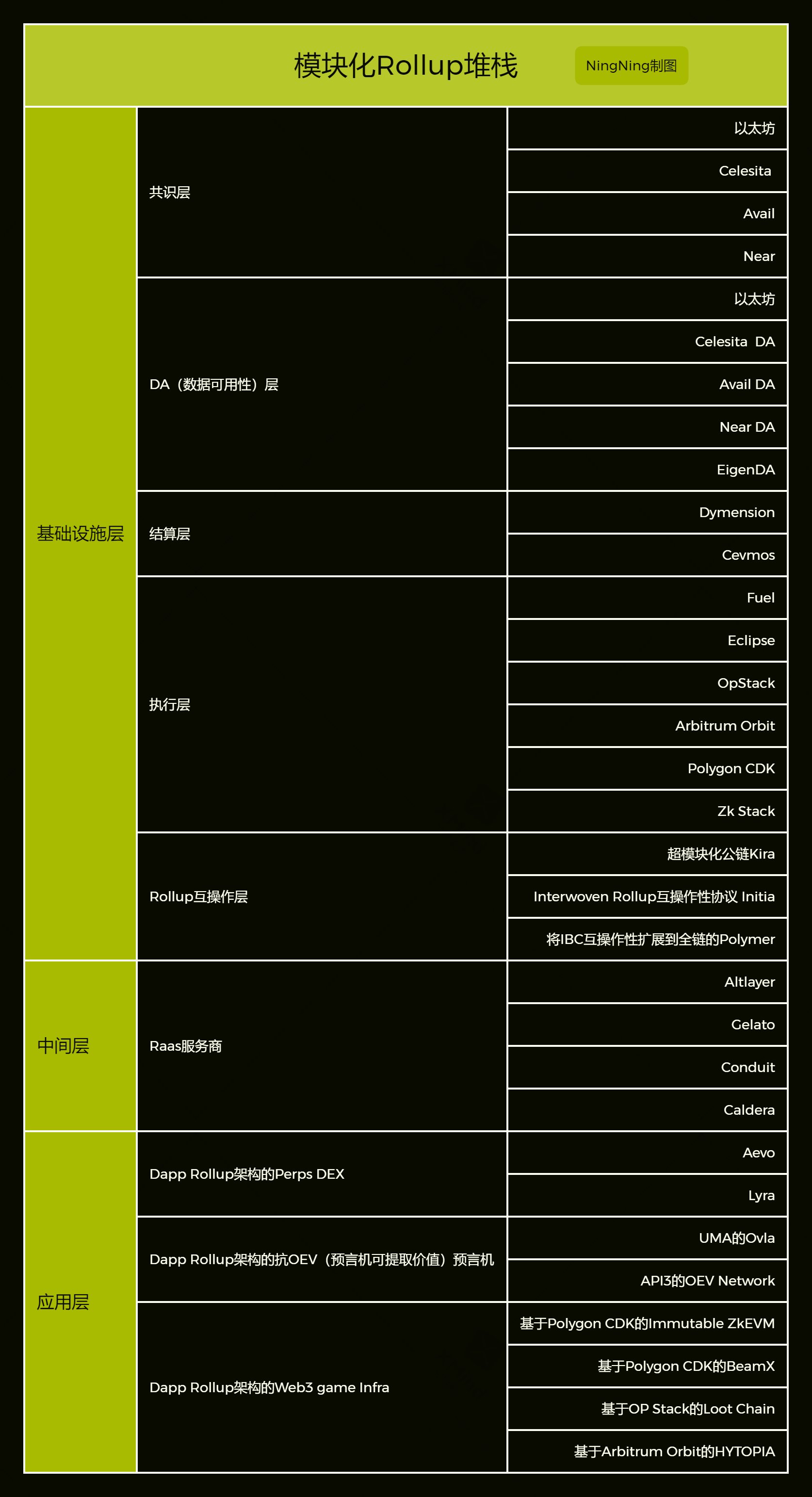
In crypto, supply often leads or even creates demand. As the Dapp Rollup paradigm gains momentum, numerous Rollup-as-a-Service (RaaS) providers have already emerged to help developers build Rollups using these modular stacks—projects such as Altlayer, Gelato, Conduit, and Caldera are now mainstream.
Among them, Conduit serves high-performance Dapp Rollups for Perp DEXs like Aevo and Lyra, while Caldera focuses on building Dapp Rollup infrastructure for Web3 games such as Loot Chain and HYTOPIA.
With mid-layer components now mature, the final missing piece of modular blockchain infrastructure—interoperability protocols for Dapp Rollups—has become a new battleground for innovation, fiercely contested by crypto VCs and developers alike.
Generally, interoperability protocols in crypto face a fundamental meta-problem: how can two distinct entities reach trustful consensus or consistency?
Blockchains solve the Alice<==>Bob problem; cross-chain bridges solve the Chain A <==> Chain B problem; Rollups solve the L1 <==> L2 problem.
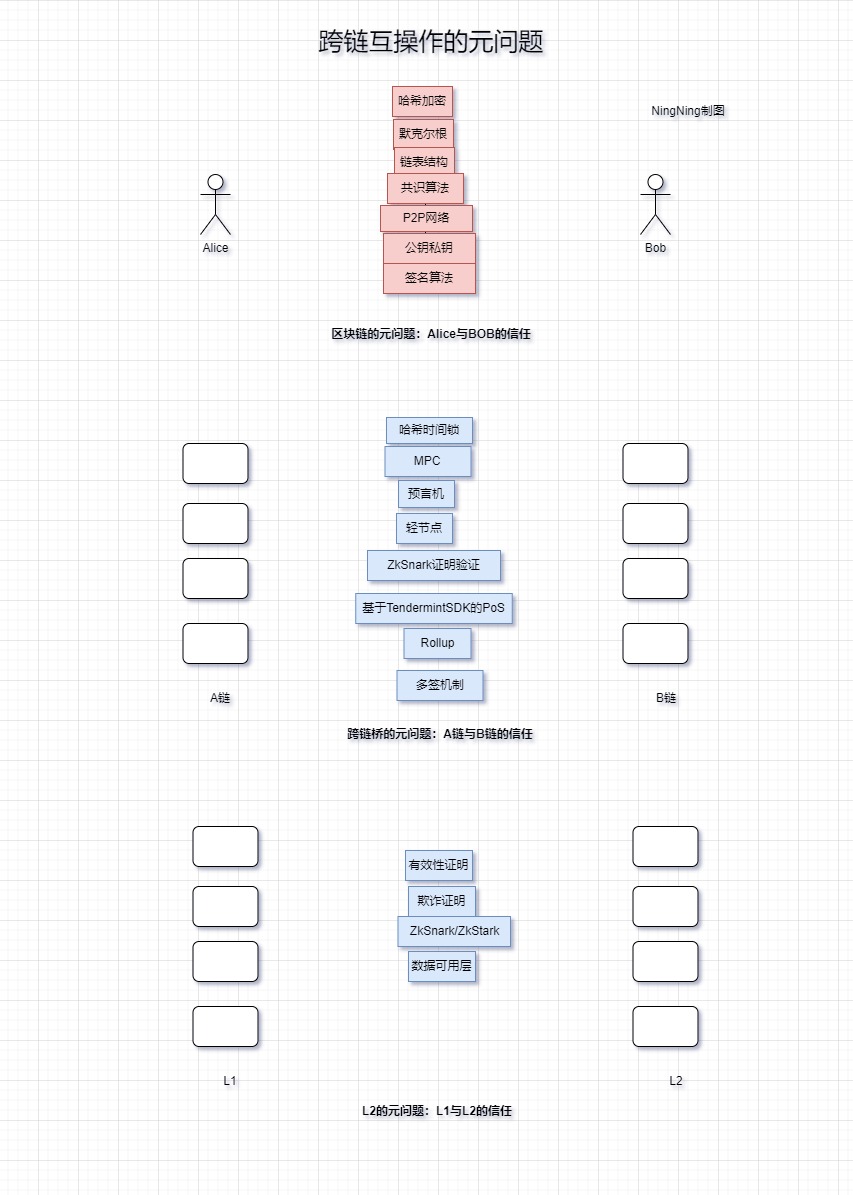
There are six classic paradigms for achieving cross-chain (including L1-L2) interoperability:
-
Hash Time-Lock Atomic Swaps
-
MPC Multi-Signature Relayer Layers
-
Tendermint SDK Relayer Layers
-
ZK Proofs + Light Clients
-
Light Clients + Oracles
-
Rollup Relayer Layers
Each of these six architectural paradigms requires trade-offs between security, finality, and capital efficiency.
Among them, the most trust-minimized cross-chain bridges adopt the L2<==>Rollup Relayer Layer<==>L2 architecture, exemplified by projects like Orbiter and Across.
This is also the model consistently advocated by Vitalik. However, adoption was previously limited due to Ethereum’s high gas fees (security costs) and long finality time (12 minutes). Now, with the maturation of modular blockchain infrastructure, both issues have been effectively resolved.
Currently, the Rollup interoperability protocols on my radar include:
Hyper-Modular Blockchain – KIRA Network
KIRA Network introduces new primitives of "hyper-modularity" and "finality." Its MF layer replicates the state of all chains and Rollups through a staking-slash game mechanism combined with block header verification, reducing network complexity from N<==>N to N<==>KIRA.
Interwoven Rollup Interoperability Protocol – Initia
Initia proposes a new primitive called Interwoven Rollup, though its documentation has not yet been released.
Polymer – Extending IBC Interoperability to All Chains
Polymer itself is an Ethereum Rollup that leverages IBC technology to enable interoperability between different Rollups. It uses OP Stack as the settlement layer, implements native IBC interoperability via Cosmos SDK, and relies on EigenDA for scalable data availability proofs.
Imagine, at the peak of this bull market cycle, one billion users active across a million Dapp Rollup applications. Interoperability between Dapp Rollups will then become a market imperative. This is why Rollup interoperability protocols—built using modular stacks and Rollup relayer layers—are becoming the new Holy Grail of modular blockchain primitives.
Join TechFlow official community to stay tuned
Telegram:https://t.me/TechFlowDaily
X (Twitter):https://x.com/TechFlowPost
X (Twitter) EN:https://x.com/BlockFlow_News
 @0xNing0x