
Restaking Sector Overview: How Many Projects You Can't Miss in the "Year of Staking"?
TechFlow Selected TechFlow Selected
Restaking Sector Overview: How Many Projects You Can't Miss in the "Year of Staking"?
Nearly 50 Projects: Can Restaking Spark a Major Market Rally?
 Navigating Web3 tides with focused insights
Author: Peng SUN, Foresight News
2024 is still awaiting a major market rally to fulfill the prediction of being the "Year of Staking."
From Cosmos and Solana ecosystems to Ethereum, staking for yield farming has become an industry-recognized wealth strategy. With increasing demand for liquid staking and capital efficiency on Ethereum, expectations around EigenLayer's token launch, AltLayer airdrop, and Renzo’s fundraising have directly ignited the Restaking race. Restaking was first proposed by Sreeram Kannan, founder of EigenLayer, allowing ETH already staked on Ethereum to be restaked onto other consensus protocols, enabling them to share Ethereum’s economic security for secure startup and operation.
Currently, points programs from Ethereum LRT projects such as Renzo, ether.fi, Kelp DAO, Eigenpie, Swell, and Puffer Finance are driving market FOMO. Beyond these mainstream players, are there other opportunities in the Restaking space? To address this, the author provides a brief overview of 47 projects—20 Ethereum-based Restaking protocols and seven cross-chain LRT protocols. In addition to EigenLayer-related Ethereum protocols, LRTFi, and infrastructure, this report also covers selected Restaking initiatives across Cosmos, NEAR, Solana, Bitcoin, BNB Chain, Polygon, Berachain, and others.
Restaking Protocols
EigenLayer
-
Token launched: No
-
Supported staking assets: ankrETH, cbETH, wBETH, oETH, swETH, stETH, ETHx, osETH, etc.
-
Multiple point accumulation: EigenLayer Points
EigenLayer is an Ethereum restaking protocol and the leader in the restaking sector, supporting LST tokens including ankrETH, cbETH, wBETH, oETH, swETH, stETH, ETHx, and osETH. Native ETH can also be restaked by Ethereum validators. According to DefiLlama data, EigenLayer’s TVL has exceeded $2 billion, rising over sevenfold since December 18.
Recently, EigenLayer launched the second phase testnet for both EigenLayer and EigenDA, with mainnet expected to go live in the first half of 2024. The third phase will introduce AVS (Active Validation Services) beyond EigenDA, anticipated to enter testnet and mainnet stages during 2024. Additionally, EigenLayer plans to offer a “shared security” model for DApps, allowing protocols to join the network by leveraging public Ethereum staking pools. Furthermore, the amount of ETH restaked on EigenLayer (currently over $1.7 billion) can simultaneously support all services built on the network, creating a shared security mechanism.
In February 2023, EigenLabs, the team behind EigenLayer, raised $50 million in a Series A round led by Blockchain Capital, with participation from Coinbase Ventures, Polychain Capital, Hack VC, Electric Capital, IOSG Ventures, among others. Terms were not disclosed.
Although EigenLayer has not issued a token yet, it has introduced “restaking points,” distributed based on users’ restaking duration and amounts. Recently, EigenLayer extended its restaking window to February 6–10 and removed caps for all LSTs.
Kelp DAO
-
Token launched: No
-
Supported staking assets: ETHx, sfrxETH, stETH
-
Multiple point accumulation: Yes
Kelp DAO is a multi-chain liquid staking platform. Its founders previously created Stader Labs, a liquid staking protocol that ranks second in LSD market share on both Polygon and BNB Chain. According to DefiLlama, Kelp DAO currently holds a TVL of $255 million.
Kelp DAO is building an LRT solution on EigenLayer, issuing rsETH as its restaking token. Supported LSTs include ETHx (Stader), sfrxETH (Frax), and stETH (Lido). Users deposit eligible assets to receive rsETH, whose price reflects accumulated rewards and underlying LST value. rsETH can be used across various DeFi protocols.
Kelp DAO has launched Kelp Miles, a loyalty program tracking user contributions to determine future reward allocations. Kelp Miles are calculated based on the quantity of LST restaked and number of days staked. Users who deposited LST between December 12, 2023, and January 1, 2024, will earn 1.25x Kelp Miles over the next three months. Deposits after January 1 will earn standard rates.
Additionally, all users who restaked via Kelp before EigenLayer’s deposit cap closed are eligible for EigenLayer Points, allocated proportionally to their LST deposits.
ether.fi
-
Token launched: No
-
Supported staking assets: ETH
-
Multiple point accumulation: Yes
ether.fi is a liquid staking platform that launched its liquid restaking token eETH on November 15, 2023. It allows users to stake ETH to earn staking rewards while automatically restaking within EigenLayer without manual intervention. eETH is usable in DeFi platforms like Pendle, Curve, Balancer, Maverick, Gravita, Term Finance, and Smmelier. eETH can be wrapped into weETH, which will later be supported on Balancer, Gravita, Pendle, Aura, and Maverick. Additionally, ether.fi plans to launch Staders for staking eETH. According to DefiLlama, ether.fi’s TVL stands at $507 million.
ether.fi has introduced loyalty points. Holders of eETH or weETH receive 100% loyalty points and EigenLayer Points. Loyalty points may be used for decentralized governance and are non-transferable. Loyalty Points = staked ETH * 1000 * number of staking days.
Eigenpie
-
Token launched: No
-
Supported staking assets: swETH, wBETH, mETH, sfrxETH, rETH, stETH, etc.
-
Multiple point accumulation: EigenLayer Points coming soon
Eigenpie is a SubDAO under Magpie, a multi-chain yield protocol offering liquid restaking services. Users can restake LSTs such as swETH, wBETH, mETH, sfrxETH, rETH, and stETH into Eigenpie. Since opening its LST pre-deposit window on January 28, TVL has surpassed $100 million, reaching $116 million. Pre-deposits are open until 03:00 UTC, February 10.
On January 23, Eigenpie revealed EGP tokenomics: total supply of 10 million, allocated as IDO (40%), community incentives (35%), Magpie Treasury (15%), and early supporter airdrop (10%). Eigenpie commits to a fair launch with no VC or private sale involvement, ensuring equal opportunity. The team waives personal allocation, assigning 15% to Magpie Treasury.
Eigenpie has launched a points reward system: users earn one Eigenpie Point per hour for every 1 ETH equivalent of LST deposited. Depositors during the first 15 days receive double points. These points qualify for airdrops and IDO participation.
Renzo
-
Token launched: No
-
Supported staking assets: ETH
-
Multiple point accumulation: Yes
Renzo is an Ethereum staking protocol built on EigenLayer. Its mainnet launched on December 18 last year, introducing native ETH restaking functionality, enabling users to earn restaking yields and full EigenLayer Points. For each LST or ETH deposited, an equivalent amount of ezETH is minted. Renzo operates a distributed validator infrastructure backed by Figment and P2P.org, allowing unlimited participation in EigenLayer. When depositing native ETH, users must meet a minimum threshold of 32 ETH to participate via Ethereum beacon chain validators. Renzo also plans to launch a Trade feature. According to DefiLlama, Renzo’s TVL is approximately $155 million.
On January 16, 2024, Renzo raised $3.2 million in a seed round led by Maven11, with participation from OKX Ventures, IOSG Ventures, Figment Capital, SevenX Ventures, and others, achieving a $25 million valuation.
Renzo has launched its ezPoints program. ezETH holders earn 1 ezPoint per hour. Early users receive bonuses. Liquidity providers in the ezETH/WETH pool get 2x ezPoints and can invite new users to earn additional exPoints.
Puffer Finance
-
Token launched: No
-
Supported staking assets: stETH, wstETH
-
Multiple point accumulation: Yes
Puffer Finance is a native liquid restaking protocol built on EigenLayer, composed of stakers and node operators (NoOps). Users need only hold 1 ETH to run a validator and retain 100% of PoS rewards (including execution and consensus rewards). NoOps can delegate their validators as restaking operators (ReOps) to earn additional restaking rewards, while retaining control over MEV strategies. Stakers can deposit any amount of ETH to receive pufETH, a native liquid restaking token (nLRT). pufETH adopts Compound’s cToken mechanism, making it fully compatible with DeFi protocols. The value of pufETH increases over time as validator tickets are minted and PoS restaking rewards accumulate.
A key difference between Puffer’s nLRT and other LRTs is that nLRT earns both traditional PoS rewards and restaking rewards, whereas most other restaking protocols only offer积分 tied to their native tokens.
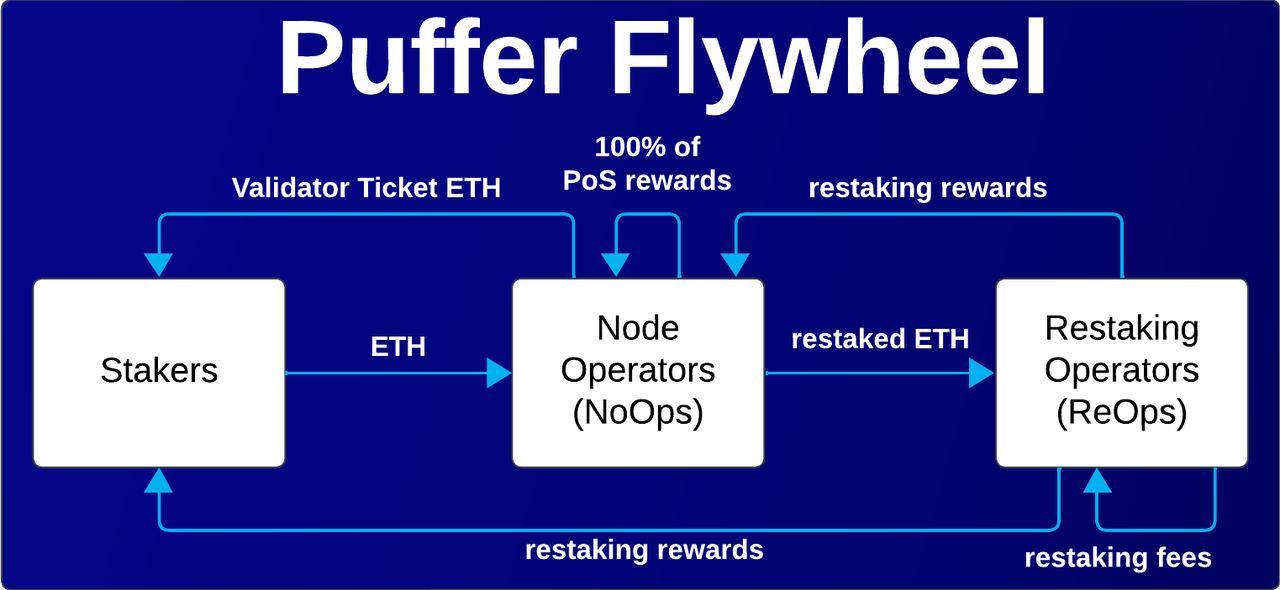
Source: Puffer Docs
On September 1, 2023, multiple Ethereum liquid staking providers including Rocket Pool, StakeWise, Stader Labs, Diva Stake, Puffer Finance, and Swell Network committed (or are committing) to limit their holdings to no more than 22% of total staked ETH, aiming to counter growing centralization in the Ethereum staking market.
In August 2023, Puffer Finance raised $5.5 million in a seed round co-led by Lemniscap and Lightspeed Faction, with participation from Brevan Howard Digital, Bankless Ventures, Animoca Ventures, KuCoin Ventures, DACM, LBank Labs, SNZ, Canonical Crypto, 33DAO, WAGMI33, Concave, and angel investors including Anand Iyer (Lightspeed partner), Sreeram Kannan (EigenLayer founder), Frederick Allen (Head of Staking at Coinbase), Shen Yu (co-founder of F2Pool and Cobo), Mr. Block (core contributor to Curve), Ramble (President of North American Blockchain Association), Calvin Liu (Chief Strategy Officer at EigenLayer), Richard Malone (Chief Business Officer at Obol), and Ladislaus von Daniels (staking community leader).
On January 30, 2024, Binance Labs announced an investment in LSD protocol Puffer Finance; the amount was not disclosed.
Puffer Finance is set to open staking for ETH, stETH, USDT, and USDC, with users earning both Puffer and EigenLayer积分. Additionally, Puffer launched the Crunchy Carrot campaign on January 30, allowing users to link Twitter and wallet accounts, select a “Family,” retweet promotional posts, earn积分, and view leaderboards. The first staking phase has ended early, and phase two is now live, with TVL surpassing $150 million.
Swell Network
-
Token launched: No
-
Supported staking assets: ETH
-
Multiple point accumulation: Yes
Swell Network is an Ethereum staking protocol that launched its restaking token rswETH (Restaked Swell Ether) on January 30 this year, offering uncapped access to EigenLayer restaking积分, usable in DeFi while continuing to accrue restaking rewards. Currently, rswETH 1.0 allows users to deposit ETH to receive rswETH and earn restaking rewards in the form of Pearls and EigenLayer restaking积分. According to DefiLlama, Swell’s TVL is $457 million, with $4.43 million in Liquid Restaking TVL.
On March 14, 2022, Swell Network raised $3.75 million in a funding round led by Framework Ventures.
Swell’s native token SWELL has not been launched, and tokenomics remain undisclosed.
Stakestone
-
Token launched: No
-
Supported staking assets: ETH
-
Multiple point accumulation: Not currently
Stakestone is a one-stop, cross-chain LST staking protocol targeting Lido, bringing native staking yields and liquidity to Layer 2. It supports top-tier staking pools, enables restaking, and plans to integrate EigenLayer. StakeStone supports restaking on the Ethereum beacon chain and LST restaking, aiming to become a leading restaking protocol.
According to DefiLlama, from December 15, 2023, to January 3, 2024—just three weeks—StakeStone’s TVL surged from $4.17 million to $542 million, currently standing at $669 million. StakeStone is deeply involved in Manta’s incentive program, providing $720 million in liquidity out of Manta New Paradigm’s $9 billion TVL.
StakeStone’s native LST is STONE, now officially upgraded to a cross-chain LRT. STONE is an OFT based on LayerZero, seamlessly usable across multi-chain liquidity markets such as DEXs, AMMs, lending, stablecoins, derivatives, GameFi, and SocialFi. Unlike rebase mechanisms, STONE functions similarly to Lido’s wstETH in terms of yield accrual—its quantity remains fixed, but its value increases with ETH staking rewards. This utility resembles Puffer’s cToken model.
StakeStone has not launched a token yet and is expected to roll out airdrop activities. Currently, users can stake ETH on StakeStone and earn yields through the STONE-Fi ecosystem.
ClayStack
-
Token launched: No
-
Supported staking assets: ETH, rETH, stETH
-
Multiple point accumulation: Yes
ClayStack is a liquid staking platform that entered the Ethereum restaking space via EigenLayer on January 24. ClayStack rebranded its liquid staking token csETH as a restaking token and now uses EigenLayer to deliver new services. Currently, ClayStack supports restaking ETH, rETH, and stETH. According to DefiLlama, ClayStack’s TVL is $3.96 million.
CLAY is ClayStack’s native token, with issuance plans to be announced in February. Prior to token launch, CLAY will be distributed 1:1 as reward积分. Total supply is 100 million, with 5% allocated to the IGD (Initial Governance Diversification) program for the community.
Users can stake ETH or LSTs to earn both CLAY积分 and EigenLayer积分, with no caps. During the IGD period, users receive enhanced CLAY rewards. As weekly ETH deposits grow, demand for csETH increases, along with CLAY积分 distribution.
Inception
-
Token launched: No
-
Supported staking assets: stETH, rETH, ankrETH, cbETH, wBETH, oETH, osETH, swETH, ETHx, sfrxETH, mETH, etc.
-
Multiple point accumulation: No
Inception is an isolated liquid restaking protocol supporting restaking of various LSTs—including stETH, rETH, ankrETH, cbETH, wBETH, oETH, osETH, swETH, ETHx, sfrxETH, and mETH—and issuing isolated liquid restaking tokens (iLRTs). iLRTs can be used in DeFi while remaining isolated from their underlying LSTs.
Inception has launched on Ethereum mainnet with a current TVL of $65,000. It plans to expand to other Layer 2 networks and integrate with multiple DeFi protocols.
Per its roadmap, Inception plans to conduct a private sale in Q1 2024, launch mainnet, initiate TGE in Q2, and develop cross-chain and modular LRT. InceptionLRT will issue a native token ING, with current allocation as follows: 2.5% for Pre-Seed, 9% Seed, 10% Private Sale, 6% Treasury, 6% Advisors, 3% Marketing, 15% Team, and 48.5% for liquidity incentives.
Sommelier Finance
-
Token launched: Yes
-
Supported staking assets: eETH, stETH, swETH
-
Multiple point accumulation: Yes
Sommelier Finance is a decentralized asset management protocol built using the Cosmos SDK. It has launched restaking vaults Turbo eETH, Turbo stETH, and Turbo swETH. Depositing in the eETH vault also earns ether.fi loyalty points.
According to DefiLlama, Sommelier’s TVL is currently $60.23 million.
Sommelier’s native token SOMM has a total supply of 500 million, with full distribution completed to all investors by August 2023.
Astrid
-
Token launched: No
-
Supported staking assets: stETH, rETH, or cbETH
-
Multiple point accumulation: Not currently
Astrid is an Ethereum liquid restaking protocol powered by EigenLayer. Users deposit LSTs (stETH, rETH, or cbETH) into restaking pools and receive Astrid liquid restaking tokens (LRTs): rstETH, rrETH, or rcbETH. These LSTs are restaked on EigenLayer and delegated to multiple operators voted on by the Astrid DAO. Rewards are compounded and restaked back into EigenLayer, distributed via balance resets so LRT holders see automatic balance adjustments.
Astrid has launched a testnet and introduced restaking积分. Astrid积分 are determined by the amount of ETH restaked and duration, totaling stETH积分 plus rETH积分.
GenesisLRT
-
Token launched: No
-
Supported staking assets: ETH
-
Multiple point accumulation: Not currently
GenesisLRT is a restaking platform allowing ETH to be restaked across multiple networks in exchange for the restaking token genETH. Currently, GenesisLRT has launched a testnet, with mainnet not yet live. According to its website, testnet restaked ETH TVL is $147 million.
According to its roadmap, GenesisLRT aims to complete a seed round and raise $3 million in a private sale in Q1, deploy its governance token GEN, launch TGE and GEN airdrop in Q2, and develop cross-chain and modular LRT in the second half of the year.
Restaking Cloud - K2
Restaking Cloud - K2 is an Ethereum liquid restaking protocol currently on testnet, supporting kETH, stETH, rETH, dETH, and ETH for restaking in exchange for K2, though TVL remains at 0.
Rest Finance
-
Token launched: No
-
Supported staking assets: ETH, stETH, rETH, cbETH, etc.
-
Multiple point accumulation: Yes
Rest Finance is an ACM (Algorithmic Collateral Management)-enhanced liquid staking solution. Users can stake ETH, stETH, rETH, cbETH, and other LSTs to receive restETH, a liquid restaking token. Holding restETH grants real-time access to LST rewards and EigenLayer AVS rewards. ACM provides deep liquidity, higher yields, and improved peg stability for the protocol.
Rest Finance launched on January 29, but according to its website, TVL is currently 0.
The native token REST has not been issued yet. Total supply is 100 million, with FDV at $20 million. Allocation: 10% to Investor Reserve, 20% to contributors, 5% to DAO treasury, 5% to initial liquidity, and 60% to token release. The REST call option oREST allows holders to purchase REST at a discount, with premiums paid directly to the protocol upon exercise.
Restake Finance DAO (RestakeFi)
-
Token launched: No
-
Supported staking assets: LST
-
Multiple point accumulation: Yes
RestakeFi is a modular liquid restaking platform powered by EigenLayer. Users deposit LSTs into RestakeFi to receive rstETH, its restaking token. rstETH holders earn native EigenLayer rewards and Ethereum staking rewards. rstETH is tradable on DEXs and will be integrated into DeFi protocols. According to official documentation, RestakeFi will initially integrate stETH, followed by other LSTs.
Currently, RestakeFi is on testnet; mainnet has not launched.
In September 2023, RestakeFi raised $500,000 in a seed round with participation from AlfaDAO, DCD, Yields and More, and Moni.
StakeEase
-
Token launched: No
-
Supported staking assets: LST
-
Multiple point accumulation: No
StakeEase is a cross-chain restaking aggregator powered by Router’s Cross-Chain Intent Framework (CCIF), enabling one-click completion of multi-step restaking processes. On January 18, StakeEase launched on Ethereum Goerli testnet, supporting ETH staking via Stader and restaking via Kelp.
StakeEase will soon launch a points system and go live on mainnet, integrating more protocols and LSTs.
YieldNest
YieldNest is a liquid restaking protocol supported by EigenLayer. Its product has not yet launched.
Euclid Finance
-
Token launched: No
-
Supported staking assets: ETH, LST
-
Multiple point accumulation: Yes
Euclid Finance is a cross-chain liquid restaking protocol based on EigenLayer. Users can restake ETH and LSTs to receive elETH, an LRT that auto-compounds. Holding elETH earns restaking rewards, EigenLayer积分, and Euclid governance token ECL rewards. Additionally, users who independently stake ECL and restake ETH or LSTs can join the operator node network.
The product has not launched, and token details have not been disclosed.
Rio Network
Rio Network is a liquid restaking network. Its first liquid restaking token is reETH. The restaking product has not launched yet. Chorus One, Figment, HashKey Cloud, Kiln, and Unit 410 are Rio’s first batch of node operators, running ETH validators and maintaining AVS.
According to official documents, Rio Network has completed a seed round co-led by Polygon Capital, Blockchain Capital, and Breyer Capital.
Layerless
Layerless is a cross-chain liquid restaking protocol supported by EigenLayer and LayerZero. Launched on January 4, it lacks a formal website and plans to launch its testnet in the first week of February. Layerless is developing an omnichain restaking token (ORT). Users can deposit EigenLayer-supported LSTs into EigenLayer via Layerless. The received ORT will be liquid and usable in DeFi protocols.
LRTFi
Agilely
Agilely is a liquid restaking derivatives protocol that has introduced a decentralized lending protocol on Arbitrum and launched USDA (Agilely USD), a cross-chain interest-bearing stablecoin powered by LayerZero. USDA is backed by collateral including ETH, wstETH, rETH, cbETH, sfrxETH, wBTC, ARB, GLP, GMX, and LRT. Currently, the product supports minting USDA using ETH, wstETH, rETH, wBTC, sfrxETH, and cbETH, but not yet LRT or other assets. Users can deposit these assets to create Vaults and borrow USDA.
Agilely currently supports Arbitrum, BNB Chain, and Polygon. Its native token AGL has not launched and will be released through public sales and a points program.
Entangle
Entangle is a cross-chain DeFi protocol featuring Liquid Vaults, oracle services, and the Photon communication protocol. Entangle aims to enter the restaking space, allowing users to deposit LP tokens or staking tokens into Liquid Vaults to receive LSDs backed 1:1, which can then be restaked or traded. Entangle currently supports 11 blockchain networks. It has launched a testnet and initiated a testnet incentive program.
In January 2024, Entangle raised $4 million in seed and private rounds, with participation from Big Brain Holdings, Launch Code Capital, LBank Labs, Skynet EGLD Capital, Cogitent Ventures, Owl Ventures, Faculty Group, and Seier Capital.
Entangle’s native token NGL has not launched.
Ion Protocol
Ion Protocol is a liquidity unlocking protocol for stakers and a lending platform for staked and restaked assets. Users can deposit any validator-backed asset—including LSTs, LST LP positions, restaked positions, liquid restaked positions, staked LST LP positions, LST index products—into collateral vaults and mint allETH against their deposits.
Currently, Ion Protocol has launched Testnet V2.
In July 2023, Ion Protocol raised $2 million in a Pre-Seed round co-led by Portal Ventures and SevenX Ventures, with participation from Foresight X, Bankless Ventures, Maelstrom Fund, Alexander, Anthony Sassano (sassal.eth, founder of The Daily Gwei), and Ryan Watkins (co-founder of Syncracy Capital).
Additionally, Ion Protocol was selected in March 2023 as one of the inaugural projects in Foresight X’s Accelerator Program.
Pendle
-
Token launched: Yes
-
Supported staking assets: eETH, reETH, ezETH
-
Multiple point accumulation: Yes
Pendle is a DeFi yield protocol that recently launched Pendle LRT pools, currently supporting eETH from Ether.fi, reETH from Kelp DAO, and ezETH from Renzo Finance. Users purchasing Pendle YT tokens can earn corresponding LRT protocol积分 (2–3x) and EigenLayer积分 (1x).
Equilibria
Equilibria is a yield booster on Pendle, utilizing Pendle’s veToken/yield amplification model. Through the tokenized version of vePendle called ePENDLE, it offers LPs higher yields and additional rewards for PENDLE holders. LPs on Pendle can deposit via Equilibria to boost yields without holding any vePENDLE. PENDLE holders can mint ePENDLE from PENDLE, which can then be restaked to earn extra returns.
Maverick Protocol
Maverick Protocol is a DeFi infrastructure enabling liquidity providers to achieve high capital efficiency through customizable LP strategies. It now supports LRTs and related assets such as rsETH, rswETH, and weETH.
In June 2023, Maverick Protocol raised $9 million in a strategic round led by Founders Fund, with participation from Pantera Capital, Binance Labs, Coinbase Ventures, and Apollo Crypto. Funds will scale the protocol, deploy to new chains, and support developer growth. Maverick Protocol was also the 34th project on Binance Launchpool.
Davos
Davos is an over-collateralized stablecoin project that has integrated LSTs and LRTs as collateral for its CDPs. Users deposit collateral to mint and borrow its cross-chain stablecoin DUSD. For LSTs, Davos sets the loan-to-value (LTV) ratio at 66%, ensuring DUSD loans are over-collateralized by 150%. Davos supports Ethereum, Polygon, Arbitrum, Optimism, Polygon zkEVM, BNB Smart Chain, Linea, and Avalanche.
According to DefiLlama, Davos TVL is approximately $486,000.
In January 2023, Davos raised $500,000 in a Pre-Seed round with participation from Polygon Ventures and Sandeep Nailwal, co-founder of Polygon. In March of the same year, it received investments from MH Ventures and LD Capital. Additionally, Davos participated in OKX Web3 Wallet’s Cryptopedia Season 7 event in September 2023.
Ender Protocol
Ender Protocol is a liquid staking protocol allowing users to mint centralized yield tokens and liquid staking power tokens END, fully backed by liquid staking rewards from Ender Bond deposits. Ender will launch endETH and build a restaking solution on the EigenLayer stack. In a tweet on January 31, Ender described itself as an all-in-one protocol combining liquid staking, restaking, yield separation, yield provision, LST-bond, compressed yield transformation, metaverse bond, liquid-staking-driven metaverse, L2-EVOS, superfluid restaking, and liquidity provision derivatives—an effort to become a yield-based trading platform similar to Pendle.
Users can mint Ender WL NFT#2 for early access and ENDR airdrop eligibility, with no VC or private sale participation and no internal allocation. Users can also participate in Bond Liquidity Provision (BLP) events to qualify for airdrops.
Restaking Chains
Supermeta
Supermeta is a zkLayer2 dedicated to liquid restaking. Users can deposit supported LSDs into its Layer2 bridge and receive LSTs, along with auto-compounding ETH and EigenLayer rewards. Supermeta’s LRT can serve as collateral or enhance liquidity on its native DEX.
Currently, Supermeta’s product has not launched.
Tenet
Tenet is a restaking chain introducing the DiPoS consensus mechanism, allowing LSDs from other networks to be restaked into Tenet for network protection and governance participation. TENET is Tenet’s native token, used as gas for transaction fees. TENET can be staked to validators to receive LSD tokens tTENET. Users staking LSDs from other blockchains receive tLSD. Tenet also employs a ve-token economic model, where locking TENET generates veTENET.
Tenet features a native stablecoin protocol supporting the minting of all tLSDs. Its dollar-pegged stablecoin, LSDC (Liquid Stake Dollar), can be used to repay loans on the Tenet stablecoin protocol and is minted during genesis by restaking LSDs into the Tenet validator network. Users can borrow LSDC interest-free and earn yield from base collateral rewards.
Currently, Tenet has launched a test version of its mainnet.
Karak
Karak is a modular Layer2 with native risk management, restaking, and AI infrastructure. Currently, users can earn XP rewards on Subsea.
On December 13, 2023, Andalusia Labs, Karak’s developer, raised $48 million in a Series A round led by Lightspeed Venture Partners, achieving a valuation exceeding $1 billion. Participants include Mubadala Capital, Pantera Capital, Framework Ventures, Bain Capital Ventures, and Digital Money Group.
Omni Network
Omni Network is a restaking blockchain allowing developers to access applications across all Rollups. Omni validators must restake their ETH to participate in network consensus. Omni introduces a unified global state layer secured via EigenLayer restaking, enabling cross-rollup communication, lending, and more.
In April 2023, Omni Network raised $18 million with participation from Pantera Capital, Two Sigma Ventures, Jump Crypto, Hashed, and The Spartan Group.
Restaking Infrastructure
This article briefly lists select restaking infrastructure projects. Further analysis of EigenLayer ecosystem AVS, Rollups, node operators, etc., will follow.
AltLayer
AltLayer is a Rollup-as-a-service protocol. In December 2023, EigenLayer and AltLayer partnered to launch Restaked Rollups. AltLayer aims to offer Restaked Rollups as a single bundled service, allowing Rollup users to benefit from single-point integration. Restaked Rollups combine decentralized sequencing, fast finality, and composability into a single Rollup solution.
AltLayer is also one of eight initial partners integrating EigenDA for data availability.
Exocore
-
Token launched: No
-
Supported staking assets: LST, product not launched
-
Multiple point accumulation: No
Exocore is a cross-chain restaking protocol with a modular architecture, combining Tendermint-based Byzantine Fault Tolerance (BFT) consensus, zero-knowledge (ZK) light client bridges, and a fully EVM-compatible execution environment. Exocore enables restaking of any token across all supported chains—including native L1/L2 tokens, LSTs, DeFi LP tokens, stablecoins, and other tokenized assets—providing cryptoeconomic security for off-chain services. Using trustless bridging, Exocore seamlessly connects with external L1 and L2 blockchains without additional trust assumptions. Exocore also introduces “Alliance Restaking,” allowing off-chain services to form alliances and mutually extend their cryptoeconomic security.
Exocore has not launched its product yet. Users can join the ecosystem via its website as member rest
Join TechFlow official community to stay tuned
Telegram:https://t.me/TechFlowDaily
X (Twitter):https://x.com/TechFlowPost
X (Twitter) EN:https://x.com/BlockFlow_News
 Foresight News