








Consumer Cryptocurrency: The Cradle Where Killer Applications Are Born?
TechFlow Selected TechFlow Selected
Consumer Cryptocurrency: The Cradle Where Killer Applications Are Born?
Ordinary users come to consume products, not to speculate.
 Navigating Web3 tides with focused insights
Author: BlockchainBrett
Translated by: Luffy, Forsight News
Imagine having to explain early on that cryptocurrency has use cases beyond finance — that’s exactly where we are today.
NFT technology and smart contracts have the potential to transform and improve every consumer industry, including content, social media, and gaming platforms, with respective TAMs of $2.6 trillion, $200 billion, and $250 billion.
The future of the internet will be built on permissionless infrastructure powered by smart contracts that developers can freely build upon. It also includes owning digital objects (NFTs) online, which will form digital relationships and network identities — all under user control.
Almost every element of the web will be scalable, ownable, and infrastructure-backed. Owning digital objects will become the primary business model for any consumer-facing digital-native application.
Consumer crypto may be the main category driving mass adoption of blockchain technology. Most applications will involve users in on-chain activities and NFT ownership, whether they realize it or not.
Why Consumers Need Smart Contracts and NFT Technology
An NFT represents a unit of ownership over one or a set of unique digital objects, enabling wallets to own and control digital assets.
For context, Bitcoin was the first cryptocurrency, making units scarce and non-replicable. NFTs simply extend this concept to files — referencing any file within an NFT makes it scarce and non-replicable.
Any file format (e.g., .jpegs, .pdfs, .wavs, .mp3s, .mp4s, etc.) can now be scarce, valuable, and ownable. This is known as Cryptomedia, or content NFTs.
These file types form the foundation of our consumed content and media industries — art, music, podcasts, films, and more. Digital objects bring new capabilities to these industries, potentially transforming their existing business models.
Beyond NFTs, blockchains and smart contracts enable permissionless applications within open economies. These can serve as platforms where developers or companies build and integrate their economies on open infrastructure, potentially reshaping industries like social media and gaming.
Which Consumer Use Cases Are Exciting?
When new technologies emerge, people often try to replicate existing systems. But what's more exciting is how technology enables entirely new behaviors, applications, and business models previously unimaginable.
What consumer activities were impossible before smart contracts and NFTs? Which industries could ownership of digital objects transform?
-
Before NFTs, digital art couldn’t be owned, bought, or sold;
-
Collecting content is a new business model for media types beyond art — music, video, articles, podcasts, etc.;
-
A permissionless social media platform where apps can be built and monetized through content collecting;
-
A permissionless gaming platform where game apps can be built and monetized via collectibles and open economies.
There are also use cases no one has yet considered. NFTs aren't just about ownership — they can themselves be dynamic and interactive. For example, NFTs can have their own wallets and directly interact with applications via standards like ERC6551 or Tokenbound accounts.
What Is the Current State of Consumer Crypto?
Key themes to watch here are user experience, speculation, and gamification.
Over the past few years, user experience in consumer crypto apps has improved significantly. Previously, you had to buy crypto on exchanges, download wallets, write down seed phrases, pay $20 in transaction fees, and each NFT cost at least $200.
On top consumer crypto apps like Sound, users can now log in via email and purchase a song for under $1 using Apple Face ID. Users might not even realize they’ve set up a wallet, converted cash to crypto, and bought a music NFT on a Layer 2 blockchain.
Despite these advances, integration work remains challenging. App founders still need 3–6 months to integrate wallet providers, credit card on-ramps, and Layer 2 solutions. Even with full access to best-in-class tools, more UX tooling is needed — especially from both developer and end-user perspectives when integrating Layer 2 networks.
Ultimately, apps are ready to serve more users, but further infrastructure and UX tools are required for mainstream adoption.
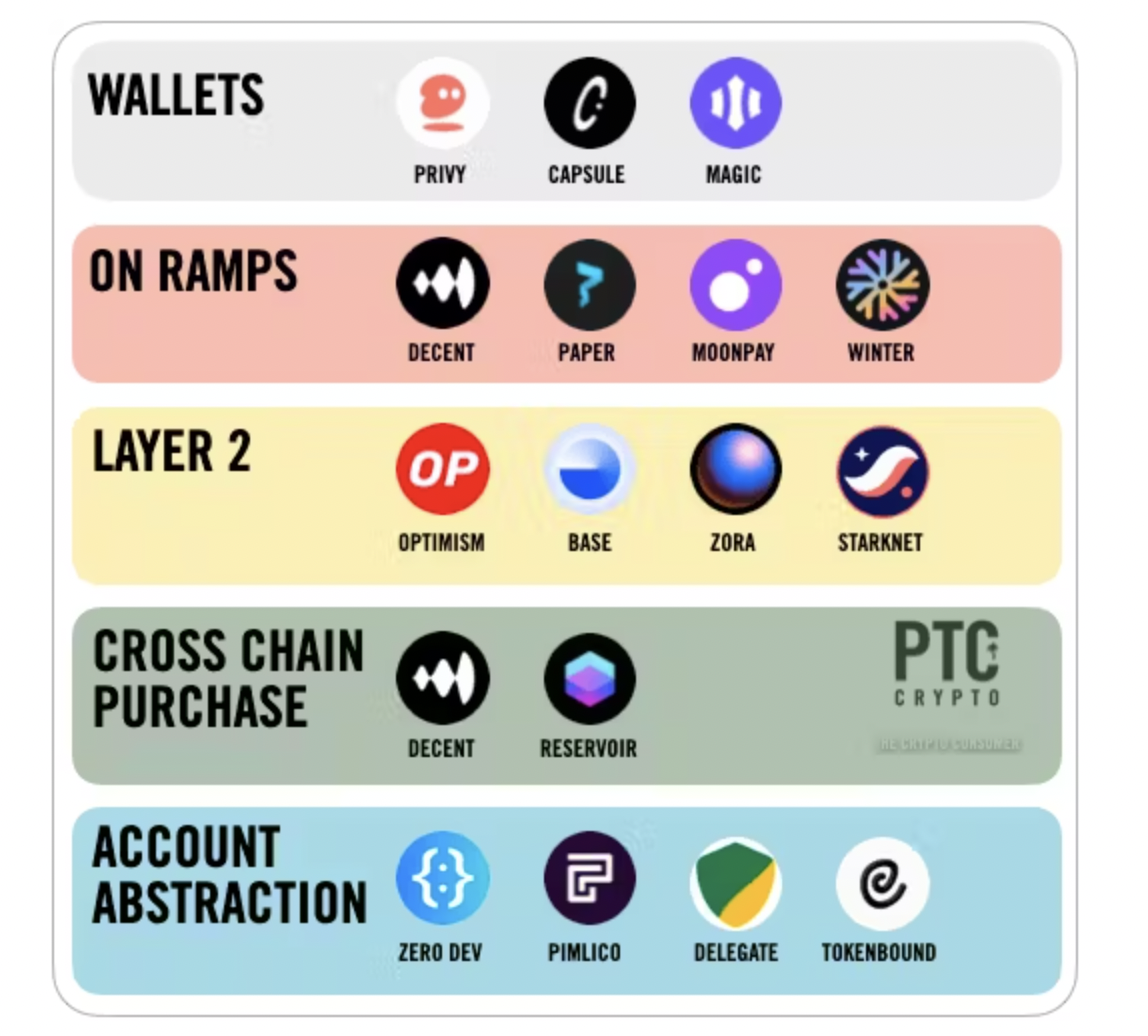
Developer UX stack
Speculation is a core feature of online ownership and one of the advantages of digital objects. Many consumer crypto apps begin by representing a type of on-chain digital object as an NFT — whether digital art, music, podcasts, game items, social posts, etc. — allowing users to become collectors.
Internet users owning things they love creates a new market. They benefit from participating in and supporting what they care about. While controversial, speculation is a key aspect of NFTs because it introduces open markets for any online entity.
While speculation is a prominent aspect of owning digital objects, it's not the only value offered to users — even in the simplest form of owning on-chain digital objects as NFTs. For web collectors, two other key value propositions are building relationships with creators and communities, and reinforcing their network identity through on-chain asset data.
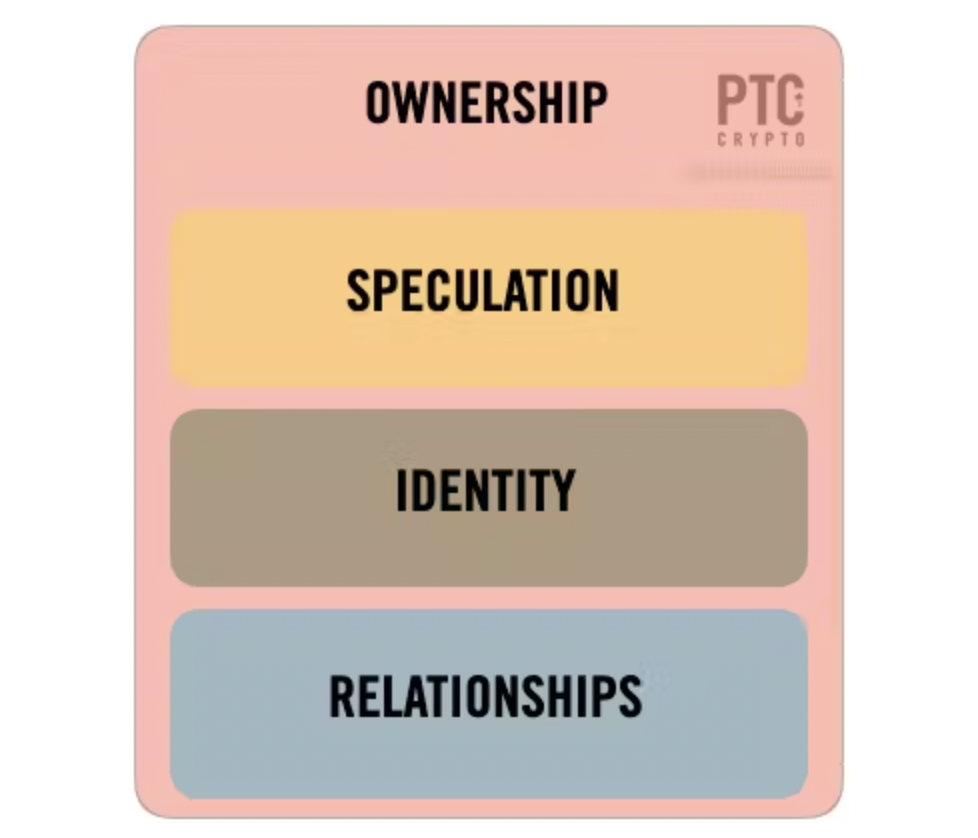
Atomic units of NFTs
Gamification enhances user engagement beyond ownership and speculation. The consumer crypto space has matured enough to focus on layering additional experiences around digital collectibles through gamification. Key elements of gamification in consumer crypto include user experiences tied to gameplay, social satisfaction, and community identity.
There are already many examples of gamification: gameplay in games like Axie Infinity, Dookey Dash, and The Worlds Largest; social satisfaction via leaderboards on media and entertainment apps like Sound, SuperRare, and 9dcc; community identity reinforced through unique NFT series such as Punks, Squiggles, and Apes.
Gamification can attract more users and drive growth during bear markets — something ownership alone cannot achieve. By prioritizing gamification and treating speculation as secondary, crypto-based apps can retain users across market cycles. When markets rise, speculation can accelerate growth.
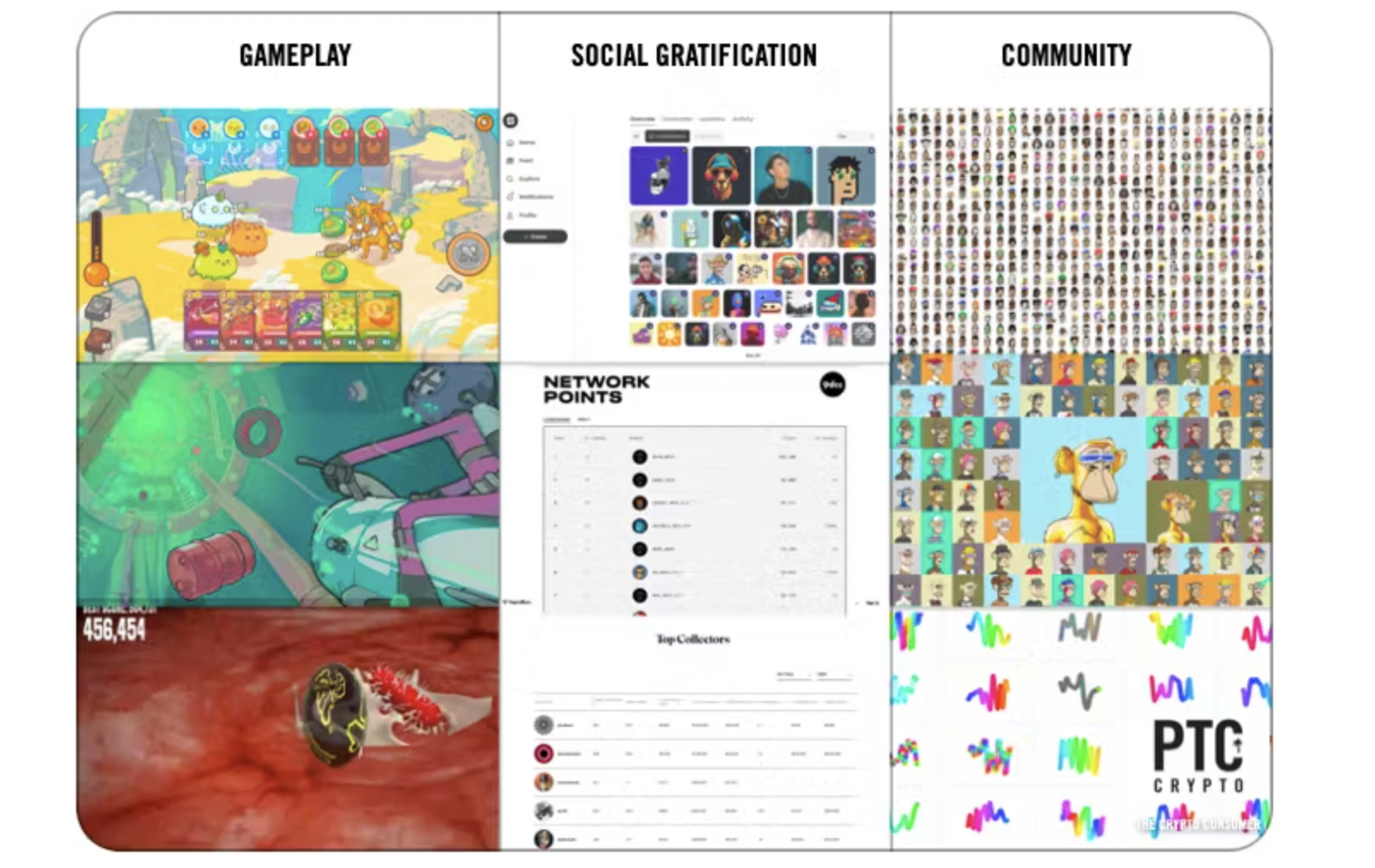
Key components of gamification
Looking Ahead: The Future of Consumer Crypto
Looking forward, we’re most excited about encrypted media and autonomous worlds powered by NFT technology and smart contracts.
Encrypted Media
The encrypted media space includes infrastructure and applications that place or interact with content — art, music, podcasts, articles, TV/film, and social posts — as NFTs on-chain. The first major phase in this space involved shifting content monetization models. Instead of relying on consumer subscriptions or ads, it shifted toward direct-to-consumer sales of digital objects — similar to monetization in existing Web2 games.
Many early platforms have emerged across various content types: SuperRare and Foundation in digital art, Sound and Catalog in music, Paragraph and Mirror in writing, Pods in podcasts, among others. Leading products in each category now offer mature user experiences, including email login, Layer 2 support, credit card on-ramps, and cross-chain NFT purchases.
Most ecosystem activity centers around ownership and collectibility, with end users becoming collectors to build their on-chain identity, connect with creators, and speculate on quality content and artists.
As leading apps have overcome UX hurdles, the next product iteration focuses on building gamified experiences and better delivering immediate gratification from ownership. In encrypted media, gamification emphasizes accessibility and exclusivity. Early examples include gated chats, tiered access to exclusive content, and real-world experiences. Social satisfaction appears in leaderboards of top collectors and viral artists, curator rewards, and social dynamics. Community aspects are highlighted through generative collectibles or unique editions.
Beyond placing media on-chain via NFTs, apps are also building key parts of their tech stack on-chain. They take the form of protocols providing permissionless infrastructure for their own and other apps. These content protocols offer minting, management, and participation features. Examples include SuperRare’s governance protocol, minting protocols from Sound, Zora, and Manifold, and Titles’ publishing protocol. As more layers of the consumer media stack move on-chain, apps can better customize user experiences and monetize via new business models.
It’s commonly believed that encrypted media and content NFTs primarily benefit artists and collectors, not regular users. But this model actually promotes free consumption with optional valuable collecting — akin to free-to-play in games. It delivers the best consumer experience by removing ads and upfront payments.
The combination of superior consumer experience, gamified user bases, and ownership benefits could revolutionize many media and content industries.
To better understand early users in the encrypted media space, let’s explore a simple user journey:
-
Bob enjoys music for free. If he likes a song or artist, he can collect their music. His purchase directly funds the musician. His music collection becomes part of his online profile and contributes to his leaderboard ranking (based on number of songs collected). This collection grants him access to exclusive chat rooms where musicians share updates and behind-the-scenes info. As Bob’s collection grows, he gains access to more exclusive content.
-
In turn, musicians grow their audience through these collectors. As an early collector, Bob can profit by selling his early acquisitions to new collectors interested in limited initial supply versions.
Autonomous Worlds
Autonomous Worlds (AW) are fully on-chain experiences driven by smart contracts. These contracts act as servers, enforcing the logic of the experience, with early use cases focused on gaming and social applications. The core value of AW lies in its permissionless, composable smart contract infrastructure and ownership of entities within an open on-chain economy.
Game-based Autonomous Worlds are known as Fully On-Chain Games (FOCG), where game rules and economic mechanisms are entirely managed by on-chain smart contracts. This structure allows developers to build additional game apps on top of existing ones without permission. They can expand current games, enrich lore, and further develop open economies. Users also gain ownership benefits within the game’s on-chain economy.
Autonomous Worlds push beyond the boundaries of existing games and Web2 gaming business models. So far, most crypto games follow a Web2.5 approach, using NFTs as in-game items. However, before FOCG, business models closely mirrored traditional Web2 games. While Web2.5 assumes interoperability between games or social ecosystems, this is unlikely when each game has separate infrastructure and communities.
FOCG represents a paradigm shift, enabling games to be built atop one another as shared infrastructure. Games can leverage popular existing titles with established user bases, aiming to enhance gameplay by incorporating underlying experiences and economies. End users can also personalize gameplay, lore, or create additional experiences for themselves and others through UGC.
One of the most exciting use cases in AW is NPCs (non-player characters) as NFTs. Using standards like ERC6551, these characters can have their own wallets, allowing real users to own them and use them as avatars.
The AW space is still small but growing rapidly across multiple ecosystems, including Ethereum VM (EVM), Cairo VM (Starknet), Solana VM (SVM), etc. Each ecosystem offers open-source frameworks — MUD by Lattice for EVM, DoJo by Cartridge and Realms for Starknet, Bolt by Magicblock for SVM. Numerous games are being built on each, such as Primodium and Skystrife on MUD/EVM, Realms and Dope Wars on DoJo/Starknet, SolCIV and Sage on Bolt/SVM. Even within specific games, multiple derivative games exist. For example, the Realms ecosystem hosts dozens of spin-offs.

Autonomous Worlds landscape
An interesting example of permissionless expansion within ecosystems is how multiple cross-ecosystem games stem from the same conceptual foundation around Loot. Loot is a collection of 8,000 NFTs represented as white text on black background images, each symbolizing a bag of loot reminiscent of fantasy adventure games. Since its launch in August 2021, games like Realms, Dope Wars, and Treasure have innovatively expanded on the original series across different frameworks and engines, each building its own game ecosystem.
The AW space remains in early stages, with much left to build. Development needs include game engines, service providers, and layered game protocols — physics, hidden secrets, quests, world-building, etc. The ecosystem requires significant UX improvements, including enhanced wallet infrastructure, account abstraction, gas fee optimization, and higher transaction throughput.
Let’s examine an early on-chain gamer’s user journey:
-
Alice starts playing by creating a character and defeating enemies with acquired weapons. She realizes her character, weapons, and beasts all exist as NFTs in her wallet. She discovers another interesting game that expands on the first game’s mechanics. In this new game, her character, weapons, and their experience levels are fully portable.
-
As a developer and advanced AI user, Alice decides to further customize gameplay. Wanting an edge and a higher leaderboard rank, and considering sharing her innovation with the ecosystem, she builds a tool. The tool extends NPCs into AI-powered characters she can control. Now, she can play with a team of characters without active involvement.
Crypto Needs Consumer Crypto
While markets are inherently speculative, speculation diminishes when real user data and metrics support valuations. For crypto to sustain growth beyond financial product speculation, technological upgrades, and market narratives, the key is increasing user numbers and app adoption.
Of course, DeFi has users, and the demand and potential of the DeFi sector are undeniable. But in reality, average users come to consume products. Their consumption happens in media, entertainment, and gaming — precisely where most crypto app usage originates.
This is what institutions and retail investors consider when deciding whether to allocate new capital to crypto. To some, consumer crypto may seem like a promising sector — but in truth, we need it, and without doubt, the killer use case lies within.
Join TechFlow official community to stay tuned
Telegram:https://t.me/TechFlowDaily
X (Twitter):https://x.com/TechFlowPost
X (Twitter) EN:https://x.com/BlockFlow_News
 @web3brett









