









Coinbase: A Comprehensive Overview of the Current State of Cross-Chain Bridges
TechFlow Selected TechFlow Selected
Coinbase: A Comprehensive Overview of the Current State of Cross-Chain Bridges
This report aims to capture the current state of the cross-chain bridge landscape, future trends, and their impact on the broader cryptocurrency ecosystem.
 Navigating Web3 tides with focused insights
Author: Ryan Yi
Translation: Mars Finance
TL;DR
As the number of assets and chains in the crypto ecosystem continues to grow, the importance of cross-chain bridges is increasing.
The primary use cases for bridges remain asset transfers (tokens on one chain to tokens on another) and swaps (trading tokens on Chain A for tokens on Chain B). Bridges compete on differentiation factors such as distribution, product features, and security profiles.
Looking ahead, major multi-chain issuance technologies like CCTP, listings, and overlaps with oracles will influence bridge usage and adoption.
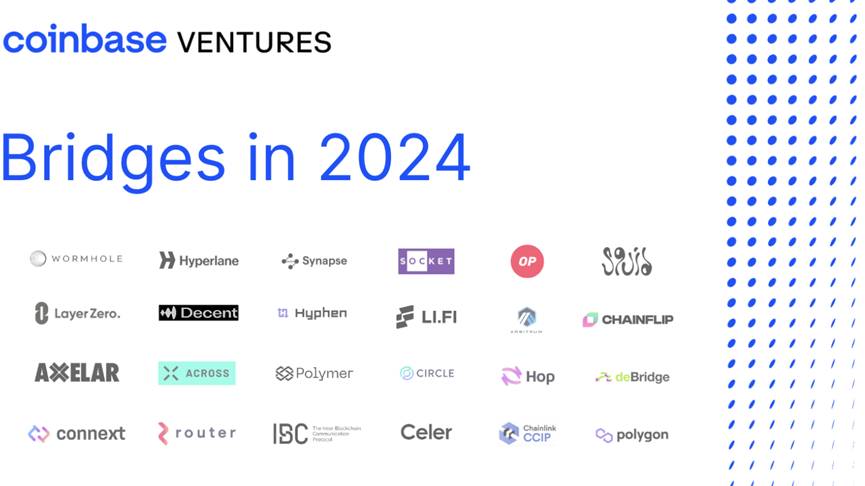
Disclosure and footnotes: Projects supported by Coinbase Ventures portfolio companies are marked with an asterisk (*) upon first mention in the article below.
Bridges have become core infrastructure enabling protocols, service providers, and users to access crypto use cases. This report aims to capture the current state of the cross-chain bridge landscape, future trends, and their impact on the broader crypto ecosystem.
Current Key Points / Learnings
1. Classification: Bridge types can be divided into three categories: native bridges, third-party bridges, and bridge aggregators.
Native bridges: Typically canonical contracts that users interact with directly to deposit/withdraw assets. These may be operated by a set of trusted participants or through decentralized consensus. Chains/L2s running on compatible open-source stacks can also leverage first-party secure bridging compatibility. Examples include Optimism OP Stack*, Arbitrum Nitro*, Cosmos IBC, Superbridge.
Third-party bridges: Networks/validators operating between chains, acting as "intermediaries." Most bridges follow some variation of this design. Examples include Axelar*, Wormhole*, LayerZero (Stargate)*.
Bridge aggregators: Integrate the first two types listed above and provide optimal routing across bridges for end users and enterprise partners. Examples: Socket*, Li.Fi*.
2. The primary purpose of bridges is to serve the incremental gap between where data/assets reside (ledger/blockchain/location) and where they are intended to be executed. Primary use cases remain asset transfers (token on Chain A to token on Chain B) and swaps (exchanging token on Chain A for token on Chain B).
Asset transfer: There's an asset (e.g., ETH) on "Chain A" that was not issued on "Chain B." A bridge enables sending the asset from "Chain A" to "Chain B," e.g., bridging USDC from ETH L1 to Zora L2 via Zora Native Bridge*.
Swap: There’s a trade involving ($ETH) on "Chain A" and ($ATOM) on "Chain B." The bridge sends the tokens and then executes the swap. Examples include [1] Squid Router's "swap" built atop Axelar's "bridge." [2] 0x*'s Matcha handles the "swap" and integrates Socket for the "bridge."
Others: These might include any type of call data or contract ownership, such as governance or multisig ownership. For example, Uniswap v3 contracts are deployed across many EVM chains, but the core governance contract resides on the Ethereum mainnet. The Uniswap Foundation* prefers a single contract executing messages "one-to-many" across other chains (rather than creating a governance contract on every chain). (Source)
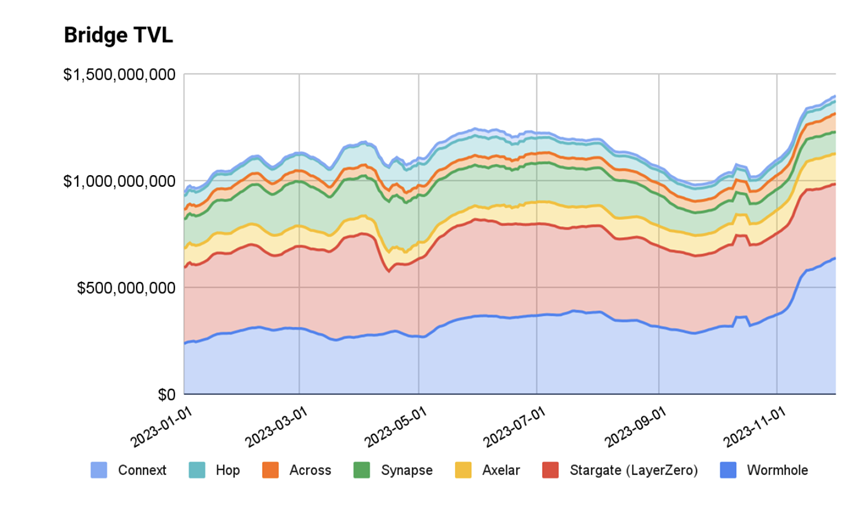
3. Bridges are typically measured by on-chain AUC (or TVL) as a proxy for liquidity and usage.
The traction of native bridges is directly tied to the underlying success of the L2 itself. Bridging contracts hold funds, which can serve as a measure of TVL bridged to the L2. According to L2 Beat data, rollup TVL ranges from $50 million to $8 billion.
Notable third-party bridges include LayerZero, Wormhole, and Axelar, based on traction in TVL, transaction volume, and chain coverage.
LayerZero: TVL: ~$304M; Volume: ~$23.9B; Transactions: 34.5M [Source]
Wormhole: TVL: ~$850M; Volume: $30B; Transactions: 1.7M [Source]
Axelar: TVL: ~$224M; Volume: $7B; Transactions: 1M [Source]
Bridge aggregators typically route transactions, making transaction volume a more relevant metric. Distribution between consumers and enterprises (a sign of winning) is a key indicator. Major providers include Socket and Li.Fi.
4. Bridges compete across various dimensions of differentiation, and there may be multiple winners depending on use case and distribution.
Security: Nuances in security depend on demand-side preferences. Most bridge users appear to prioritize speed/latency and cost over security beyond a minimal viable threshold.
Smart contracts: Most bridge hacks occur at the smart contract level. In most bridges, users lock funds in Chain A contract → bridge reads Chain A contract → mints user funds on Chain B contract. Misconfigurations in withdrawal permissions within the contract could lead to exploits.
Multisig: Control over the contract is delegated to a group of trusted participants. These are typically operated by project teams and other trusted stakeholders.
Relayer + Oracle: dApps/developers can white-label their own Relayer + Oracle setup or choose from available options provided by others.
PoS chains: Security is achieved via proof-of-stake consensus.
Distribution: Bridges aim to leverage existing partner channels and adopt go-to-market strategies using backend infrastructure.
Wallets: Bridges strive to become the underlying infrastructure/API powering bridging functions in existing wallets/portfolio aggregators. Examples include Phantom partnering with Li.Fi and Coinbase Wallet integrating with Socket. Portfolio frontends/wallets all feature some form of bridging support (e.g., Zerion*/Zapper*/Metamask*).
B2C frontends: Bridges usually build web portals where any user can connect a wallet and bridge funds. Examples include Stargate.Finance (LayerZero), Bungee.Exchange (Socket), Jumper.Exchange (Li Fi), and Squid Router (Axelar).
DApps: Applications themselves include a “deposit” function powered by a bridge, so users don’t need to jump back to L1 before going to L2 to use the app. Think of this as a developer-native abstraction of the aforementioned “B2C,” supported natively within the application interface. Example: Aevo*.
Developer platforms: Many bridge companies leverage existing developer platform distributions to enable integration. Examples include Conduit RaaS, Microsoft Azure + Axelar, Google Cloud + LayerZero.
Ecosystems: While all major third-party bridges cover the same chains, they gain early advantages by focusing resources within specific chain/developer ecosystems. The rationale is that because product feature sets require higher sophistication to differentiate, it's easier to scale within the VM/smart contract frameworks of specific ecosystems.
EVM: Socket focuses on the EVM rollup ecosystem (OP Stack, Arbitrum*, Polygon* CDK). Existing users include L2s like Aevo and Lyra.
Solana: Wormhole has broad ecosystem coverage due to early involvement. DeBridge is also gaining traction.
Cosmos: Axelar has strong ecosystem coverage thanks to its ability to deliver IBC-compatible transactions. A data point: new chains using IBC (e.g., Celestia*) receive Day-1 coverage.
Other ecosystems are served by most providers.
Product/feature set: Since bridges operate in the business of "abstraction," they often need custom smart contract work to support specific use cases. As a result, bridge teams often carve out niches in specialized verticals. Examples include NFTs/payments (e.g., Decent), gas abstraction, and swaps.
What We’re Watching
CCTP (Circle’s multi-chain USDC standard) will be a critical data point affecting bridges. CCTP is Circle*'s standard for enabling multi-chain issuance of USDC.
Pre-CCTP: When a new chain launches, due to lack of native USDC support, it uses a bridged version of USDC (since Circle must approve and add native USDC support for each new chain on its roadmap). Because blockchains want Day-1 DeFi support, USDC is bridged from ETH L1, and the bridged version becomes the standard on the new blockchain.
Example: axlUSDC via Axelar or USDC.e on Arbitrum — USDC from ETH L1 bridged via Axelar and Arbitrum bridges respectively.
Impact: This leads to liquidity fragmentation, as bridged USDC on Chain A vs. Chain B depends on individual bridge operators. Separate ecosystem DeFi protocols integrate it as an asset, making unwinding increasingly difficult.
Post-CCTP: When a new chain launches, it deploys a USDC token contract compliant with the CCTP Circle standard. When Circle is ready to operate on the chain, it can take over the CCTP-supported implementation. Essentially, the new USDC contract has backward compatibility to meet the standard offline.
Example: NewChain is a new L2 platform without native USDC. NewChain deploys a standard-compliant USDC contract. NewChain supports bridged USDC in the short term, but crucially, it can be taken over by CCTP, allowing bridged USDC to become native USDC.
Tip: If you're a developer, you'd typically rely on bridged USDC and lock in liquidity plans tied to the asset and bridge. With CCTP, you can transition to natively enabled USDC and use the CCTP API to enable cross-chain transfers for USDC.
Adoption of CCTP impacts the long-term defensibility of bridges.
Bridged USDC (non-CCTP) locked in DeFi pools will remain there until unwound or until it becomes a negligible portion of on-chain asset mindshare.
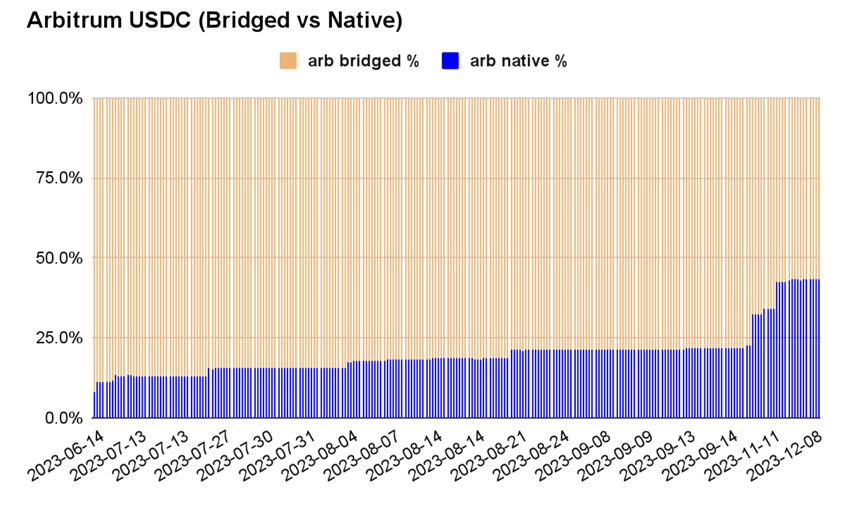
While CCTP will utilize bridges (given their distribution) to help support CCTP, its adoption naturally leads to a higher share of native USDC issuance and lower share of bridged USDC. Bridged USDC, as an asset locked in various DeFi pools, will naturally unwind over time.
Example: Ratio of bridged vs. native USDC: Arbitrum: [57%–43%]; Base: [33%–67%]; Optimism: [80%–20%]; Polygon: [77%–23%].
The CCTP story serves as an important lesson for bridges about securing proximity to asset issuers and locking in a multi-chain-first approach at the technical level. Bridges must now compete on other differentiators like latency, security, and distribution.
Bridges will continue to be used as long as the number of chains increases and demand grows for abstracting user experience.
This year, shifts in blockspace settlement trends (modularization, rollups, data availability, etc.) will affect how users execute transactions and move assets, making bridges a popular choice for delivering this user experience.
Over time, improvements in native protocols and technology will help users avoid withdrawal periods (currently seven days for optimistic rollups) and gain “fast lane” send/receive capabilities.
In the future, verified wallets and users holding on-chain proofs (such as Coinbase Verifications) may interact on-chain with centrally managed liquidity bridges.
App-hosted wallets (and self-custodial wallets) will continue advancing “Bridge Plus”—where “Swap” and “Bridge” are not separate transactions but combined into one for better user experience.
Bridges and oracles will ultimately compete for rights to publish data.
Bridges are striving to get first-party issuers to adopt and use their infrastructure. CCTP shows that native issuers want to build compatibility to reduce dependence on any single bridge. Some projects are also experimenting with multi-chain token standards. While CCTP focuses on USDC, native issuance methods can vary greatly. For example: $OP is natively issued on the Optimism chain; most ERCs are natively issued on ETH L1. Connext has a token standard called xERC (think of it as a CCTP for any ERC20).
Oracles can be seen as “bridges” for off-chain data issuers. Chainlink takes off-chain data (e.g., cryptocurrency prices from CeFi exchanges) and brings it on-chain—though it doesn't own the data, it monetizes by acting as a third-party provider. Conceptually, this mirrors how bridges position themselves today. Oracles and bridges will continue serving the gap between those needing data/assets and those capable of bridging them. Ultimately, both will need to become tools for first-party data publishers to maintain long-term moats and defensibility. Chainlink already has its own bridge product, CCIP, further evidence of this overlap.
In summary, bridging and interoperability will remain among the most important trends, as bridges emerge as compelling service providers meeting the demand for abstracted user experiences amid a growing number of chains. Within the bridge space, Coinbase Ventures is investing in novel use cases enabled by bridges. If you're building in these areas, we’d love to hear from you—Ryan Yi’s DMs are open!
Join TechFlow official community to stay tuned
Telegram:https://t.me/TechFlowDaily
X (Twitter):https://x.com/TechFlowPost
X (Twitter) EN:https://x.com/BlockFlow_News










