









Synthetix 2024 Outlook: What Are the Key Developments?
TechFlow Selected TechFlow Selected
Synthetix 2024 Outlook: What Are the Key Developments?
In 2024, Synthetix V3, Perps V3, and the USDC deployment on Base will be launched, along with a focus on other cross-chain deployments.
 Navigating Web3 tides with focused insights
Author: Westie
Translation: Baicai Blockchain
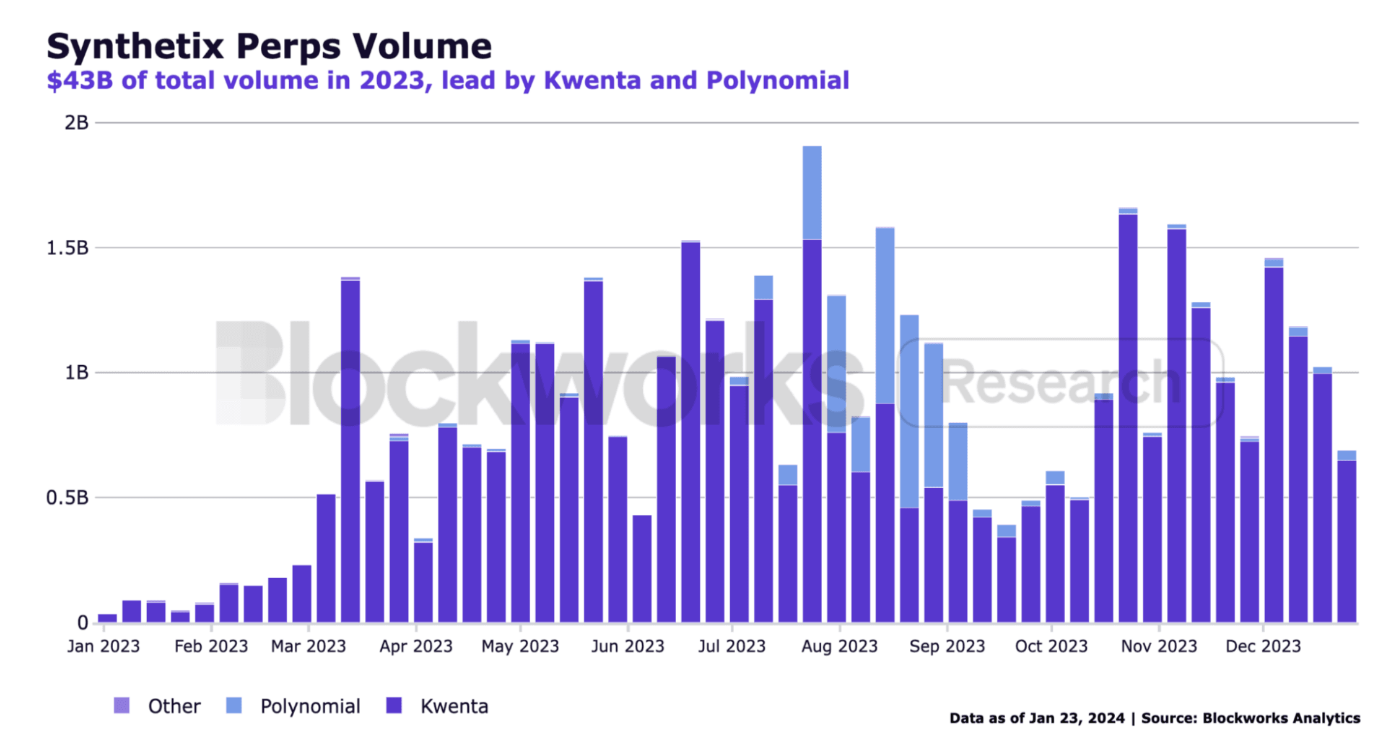
Synthetix remains one of the key drivers behind Optimism’s success, accounting for a significant portion of the chain's TVL (Total Value Locked), activity, and revenue. At year-end, Synthetix held a TVL of $316 million, representing approximately 34% of all TVL on Optimism Mainnet. Additionally, transactions related to Synthetix on Optimism Mainnet—including spot and perpetual trades as well as SNX staking—generated around 1,460 ETH (approximately $3.5 million) in transaction fees during 2023, accounting for roughly 7.3% of the entire chain’s income.
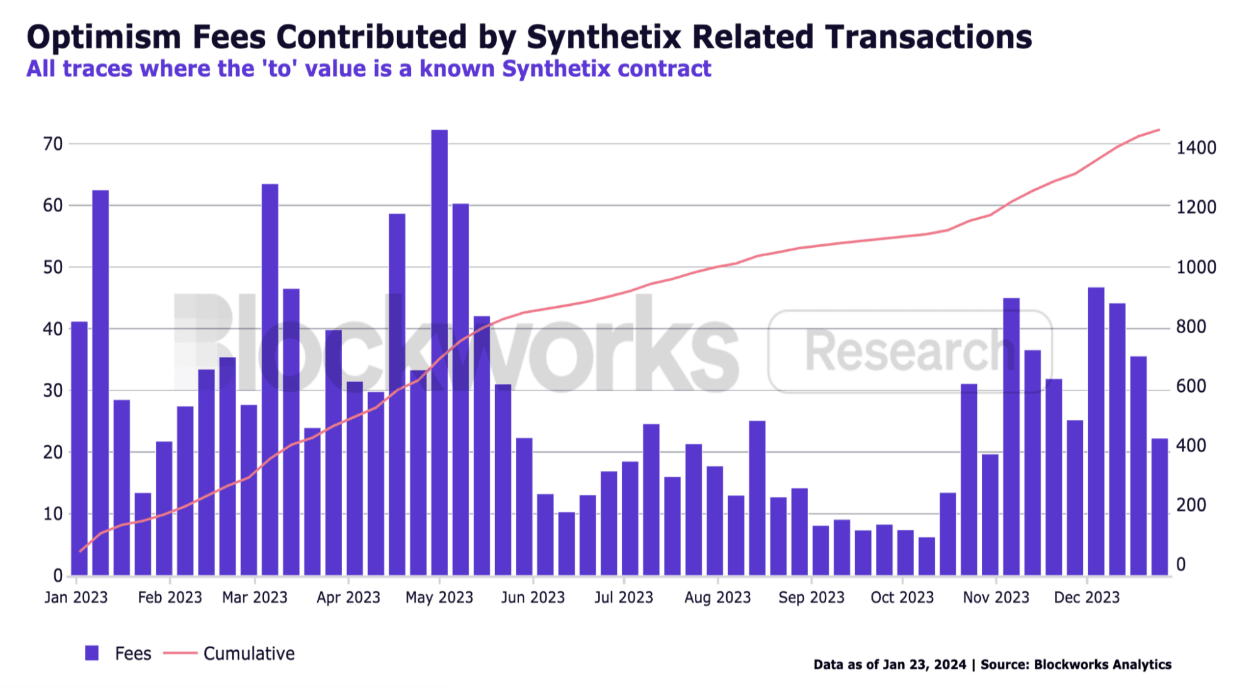
While some attribute this surge in activity to an incentive program worth 5.9 million OP—valued at about $9 million at the time—used by Synthetix and its front-ends as fee rebates for traders on the platform, trading volume has remained relatively high even after the incentive period ended. Compared to the incentivized period average of $15.5 million daily volume, Synthetix still achieved an average daily trading volume of $151 million, peaking at a weekly volume of $1.6 billion during the week of October 23. This indicates that the incentives created a degree of stickiness among users and trading volumes.
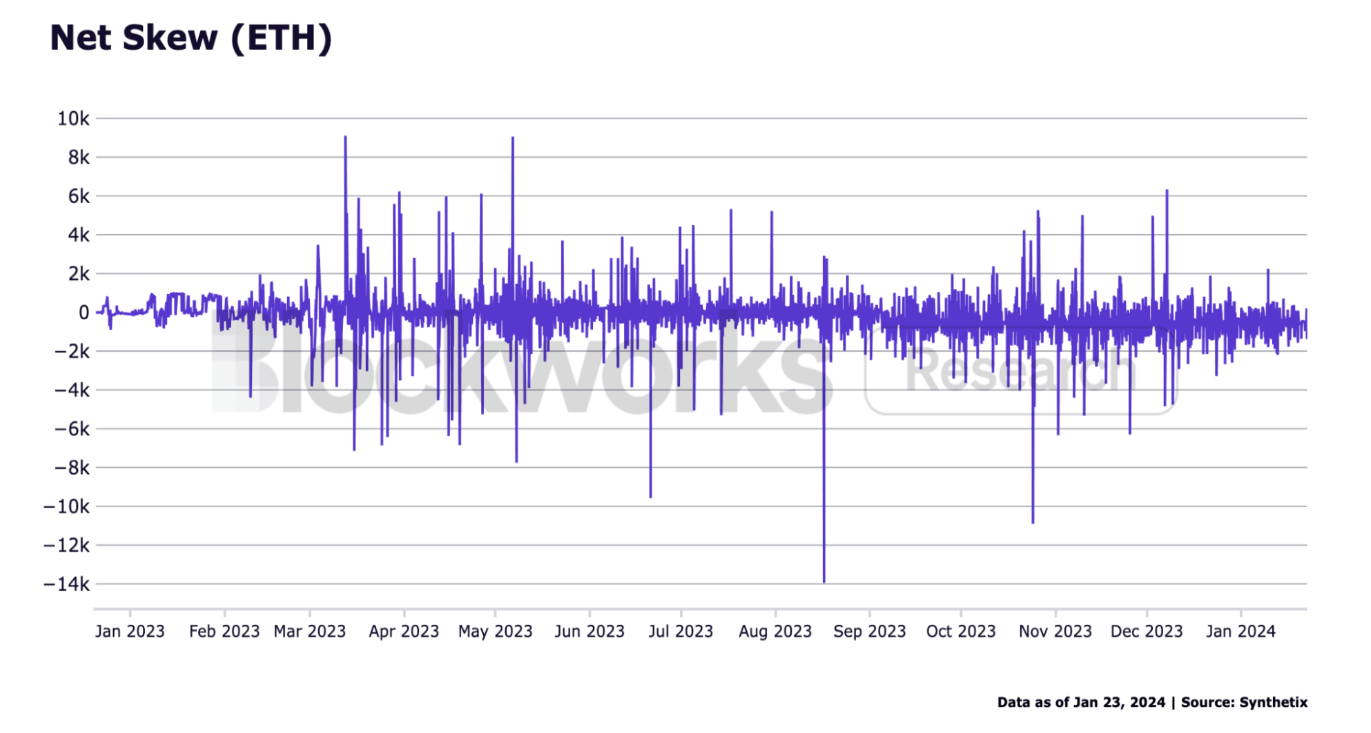
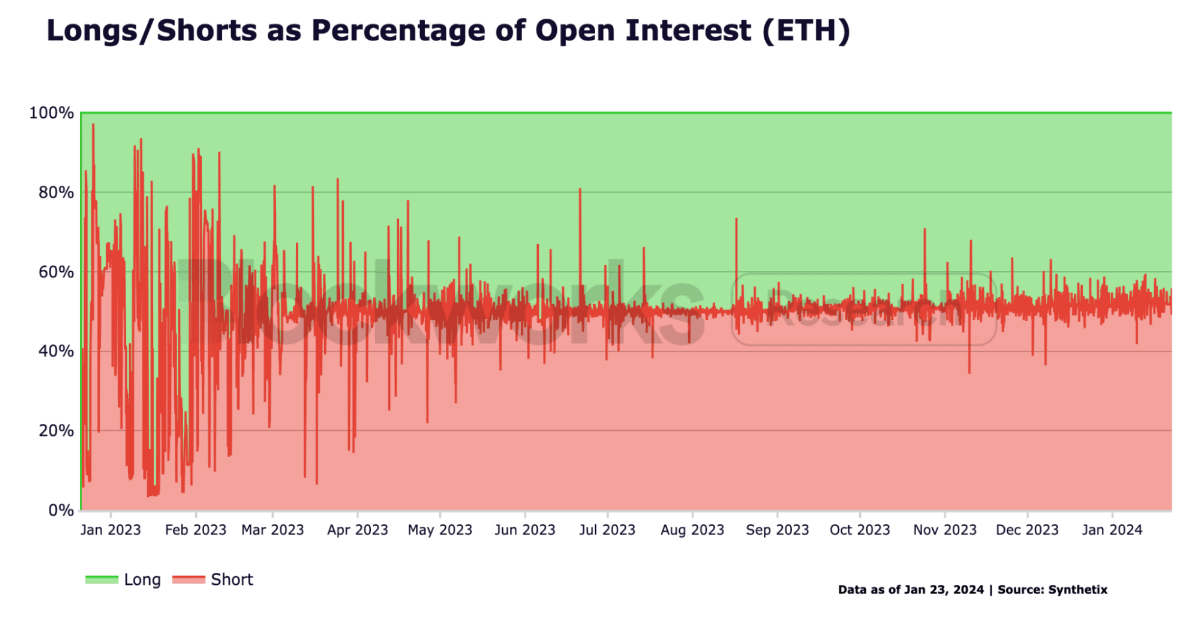
Although trading volume and fees are clearly important, a critical aspect for SNX holders is reducing exposure to market volatility. This is achieved through Perps V2’s dynamic funding rate mechanism. Unlike systems considering only skew (i.e., the difference between longs and shorts), the dynamic funding rate also accounts for velocity. This means if there is a persistent long bias over time, the funding rate will continue increasing progressively. This system strongly incentivizes arbitrage trading and helps maintain position balance. Despite significant volatility early in 2023 due to very low position caps, the system remained largely stable throughout most of the year with only occasional minor fluctuations.

Other competitors like GMX are now incorporating dynamic funding rates into their products, as they have proven effective in minimizing market exposure for liquidity providers.
With a clearly product-market-fit perpetual offering, Synthetix is aiming for ambitious deployments in 2024 to upgrade its product suite, expand perpetual trading cross-chain, introduce new collateral types to maximize liquidity and capital efficiency, and incentivize front-ends to deliver enhanced user experiences rivaling centralized exchanges.
1. Synthetix V3 and Perps V3
Synthetix is currently migrating its existing V2x system to new offerings: Synthetix V3 and Perps V3.
Synthetix serves as the core liquidity layer for financial markets. In V2, SNX holders could stake their SNX and take on a debt position, represented proportionally by their share of the system’s total debt across all holders. The value derived from this global debt pool enabled the creation of synthetic asset markets. As positions opened and closed, the debt system updated accordingly. As previously mentioned, this effectively made SNX holders temporary counterparties to traders in perpetual contracts, with dynamic funding rates helping maintain balanced positions.
In V3, Synthetix elevates this concept of a liquidity layer by introducing a more modular architecture, enabling developers and users to experiment across different layers of the liquidity stack.
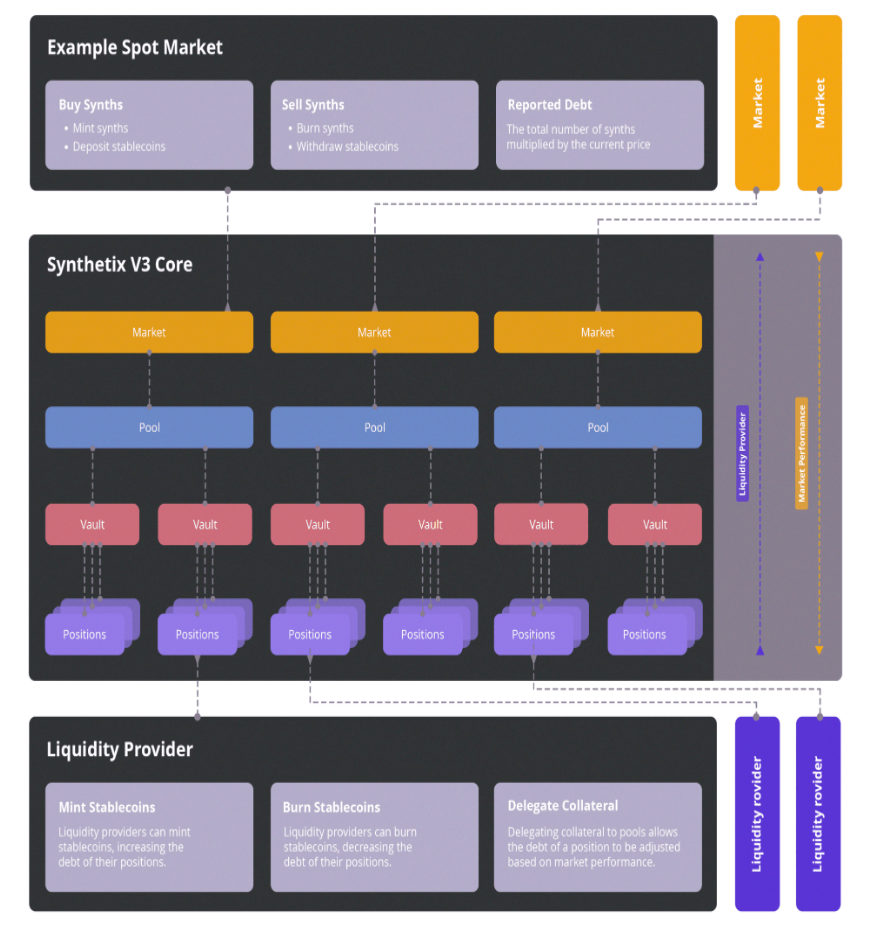
At the heart of V3 lies the pool level. Each pool represents an independent source of debt and liquidity used to provide market-making services. Debt and liquidity originate from Vaults, where liquidity providers deposit assets and delegate their collateral to pools. Each pool has a Vault for every type of collateral it accepts, and pools can choose any collateral asset they wish. Pools can then collateralize markets of their choosing. While these may include existing Synthetix spot or perpetual markets, developers also gain the ability to build entirely new markets.
This design enables experimentation across diverse markets while allowing liquidity providers to select their desired risk exposure. The primary pool will be the Spartan Pool, whose configuration, accepted collateral assets, and selected markets will be governed by the Spartan Council. Most liquidity providers are expected to opt into this safer system, though permissionless perpetual futures markets with higher risk—and potentially higher returns—are now feasible.
Several teams have already expressed interest in building products using the V3 infrastructure. One such project is Overtime Markets, a sports betting platform built on Thales, currently migrating its existing setup onto V3. The market is likely to be absorbed by the Spartan Pool shortly after launch, given that liquidity providers earned over 70% annualized returns within less than a year. Other protocols interested in building on V3 include Betswirl, a CasinoFi initiative, and TLX, which aims to tokenize Synthetix perpetual positions. Additional market types such as options, insurance, and prediction markets have also been proposed.
While much of the focus this year will center on scaling the perpetual product through improved user experience and multi-chain portability, V3 will remain open for experimentation to foster new markets.
Synthetix also plans to release the next version of its perpetual product, which will operate as a market under the V3 infrastructure: Perps V3. This upgrade enhances the foundational architecture of perpetual contracts to deliver an overall improved user experience. Key improvements include reduced trading latency, native cross-margin functionality, expanded collateral options—including the ability to trade using synthetic assets like sETH and sBTC—gradual liquidations to reduce MEV searcher-induced sandwich liquidation risks, and NFT-based accounts. This enhanced user experience aligns closely with Synthetix’s goal of expanding perpetual trading activity in 2024.
2. 2024 Roadmap
Synthetix is entering a pivotal phase in its development. While the Perps V2 product has demonstrated clear product-market fit, limitations in user experience have constrained potential growth and activity. Perps V3 improves the perpetual trading experience, but bridging the gap to match the seamless trading interface offered by centralized platforms remains a work in progress. In 2024, Synthetix and its ecosystem aim to close this gap as much as possible.
One limitation of the current perpetual contract system is that users can only trade on Optimism Mainnet. While the chain itself offers a solid user experience, porting the product to other chains with distinct user bases would allow Synthetix to generate additional activity and revenue while building brand presence across different communities.
The process of experimenting with and migrating to other chains will begin with a package of products called Andromeda by Synthetix, which will include Synthetix V3, Perps V3, and USDC as the sole collateral type. This environment allows testing of the new products themselves and assessing demand for providing liquidity with USDC rather than the native SNX token.
Synthetix is particularly testing USDC due to its potential for superior liquidity. As a stablecoin, USDC enables lower loan-to-value ratios (LTVs) for liquidity providers, enhancing capital efficiency without requiring LPs to take on significant market exposure. This increases the expected annualized return for liquidity providers. For example, assuming SNX stakers earn 3% annualized returns at a 500% collateral ratio (CR), USDC stakers would earn 13.6% annualized returns at an 110% CR under equal conditions. Additionally, plans are underway—without requiring governance votes—to introduce yield-bearing stablecoin collateral such as sDAI to further boost potential yields. Combined with the ability to incur sUSD debt and earn additional yield elsewhere, this attracts yield farmers and yield-maximizing vaults, drawing substantial liquidity into Synthetix.
The first deployment of Andromeda is currently rolling out gradually on Base. This will serve as the initial testbed for Perps V3 and USDC as primary collateral. The allowed total amount of USDC will be increased incrementally, along with permitted liquidity and positions on perpetual markets. Furthermore, Kwenta, the largest Synthetix front-end, has indicated that once rollout is complete and sufficient liquidity exists to meet trader demand, they will "actively promote" user adoption of V3 and offer incentives.
Alongside the Base deployment, Infinex will be introduced—a new front-end focused on delivering an enhanced user experience for traders and creating a liquidity flywheel for perpetual trading. Initiated by Synthetix founder Kain Warwick and using SNX as its governance token, Infinex will receive 20% of front-end fees, which will be used to buy back SNX tokens and stake them to fuel further liquidity cycles. Notable features within Infinex include username-and-password login, multi-factor authentication, and cross-chain deposits. To users, it will feel like using a centralized exchange, yet powered by decentralized, permissionless backend liquidity.
Following successful deployment on Base, Synthetix intends to deploy Andromeda to Optimism Mainnet, potentially adding ETH as an additional collateral asset. This deployment will run parallel to the current Perps V2 system, enabling comparison of liquidity provider preferences between SNX versus USDC and ETH. Subsequently, Synthetix aims to expand across other EVM-compatible chains and rollups to identify where it can attract the most users and liquidity. While the next destination hasn't been finalized, community sentiment appears to favor Arbitrum.
Beyond the rollout of Andromeda, Synthetix is also pursuing a dedicated deployment of its perpetual product on Ethereum mainnet, referred to as Carina. Although deploying on Ethereum is notably more expensive and slower than on rollups, this initiative specifically targets entities leveraging Synthetix perpetual contracts or those wishing to deploy their infrastructure directly on mainnet. For these parties, connecting via rollups introduces added risk. The first confirmed protocol building on Carina will be Ethena, a stablecoin project using delta-neutral positions to back its USDe stablecoin by holding stETH and shorting perpetual contracts. Ethena already accumulated over $130 million in TVL during its closed alpha phase, part of which will be hedged via perpetual contracts upon Carina’s official launch. Given that stETH is natively Ethereum-based, this product is ideally suited for risk mitigation and maximizing composability.
Synthetix is also exploring the possibility of launching a custom OP Stack rollup called the Synthetix Chain. The goal is to create a centralized hub for governance, where SNX holders can stake and borrow, bring their sUSD to preferred chains, and distribute generated fees across various deployments. The existing V2x system’s debt obligations will be fully migrated to this Synthetix Chain, along with SNX holders.
3. SNX Tokenomics Improvements
On December 17, the Spartan Council voted to reduce SNX inflation to zero. Previously, high inflation posed a major barrier for users and investors holding SNX, causing dilution for holders and exerting significant downward pressure on the token price. Although inflation had already declined to around 5% over the past year, many who were previously deterred by SNX inflation may now reconsider participation.
Another improvement to tokenomics comes from the Andromeda deployment on Base. The Spartan Council approved SIP-345, proposing that 50% of protocol-generated fees—after deducting integrator fee shares—be used to buy back and burn SNX. The remaining 50% of net protocol fees will continue to be used to burn sUSD, as currently implemented. Although the integrator fee share has not yet been formally established via governance, it is expected to be set at 20%, paid directly in sUSD from the V3 Reward Manager contract.
This integrator fee share will encourage competition among front-ends, driving higher trading volumes and, theoretically, greater revenue that ultimately flows back into the protocol. As noted earlier, beyond the buyback and burn pressure on SNX, Infinex will use its portion of the integrator fees to repurchase and stake SNX, further amplifying buying pressure and contributing additional liquidity.
4. Risks
Despite many exciting developments for Synthetix in 2024, it is crucial to understand certain potential risks associated with its design and implementation. One major risk stems from using the native token as the primary collateral. A rapid decline in price could trigger reflexive downside effects, as falling SNX prices might lead to cascading liquidations and reduced market liquidity. However, the current minimum collateral ratio of 500% is highly conservative and should help mitigate such concerns. Moreover, efforts are underway to support liquidity provision using alternative assets like USDC.
A second major risk involves the assets listed on Synthetix’s perpetual product. If an asset is illiquid or susceptible to price manipulation, malicious actors could exploit SNX liquidity. Notably, on December 31, TRB experienced a massive market manipulation event, surging 200% within under 36 hours before dropping 80%. This incident caused SNX holders to lose $3 million—about 10% of fees generated in 2024. Such risks are typically managed by the Spartan Council deciding against listing overly risky assets, or if listed, having CCs set tight OI parameters. SIP-2048 serves as a temporary measure granting certain CCs emergency authority to shut down markets, though discussions continue on whether a dedicated risk committee should guide asset listings.
Other non-technical risks include reliance on EVM equivalence for V3 deployment, while alternative virtual machines with parallel processing capabilities or more secure programming languages may become standard. However, Solidity and the EVM maintain a strong lead in developer tools, talent pool, and battle-testing across numerous projects over years. Additionally, perpetual DEXs using central limit order books (CLOBs), such as Aevo and Hyperliquid, are gaining traction. While growing in popularity, many newer platforms benefit significantly from airdrop hunters and wash trading, so it remains unclear whether traders genuinely prefer CLOBs over oracle-based perpetual trading or if this trend is merely driven by speculation around future large-scale airdrops.
5. Final Thoughts
Synthetix aims to leverage its 2023 success to test its Synthetix V3 and Perps V3 products, new collateral types, and user behaviors across emerging chains. Additional deployments across multiple chains will provide real-world testing for new products, highlight the most effective collateral types for attracting liquidity, and reveal which communities and deployments draw the most users and capital. The perpetual product itself will see major improvements in user experience, both through the Perps V3 upgrade and front-ends like Infinex that aim to replicate the CEX experience on-chain. Amid the recent rise of order-book-style DEXs, Synthetix has undeniably proven that oracle-based perpetual DEXs still hold relevance, and we will soon see whether these upcoming deployments can successfully redirect attention and liquidity back toward its ecosystem.
Join TechFlow official community to stay tuned
Telegram:https://t.me/TechFlowDaily
X (Twitter):https://x.com/TechFlowPost
X (Twitter) EN:https://x.com/BlockFlow_News
 Blockworks







