








A Comprehensive Guide: Which Ethereum Features Will Be Improved by the Cancun Upgrade?
TechFlow Selected TechFlow Selected
A Comprehensive Guide: Which Ethereum Features Will Be Improved by the Cancun Upgrade?
Will Ethereum become more user-friendly after the Cancun upgrade?
 Navigating Web3 tides with focused insights
Author: Xiyu, ChainCatcher
Editor: Marco, ChainCatcher
The Dencun upgrade is undoubtedly the most anticipated event for the Ethereum network in 2024, marking a major update following last year’s Shanghai (Shapella) upgrade and expected to be completed by the end of February.
According to an Ethereum blog post dated January 24, the Dencun upgrade was activated on the Goerli testnet on January 17 and is scheduled to activate on the Sepolia testnet on January 30 and the Holesky testnet on February 7.
Once the Dencun upgrade successfully completes on these three testnets, it will proceed to activation on the Ethereum mainnet, with activation expected by the end of February.
Given that every Ethereum upgrade brings hidden opportunities, tracking the progress of Ethereum upgrades has become the top priority for the crypto community. In September 2022, Ethereum completed the Merge, transitioning from PoW to PoS, making ETH a deflationary asset. Last May, the Shanghai upgrade enabled staking withdrawals; in the months leading up to this upgrade, LSD assets such as Lido and SSV Network saw significant gains across the board.
So, what exactly is the Dencun upgrade? How will this upgrade change Ethereum's performance? What is EIP-4844? Which projects and sectors stand to benefit from this upgrade? And what potential trading opportunities exist?
What Is the Dencun Upgrade?
The full name of the Dencun upgrade is "Cancun-Deneb," combining two separate upgrades—Cancun and Deneb—with the English abbreviation "Dencun." The Chinese term "Kanqun Upgrade" only refers to the first half ("Cancun") while omitting the Deneb portion; the complete name should be the "Cancun-Deneb" upgrade.
Each Ethereum upgrade corresponds to a specific layer within the Ethereum network: the Cancun upgrade aims to improve performance at the execution layer, while the Deneb upgrade focuses on the consensus layer.
To better understand these concepts, let's first review Ethereum’s current architecture and state.
Before the Merge, the Ethereum network consisted primarily of two distinct parts—the execution layer and the consensus layer—operating independently.
The execution layer handles smart contract logic execution—the place where transaction computations occur. It represents the original Ethereum mainnet, also known as "Ethereum 1.0," responsible for maintaining Ethereum’s network state and executing code via the Ethereum Virtual Machine (EVM).
Execution layer upgrades are named after cities that have hosted Devcon conferences: Berlin → London → Shanghai → Cancun → Prague → Osaka → Bogotá.
The consensus layer ensures all transactions and smart contracts are validated through PoS staking, enabling agreement among nodes and clients to achieve consistent network states. This was previously formed as the Beacon Chain after merging with the execution layer and is referred to as "Ethereum 2.0."
Each consensus layer upgrade is named after a star, selected alphabetically: Altair → Bellatrix → Capella → Deneb → Electra → (F)unknown.
After the Merge, Ethereum’s execution and consensus layers run in parallel, communicating through the Engine API interface. The Engine API allows execution clients to request block information from consensus clients and enables consensus clients to send new blocks or request execution validity proofs from execution clients.
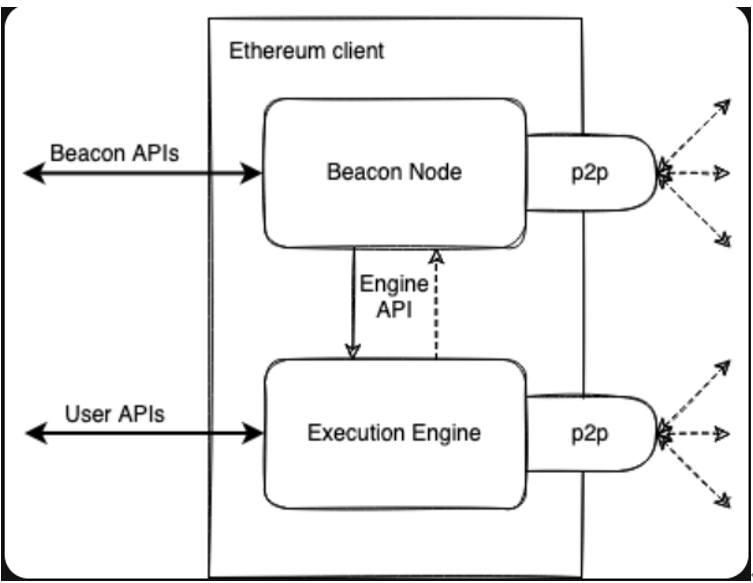
The execution layer upgrade is called Cancun, and the consensus layer upgrade is called Deneb. Together, they form the Cancun-Deneb upgrade. Although technically distinct, both upgrades are implemented simultaneously, hence the combined term "Dencun" is commonly used.
Significantly Reducing On-Chain Data Costs
The Dencun upgrade follows the Shanghai upgrade as another major enhancement to the Ethereum mainchain. Its primary goal is to address long-standing criticisms regarding low performance, high fees, and network congestion by advancing Ethereum’s scalability efforts—increasing mainchain TPS, reducing user gas fees, and enhancing overall scalability and security.
Based on the naming convention of the Dencun upgrade, it is clear that this update will mainly focus on improving and optimizing issues related to smart contracts and the EVM in the execution layer, along with data consensus and state alignment in the consensus layer. For this upgrade, the Ethereum community proposed several improvement proposals (EIPs), with six technical specifications finalized after discussion, testing, and voting by community members.
Among them, EIP-4844 is the centerpiece of the Dencun upgrade. Also known as the proto-danksharding proposal, EIP-4844 serves as the initial version of the Danksharding sharding scaling solution—an interim scalability measure.
By enabling temporary off-chain storage and access, EIP-4844 significantly reduces the gas cost for Layer2 networks posting data onto the Ethereum mainnet—especially Rollup solutions, which could see their data publication costs drop to less than one-thousandth of current levels—greatly lowering users’ gas expenses when using these networks.
EIP-4844 introduces a new transaction type called Blob-carrying transactions—a novel data format designed to scale Ethereum. Blobs carry data originating from Layer2, distinguishing them from native Calldata generated directly on the Layer1 Ethereum mainnet. Blob data is downloaded and stored solely by the Ethereum consensus layer but cannot be accessed by the EVM for execution purposes. Additionally, Blob data is time-limited, expiring after approximately 18 days.
Blobs act as external temporary storage—they do not permanently store Layer2 transaction data on Layer1, and the data expires regularly, drastically reducing data storage costs.
In simple terms, Blobs create a dedicated channel on the Ethereum mainnet specifically for transferring, storing, and verifying Layer2 network data. Within this channel, services like data transmission, storage, and validation are performed under customized gas and storage pricing independent of Ethereum network activity.
The main objective of EIP-4844 is to reduce L2 gas fees on Ethereum by utilizing the new Blob data format, facilitating a smoother transition toward full sharding since all future upgrades will occur exclusively at the consensus layer.
At the product architecture level, EIP-4844 marks the first time Ethereum builds a dedicated data layer specifically for L2s, laying the foundation for fully realized Danksharding;
At the economic model level, EIP-4844 introduces a new fee market for Blobs, representing Ethereum’s first step toward a multi-dimensional fee market;
From a user experience perspective, the most noticeable impact will be dramatically lower L2 fees, providing a critical foundation for explosive growth in L2s and their application ecosystems.
As StarkWare co-founder Eli Ben-Sasson stated, this upgrade will reduce data availability costs for all L2s.
What Other Network Improvements Does the Dencun Upgrade Bring?
Beyond EIP-4844 reducing Rollup data publishing costs, other key proposals include EIP-6780 and EIP-5656 to enhance EVM efficiency, EIP-7044 to improve staking experience, and EIP-4788 to optimize communication between the consensus and execution layers.
Regarding EVM improvements at the execution layer, EIP-6780 and EIP-5656 enhance smart contract security and processing efficiency by modifying relevant code functionalities.
EIP-6780 modifies the functionality of the SELFDESTRUCT opcode in smart contracts, restricting its execution to certain conditions to enhance code security.
SELFDESTRUCT, also known as self-destruct code, automatically deletes a smart contract, allowing it to remove itself from the blockchain.
When triggered, any remaining ETH in the contract account is sent to a designated address, and its storage and code states are erased. While useful for developers to delete contracts in emergencies and transfer funds, this feature can also be exploited maliciously, becoming a vector for attacks.
EIP-6780 aims to reduce vulnerabilities by limiting the destructive capabilities of the SELFDESTRUCT opcode. For example, a contract would only execute self-destruction if called directly by its owner, sending remaining ETH to the caller.
EIP-5656 upgrades EVM code by introducing a new opcode called MCOPY, which optimizes memory data copying during smart contract execution. MCOPY simplifies data handling instructions in the EVM, improving data movement efficiency and reducing associated gas costs.
Under the current EVM architecture, existing opcodes require excessive instructions to copy large data segments, resulting in inefficiency and high costs. With EIP-5656, copying 256 bytes of memory using MCOPY costs only 27 gas, compared to 96 gas previously—reducing gas consumption by about 75%.
Faster memory operations mean quicker contract execution, giving developers an edge when working with large data structures or complex memory-intensive operations.
While EIP-5656 and EIP-6780 don’t alter Ethereum’s overall direction, they improve developer efficiency and reduce vulnerabilities by updating or introducing new EVM opcodes.
On the consensus layer, EIP-7044 and EIP-7045 aim to improve validator and staking processes, enhancing Ethereum staking security.
EIP-7044 simplifies and improves Ethereum’s staking exit mechanism, ensuring voluntary exits signed before the Capella (Shanghai) upgrade remain permanently valid.
Currently, Ethereum staking is largely delegation-based—users delegate their 32 ETH (or multiples) to validator operators who manage the technical operation of running validators. To exit, users must sign a “voluntary exit” request using the validator’s signing key. However, currently, these voluntary exits are only valid across two upgrades and expire upon the Deneb upgrade. Without changes from the Dencun upgrade, users exiting staked positions would need to comply with new rules set by validator operators.
EIP-7045 increases the inclusion window for attestations in Ethereum blocks, reducing block confirmation times and user latency.
Additionally, EIP-4788 addresses communication between Ethereum’s execution and consensus layers, while EIP-1153 focuses on reducing data storage costs.
EIP-4788 improves cross-layer information exchange between Ethereum’s execution and consensus layers by placing the consensus layer’s beacon chain block root (summary of parent block information) into the EVM execution layer. This enables direct transmission of consensus state information within the Ethereum mainnet EVM without relying on third-party data providers, eliminating the need for external oracles and reducing risks of failure or manipulation—enhancing interoperability and stability.
Essentially, EIP-4788 introduces a protocol-level oracle that delivers Ethereum’s consensus state directly to the mainnet. Smart contracts deployed on Ethereum no longer require trusted oracle solutions to obtain consensus state information.
This change particularly benefits liquid staking protocols like Lido and Rocket Pool, restaking solutions like EigenLayer, and cross-chain bridges—since smart contracts on Ethereum can now directly access critical data such as validator balances and statuses from the consensus layer, reducing trust assumptions in restaking and enhancing security and operational efficiency.
EIP-1153 focuses on reducing data storage costs during contract execution and optimizing block space usage, making transactions more cost-effective and efficient.
Overall, the Dencun upgrade centers on lowering L2 data publishing costs, improving EVM performance at the execution layer, and enhancing the Ethereum staking experience.
Timeline for the Dencun Upgrade
Following the roadmap provided by previous ACDE meetings, Dencun testing proceeds sequentially across testnets: Goerli, then Holesky, followed by Sepolia.
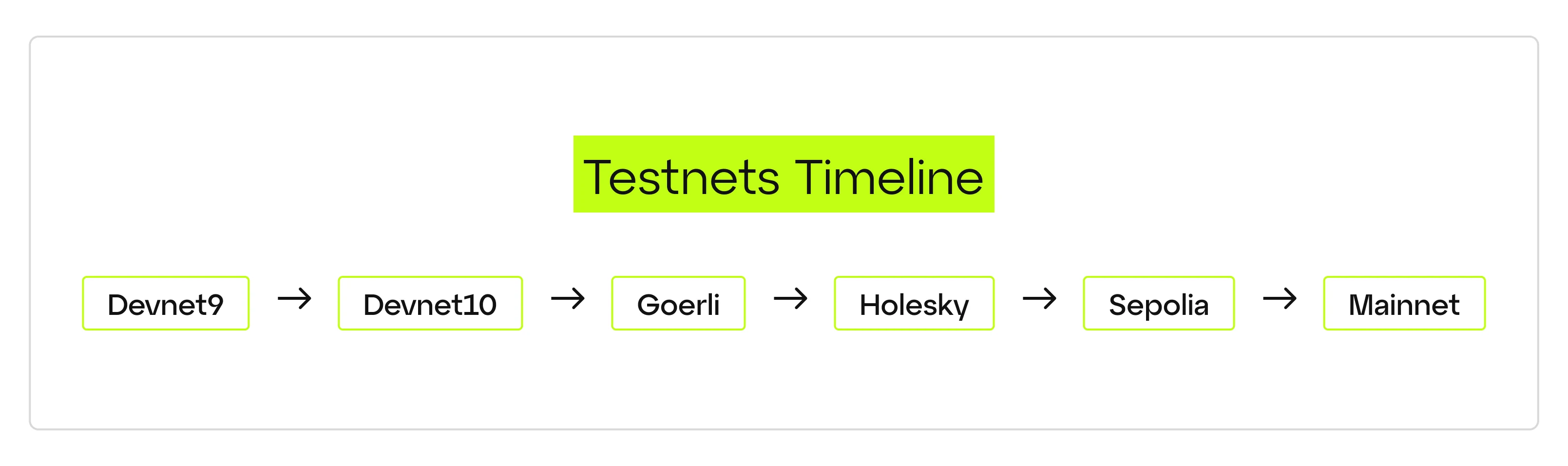
According to the Ethereum blog post dated January 24, the Dencun upgrade was activated on the Goerli testnet on January 17. Activation on the Sepolia testnet is planned for January 30, and on the Holesky testnet for February 7.
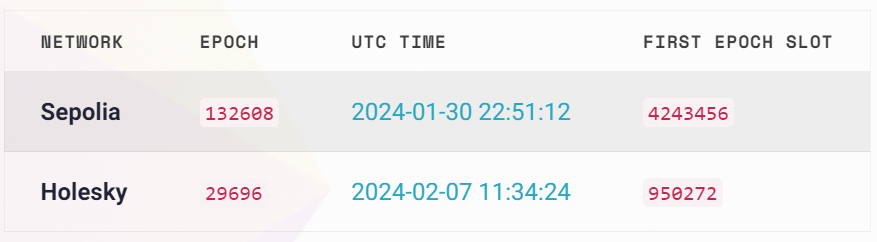
Once the Dencun upgrade successfully completes on all three testnets, activation on the Ethereum mainnet will follow, expected by the end of February.
However, during the latest ACDE core developer call on January 18, developers were asked about their confidence in the Dencun Layer2 upgrade.
A developer known as "Protolambda" from the Optimism L2 team indicated that Optimism aims to begin testing on Goerli within weeks. While the team appears ready to support Dencun, concerns remain about preparedness of infrastructure and tooling for Blob transactions, along with necessary updates required across many components on the Layer1 Ethereum mainnet.
How Will the Dencun Upgrade Impact Developers and Users?
Through implementing proposals such as EIP-4844 and EIP-1153, the Dencun upgrade optimizes network throughput, data storage, and block space utilization—lowering transaction fees and increasing processing speed. This delivers a seamless experience for developers and users alike and opens a new milestone for Ethereum’s on-chain ecosystem.
Moreover, the introduction of Blobs accelerates progress toward Ethereum’s Danksharding sharding plan. Proto-danksharding is expected to increase Ethereum’s throughput by over 100x, bringing Layer2 transaction costs below $0.001 and reducing Rollup-related gas fees by up to 99.9%.
So how will the Dencun upgrade affect developers, users, and the broader Ethereum ecosystem?
For users, the Dencun upgrade lowers the cost of posting Layer2 data on-chain via Blob storage and retrieval, enabling cheaper L2 transactions and unlocking more diverse on-chain use cases. Low gas fees and high throughput will foster innovative applications—particularly those requiring frequent interactions, such as gaming and derivatives platforms.
Additionally, according to current community plans, Ethereum will soon trial the full Danksharding sharding approach. If successful, combined with Layer2 Rollup technologies, Ethereum’s TPS could see massive gains, ushering in a new narrative era.
For developers, EIP-4844 enables greater flexibility, innovation, and diversity in building Ethereum applications.
Developers can leverage proto-danksharding to store and retrieve on-chain data, supporting more Layer2 solutions and application scenarios. They can also prepare for full danksharding, taking advantage of additional shard resources and features.
Improvements from proposals like EIP-6780 and EIP-5656 provide developers with a more efficient and cost-effective platform for deploying and developing smart contracts, freeing them to focus on product innovation rather than infrastructure optimization.
Enhanced Rollup network performance makes handling high-frequency, complex transactions feasible, enabling developers to integrate more sophisticated functions into smart contracts or DeFi applications.
For the Ethereum ecosystem, the Dencun upgrade enhances Layer2 performance, driving application prosperity and catalyzing ecosystem growth. Optimizations in data storage and data availability will promote development in DA and decentralized storage applications, while improved staking experiences benefit LSD and LSDfi applications.
Join TechFlow official community to stay tuned
Telegram:https://t.me/TechFlowDaily
X (Twitter):https://x.com/TechFlowPost
X (Twitter) EN:https://x.com/BlockFlow_News
 ChainCatcher 链捕手









