Enter the Web3 version of Dream Star, PuffGo party journey opens a new chapter
TechFlow Selected TechFlow Selected
Enter the Web3 version of Dream Star, PuffGo party journey opens a new chapter
Aiming for the future, PuffGo is about to launch its UGC gameplay.
 Navigating Web3 tides with focused insights
Text: Karen, Foresight News
By the end of 2023, Tencent's high-profile launch of "Dream Star" intensified an already fierce competition in the party game arena. Meanwhile, pioneering titles like "Fall Guys" and NetEase’s "Eggy Party" continued their steady growth, further confirming that the popularity of party games has become an inevitable trend.
Party games emphasize fun, family-friendly entertainment, stress relief, and social interaction. Supporting multiplayer competition, confrontation, and cooperation, they appeal to players due to diverse gameplay mechanics and a reduced focus on winning or losing.
Data remains the clearest indicator of market trends and vitality. At the end of 2023, shortly after its release, Dream Star topped the iOS free game chart and maintained its leading position, still ranking among the top today. According to Diandian data, since its mid-December launch, Dream Star has surpassed 6.6 million downloads on the App Store alone—with estimated revenue nearing 140 million RMB—not including Android figures. During the same period, Eggy Party, benefiting from its first-mover advantage, achieved comparable download numbers with approximately 112 million RMB in estimated revenue. Notably, last month Eggy Party announced it had reached 500 million players after 560 days online.
Can party games find a place within Web3 gaming? The author believes they absolutely can—and that gaming and social experiences are among the most promising drivers for mass Web3 adoption. Party games perfectly blend these two elements. Imagine owning full rights to in-game assets such as skins, being able to trade or rent them, and enabling both creators and players to earn tangible rewards—something entirely novel and unprecedented for Web2 gamers. More importantly, if Web3 party game avatars support blue-chip NFTs or domain-based identities, this would significantly enhance the game’s social value and utility.
Today, Foresight News introduces PuffGo—a Web3 party game backed by numerous high-quality partners. Through a series of strategic initiatives, PuffGo is building a vibrant, co-creative, and sustainable platform model.
What is PuffGo?
PuffGo is a creatively designed party game launched by Puffverse, integrating casual play, competitive mechanics, and blockchain technology. It adopts a unique Skill-to-Earn model, allowing players to earn on-chain asset rewards through gameplay. With rich thematic levels and varied gameplay modes, PuffGo offers diverse match options while emphasizing fun, challenge, and the incentive economy most valued by Web3 users.
According to PuffGo’s team, the founding members include former Xiaomi employees, and the project established and maintains a collaborative relationship with Xiaomi from early stages. This partnership undoubtedly brings strong technical support and resource networks, giving PuffGo significant advantages in development and operations, potentially attracting a large base of loyal users. As PuffGo suggests, it aims to deliver a more open and free Web3 experience within the Xiaomi ecosystem.
Beyond Xiaomi, PuffGo’s public list of partners includes leading interactive entertainment creation platform YAHAHA, Weilin Times, game engine Unity, and BNB Chain. These collaborators bring leading-edge technologies and infrastructure in their respective fields, providing PuffGo with support in metaverse engines, game engines, and 3D interactive experiences. Additionally, Puffverse received a grant from the BNB Chain Builder Grant program in October 2022.
PuffGo Gameplay
In terms of gameplay, PuffGo features a wide variety of level themes and mechanics, offering players multiple match mode choices.
Level design in PuffGo considers whether players own NFT characters. Players without NFT avatars can enjoy beginner to intermediate levels in casual, story, and elimination modes, earning in-game props and coins upon victory. Players who own NFT characters gain access to advanced elimination mode levels, where they can win on-chain asset rewards.
In the world of PuffGo, players can collect various unique characters, each with distinct appearances, personalities, and skills. They can also customize outfits according to personal preferences, making their avatars more individualized. Moreover, players use diverse character abilities and strategies to compete against others, aiming for higher rankings and better resource rewards.
It's worth emphasizing that PuffGo targets not only Web3 users but also actively seeks to onboard Web2 players, broadening its user base and unlocking greater market opportunities and growth potential. Additionally, PuffGo will use a portion of its Web2 revenue to repurchase tokens, creating intrinsic value support.
Based on the author’s hands-on experience, aside from minor connection latency caused by VPN usage and slightly longer matchmaking times, the overall gameplay experience is smooth, visually appealing, and delivers gameplay quality comparable to major studio productions. Combined with frequent rewards, it’s highly engaging and addictive.
PuffGo Economic Model
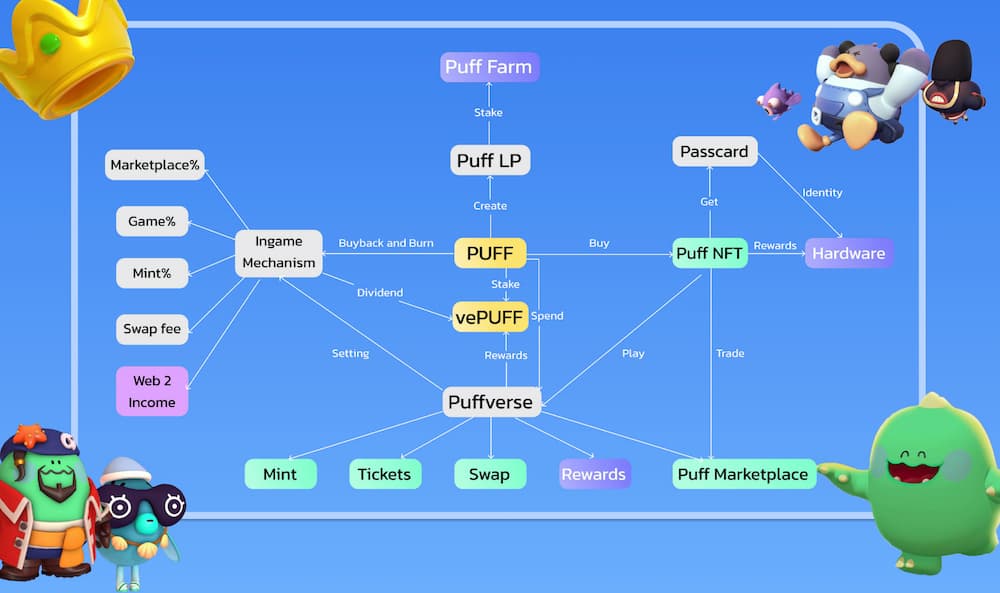
For Web3 games, beyond gameplay and mechanics, the economic model is crucial. According to official documentation, the Puffverse ecosystem features two tokens: PUFF and vePUFF. PUFF serves payment functions—for items such as Passcards, PuffGo Passes, and PuffLand land resources—while vePUFF represents yield.
Moreover, vePUFF acts as a governance token with voting rights. It can be obtained by staking PUFF (at a certain ratio) or earned via in-game rewards. While vePUFF is non-transferable, it can be converted back into PUFF and entitles holders to share in platform revenues—including a percentage of transaction fees from PuffTown app token swaps, NFT marketplace trades, and Pass sales.
As shown below, Puffverse has designed a closed-loop economic model incorporating yield, staking, burning, and buybacks to ensure long-term sustainable development.
Looking Ahead: UGC Features Coming Soon to PuffGo
In today’s content-driven era, the gaming industry is shifting toward co-created content, entering a new age of player-generated creativity.
When Dream Star launched, Tencent announced an initial 1.4 billion RMB ecosystem incentive fund, with up to 1 billion RMB dedicated to comprehensive support for UGC (user-generated content) map creators. Meanwhile, by August 2023, Eggy Party had already surpassed 100 million user-created maps in-game.
Clearly, a constant stream of UGC maps enriches gameplay diversity and sustains long-term game vitality.
Given this, PuffGo will launch its UGC feature at the end of this month, allowing players to create their own game levels and challenge custom levels made by others—unlocking possibilities for new gameplay types, increasing interactivity, and boosting user retention. Future iterations will integrate UGC functionality into PuffLand, spawning even more gameplay innovations.
Complementing the UGC feature is an efficient, low-barrier map creation tool. By the end of 2024, PuffGo will introduce AIGC capabilities within PuffLand, enabling users to generate their own levels simply by entering text commands.
How Does PuffGo Ensure Sustainable Development?
Discussing PuffGo’s sustainability plan requires examining the broader Puffverse product matrix. Beyond PuffGo, Puffverse includes:
1. PuffTown – An asset dashboard featuring a built-in Puff NFT marketplace, displaying in-game and on-chain data and tracking your gaming history. Notably, PuffTown allows users to create MPC (multi-party computation) wallet addresses directly using email addresses—an approach that eliminates private keys and seed phrases, making it seamless to onboard Web2 users.
2. PuffWorld – A 3D metaverse space serving as a social bridge between players. Currently supporting up to 40 adventurers per channel, PuffWorld plans to scale to over 10,000 simultaneous users per channel, with the “ten thousand players on one screen” capability under joint development with Weilin Times.
3. PuffLand – A convenient creator tool combining AIGC and UGC functionalities.
According to the Puffverse roadmap, this quarter will see the launch of the Creator Program, followed by a Token Points IGO event in Q2, allowing users to participate and accumulate points toward initial token distribution, with the official token launch expected in Q3.
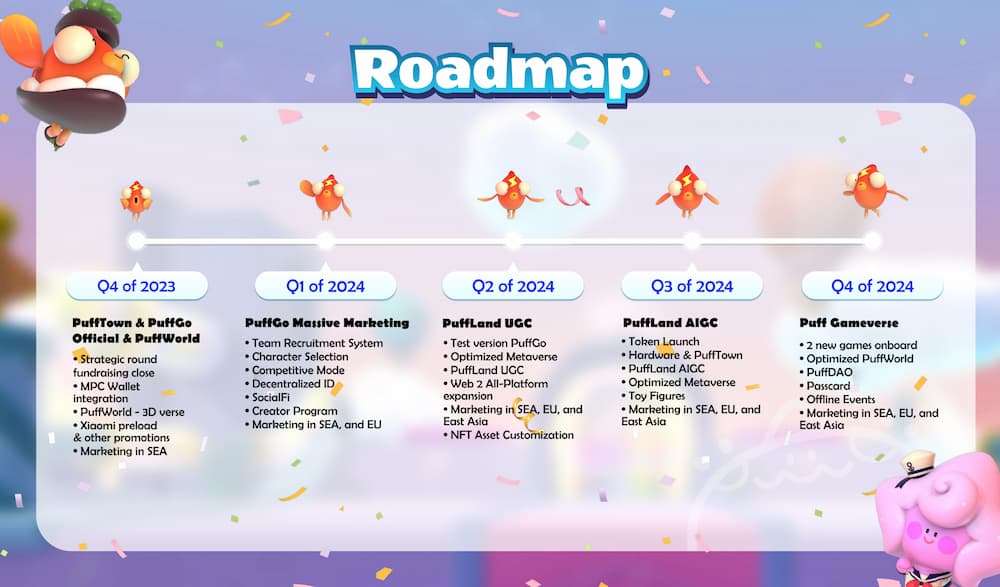
From PuffGo’s product offerings, roadmap, and economic model, we can see that PuffGo is empowering creators through concrete incentive programs—driving motivation and creativity, generating higher-quality content, and achieving true diversification. Furthermore, by leveraging UGC gameplay and AIGC tools, PuffGo enables creators to contribute content more efficiently and conveniently, catalyzing both quantitative and qualitative improvements to sustain a co-creative ecosystem.
Additionally, PuffGo aims to establish a closed-loop economic model through PUFF staking, burning, and buybacks, while distributing platform revenues and governance rights via the vePUFF governance token. Coupled with PuffWorld’s role as a social connector, players can meet like-minded friends, discover, share, and engage with game-related content, deepening connections and interactions—further enhancing ecosystem vibrancy, diversity, and triggering a snowball effect in social expansion.
PuffGo Game Background
A well-crafted storyline and character design are key components of any successful game, playing a pivotal role in narrative progression. In Puffverse, the core story revolves around a princess, a little dinosaur named Patty, and a mysterious figure known as Mr. B. Centuries ago, after magical energy faded, monsters became peaceful and built a prosperous, harmonious kingdom under the Demon King’s rule.
However, the Demon King suddenly vanished, and his castle was invaded by the evil Moru gang, who seek the princess and the Demon King’s crown. During their escape, the princess and Patty—who rescued her—accidentally discover that the crown was shattered into countless magic fragments by a small fish named Pop. These fragments spread globally, forming “magic fields.” To reclaim their castle, they embark on a journey to collect the magic shards, while a mysterious Mr. B follows closely behind with unknown motives. With the Demon King missing, magic depleted, and the crown’s power fragmented, many mysteries remain unsolved. Can the princess and her companions uncover the truth and overcome all obstacles?
Besides the adorable Patty and little fish Pop, other characters in Puffverse include the righteous Claude and light-chasing Bill Duck.
Conclusion
In summary, PuffGo is building a dynamic, co-creative, and sustainable platform model through a series of strategic measures. The platform, creators, players, and token holders are all interconnected, each playing a unique role within the PuffGo ecosystem, collectively driving a virtuous cycle of growth. This co-creation and mutual benefit mechanism will stand as one of PuffGo’s core strengths.
Amidst the bustling real world, what visual feast will PuffGo’s UGC-powered wave of creativity bring? Can PuffGo emerge as a shining new star in the Web3 gaming landscape? Let us wait and see.
Join TechFlow official community to stay tuned
Telegram:https://t.me/TechFlowDaily
X (Twitter):https://x.com/TechFlowPost
X (Twitter) EN:https://x.com/BlockFlow_News
 Foresight News