After reviewing the 2023 Web3 Grants funding round, which interesting projects did we discover?
TechFlow Selected TechFlow Selected
After reviewing the 2023 Web3 Grants funding round, which interesting projects did we discover?
This article selects the four most representative Grants.
 Navigating Web3 tides with focused insights
Author: Chunzhen
Web3 Grants can be understood as protocols allocating a portion of their revenue or native tokens to incentivize protocols, projects, or research that benefit the broader Web3 ecosystem or a specific sub-ecosystem. For projects, grants provide not only financial support but also endorsement and diversified assistance; for large-scale protocols, grants help retain developers and thereby promote overall ecosystem development.
This article examines four of the most representative grants—Ethereum Foundation's Ecosystem Support Program (ESP), Gitcoin Grants, Optimism RPGF, and Uniswap Foundation Grants—aiming to uncover "hidden gems" from the projects and research they funded in 2023.

Ethereum Foundation Ecosystem Support Program (ESP)
The Ethereum Foundation’s Ecosystem Support Program (ESP) is a division dedicated to providing financial and non-financial support to teams building across the Ethereum ecosystem.
In April 2015, the Ethereum Foundation launched DEVgrants to fund key components of Ethereum’s core software, its development process, or critical parts of the ecosystem such as public services, APIs, and ABIs. (Note: Public records show that only the first batch of DEVgrants recipients was disclosed, with no updates thereafter.) In March 2018, the foundation introduced Ethereum Foundation Grants to expand funding for projects excelling in scalability, usability, and security. In November 2019, it launched the new Ecosystem Support Program (ESP), shifting focus from developer-centric DEVgrants and scalability-focused initiatives toward broad-based support for tools, infrastructure, research, and public goods.
ESP Funding Rounds in 2023:
-
Q1: 63 projects, $12,910,616.53
-
Q2: 56 projects, $9,218,158.34
-
Q3: 98 projects, $8,945,982.74
-
Q4: Not yet disclosed
Spotlight: Projects Receiving More Than Two Grants
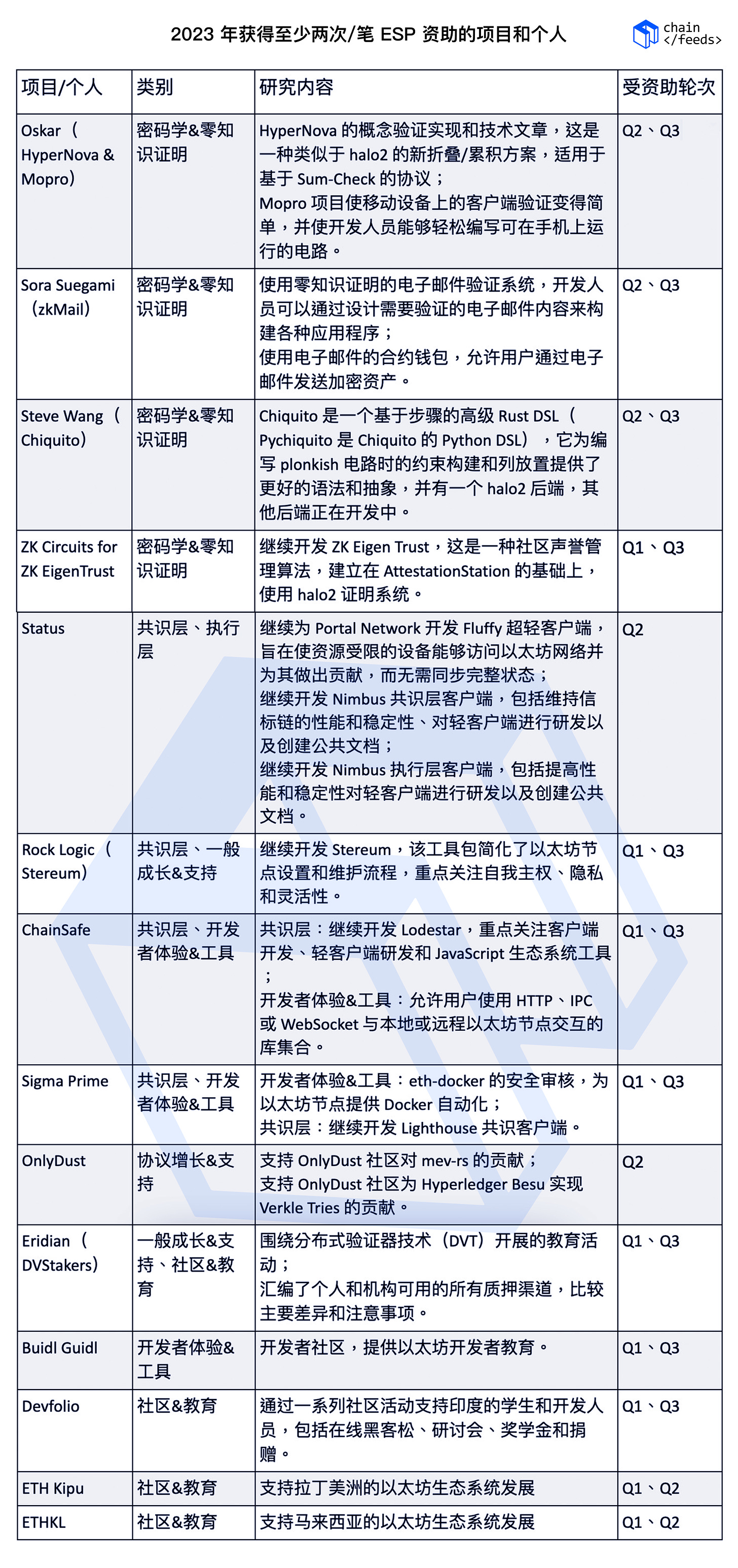
In terms of number of funded projects, "Community & Education" was the largest category—an alignment with Ethereum’s mature technical stage and emphasis on ecosystem growth. Second came focused attention on "Cryptography & Zero-Knowledge Proofs," which ranked second in project count and includes multiple long-term ESP-funded projects and research efforts.
Below are projects and individuals that received at least two ESP grants in 2023:
Gitcoin Grants
Founded in 2017, Gitcoin initially aimed to support open-source development and monetize open-source software through bounty programs. In 2018, one of Gitcoin’s co-founders, Vitalik, published a paper on quadratic funding, proposing that the more individual donors contribute, the larger the matching pool a project receives. Gitcoin launched Gitcoin Grants in 2019, becoming the first project to implement quadratic funding. From 2019 to 2022, Gitcoin Grants raised $700K, $2.8M, $13.2M, and $21.4M respectively for public goods.
Gitcoin Program Alpha Round and Gitcoin Program Beta Round were test rounds for Gitcoin Grants Stack, a customizable and decentralized donation solution built on the Allo protocol. Gitcoin Grant 18 and Gitcoin Grant 19 were standard fundraising rounds in 2023, with some rounds conducted on the Public Goods Network. Gitcoin Grants primarily focuses on Web3 open-source software, Ethereum infrastructure, climate solutions, and Web3 community and education.
Gitcoin Funding Rounds in 2023:
-
Gitcoin Grant 19: 471 projects, $1.09M
-
Gitcoin Grant 18: 480 projects, $1.68M
-
Gitcoin Program Beta Round: 468 projects, $1.857M
-
Gitcoin Program Alpha Round: 150 projects, $1.667M
Spotlight: Public Goods Network
Public Goods Network (PGN), spearheaded by Gitcoin, is an L2 dedicated to creating sustainable and recurring funding for public goods. Built on Optimism’s OP Stack, PGN plans to allocate the majority of sequencer fees to public goods projects. This means PGN does not rely on external donations but instead sustains itself through endogenous user-generated fees.
Notably, PGN plans to eventually implement Contract Shared Revenue (CSR) to meet developers’ demand for sustainable income. The CSR protocol, EIP-6969, proposed by Slingshot CTO zkCole, aims to incorporate economic incentives for developers at the protocol layer. EIP-6969 introduces a new gas fee distribution mechanism for EVM-based L2s, allowing a portion of gas fees to be rewarded directly to contract developers. If EIP-6969 is adopted in future Ethereum upgrades, PGN could experience significant growth due to scale effects.
PGN’s mainnet launched in July 2023. According to L2BEAT data, PGN currently has a TVL of $1.57M and 4,200 total addresses, indicating it remains in a very early development phase. Per PGN’s official roadmap, after six months of mainnet operation, fee allocation will be evaluated and adjusted based on accumulated data. Further disclosures on metrics and distribution rules are anticipated.
Optimism RPGF
Retroactive Public Goods Funding (RetroPGF or RPGF) is a funding initiative encouraging contributions to projects related to Optimism. RPGF leverages protocol-generated revenue (profits from sequencers), retroactive public goods funding, and a Results Oracle to create a startup-like financing cycle for public goods. At its core is Vitalik’s concept of retroactive funding: it is easier to reach consensus on what *was* useful than on what *will be* useful.
RPGF Funding Rounds in 2023:
-
RetroPGF Round 2 (Q1): 195 projects, 10 million OP tokens
-
RetroPGF Round 3 (Q3): 501 projects, 30 million OP tokens
Spotlight: Protocol Guild
Protocol Guild, which received the highest total funding in both RetroPGF2 and RetroPGF3 (over 1.22 million OP combined), began in 2022. It is a collective of Ethereum contributors aiming to enhance incentives for maintaining the core protocol. Through a blockchain-based registry of members, Protocol Guild enables ecosystem sponsors to directly fund contributors and support their public-benefit work.
The initial goal of Protocol Guild was to pilot a new funding mechanism that consolidates all protocol contributors into a single financing model while enabling continuous updates. On an operational level, large grants are released to members over one year, while small or recurring grants can be withdrawn anytime. Each member’s withdrawal weight is calculated based on their duration of contribution to the ecosystem.
As of January 15, 2024, Protocol Guild has 161 members who have collectively received over $20.77M in grants. The program was originally intended as a one-year pilot from May 2022 to May 2023. However, aside from a mid-term update in December 2022, the official website has seen little activity since.
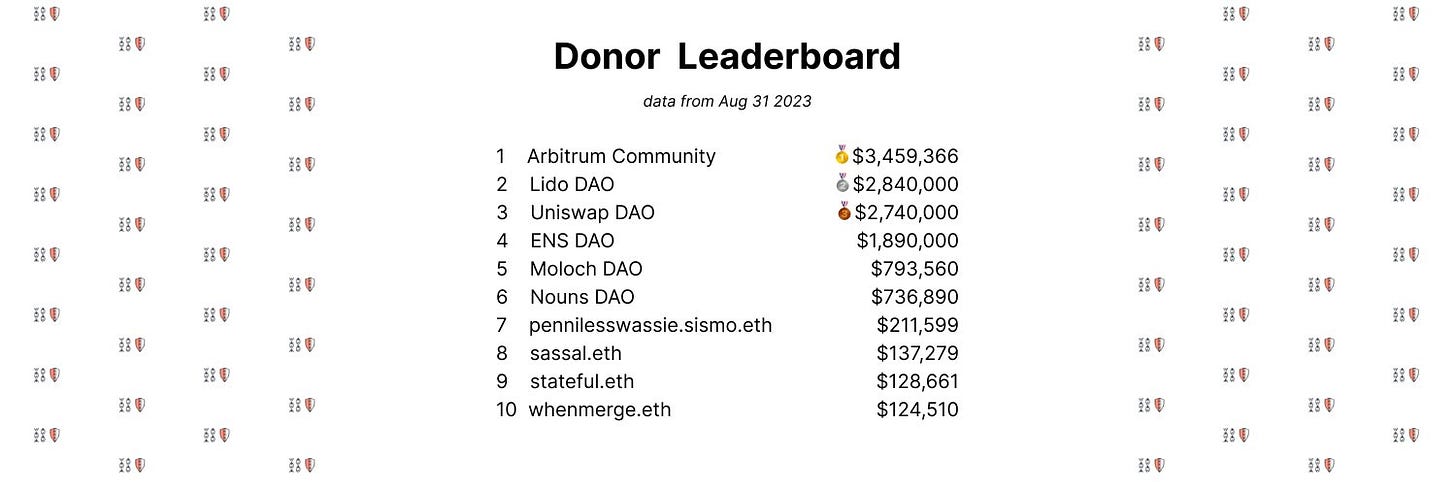
While Protocol Guild represents an innovative on-chain incentive distribution experiment—primarily at the smart contract level—it fails to solve a fundamental issue: how to assess the value of contributions? Protocol Guild uses a simplistic time-based metric, resulting in minimal differentiation among members—akin to equal sharing regardless of impact. This makes subsequent evaluation difficult: did the economic incentives truly drive greater contributions? Finally, membership remains limited to established Ethereum developer groups and top-tier ecosystem projects. Whether it can expand to include independent developers in the future remains an open question.
Uniswap Foundation Grants
The Uniswap Grants Program (UGP) launched in December 2020 following a governance vote, allocating $1.5M in UNI over six months. Initially narrow in scope—focused on MVP-level support for the developer ecosystem—it later expanded to include governance research, community building, education, and core protocol work. Due to the crypto bull market, UGP lasted 18 months and distributed $7M in grants. In August 2022, the Uniswap Foundation (UF) was established, evolving UGP into Uniswap Foundation Grants (UFG) with a $60M budget over three years.

As a typical ecosystem fund, Uniswap Foundation Grants primarily supports the growth of the Uniswap ecosystem. Uniswap Foundation Grants Wave 3 focused on four categories: 1. Protocol Growth, including grants to enhance the Uniswap v3 SDK and LP toolkits; 2. Research & Development, including studies on checkpoint-free TWAP oracles and cross-chain MEV market dynamics; 3. Community Development, supporting industry analysis around public goods and co-hosting live events with FWB; 4. Governance Operations, including research on novel governance structures and evaluation of governance information bridges.
Uniswap Foundation Grants Rounds:
-
Uniswap Foundation Grants Wave 3 (June 2023): 21 projects, $990,000
Spotlight: Three Projects Supported by the Uniswap Foundation
The Uniswap Foundation highlighted three key grants: “Checkpoint-Free” TWAP Oracles, Uniswap v3 SDK Rewrite, and LP University: From Beginner to Intermediate Course on Uniswap v3.
Axiom’s research and prototype development on “checkpoint-free” Uniswap v2 and v3 TWAP oracles: This research could reduce oracle operation risks and increase the use of trustless on-chain oracles in DeFi applications. The proof-of-concept eliminates the need for checkpoints in v2 TWAP and reduces caching overhead in v3 oracles. Axiom has extensive expertise in zero-knowledge systems and blockchain infrastructure.
Koray and Florian’s Uniswap v3 SDK Rewrite: This effort will support updates and improvements to the Uniswap v3 SDK, including refreshed JavaScript SDK documentation, modernized architecture and codebase, and new testing suites. The team has strong technical credentials, having created web3.swift (one of the most widely used crypto development tools on iOS) and revived web3.js.
DoDao’s LP University: This will serve as an excellent resource for those interested in liquidity provision but unsure where to start. The grant funds an interactive educational experience for aspiring liquidity providers, covering topics such as AMM basics, Uniswap v3 fundamentals, and active vs. passive LP strategies. DoDao has extensive experience creating educational content for crypto ecosystems.
What’s Next
This article reviewed major foundation grants in 2023 and highlighted notable projects. In the coming year, we will continue monitoring and engaging with foundation activities and discussions around public goods, including but not limited to:
-
Definition of public goods: Debates over whether funded projects qualify as public goods—for example, whether financially stable companies like Alchemy should receive RPGF funding;
-
Transparency: Disclosure of grant processes, foundation finances, and funded project expenditure;
-
Incentive evaluation: How to properly incentivize projects of different scales/types, and how to measure the outcomes of such incentives;
-
Emerging research: Ongoing academic and practical research on public goods.
Join TechFlow official community to stay tuned
Telegram:https://t.me/TechFlowDaily
X (Twitter):https://x.com/TechFlowPost
X (Twitter) EN:https://x.com/BlockFlow_News
 @ChainFeedsxyz