








BTC L2 Paradigms and Schools: Rollup-like Approaches Will Ultimately Prevail
TechFlow Selected TechFlow Selected
BTC L2 Paradigms and Schools: Rollup-like Approaches Will Ultimately Prevail
The key is that a general-purpose L2 can scale up and down.
 Navigating Web3 tides with focused insights
Author: Zuo Ye
Since May 2023, the explosive popularity of inscriptions and their various derivative protocols has re-established Bitcoin as a new frontier for blockchain entrepreneurship. In this wave, two key characteristics stand out: the "orthodoxy" established through Bitcoin's UTXO transaction model, and the "migratability" of Ethereum-style innovations being adapted back to Bitcoin.
On orthodoxy, Ordinal (inscriptions) and Runes (runes) are protocols created by Casey Rodarmor for Bitcoin NFTs and FTs respectively. However, while Runes is still under development, the trend has already arrived, and BTC L2s are beginning to gain momentum.
On migratability, nearly all issuance and circulation of Bitcoin assets integrate with the EVM ecosystem. As such, adopting Ethereum’s L2 development approach has become an industry consensus. More specifically, both ZK and OP rollups have been incorporated into BTC L2 designs. Yet similar to Ethereum's scaling journey, there are many followers but few true innovators.
The core of BTC L2 lies in establishing clear paradigms and schools of thought. Only with defined technical directions can one identify high-potential projects. Currently, however, BTC L2 remains in an early, concept-heavy phase where ideas outweigh practical implementation.
My purpose in writing this article is to outline potential developmental paths for BTC L2—not to catalog existing projects or delve deeply into technical principles (this article contains no formulas or code beyond elementary school level—feel free to read on~).
Bitcoin Needs Scaling, But 'Adding Water Then Flour, Then More Water' Won't Work
Before BTC L2 became popular, the dominant narrative was “scaling.” Bitcoin’s weak TPS couldn’t support large-scale transactions like frequent micro-payments. High gas fees and snail-like confirmation speeds were unbearable—for at least some users.
Scaling was inevitable. The 2017–2018 period gave rise to forked projects like BCH and BSV, which in turn pushed Bitcoin’s mainnet to adopt SegWit—an unprecedented move that increased block size to 4MB instead of Satoshi Nakamoto’s original 1MB limit.
According to Nakamoto’s design, a Bitcoin block header without transaction data is about 80 bytes. With a 10-minute block time, this would generate roughly 4.2 MB of data per year. After SegWit, that figure rose to 16.8 MB—but TPS improvements remained negligible, still hovering in single digits.
Herein lies the paradox: improving TPS requires advancements in hardware and network speed. If we continue down this path solely focused on faster transactions, Bitcoin will need continuous expansion, ultimately leading to centralization.
Forward-thinking individuals argued for halting base-layer expansion and shifting focus to L2 solutions—thus sparking the first wave of L2 enthusiasm, during which the idea of the Lightning Network emerged.
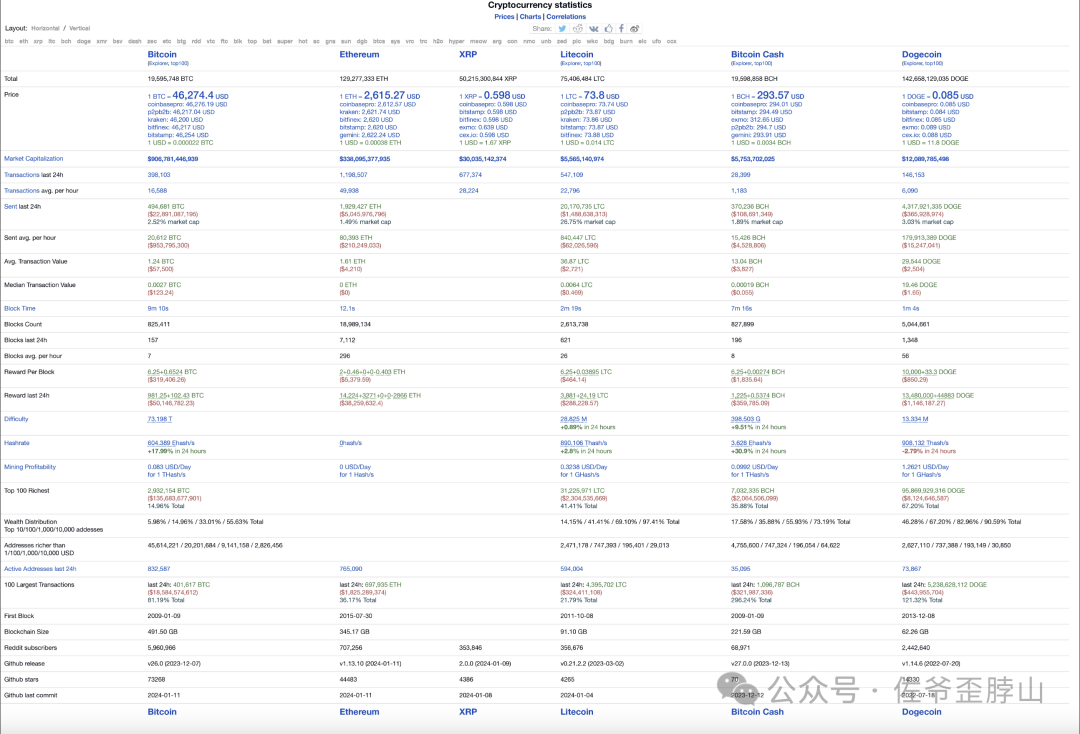
Comparison of Bitcoin, Ethereum, Dogecoin, and Litecoin – Data Overview
As shown above, Ethereum was Vitalik’s response after his proposal for smart contracts on Bitcoin was rejected. LTC, BCH, and Dogecoin are all Bitcoin variants, differing only slightly in difficulty and speed adjustments.
However, two critical shortcomings have made building L2s on Bitcoin a bumpy process:
-
Bitcoin’s scripting language lacks Turing completeness, making it difficult to support complex functionalities;
-
Hardware limitations from 2008 mean Bitcoin’s mainnet is genuinely too slow and needs improvement.
Turing completeness refers to computational capability—in simple terms, solving complex problems within finite rules. For example, setting up automatic transfers: Ethereum uses smart contracts to define rules that execute automatically. Bitcoin, however, functions more like a public ledger—it can only record transactions and cannot natively support automation. This ensures absolute security but results in extremely low efficiency.
Due to its limited functionality, Bitcoin first implemented the SegWit upgrade to significantly increase block space, followed by Taproot. Inscriptions (the foundation of Ordinals) function similarly to code comments—and owe their existence to these upgrades.
With this context, we can establish a minimal framework for understanding Bitcoin scaling and L2 evolution, gradually adding details later:
-
Early L2 experiments around 2017–2018: Lightning Network, ChainX, Stacks (founded in 2015);
-
After the 2021 Taproot upgrade, partial L2 attempts emerged with EVM compatibility becoming standard—e.g., Liquid Network (predicted in 2020);
-
Following the 2023 inscription boom, Ethereum-style L2 approaches—including ZK/OP Rollups, WASM, multisig bridges, and widespread EVM adoption—were imported into Bitcoin via projects like BitVM, BEVM, and Interlay V2. Overall, this marks a phase where Rollup-EVM models feed innovation back into Bitcoin.
Note that these three stages are not mutually exclusive—they increasingly converge. Most current BTC L2s incorporate EVM capabilities, albeit through different implementation strategies. This article does not aim to recount history in detail, but rather selects representative cases for analysis.
General-Purpose L2: The Key Is Bidirectional Interoperability
In short, current BTC L2s fall into four broad categories: Lightning Network-type, bridging-based, smart contract-based (early versions built directly on mainnet, now resembling Rollups), and sidechains. This classification isn't strictly technical—it focuses more on how each connects to the EVM ecosystem. Unlike Ethereum L2s, which primarily consider how to connect to the mainnet, BTC L2s must bridge three layers: Bitcoin mainnet, the L2 itself, and the EVM environment.
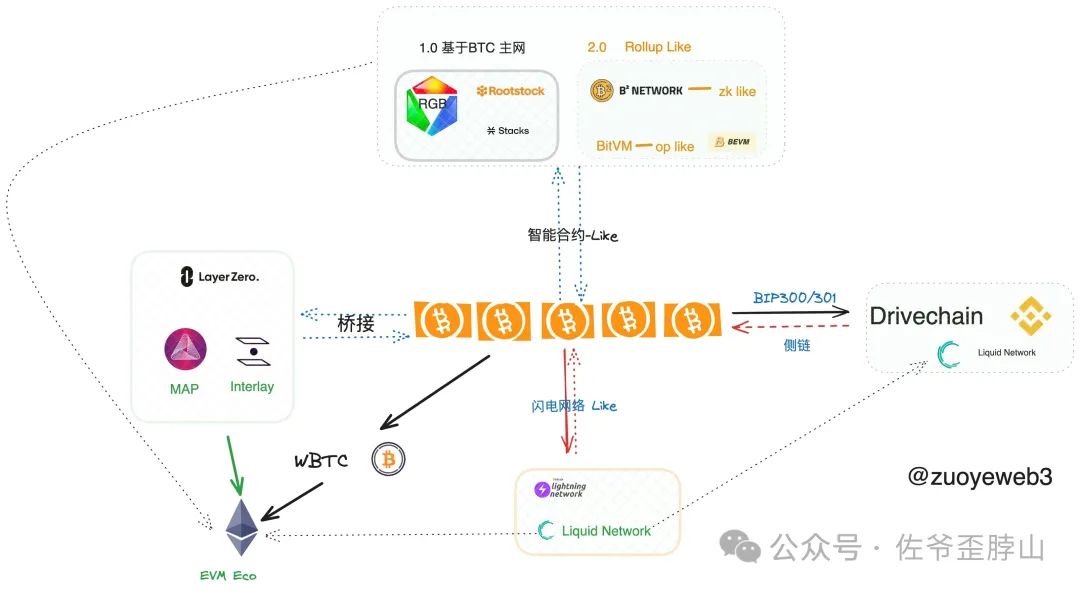
Deconstruction of BTC L2 Paradigms
Among these, the Lightning Network cannot interface with EVM and, despite being the most Ethereum-L2-like BTC L2 historically, is now considered an outlier. All other BTC L2s fit into the framework illustrated above. Also note that EVM compatibility isn’t limited to smart contract-based systems—the categorization here serves clarity and highlights distinguishing features of each type.
In terms of development strategy, BTC L2s must address bidirectional channels: how to lock BTC into their system, enable BTC to flow into EVM ecosystems for practical use, and ensure final settlement outcomes are securely relayed back to the Bitcoin mainnet to leverage its ultimate security guarantees.
We’ll now focus on WBTC and the Lightning Network mechanism—most subsequent solutions can be seen as decentralized evolutions of the former and generalized adaptations of the latter. WBTC solved the problem of bringing BTC into EVM and DeFi, albeit through centralized means; the Lightning Network ultimately settles on Bitcoin, achieving security equivalent to the mainnet upon finality.
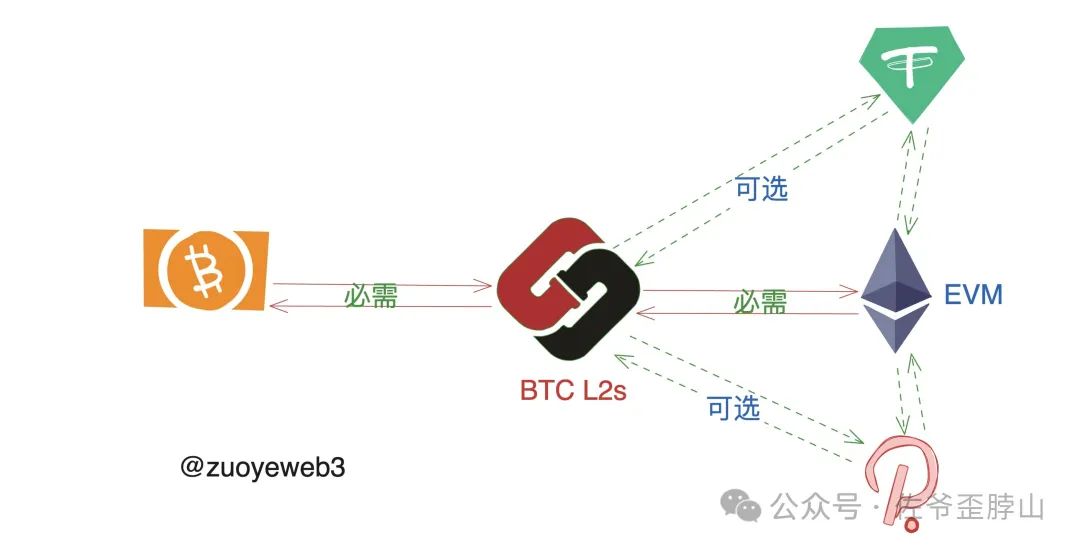 Functionality Overview of BTC L2s
How WBTC Works
WBTC stands for Wrapped Bitcoin—an ERC-20 token circulating on Ethereum, fully backed 1:1 by BTC. Operationally, it involves users, merchants, and custodians, with functions divided into deposit, minting, and redemption:
-
Deposit: Users apply through merchants who perform KYC/AML checks. Once verified, users send BTC to the merchant, who issues WBTC to the user;
-
Minting: Merchants request issuance from custodians by sending BTC. Custodians then issue WBTC to merchants;
-
Redemption: Merchants request BTC withdrawal from custodians. Custodians return BTC to merchants after confirming the corresponding WBTC has been burned.
Clearly, WBTC operates based on custody and centralized validation. Although elements like DAO governance, multisig control, and transaction anonymity exist, overall it resembles USDT—a traditional financial logic infiltrating blockchain. It cannot serve as a foundational pillar for BTC L2.
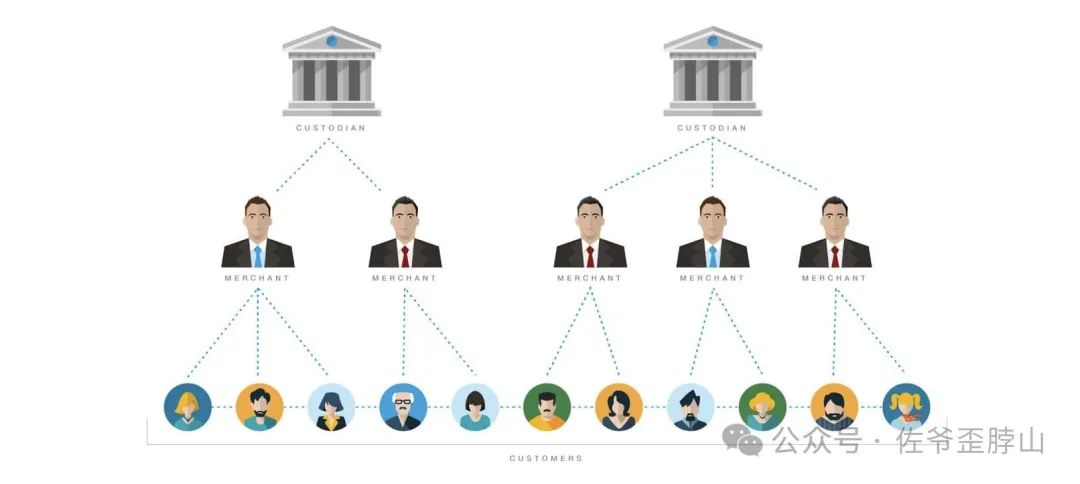 WBTC Operational Architecture
Settlement Mechanism of the Lightning Network
As previously mentioned, the Lightning Network eventually settles on the Bitcoin mainnet. Specifically, it establishes multiple BTC staking nodes, forming a PoS-like network atop Bitcoin. This enables peer-to-peer off-chain payment channels that do not require real-time confirmation—resulting in high efficiency and very low gas fees. Only when participants decide to close the channel does final settlement occur on-chain, triggering actual BTC transfers.
Thus, the Lightning Network balances Bitcoin’s security with transaction convenience. However, because settlements aren’t instantaneous, certain risks remain. Extending the Lightning Network into a general-purpose settlement layer is another active area of BTC L2 development.
At this point, the fundamental思路 of BTC L2 has been outlined. My intention is not deep technical analysis, so many implementation details are omitted—experts please bear with me, consider this merely a starting point for discussion.
Next, I will examine representative projects from each category to illustrate the current state of BTC L2 development, offering insights for investment or usage decisions.
Paradigms and Schools: The Hidden Agendas Behind BTC L2 Projects
I reviewed currently emerging L2s and noticed a clear spike starting in 2023. The surge in inscriptions attracted both capital and technical talent. At the same time, the concentration of inscriptions on the mainnet sparked intense debate within the community—for instance, Luke proposed banning inscriptions altogether, but miners opposed it fiercely due to economic incentives. I’ve analyzed this in depth before: The Great Inscription Debate: Developer Conflicts Are About利益争夺.
A balanced solution between miners and developers is widespread L2 adoption—moving such "creative" activities off the mainnet while keeping it reserved for final settlement. The Runes protocol, created by the Ordinal founder, follows this philosophy. Drawing from Ethereum’s evolution, Bitcoin may also evolve toward a modular architecture: mainnet → Ordinal (BRC-20) → L2 → dApps.
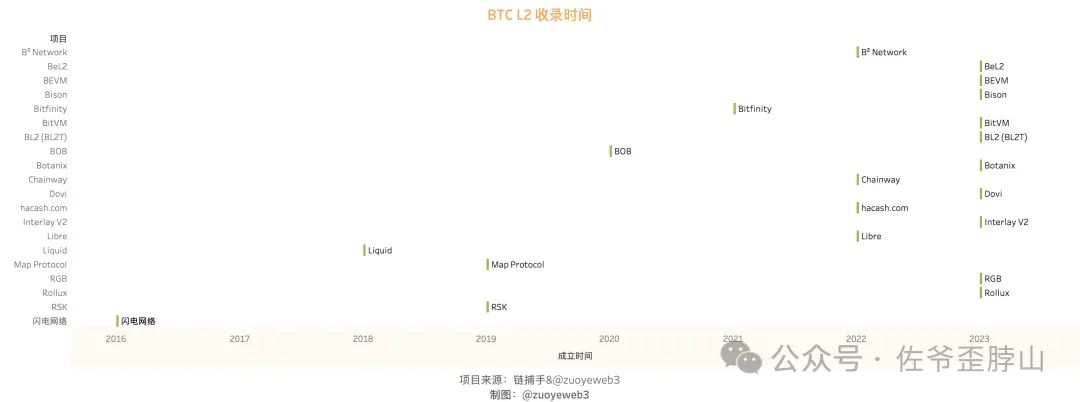 Timeline of BTC L2 Project Launches
Project timelines may shift; dates listed reflect verifiable milestones such as whitepaper releases or mainnet launches. While classifications might evolve, the goal here is conceptual clarity.
Based on differences in how BTC flows upward and results settle downward, I further classify L2s using criteria including BTC mapping method, L2 fund management, data anchoring mechanism, plus secondary factors like EVM compatibility and native token issuance, resulting in the following comparison table of representative projects across paradigms.
 Representative Projects Across BTC L2 Paradigms
From the table, we see that no fully decentralized L2 solution is perfect—all rely to some extent on off-chain processing or multisig mechanisms, striving to balance efficiency, decentralization, and scalability (EVM compatibility).
Take the Lightning Network: it’s nearly the only surviving L2/scaling solution from the previous era. It fully leverages Bitcoin’s core properties and doesn’t issue tokens. However, its reliance on payment channels limits universality, and non-instant settlement makes large-value transfers impractical.
Liquid Network can be seen as a special variant of Lightning with strict access controls. More accurately, Liquid is a specialized, centralized version tailored for institutional clients—better classified as a sidechain. While it allows reissuance and circulation of BTC, it’s not open to all users and suffers from low decentralization.
Stacks goes further in openness and attempts to introduce smart contracts. It plans to issue sBTC pegged to BTC, featuring permissionless access. Future EVM support is planned, though miners must stake BTC to mine STX tokens. These tokens mainly serve governance purposes and lack robust utility—essentially representing pre-inscription attempts at EVM compatibility.
Similar projects include RGB and Rootstock. Differences among them are minor, varying mostly in degrees of decentralization and tokenomics. I believe these won’t dominate the future landscape.
The mainstream direction is clear: Ethereum-style Rollup L2s are likely to prevail. Sidechains and Lightning-like networks, while sometimes grouped under L2 for convenience, technically don’t qualify as true L2s by Ethereum standards—especially Rollups. Nonetheless, I expect Bitcoin to follow a similar evolutionary path.
Focusing on Ethereum-like Rollup L2s, BitVM introduces BTC via hash locks and stores optimistic verification results in Bitcoin scripts to ensure security—effectively moving computation off-chain and anchoring results on-chain. However, optimistic verification introduces delays. Given BTC’s value, capital efficiency and fraud handling likely won’t mirror Ethereum’s OP stack exactly. Since BitVM is still early-stage, I’ll keep monitoring its progress.
Then there’s the ZK-based L2, B² Network. Currently, it appears (not fully confirmed) that BTC is officially bridged to the L2, with ZK proofs written into Bitcoin scripts for permanent security. This assumes ZK proofs are always correct, treating Bitcoin purely as a DA layer. The whitepaper indicates issuance of BSQ tokens—worth tracking as the project evolves.
Another Ethereum-inspired model is BEVM, which emphasizes “synchronicity” between Bitcoin and the L2. When BTC is bridged to BEVM, Bitcoin block headers are synced to maintain consistency. Final consensus relies on PoS, with results anchored via Bitcoin scripts. Success depends on the stability of this consensus mechanism—only time will tell if it holds.
There’s also the bridge + WASM approach—a rare case using Polkadot as infrastructure for BTC L2. It relies on familiar bridging to issue iBTC. Innovations include treasury liquidity provisioning, encouraging vault operators to deploy iBTC into DeFi, and multi-bridge integration with Near/EVM/Cosmos ecosystems. This layered complexity poses security challenges, but having won two Polkadot parachain auctions, it stands as a primary bridge between Polkadot and Bitcoin. It will issue INTR tokens—definitely worth watching.
If Polkadot has a solution, so does ICP—both being heterogeneous chains and once dubbed “Ethereum killers.” Bitfinity builds an EVM-compatible BTC L2 atop ICP, supporting BTC assets well. It allows BTC bridging via threshold signatures and even supports bridging BRC20 assets to the L2. However, how it manages funds and anchors data back to Bitcoin remains unclear—readers are welcome to contribute insights.
We began with the Lightning Network and must eventually return to Bitcoin. The Runes protocol by the Ordinal creator can also issue tokens—I include it within the L2 scope. Like BRC20, it runs entirely on Bitcoin’s mainnet using UTXOs for token creation. Though not yet live, it could spark the next major Bitcoin mainnet frenzy—after all, miners profit from fees and have strong incentives to create FOMO and attract capital.
Returning to the start of this section, the hidden agenda behind most projects is issuing tokens—even if just governance tokens. Bitcoin’s gravitational pull is so strong that building an ecosystem purely around BTC benefits only miners, leaving L2s with mere fee scraps. In Ethereum’s L2 business model, virtually every successful L2 eventually issues a token. I believe this pattern will repeat in BTC L2s. The challenge lies in Bitcoin’s dominance—convincing users to stake BTC or swap it for a project’s native governance token won’t be easy.
By now, we’ve covered the major existing BTC L2 paradigms and representative projects. You may notice my emphasis is on classification and future possibilities rather than exhaustive project reviews or ecosystem details. That’s intentional—the big picture matters most. Getting the direction right is what truly counts.
Vision for BTC L2: Multi-Layer Folding, LSD/LRT Igniting Liquidity
For a long time, BTC served only as digital gold—one of two pillars (alongside USDT) defining value and serving as medium of exchange in crypto markets. Despite WBTC’s adequacy for daily use, post-inscriptions, BTC has evolved into an asset issuance platform. Whether through Layer-1 protocols like BRC20 and Ordinals, or the flourishing array of BTC L2s, BTC is clearly transcending its historical single-use role. Even transaction fees now benefit from new revenue streams driven by asset minting, issuance, and transfers.
We can dream bigger: most BTC sits idle, used solely for value storage. But after the mining reward halving and approval of BTC spot ETFs, BTC must learn from ETH’s post-PoS transition—exploring survival strategies like LSD/LRT leverage effects. With a market cap around $1 trillion, if large amounts of BTC begin staking for L2 operations, capital efficiency could drop. Taking inspiration from Blast, interest-generating L2s will attract retail users and capital inflows. Given BTC’s intrinsic value, it could easily support 10x or even 100x leverage. Not leveraging it for LSD/LRT products would be a missed opportunity.
Join TechFlow official community to stay tuned
Telegram:https://t.me/TechFlowDaily
X (Twitter):https://x.com/TechFlowPost
X (Twitter) EN:https://x.com/BlockFlow_News
 @zuoyeweb3









