Interpreting Rome: Building a Shared Sequencer Between Solana and ETH to Expand the Liquidity Pie
TechFlow Selected TechFlow Selected
Interpreting Rome: Building a Shared Sequencer Between Solana and ETH to Expand the Liquidity Pie
This article analyzes the concept of shared sequencers, explores the unique advantages of the Rome protocol, and examines its potential profound impact on the blockchain field.
 Navigating Web3 tides with focused insights
Authors: Catrina Wang & Evan Fisher
Translated by: TechFlow
Portal Ventures recently announced their lead investment in the pre-seed round of Rome Protocol, and they've written this article to dive deep into Rome—a groundbreaking protocol leveraging Solana as a shared sequencer. This piece unpacks the concept of shared sequencers, explores Rome’s unique advantages, and discusses its potential far-reaching impact on the blockchain landscape.
Introduction
At Portal Ventures, one of our guiding principles is backing protocols that “grow the pie” rather than merely “slice the pie.” This principle guides all our research—from our deep dives into MEV (Miner Extractable Value) business models to our analysis of new use cases and value pools unlocked by FHE (Fully Homomorphic Encryption).
Since our MEV research last year, we’ve been closely watching the rise of shared sequencers (SS). Initially, we were skeptical—shared sequencers seemed like a “nice-to-have” addition to modular stacks, not essential, falling squarely into the “slicing the pie” category, as they extract a portion from existing revenue pools (i.e., gas fees).
However, Rome changed our minds.
Today, we’re excited to announce that Portal has led the pre-seed round of Rome Protocol—an innovative shared sequencer leveraging Solana to unlock new design spaces and unique products.
What Is a Shared Sequencer?
A shared sequencer decentralizes block production at the sequencing layer. Its customers are various rollups—OP Stack, ZK Stack, Arbitrum, Eclipse, Scroll, and more. Today, most rollups are built either on Ethereum or use Celestia to create more modularized stacks.
Why Do We Need Shared Sequencers?
The conventional rationale for shared sequencers centers around the need for decentralized transaction ordering and achieving cross-rollup atomic composability. Currently, nearly all rollups rely on centralized sequencers, which brings several drawbacks:
-
Limited visibility into transaction ordering: It's unclear how transactions submitted to a rollup are ordered, or whether the centralized sequencer is extracting MEV
-
Excessive wait times for inclusion: Each rollup must wait for transactions to be included on the base layer by other rollups, potentially leading to expired bids and requiring users to decide whether to resubmit
-
High cost of proof generation: The expense of generating proofs for rollups remains high, which is why many stay centralized. Shared sequencers can solve this by allowing rollups to outsource and share proof generation costs, enabling economies of scale
Benefits for rollups using a sequencer instead of self-ordering transactions include:
-
Pre-confirmation: Pre-confirming transaction inclusion on their chosen data availability (DA) layer
-
Performance/speed: Confirmation time is critical for users such as hedge fund traders. The ability to quickly confirm inclusion is key to attracting rollup users
-
Interoperability with other rollups: Shared sequencers enable cross-rollup use cases by batching and executing transactions across different rollups, allowing end users to bypass complex “bridging” between chains
-
Intent-based execution: From a block builder’s perspective, shared sequencers can provide binary pre-confirmations (from probabilistic to deterministic) on whether blocks submitted with certain intents will succeed, eliminating the need to juggle 10 different rollups just to gauge inclusion probability
Reasons Rollups May Hesitate to Use Shared Sequencers
-
Trust assumptions: They may be reluctant to introduce additional trust assumptions, as shared sequencers typically require billions in economic stake to secure the network—the strength of a chain is only as strong as its weakest link
-
Value leakage: Centralized sequencers currently collect sequencing fees and may extract MEV (even if they theoretically shouldn’t)
While we acknowledge these points, we remained hesitant—believing these value propositions alone weren’t strong enough to drive significant value creation or market expansion. Ultimately, most current shared sequencers still operate within the same “pie” of rollup stacks or EVM liquidity. Neel Somani’s article “Rollups-as-a-Service Are Going To Zero” offers excellent insights on value capture.
Rome: Not Just Another Shared Sequencer
Competition is for losers. We look for founders creating something new in spaces with no competition—and the Rome team shares that vision. While today’s dominant shared sequencers are slicing up the same pie within the Ethereum/EVM ecosystem, what excites us most about Rome is its unique positioning: building an important new liquidity bridge between Solana and Ethereum, two of the largest ecosystems by market cap—essentially, making a new “cake.”
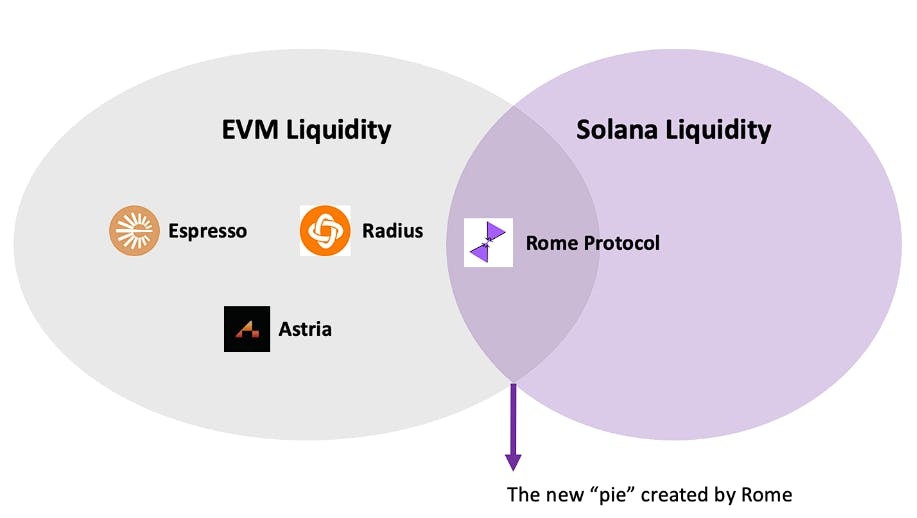
Rome is a shared sequencer that directly leverages Solana’s performance and security. Beyond offering all the standard benefits of traditional/EVM-based shared sequencers, Rome delivers additional value through:
-
Native interoperability between Solana and Ethereum—fully on-chain, without relying on off-chain bridges via the shared sequencer
-
The most secure shared sequencer from day one: By directly using Solana as its sequencer, Rome inherits the fifth-largest security budget in crypto (approximately $50 billion at time of writing), making it the most secure shared sequencer network to date
-
Lower costs: Solana’s native fee market and parallel architecture keep costs low. Rome benefits from this efficiency and passes those savings on to its customers (rollups)
-
Speed: Solana’s throughput enables Rome to deliver high-performance sequencing. Rollups don’t have to worry about outsourcing block production compromising user experience
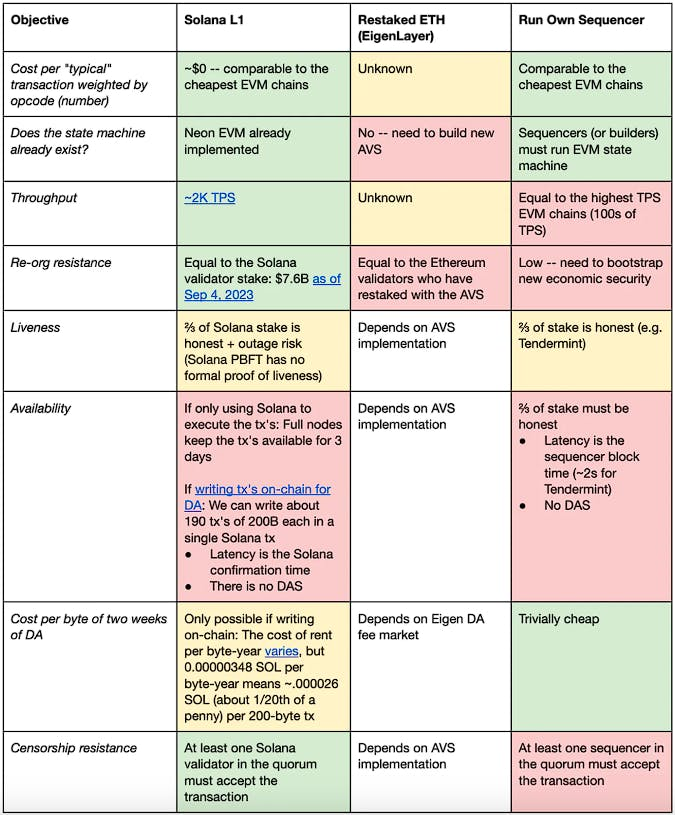
The result: The network creates a native bridge between Solana and Ethereum liquidity, while delivering cheaper, faster, and more secure block construction.
By sequencing transactions from both EVM rollups and Solana, and executing them through atomic conditional transactions, Rome is uniquely positioned to enable:
-
Custody-free, trustless bridging between Ethereum and Solana—without relying on off-chain bridges
-
Cross-domain arbitrage between EVM and Solana, ideal for institutions and sophisticated traders
-
Greater exchange of products and services between the Ethereum and Solana economies
-
Access to cross-chain liquidity, enabling users to atomically tap into liquidity on both chains
-
Multi-chain games and dApps. Developers can leverage the strengths of each chain—Solana’s speed and throughput, and Ethereum’s settlement and asset base
Join TechFlow official community to stay tuned
Telegram:https://t.me/TechFlowDaily
X (Twitter):https://x.com/TechFlowPost
X (Twitter) EN:https://x.com/BlockFlow_News
 @PortalVentures