








Did BTC plummet despite ETF approval due to Grayscale dumping? How much more selling pressure remains ahead?
TechFlow Selected TechFlow Selected
Did BTC plummet despite ETF approval due to Grayscale dumping? How much more selling pressure remains ahead?
The previous 50% negative premium has almost completely disappeared, so selling after substantial profits is a normal choice.
 Navigating Web3 tides with focused insights
Author: JK, Odaily Planet Daily
Following the SEC's approval of spot Bitcoin ETFs this week, Bitcoin's price has fluctuated accordingly: after the approval, it surged to a high above $48,000 before declining steadily. After a period of consolidation around $46,000, it dropped further to below $42,000—the lowest point—and is now stabilizing around $43,000, with a 7-day decline of 1.69%.
As previously reported by Odaily, according to Yahoo Finance data, spot Bitcoin ETFs saw $4.6 billion in trading volume on their first day and $3.1 billion on the second, bringing cumulative volume close to $7.7 billion. Among the newly launched spot Bitcoin funds, BlackRock led on Friday with $564 million in trading volume, followed by Fidelity at $431 million.
However, both were far surpassed by Grayscale’s GBTC, which recorded $2.29 billion in volume on Thursday and $1.83 billion on Friday—accounting for more than half of the total trading volume.
According to BitMEX Research, on the second day of spot Bitcoin ETF trading, GBTC experienced outflows of $484 million, with total outflows over the first two days reaching $579 million.
What Was the Connection with Grayscale’s Past Negative Premium?
Data shows that after converting the trust into an ETF, the previous negative premium has almost disappeared. In December 2022, the discount reached as high as 50%, but gradually narrowed as market sentiment improved and anticipation of ETF approval grew. By Monday, the discount had shrunk to just 5.6%.
Why? This comes down to structural differences between trusts and ETFs.
Trusts like the former GBTC are closed-end, meaning they issued a fixed number of shares during their IPO, which then trade on secondary markets. After issuance, the number of trust shares cannot be adjusted based on market demand. As a result, the market price of a trust is primarily determined by supply and demand dynamics between buyers and sellers, potentially leading to significant deviations from the actual value of its underlying assets (i.e., net asset value, or NAV). If demand for the trust declines, its market price may fall below NAV, resulting in a discount.
ETFs, however, are open-ended and allow authorized participants (APs) to create or redeem ETF shares as needed. These APs can exchange cash or assets of equivalent value with the ETF issuer to create new shares when demand rises, or redeem shares to receive cash or assets when demand falls. This flexible creation and redemption mechanism ensures that an ETF’s market price typically stays closely aligned with its NAV. For example, if an ETF trades below its NAV, APs can buy the undervalued shares and redeem them for underlying assets, profiting from the arbitrage while simultaneously pushing the ETF’s market price back toward its NAV.
Therefore, purely from a pricing perspective, financially motivated investors who bought at lower levels may now choose to sell as the negative premium disappears. This would force Grayscale to sell Bitcoin to return cash to investors redeeming their GBTC shares.
So, Has Grayscale Actually Dumped?
According to data from Arkham, no dumping behavior has occurred. Currently, based on identified Grayscale wallet addresses, Grayscale holds approximately 617,000 BTC, worth about $26.6 billion, with recent outflows totaling around $1.67 billion. This means Grayscale has not been forced to sell most of its Bitcoin holdings despite ongoing redemptions of GBTC shares—the amount sold remains only a small portion.

Grayscale's current holdings. Source: Arkham
However, market sentiment remains tense. One possible argument is that Arkham does not track all Grayscale addresses, and those it does identify may not be fully accurate—meaning some BTC sales and transactions could have been missed. Thus, the $1.67 billion in outflows might not be entirely precise.
An even more concerning argument involves the management fees across all spot Bitcoin ETFs. According to Bloomberg analysts, Grayscale’s GBTC currently has the highest management fee among them:
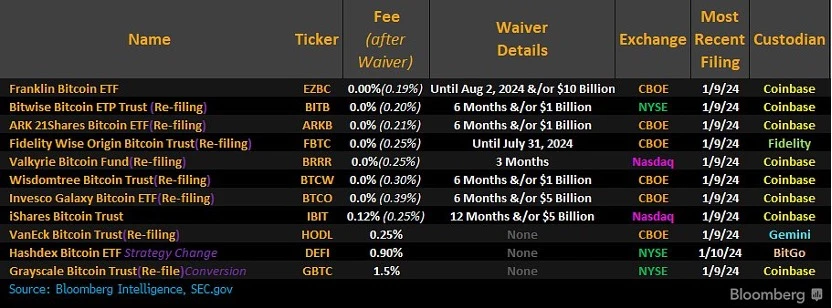
Current ETF management fee ratios. Source: Bloomberg
As shown, issuers such as Franklin and Bitwise have introduced relatively low fees, while Grayscale’s fee sits at the highest tier—around 1.5%. If investors are unwilling to pay this 1.5% management fee, they can simply sell their GBTC shares and shift to other ETFs. Moreover, since all these ETFs use cash redemption, selling GBTC shares yields only USD, not Bitcoin, inevitably increasing downward pressure on the price.
This leads to a widely held view on Twitter: the absence of selling now doesn’t mean there won’t be in the future. If more investors shift away from GBTC to other BTC ETFs due to fee concerns, and if this selling triggers further price declines that prompt others to hold cash and wait on the sidelines, it’s not impossible that BTC could continue sliding below $40,000.
Crypto KOL Neuner stated that Bitcoin “could face a period of selling pressure,” because “$25 billion is a significant figure—even if only 20% is redeemed, that implies $5 billion in sales hitting the market.”
Join TechFlow official community to stay tuned
Telegram:https://t.me/TechFlowDaily
X (Twitter):https://x.com/TechFlowPost
X (Twitter) EN:https://x.com/BlockFlow_News
 Odaily









