









Countdown 1 Day: Bitcoin Spot ETFs Kick Off "Price War"
TechFlow Selected TechFlow Selected
Countdown 1 Day: Bitcoin Spot ETFs Kick Off "Price War"
On the eve of witnessing history.
 Navigating Web3 tides with focused insights
Author: Tuoluo Finance
As the approval deadline for Bitcoin spot ETFs approaches, market volatility intensifies amid a chaotic mix of news.
False rumors previously triggered long liquidations and a sharp drop in Bitcoin prices. Now, institutions are finalizing their S-1 forms with anticipation, while positive news keeps emerging. Meanwhile, the SEC’s Office of Investor Education and Advocacy has issued a statement warning against FOMO, and Chairman Gary Gensler reiterated his caution on cryptocurrency investments early this morning via X (formerly Twitter).
Public data shows that out of the 13 institutions applying for Bitcoin spot ETFs, 10 have already submitted revised final S-1 forms, many also cutting their ETF fee rates. Tomorrow marks the final review date for the first batch of spot ETF applications—will Gary Gensler’s latest warning be a final act of powerless resistance or a cold comfort rooted in prior knowledge?
The answer is about to be revealed. Yet from an institutional perspective, the battle over ETFs—from modeling strategies to pricing wars—has already begun.
01 Institutions Submit Final Updates, Racing to Cut Fees
On January 8, except for Hashdex, major applicants including BlackRock, Ark Invest/21Shares, VanEck, WisdomTree, Invesco, Fidelity, and Valkyrie submitted their amended final S-1 forms. Since these filings were largely finalized by December 29, 2023, most adjustments were minor.
According to the updated filings, most institutions—including BlackRock, which initially insisted on a hybrid physical-and-cash model—have shifted toward a cash-based model as a concession to the SEC. The key difference lies in who purchases Bitcoin: under the physical model, market makers and authorized participants (APs) buy BTC; under the cash model, the ETF issuer itself buys Bitcoin.
In the cash model, fund shares correspond to cash during creation and redemption. The ETF issuer uses cash to acquire BTC directly and adds custodians, reducing the number of intermediaries handling actual Bitcoin. This creates a more closed system, making transactions easier to track, lowering anti-money laundering risks, and excluding exposure to traditional financial institutions like banks.
Although the physical model offers greater operational simplicity and lower risk for issuers, institutions have not pushed back against the SEC's preference. Only BlackRock noted in its latest S-1 update that "the timing for physical custody approval remains unclear, and there is no guarantee Nasdaq will receive such approval at any point in the future," indirectly expressing resignation. Meanwhile, Fidelity, WisdomTree, BlackRock, and JPMorgan Securities have all designated Jane Street Capital as a potential authorized participant for their prospective spot Bitcoin ETFs. As APs, broker-dealers handle basket creation and redemption, including cash transfers between fund managers and shareholders.
Beyond models, management fees have become another focal point. Given highly similar target users, the market exhibits winner-takes-all economies of scale. To capture market share and gain early entry into crypto, ETF applicants have entered a price war.
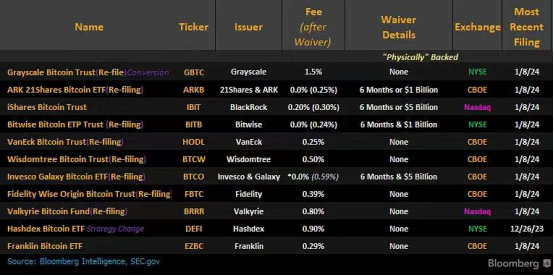
Comparison of major ETF management fees, source: Bloomberg
In the U.S., the average ETF fee stands around 0.54%. However, BlackRock—one of the world’s largest asset managers—announced a rate of just 0.30%, dropping to 0.20% for the first year until assets reach $5 billion. Under BlackRock’s aggressive pressure, other firms have been forced to slash fees to trade cost for scale. Bitwise now offers the lowest rate at only 0.24%. VanEck follows closely with a permanent rate of 0.25%—the lowest among current filers—and even pledged to donate 5% of its Bitcoin ETF profits to core Bitcoin developers to win broader crypto community support. Ark/21Shares has also cut its planned fee from 0.80% down to 0.25%, waiving fees entirely for the first six months or until assets hit $1 billion. Clearly, nearly all applicants are pricing significantly below the industry average.
In contrast, Grayscale only reduced its fee from 2% to 1.5% in its revised S-3 filing. However, given Grayscale’s existing scale and liquidity advantages—and the fact that share unlocks take time—a steep fee reduction would be unwise. For investors, liquidity often outweighs cost savings. Whether Grayscale can maintain this proud stance amid rising competition remains uncertain.
Per regulations, spot Bitcoin ETFs must complete both Form 19b-4 (exchange rule change proposal) and Form S-1 (issuer registration). Previously, 11 applicants had already submitted revised 19b-4 forms. On January 5, Grayscale, Valkyrie, ARK 21Shares, and Invesco filed new proposed fund applications, while Cboe BZX Exchange submitted forms for VanEck, WisdomTree, Pando Asset AG, and Franklin Templeton.
To date, once the SEC approves the 19b-4 form and activates the S-1, issuers could begin trading as early as the second business day after approval.
02 Approval Inevitable? The Market Votes With Its Feet
From market sentiment alone, up to 90% of participants believe approval of a Bitcoin spot ETF is inevitable—even ridiculing those who suggest otherwise within online communities.
Yet market behavior continues to reflect uncertainty. Just days ago, a false rumor incident reminiscent of the CTC fiasco occurred again. While past fake news spiked Bitcoin toward $40,000, this time misinformation caused a nearly 10% plunge.
On January 3—Bitcoin’s 15th anniversary—it suffered a full market flash crash. Starting at 5 PM, Bitcoin dropped steadily from $45,000 to a low of $40,157.30 USDT, falling over 10% in 24 hours. Ethereum followed, sliding from $2,380 to $2,051.76. Altcoins were hit hardest, with nearly all down over 20%. Rapid price declines triggered massive contract liquidations: Coinglass reported total liquidations of $489 million, including $466 million in long positions (over 95%), marking another violent deleveraging event.
While multiple factors contributed—such as weak U.S. equity performance at year-start and extended expectations for Fed rate cuts—a report from Matrixport was widely seen as the primary catalyst. That day, Matrixport’s piece titled “Why the U.S. SEC Will Reject Spot Bitcoin ETFs Again” went viral. It claimed all applications failed to meet key requirements, predicting the SEC would reject every proposal in January. It further forecasted Bitcoin would fall to between $36,000 and $38,000, advising investors to buy put options. Coming at such a critical moment, many assumed this reflected insider knowledge, triggering panic. Profits were quickly taken, retail traders followed suit, and the steepest price drop occurred roughly four hours after the report’s release.
Given the intense anticipation, misinformation hits investor sentiment especially hard. Once the false report was debunked, prices rebounded swiftly. As the approval date nears, momentum-driven rallies grow stronger. During the first week of January, USDT’s market cap surged by over $1.83 billion, reflecting surging demand from European and Asian investors. Even USDC, representing U.S. investor interest, grew by more than $780 million. Despite ongoing ETF speculation and pullbacks, capital hasn’t fully converted into buying power but remains parked on exchanges—still signaling strong bullish sentiment. The market speaks clearly: this morning, Bitcoin briefly surpassed $47,000, hitting its highest level since last year.
Is rejection still possible?
Overall, the probability of rejection continues to decline. Still, until the final decision, no one can guarantee approval. Even a 5% chance of rejection could trigger massive sell-offs that ordinary investors may struggle to withstand—something already evident in recent violent deleveraging events.
Despite repeated assurances from issuers, the SEC remains ambiguous. On January 6, the SEC’s Office of Investor Education and Advocacy published “Say No to FOMO,” warning investors about crypto asset risks.
At the same time, Better Markets—a Wall Street nonprofit—submitted an 11-page letter to the SEC using harsh language, calling approval of a Bitcoin ETF a “serious, even historic mistake.” It argued such approval would place the U.S. government’s stamp of legitimacy on a market “thoroughly polluted by fraud and manipulation.” Closer inspection reveals ties between this organization and prominent anti-crypto Democratic figures like Senator Elizabeth Warren and SEC Chair Gary Gensler. After the letter surfaced, some industry insiders expressed concern—but errors in dates and unspecified ETF applicants led others to realize it was merely an updated version of an earlier opposition document from summer 2023.
Then, on the evening of January 8, SEC Chair Gary Gensler posted again on X, stating individuals offering crypto investment services might violate applicable laws, including federal securities law. He emphasized that investing in crypto assets carries extremely high risks, often involving extreme volatility. Many major platforms and cryptocurrencies have already faced bankruptcy and/or devaluation, and the investment landscape remains rife with fraud.

SEC Chair warns of crypto investment risks, source: X platform
Considering that Gensler made similar statements before the approval of Bitcoin futures ETFs in 2021, some interpret this as a signal that approval is imminent. This morning, Perianne Boring, founder and CEO of the Chamber of Digital Commerce, tweeted that the SEC has issued supplemental comments on pending applicant S-1 filings.
Interestingly, there’s also speculation that Bitcoin ETF approval could be delayed again. Fox Business journalist Eleanor Terrett noted that although no timetable exists for a commission vote on spot Bitcoin ETFs, each SEC commissioner retains the right to request a review and full committee vote—even if delegated authority has already approved the application.
03 Information Warfare Continues—Caution Remains Key
To date, the battle between real and fake news persists, awaiting tomorrow’s definitive outcome. Bullish sentiment remains strong. According to Deribit data, large volumes of Bitcoin call options are concentrated at the $50,000 strike price expiring January 26. However, compared to early November, the premium of calls over puts has narrowed from 8% to about 2%. Market sentiment for Bitcoin has reached 76 points—the highest since mid-November 2021, when Bitcoin hovered near its all-time high of $69,000. Never missing a trend, Standard Chartered Bank predicted Bitcoin could surge 344% to $250,000 by the end of next year, driven by ETF inflows.
However, initial seed investments disclosed by the ETFs suggest limited immediate buying power. Among new entrants, Bitwise leads with a seed investment of $500,000. Pantera Capital said it plans to inject $200 million into Bitwise upon ETF approval. VanEck follows with $72.5 million already committed. Industry giant BlackRock has seeded its Bitcoin spot ETF with only $10 million, though VanEck reports over $2 billion in funds waiting to flow into BlackRock’s ETF within its first week of launch.
Of course, if approval is partially denied in January, remaining ETFs may be pushed to March—with obvious negative impacts on market sentiment. Among retail investors, while most expect approval and continue chasing higher prices, many others say they’re buying put options to hedge risk.
Perhaps at such a critical juncture, caution remains paramount. A 10% drop may seem small relative to Bitcoin’s current price—but for individuals, it can represent a significant loss.
Join TechFlow official community to stay tuned
Telegram:https://t.me/TechFlowDaily
X (Twitter):https://x.com/TechFlowPost
X (Twitter) EN:https://x.com/BlockFlow_News










