









CryptoSlate Report: Who Are the Biggest Bitcoin Whales Holding the Most BTC in 2024
TechFlow Selected TechFlow Selected
CryptoSlate Report: Who Are the Biggest Bitcoin Whales Holding the Most BTC in 2024
This report focuses on analyzing the holdings of various entities (public companies, private companies, nations, exchange-traded funds (ETFs), and mining companies) to provide a comprehensive understanding of their impact on the Bitcoin market.
 Navigating Web3 tides with focused insights
Text: Andjela Radmilac, Cryptoslate
Translation: Songxue, Jinse Finance
Introduction:
Bitcoin's market dominance within the crypto industry cannot be overstated. Tracking the largest Bitcoin holders is important due to their significant influence on market trends and investor confidence. This report focuses on analyzing holdings across various entities—public companies, private firms, nations, exchange-traded funds (ETFs), and mining companies—to provide a comprehensive understanding of their impact on the Bitcoin market.
Publicly traded companies with Bitcoin investments have the potential to shape market sentiment, as their relationship with Bitcoin goes beyond mere diversification—it often reflects a strategic alignment with the future of crypto. While less transparent than their public counterparts, private companies also play a critical role. Though their holdings may not immediately surface during market fluctuations, they contribute to underlying demand for Bitcoin.
ETFs are vital in providing broader market access to Bitcoin. Countries incorporating Bitcoin into national treasury reserves demonstrate its growing acceptance and potential as a hedge against traditional monetary volatility. Mining companies, by accumulating Bitcoin through mining activities, directly affect the supply side of the Bitcoin market. Their decisions to hold or sell Bitcoin can immediately influence supply levels and, consequently, price.
In this report, CryptoSlate dives into the largest Bitcoin holders to shed light on how these entities collectively influence the Bitcoin market.
Public Companies
Publicly traded companies have become key players in the Bitcoin ecosystem, with their holdings influencing both stock performance and the broader cryptocurrency market.
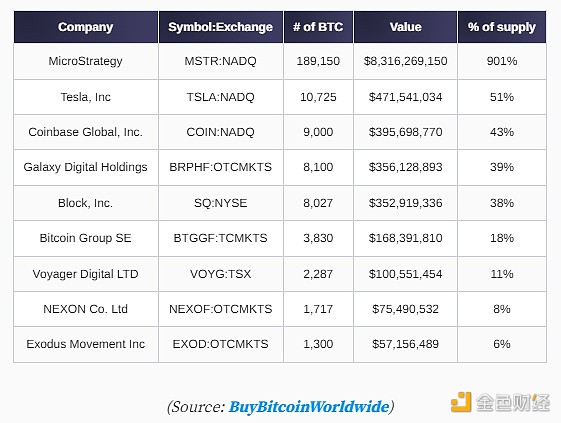
One of the most significant is MicroStrategy, a business intelligence firm holding 189,150 BTC, valued at approximately $8.2 billion. This represents about 0.901% of Bitcoin’s total supply (21 million BTC). MicroStrategy’s aggressive Bitcoin acquisition strategy has made its stock (MSTR:NASDAQ) a proxy for Bitcoin itself, with share prices often mirroring movements in the crypto market.
Tesla, the electric vehicle and clean energy company, holds 10,725 BTC worth approximately $471 million. Its disclosure of Bitcoin investment in early 2021 served as a major endorsement of Bitcoin’s potential as a store of value, impacting both crypto and traditional financial markets. Tesla’s stock (TSLA:NASDAQ) has since been influenced by Bitcoin price swings, reflecting the interplay between its investment and market valuation.
Coinbase Global, a cryptocurrency exchange platform, holds 9,000 BTC worth around $395.7 million. As a major player in crypto trading, Coinbase (COIN:NASDAQ) treats its Bitcoin holdings as both a balance sheet asset and a strategic extension of its core operations. The company’s stock performance closely tracks the health of the crypto market, with Bitcoin prices being a key driver.
Galaxy Digital Holdings, a merchant bank focused on digital assets and blockchain, holds 8,100 BTC valued at approximately $356.13 million. Galaxy Digital’s stock (BRPHF:OTCMKTS) reflects its deep involvement in the crypto space, with Bitcoin’s performance directly affecting its valuation.
Block, Inc. (formerly Square, Inc.), a financial services and mobile payments company, holds 8,027 BTC worth about $352.92 million. Block’s investment (SQ:NYSE) underscores its commitment to integrating cryptocurrencies into its broader payment ecosystem. The company’s Bitcoin holdings and developments in the crypto space significantly influence its stock performance.
These companies’ choices to invest in Bitcoin highlight a broader trend of institutional acceptance of cryptocurrencies. Their substantial holdings represent strategic bets on Bitcoin’s long-term value proposition, reflecting growing confidence in Bitcoin as an asset class.
Private Companies
Among private firms, several have accumulated significant amounts of Bitcoin, reflecting a strategic shift toward digital assets. These investments are driven by multiple factors, including belief in Bitcoin’s long-term value, its potential as an inflation hedge, and the desire to participate in the burgeoning digital economy.
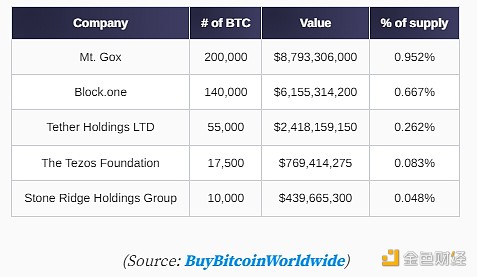
Mt. Gox, originally a major Bitcoin exchange, currently holds approximately 200,000 BTC, valued at around $8.79 billion. This holding accounts for 0.952% of Bitcoin’s total supply. Mt. Gox’s Bitcoin holdings stem largely from historical operations and have remained a focal point of legal and financial discussions following its infamous hack and subsequent bankruptcy.
Block.one, a software company focused on high-performance blockchain technology, holds 140,000 BTC worth approximately $6.16 billion, representing 0.667% of Bitcoin’s total supply. This investment demonstrates Block.one’s strong commitment to the blockchain ecosystem and belief in Bitcoin as a future reserve asset.
Tether Holdings LTD holds 55,000 BTC, valued at about $2.42 billion, or 0.262% of total supply. This holding highlights Tether’s strategic positioning in the crypto market, balancing its stablecoin operations with substantial Bitcoin investment.
The Tezos Foundation holds 17,500 BTC, valued at approximately $769.41 million, or 0.083% of Bitcoin’s total supply. Stone Ridge Holdings Group, an asset management firm specializing in alternative investments, holds 10,000 BTC worth about $439.67 million, accounting for 0.048% of total supply. Their Bitcoin investments form part of a broader portfolio diversification strategy.
Rationales behind these investments vary but commonly reflect a belief in the digital transformation of finance and Bitcoin’s role as a foundational asset within that shift. These private holdings are significant as they indicate increasing institutional adoption of Bitcoin.
Though less visible than public company investments, these holdings contribute to overall market stability and maturity. They also shape investor sentiment, reinforcing the perception of Bitcoin as a viable and valuable asset class.
Mining Companies
Mining companies play a crucial role in the Bitcoin ecosystem, contributing to network security and influencing the market through their Bitcoin reserves.
Marathon stands as a leader in the mining sector, holding approximately 15,174 BTC valued at around $667.15 million—about 0.072% of Bitcoin’s total supply. Marathon’s strategy of accumulating rather than selling Bitcoin for operating expenses reflects a long-term investment outlook and confidence in Bitcoin’s value.
Another key player, Hut 8, has accumulated 9,129 BTC worth approximately $401.37 million, or 0.043% of total supply. Riot Platforms holds 7,362 BTC valued at about $323.68 million, or 0.035% of total supply. Riot’s strategy signals a bullish stance on Bitcoin and a focus on strengthening its mining operations.
There is a delicate balance between mining activity and reserve accumulation. On one hand, mining companies must sell a portion of mined Bitcoin to cover operational costs such as electricity, hardware maintenance, and expansion.
On the other hand, holding mined Bitcoin serves as a vote of confidence in the cryptocurrency’s future value. This strategy not only impacts Bitcoin’s supply dynamics but also reflects miners’ perspectives on market trends.
Moreover, these holdings play a vital role in the security and robustness of the Bitcoin network. By reinvesting profits into expanding mining operations, these companies help maintain a high hash rate, which is essential for network security.

ETFs
Exchange-traded funds (ETFs) are pivotal financial instruments that bridge traditional investment mechanisms with innovative digital assets like Bitcoin.
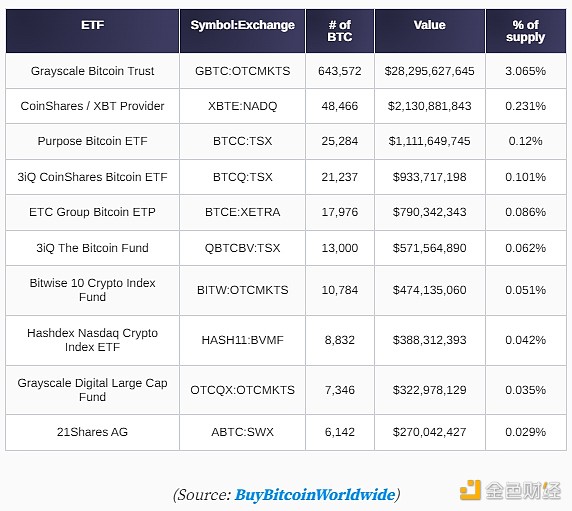
Prominent Bitcoin ETFs have amassed substantial Bitcoin holdings, playing a significant role in the cryptocurrency market. The largest, Grayscale Bitcoin Trust, holds 643,572 BTC valued at approximately $28.3 billion—about 3.065% of Bitcoin’s total supply. Other notable ETFs include CoinShares / XBT Provider and Purpose Bitcoin ETF, each holding significant positions.
These ETFs enhance market accessibility, enabling a broader range of investors to participate in Bitcoin investment. By offering Bitcoin exposure through traditional investment platforms, they improve liquidity. This liquidity is crucial, as it helps smooth price fluctuations and reduce volatility, making Bitcoin a more accessible and potentially stable investment option.
Additionally, the presence of Bitcoin in these ETFs influences investor behavior by providing a regulated and familiar investment pathway. This can boost investor confidence and attract more institutional and retail participants into the Bitcoin market.
The anticipated approval of the first spot Bitcoin ETF in the U.S. in January marks a significant development. This approval is expected to have a major market impact. It could lead to an influx of new investments, as spot Bitcoin ETFs will offer direct exposure to Bitcoin price movements—unlike current futures-based ETFs.
This could further enhance liquidity and potentially stabilize Bitcoin’s price. Moreover, the approval would signal regulatory acceptance, potentially paving the way for broader adoption of Bitcoin and other cryptocurrencies.
Conclusion
Through significant holdings and strategic investments, public companies underscore Bitcoin’s growing integration within traditional financial frameworks, shaping market dynamics and investor sentiment. Though less visible, private firms support underlying demand for Bitcoin through substantial investments, reinforcing its long-term value proposition.
By maintaining large Bitcoin reserves, mining companies stabilize the market’s supply side and strengthen the security of the Bitcoin network—critical for its ongoing operation and credibility. Nations venturing into Bitcoin holdings signify a paradigm shift, reflecting Bitcoin’s increasing acceptance as a viable asset class at the governmental level and potentially influencing global regulatory perspectives.
ETFs have emerged as key mechanisms, enhancing Bitcoin’s market accessibility and liquidity. They bridge the gap between traditional finance and the rapidly evolving crypto landscape, contributing to market stability and shaping investor behavior.
Looking ahead, the collective influence of these entities may drive Bitcoin toward greater institutionalization and mainstream acceptance. The converging trajectory of Bitcoin with traditional financial assets suggests a future where Bitcoin’s role extends beyond speculation, becoming a foundational component of diversified investment portfolios.
This evolution points to an increasingly sophisticated and integrated financial ecosystem, where digital assets like Bitcoin coexist with traditional financial instruments, offering broader investment opportunities and risk management strategies.
Join TechFlow official community to stay tuned
Telegram:https://t.me/TechFlowDaily
X (Twitter):https://x.com/TechFlowPost
X (Twitter) EN:https://x.com/BlockFlow_News










