U.S. Sanctions and Blockchain Censorship: The Current State of Ethereum Network Transaction Filtering Under OFAC Regulations
TechFlow Selected TechFlow Selected
U.S. Sanctions and Blockchain Censorship: The Current State of Ethereum Network Transaction Filtering Under OFAC Regulations
Coinbase's non-compliant on-chain interactions are clearly visible, and it is expected that OFAC will eventually have to address this issue and make a decision.
 Navigating Web3 tides with focused insights
Author: Aiying
According to data from Labrys and Rated Network, since Ethereum transitioned from proof-of-work to proof-of-stake on September 15, 2022, approximately 42% of blocks on the Ethereum blockchain have included censorship against wallet addresses listed on the U.S. Department of Treasury's Office of Foreign Assets Control (OFAC) Specially Designated Nationals List (SDN List). In other words, these blocks exclude or block transactions from wallet addresses appearing on U.S. sanctions lists. Earlier this week, the proportion of such censored blocks even approached 50%, indicating that roughly half of all Ethereum blocks are enforcing some form of transaction censorship in line with U.S. sanctions.
Unlike permissionless crypto networks like Bitcoin, Ethereum relays compliant with OFAC regulations actively censor wallet addresses on U.S. sanctions lists.
Among them, Flashbots’ dominant Maximal Extractable Value (MEV) tool, MEV-Boost — by default — censors these wallets, and many relay operators use its default configuration. MEV-Boost also outsources block production for validators to a third-party marketplace operated by Flashbots itself, maximizing profits through quantitative trading strategies such as frontrunning, backrunning, and sandwich attacks—strategies that may exploit ordinary Ethereum users.
Examples of MEV-Boost relays include Flashbots (by far the largest), as well as BlockNative, Manifold, Eden, BloXroute Max Profit, BloXroute Ethical, and BloXroute Regulated.
This means that when Ethereum relay nodes using MEV-Boost software (nodes responsible for propagating transactions and blocks) process transactions, they automatically filter out transactions from wallet addresses on the U.S. OFAC SDN List. As a result, these addresses' transactions are not included in the blockchain. Many relay operators may choose to use MEV-Boost’s default settings, thereby implementing this censorship mechanism in their operations.
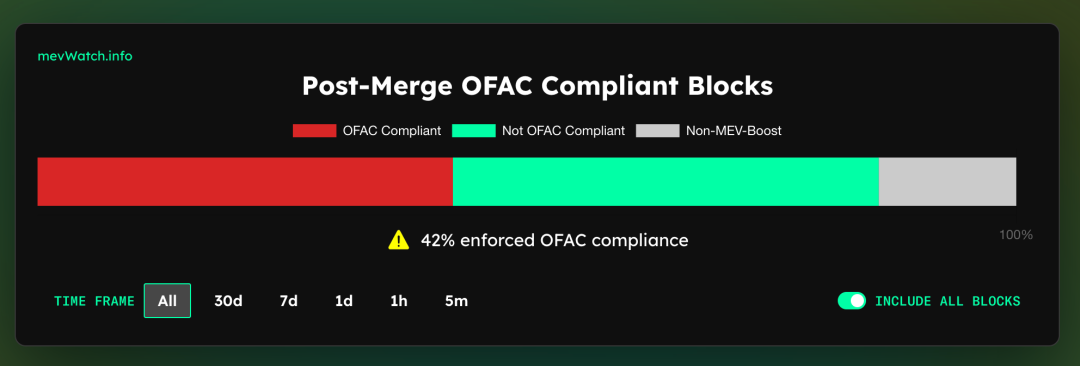
(Image provided by Mev Watch)
Relay operators complying with U.S. sanctions effectively control which users can broadcast transactions on the Ethereum blockchain. While users sanctioned by the U.S. Treasury’s Office of Foreign Assets Control (OFAC) may be blocked from using OFAC-compliant channels (such as certain cryptocurrency exchanges or validating nodes), they can still attempt to execute their transactions through non-compliant alternatives. In other words, these users might seek out trading platforms or network nodes that do not follow OFAC sanction rules to complete their blockchain transactions, as such platforms or nodes do not filter or reject transactions based on OFAC’s sanctions list.
Take Coinbase, for example. Last year, Tornado Cash was sanctioned by the U.S. government for providing mixing services to North Korea. However, according to data from Tornado Warnings, within the past two weeks, Coinbase validated 686 transactions related to Tornado Cash. As a validator on the Ethereum network, Coinbase confirmed and included these transactions in the blockchain.
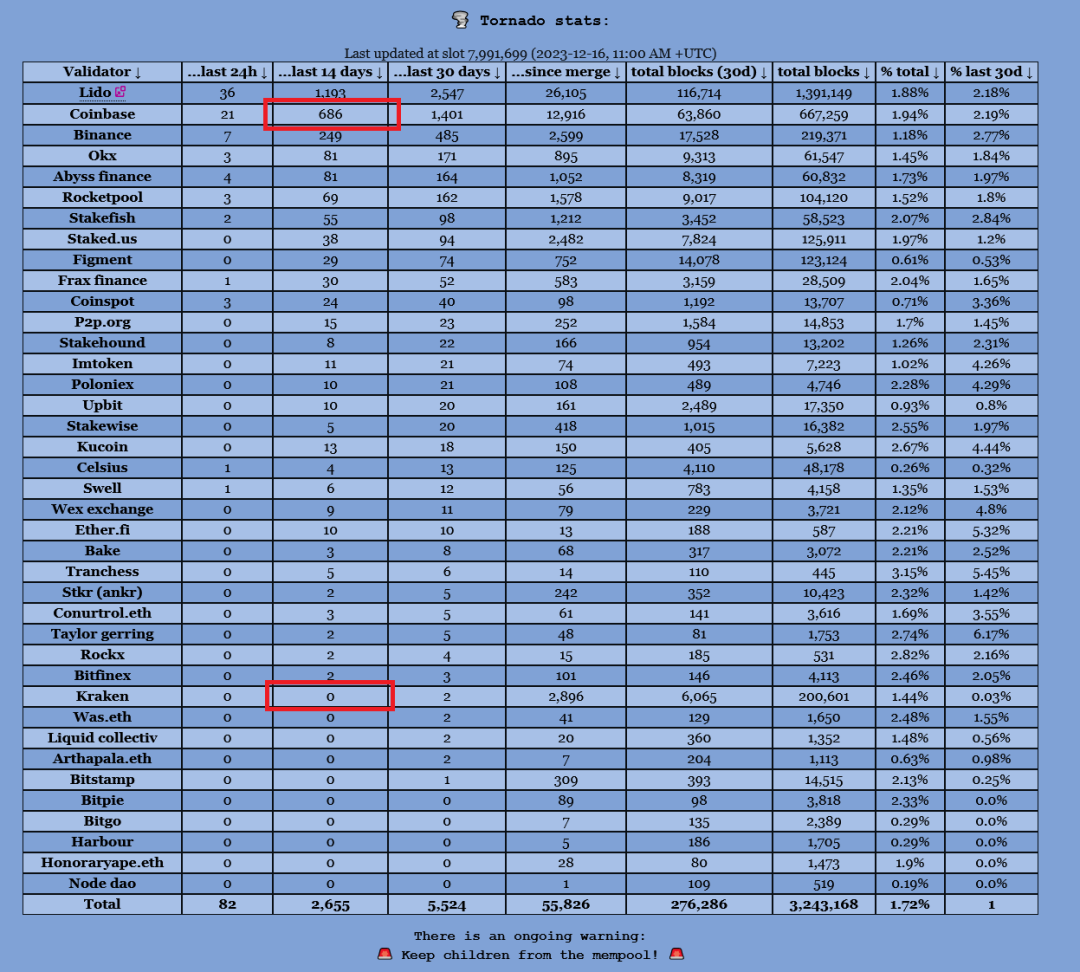
This table shows how many blocks each validator proposed that included transactions interacting with Tornado Cash contracts (of any denomination) or TORN on Tron (deposits or withdrawals).
Source: Toni Wahrstätter
This is somewhat embarrassing for OFAC, as it appears to be turning a blind eye to Coinbase’s actions. Yet these contract interactions are clearly visible on-chain, and it is expected that OFAC will eventually need to confront this issue and make a decision—an outcome that could significantly impact both Coinbase and Ethereum.
Join TechFlow official community to stay tuned
Telegram:https://t.me/TechFlowDaily
X (Twitter):https://x.com/TechFlowPost
X (Twitter) EN:https://x.com/BlockFlow_News
 Aiying Compliance