








Gitcoin founder discusses nearly 30 mechanisms for coordinating collective intelligence
TechFlow Selected TechFlow Selected
Gitcoin founder discusses nearly 30 mechanisms for coordinating collective intelligence
When you can access better collective intelligence, you can achieve more effective collective resource allocation.
 Navigating Web3 tides with focused insights
Talk: Gitcoin Founder on Nearly 30 Mechanisms for Coordinating Collective Intelligence
Translation: Yu Xing
In episode 65 of the GreenPill podcast, Griff Green from Giveth and Gitcoin founder Kevin Owocki discussed nearly 30 different mechanisms for coordinating collective intelligence aimed at achieving better collective resource allocation. This article distills their conversation.
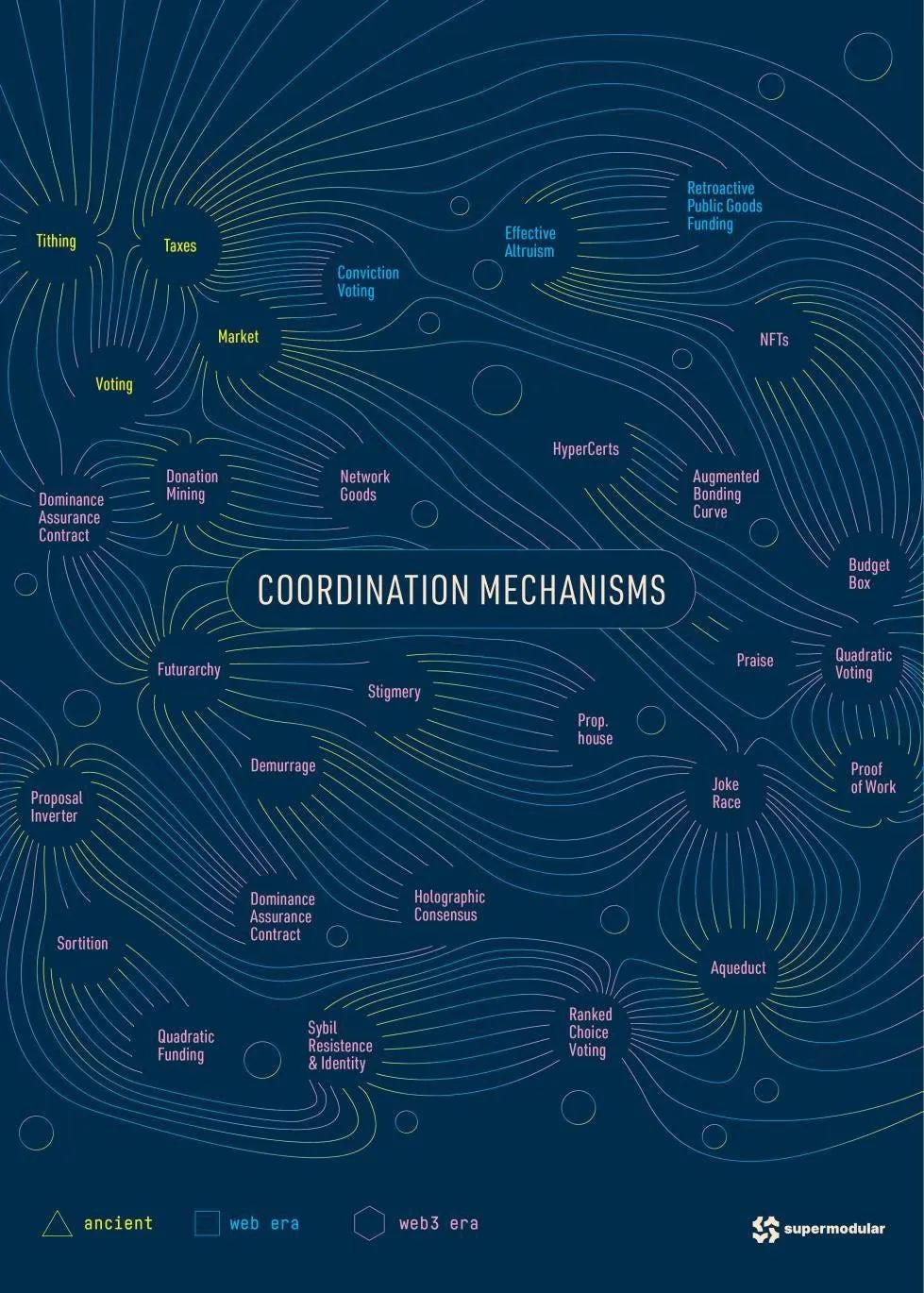
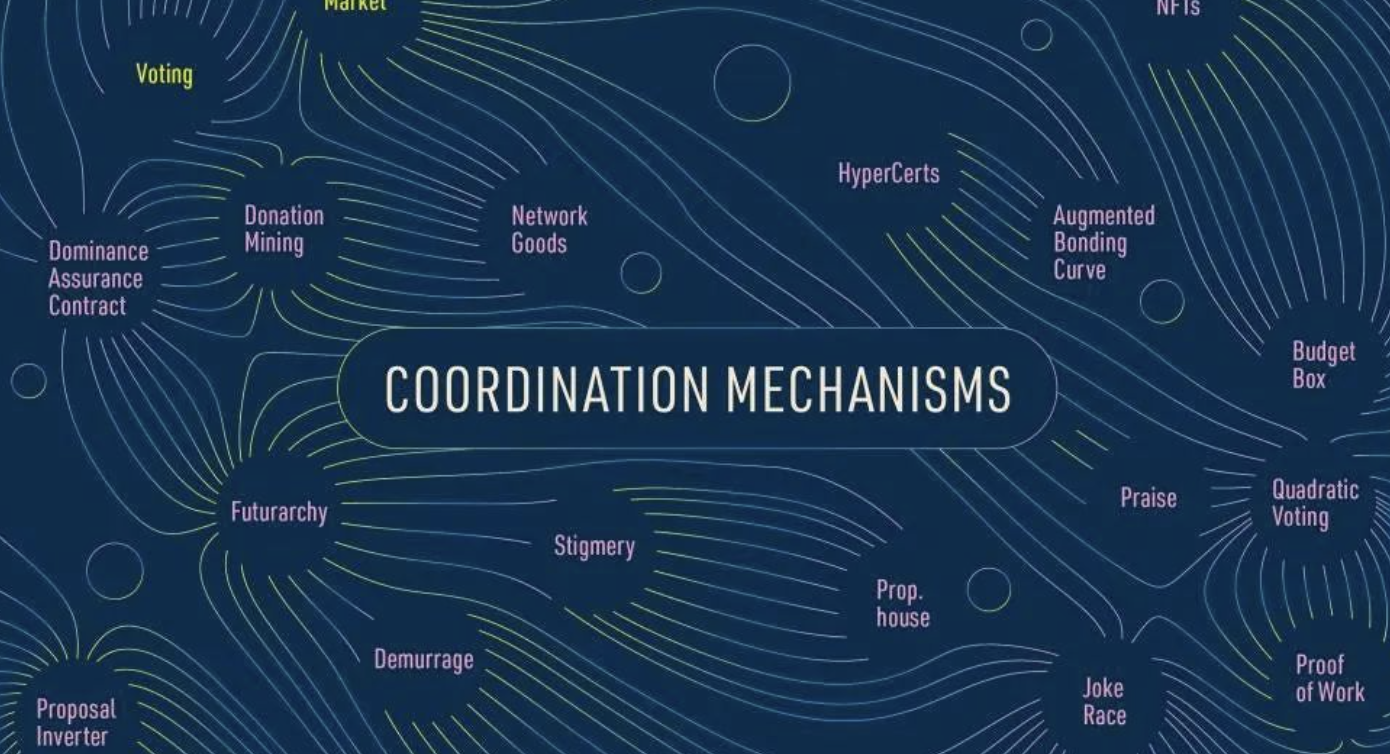
The coordination mechanism chart was originally published by Kevin Owocki on Twitter, based on work by Octavian
When you can achieve better collective intelligence, you enable better collective resource allocation. This is transformative when funding public goods and building a regenerative financial system. – Kevin Owocki
Let’s begin with several classic examples of mechanisms:
Tithing —
Tithing – An ancient religious practice historically involving donating a portion of income to churches or nonprofits. It's simple and easy to understand. Its shortcomings include lack of feedback—donors don’t know where their money goes—and no enforcement or checks and balances. It requires strong cultural motivation to function effectively.
Taxes —
Taxes – Essentially “mandatory” tithing, requiring individuals to contribute part of their income to the government. The main drawbacks are that power leads to corruption, centralized institutions make top-down decisions about fund usage, and the only feedback loop is voting—a slow process. Still, it remains the best current method for funding public goods.
Voting —
Voting – Exists in various forms, typically majority rule. Representative democracy is also a form of majority rule. Another variant is consensus voting, which requires absolute agreement to proceed.
Taxes are a fundraising mechanism; voting is an allocation mechanism. There are powerful tools for raising public funds, but allocation mechanisms seem less effective. Voting can be corrupted by money—so how about using markets as an allocation mechanism?
What if there were a market for trading “clean rivers”? Different companies could compete in this new market. Collectives could use supply and demand to select desired public goods and reward value creators.
Markets —
Markets – Often seen as the optimal way to allocate resources, but unsuitable for collective resource allocation. Markets maximize profit and serve only those who can afford prices, making them fit only for highly excludable goods. Market failure is evident in public goods financing. Yet markets are decentralized collective intelligence mechanisms: any good with consumer demand and willingness to pay will be produced, incentivizing innovation.
“The coolest thing about markets is that it’s win-win. Nobody is losing. If you’re creating value, you win, which is amazing. The real problem is commons don’t have markets to push back.” – Griff Green. Markets are great because they’re win-win—creating value means winning. The real issue is that public goods lack market feedback loops.
Web-based Mechanisms
As we transition from the industrial age to the information age, we now have opportunities to implement more effective governance mechanisms that offer market-scale funding while retaining the legitimacy and public-interest orientation of taxation and coordination, truly democratizing the economy. Whenever people create a high-resolution image of public good demand, collective intelligence channels funding toward fulfilling it.
Below are the 27 mechanisms discussed by Griff and Owocki—each comes with limitations.
Quadratic Funding —
Quadratic Funding – Created by Microsoft’s Glen Weyl and Ethereum co-founder Vitalik Buterin, this mechanism pools funds centrally and allocates them based on the number of supporters rather than capital invested. Unlike 1:1 matching, which reflects plutocratic preferences, quadratic funding emphasizes contributor count over dollar amount, reducing large donors’ influence and enhancing democratic fairness.
Example: You raise $100 from 100 donors; I raise $100 from one donor. Though both campaigns received $100, you receive 99% of the matching pool. This favors “the poor and many”—even a $1 donation signals public will and guides public funding.
Problem: Vulnerable to Sybil attacks and requires a public funding pool.
Conviction Voting —
Conviction Voting – Similar to quadratic funding in reducing plutocracy, but time-based. Rules: Stake tokens to support proposals; can withdraw or reassign anytime. Voting weight increases with staking duration. Proposals pass once reaching threshold.
More tokens mean greater influence, but even small holders can advance major proposals—just slower. Works well when multiple proposals compete under a fixed budget, enabling flexible token distribution across preferred initiatives. Concept developed by Michael Zargham et al., implemented by 1Hive. Effective when many proposals vie for limited funds, ensuring community priorities are funded within set periods.
Problem: Needs competitive proposals; otherwise, passage becomes too easy. Benefit: Minority views can still succeed.
Retroactive Public Goods Funding —
Retroactive Public Goods Funding – Inspired by Karl Floersch and implemented on Optimism. A revenue stream from the Optimism network funds an expert committee tasked with allocating capital to ecosystem contributors who’ve created value.
Benefits: Enables talent to develop public goods today based on expectations of future rewards, while funders avoid measurement challenges.
Network Goods —
Network Goods – Private goods are rivalrous (e.g., iPhone: you must afford it); public goods are non-rivalrous (e.g., air: everyone breathes freely regardless of wealth). Network goods gain value as more people consume them—like open-source software. NFT art gains value with attention. By issuing NFTs tied to public goods, increased visibility boosts NFT value, creating a funding mechanism.
Effective Altruism —
Effective Altruism – Follows cost-effectiveness principles, aiming to fund the most efficient groups—maximizing impact per dollar spent.
Kevin: Effective altruism stems from the idea that people donate not primarily to create impact, but to feel good. As a philosophy, its practical implementation varies. From a utilitarian view, how do we classify public causes by potential benefit?
Suppose $5 buys five mosquito nets, saving 100 lives from malaria in 5–10 years in a region, while the same $5 saves only two elsewhere. Ranking public goods similarly lets us fund the most impactful ones—an intriguing approach.
Limitation: Cannot identify future projects whose effectiveness isn’t yet proven. Better suited for large-scale operations where aggregation effects emerge.
Griff: The challenge lies in measuring impact data—it’s inherently qualitative, yet we try to quantify it. Some values resist quantification: How much is a sunset worth? These are monetary vectors. An ethical dilemma like the trolley problem highlights the difficulty of quantifying life’s value.
Hypercerts —
Hypercerts – Owocki is developing this with Protocol Labs. The concept: Suppose I remove ten tons of carbon from the atmosphere and receive a certificate. That certificate may hold market value because someone else might emit ten additional tons.
Hypercerts generalize proof-of-impact contributions across any impact vector—I saved ten people, picked up ten tons of trash, helped ten grandmas cross the street. Any positive action earns a Hypercert. We then launch a market for impact assessors, attracting people who buy Hypercerts to display virtue. Web3 enables verifiable proofs of virtue.
We’re launching a three-sided market: any DAO creating positive impact can issue Hypercerts; impact validators certify them; concerned parties purchase them.
The key value: Impact-focused DAOs shift focus from capturing measurable impact to maximizing actual impact creation. This fundamentally changes incentives, enabling business models and attracting more capital and talent into impact DAOs.
It also addresses effective altruism’s earlier limitation—if we build a decentralized, collectively governed market where people issue, evaluate, and buy Hypercerts—we gain a decentralized data source to detect emerging future impacts.
Why didn’t such markets work before? They existed pre-NFT but weren’t widely discussed. What’s different now?
A globally transparent, programmable, immutable ledger is key. Impacts flow within global systems; previously, people lacked a shared basis for consensus. One lesson from carbon markets: generating buyer demand is the hardest part. Carbon credits are a subset of Hypercert applications—99% of compliance demand comes from regulation. In a decentralized market, how do we generate similar pressure? Will a Vitalik tweet help? Or mandating Hypercert holdings for funding eligibility? Likely, social and cultural momentum—making Hypercert collecting fashionable—is the most plausible path. Until then, we can still build a market, a donation game.
Augmented Bonding Curve —
Augmented Bonding Curve (ABC) – A bonding curve is a smart contract mechanism to bootstrap a market: mint tokens against reserve assets. Adding assets mints tokens; removing burns tokens to release collateral. Tokens trade directly with the contract, eliminating need for buyers during sales. Token price rises with minting, falls with burning—addressing cold-start pricing via improved liquidity foundations.
ABC adds fees during minting and burning. When assets are sent to ABC to mint tokens, part flows into a treasury managed by token holders, the rest mints tokens.
When users burn tokens by sending them to ABC, part of released funds flows to the collective. This creates a continuous market-driven funding stream—price discovery occurs through every trade.
ABC also includes a “Hatch” phase before launch: collect initial funds, some used to mint tokens at equal price for all participants, others allocated to the collective.
Dominant Assurance Contracts —
Dominant Assurance Contracts – A type of conditional pledge: “I’ll fund this project only if others do too.” If fundraising fails to meet threshold within x weeks, all funds are refunded. Kickstarter popularized this model.
Dominant assurance contracts go further—they’re bets: If the goal is met, primary backers get refunds plus profits; if not, their funds go to secondary contributors. It’s a game of profit, donation, and foresight, offering strong incentives for both self-interest and altruism to participate in public goods funding. Model developed by Alex Tabarrok.
Donation Mining —
Donation Mining – Giveth.io is a community-driven platform funding nonprofits and social causes. GIVbacks is a donor rewards program: every two weeks, verified impact project donors receive GIV governance tokens, building their influence in the ecosystem. Network effects may increase GIV value, offering financial upside. Beyond GIVbacks, users can join GIVpower—staking GIV to boost project visibility and earn mining rewards.
Pairwise (formerly Budget Box) —
Pairwise (formerly Budget Box) – Originated in the Colony ecosystem (2018). Pairwise comparison shows two options on screen—you pick your preference. Eventually, you get a ranked list based on your choices. Individual rankings merge into group rankings—yielding ordered lists, top picks, or weighted allocations for budgeting.
Collaborative filtering pairs you with users of similar preferences. With enough user profile data, it predicts other likely preferences without complex individual selections.
Moreover, voting should ideally be signal aggregation. Imagine having a personal server running your own AI agent, trained on all your online content—even private messages—to vote on your behalf. You’d just occasionally check its performance. How powerful would that be?
Futarchy —
Futarchy – Proposed by Robin Hanson, futarchy uses prediction markets to decide policies. You bet that a proposal will create positive impact; if it does, you’re rewarded; if not, you lose your stake. It embeds expected economic or social outcomes into voting, channeling voters into predictive roles. Markets thus filter policies likely to improve national welfare metrics. Leverages market efficiency—but risks turning metrics into targets, undermining their validity.
Stigmergy —
Stigmergy – An indirect coordination mechanism—or rather, a feature common to all coordination systems, not a mechanism itself. Stigmergy relies on traces of past actions narrowing consensus scope to achieve coordinated goals. Agents leave environmental traces stimulating subsequent actions by themselves or others—how ants coordinate, leaving pheromone trails guiding others to food.
If you build a trust network identifying highly credible individuals—whose credibility grows with good deeds—sharing donation behavior on Gitcoin acts like a pheromone, inspiring others. This mechanism has self-reinforcing properties.
Praise —
Praise – A bottom-up, peer-to-peer reputation/reward system. Praise maintains a reward fund by recognizing community members. Praise events are automatically recorded. Every two weeks, quantifiers score each praise instance. Based on scores, recipients receive tokens linked to specific praises. Motivation includes gratitude, emotional uplift, positivity. Rich data reveals contributions and informs community awareness of value creators. Mutual voting signals who’s valuable—building trust networks. Now we can attach tokens to these networks—making it even cooler.
In Regen web3, we’re linking financial capital with other capital types—social, cultural—while making finance serve these capitals. See Gregory Landua and his theory of eight capital forms.
Demurrage —
Demurrage – Like the opposite of inflation (increasing supply reduces unit value), but with similar intent (currency depreciates over time). With demurrage, holding 1 unit of currency gradually reduces it to 0.99 units—the 0.01 lost flows into a communal pool. Designed to encourage circulation speed, inspired by perishable assets like rice or flour, which decay. Historically, churches issued stamps showing rotting grain, signaling declining value. Term originates from shipping—"delay" (Old French), referring to time loss unloading cargo—"damage for detention." While some demurrage currencies saw relative success, they often yield results similar to inflation, though the latter offers better user experience. Demurrage feels like forced taxation.
Proposal Inverter —
Proposal Inverter – Emerged from research on DAO-to-DAO coordination. Traditionally, a proposer submits to one DAO. Proposal Inverter acts as middleware, allowing one proposal to face multiple funders or DAOs simultaneously. If a proposal solves issues across multiple DAOs, they jointly fund it, with funds collected and disbursed per agreed milestones.
Prop House —
Prop House – A funding model created by Nouns DAO. Community raises funds in their treasury. Builders submit ideas; each round, a fixed sum is awarded to selected proposals via community token-holder voting.
Quadratic Voting —
Quadratic Voting – A derivative of quadratic funding, measuring not just preference but intensity of preference—alternative to one-person-one-vote. You receive voting credits, allocatable across issues. Weight assigned equals square root of credits staked per proposal. Reveals both voter preference and strength of conviction on issues. Prevents plutocratic outcomes where loud voices dominate perception of popularity, instead favoring broad consensus. Encourages spreading votes across multiple proposals rather than concentrating all credits on one.
JokeRace —
Created by JokeDAO, this is a bottom-up on-chain governance mechanism. Share a joke in JokeDAO’s channel; if funny enough, earn funding usable for anything—roadmap planning, idea generation, bounty rewards. Humor validation uses various voting methods: 1-token-1-vote, time-decaying votes, quadratic voting. Best part: weekly decentralized joke contests.
Side Notes
$25 Trillion Opportunity —
$25 trillion opportunity – Public goods are serious business! If we can improve the world better than governments, we can redirect funds currently wasted by governments failing to create societal value. Over $25 trillion is spent annually on public goods. Creating a more efficient system capturing even a fraction of generated value allows entrepreneurs to innovate here. We might even transform private goods—food, water, shelter, basic needs—into public goods, bringing them into the public domain.
“We can invent higher resolution mechanisms for democracy. Regen web3 is a blue ocean of opportunity.” – Griff Green. We can design higher-fidelity democratic mechanisms. Regen web3 is a vast untapped opportunity space.
Holographic Consensus —
Holographic Consensus – OG DAO tech from DAOStack, blending futarchy with regular DAO voting. Anyone can propose (very low barrier). Token holders “stake” (vote) on proposals, increasing their visibility and potentially accelerating voting. If passed, stakers earn tokens (“money,” says Griff); dissenters lose stakes.
Considers attention economics—not everyone can track all proposals. When someone you trust stakes on a proposal, it signals quality, prompting follow-through. Works well amid many proposals and limited attention.
Holographic consensus balances scalability with resilience—rarely achieved together. Here, stakers act as prediction markets.
Skeuomorphism —
Skeuomorphism – A classification of mechanisms, not a mechanism itself. Divides coordination designs into skeuomorphic vs. non-skeuomorphic. Example: Google vs. Yahoo search. Yahoo was skeuomorphic—used traditional library card catalog models, browsing parent/child topics like physical libraries. Google was non-skeuomorphic—simple search box delivering unprecedented information retrieval.
“The earliest ideas for blockchain ledger technology are going to be just to port over existing methods and ideas. The best, most interesting mechanisms are going to be non-skeuomorphic.” – Kevin Owocki
Blockchain ledger concepts will initially transplant old methods. The best, most exciting mechanisms will be non-skeuomorphic.
Sortition —
Sortition – Rarely used in real life (jury duty is an exception). Involves randomly selecting a few from a larger eligible pool to make decisions—like delegation, but random selection of “ordinary people.” Why rare in blockchains? No consensus yet!
Aqueduct —
Aqueduct – Like irrigation channels directing water between systems. For a diversified public goods funding ecosystem, what would bridges between different funding mechanisms look like? Send an aqueduct from your DAO to another, linking public goods funding modules. A universal connector integrating any mechanism within the ecosystem. Like Radicle Drips—you can program percentages of your revenue to stream here and there based on governance. Circular token flows. Set it and forget it.
Owocki’s example: Gitcoin Grant 2’s new “aqueduct”—a project allocates a percentage of its DAO-managed funds to stream into Gitcoin Grant’s Matching Pool, which runs a quadratic funding round aligned with the project’s vesting schedule.
High-level primitive here is simply “money (token) streaming.”
Ranked Choice Voting —
Ranked Choice Voting – Instead of picking one representative, submit an ordered list (first choice, second, etc.). Ballots are counted in a way giving seemingly minority candidates a chance, letting voters express true preferences instead of strategically voting for the “lesser evil.” Eliminates vote-splitting by third parties. Useful for races with 4–8 candidates.
Staking/Slashing —
Staking/Slashing – On Ethereum, staking requires depositing 32 ETH to activate validator software and follow protocol rules, earning modest issuance rewards. If you provide false information or cause consensus forks, your stake can be slashed—losing your deposit. Even brief offline periods may result in partial slashing due to inactivity. This creates cryptoeconomic incentives—capital is at risk, subject to protocol-enforced slashing or rewards. Binds capital to protocol behavior.
Drawback: Requires capital, somewhat plutocratic.
Proof-of-Work —
Proof-of-Work – Predecessor to Proof-of-Stake, still active in Bitcoin (unfortunately energy-intensive). Used in many projects beyond Bitcoin’s high-energy network to allocate resources—specifically issuance (“minting money”). Griff cites CureCoin and FoldingCoin, which reward token issuance for useful work (protein folding) aiding cures for cancer, Alzheimer’s, etc. Those folding more proteins earn more issuance.
Decentralized Identity —
Decentralized Identity – We reject oligarchic digital identities, privacy erosion, identity theft. We seek sovereign digital identities (assuming protection). A key opportunity: building systems that don’t treat participants as interchangeable. We can design mechanisms using one-person-one-vote (more democratic), one-token-one-vote, or hybrids (e.g., quadratic voting).
To build a more regenerative crypto-economic internet, we need positive-sum games and repeated interactions—you do something helpful for me, earn a credential, vice versa—building trust via verifiable actions. This opens rich combinatorial design spaces for all coordination mechanisms mentioned, accommodating massive volumes of nuanced positive behavior markers. Over time, the system generates gravitational pull—forming economic gravity wells attracting more participants. Repeat until we achieve a regenerative crypto-economic internet.
Web3 Social —
Decentralized social apps are excellent due to sovereignty, privacy, and portable social graphs across platforms. Building network effects takes time. Once we shift attention from Web2 social, owning our social graphs, forking interfaces, and expressing shared influence circles on our social maps—we become centers within multi-centric collective coordination. This is one vision of the future of group coordination mechanisms.
Join TechFlow official community to stay tuned
Telegram:https://t.me/TechFlowDaily
X (Twitter):https://x.com/TechFlowPost
X (Twitter) EN:https://x.com/BlockFlow_News
 Bankless









