








Cancun Expectations: The Layer2 Hype Heats Up
TechFlow Selected TechFlow Selected
Cancun Expectations: The Layer2 Hype Heats Up
As Ethereum rises and the upcoming Dencun upgrade approaches, ARB continues to break new all-time highs, while other L2s begin to gain momentum.
 Navigating Web3 tides with focused insights
Author: Luccy
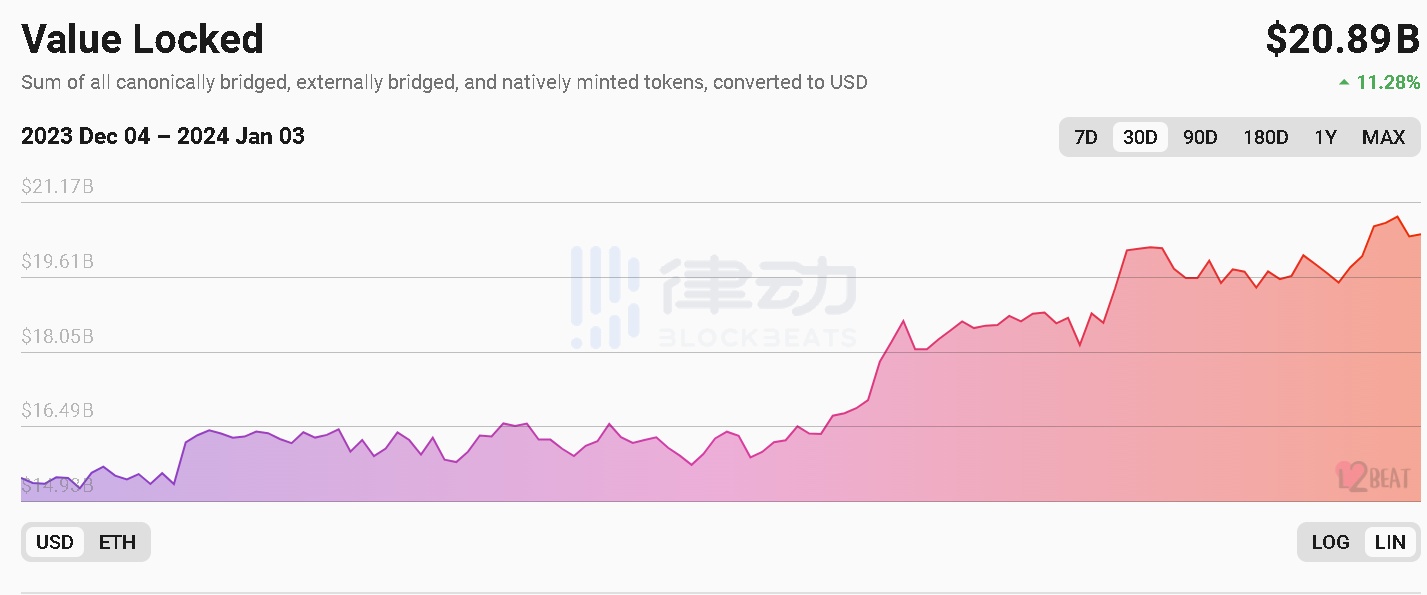
Arbitrum's native governance token ARB continues to hit new highs. On January 3, according to OKX market data, ARB briefly surged past $1.94 at the time of writing, marking another all-time high with a 24-hour gain of 10.33%. According to data from L2BEAT, Arbitrum’s total value locked (TVL) has surpassed $20 billion, making it the largest L2 rollup.
ARB Up 60% Since December
On July 7, 2023, the Arbitrum community passed two proposals: AIP-1.1 and AIP-1.2. Proposal AIP-1.1 suggested placing the remaining 700 million ARB tokens held by the foundation into "smart contract-controlled lockups," to be unlocked over four years. Proposal AIP-1.2 aimed to revise several governance documents within the Arbitrum ecosystem, including lowering the threshold of ARB tokens required to submit improvement proposals on-chain from 5 million to 1 million.
The massive unlock initially caused a brief price spike, but was followed by a sustained decline. The price only began recovering after hitting a low of $0.74 on September 11.
In terms of timing, ARB’s rise closely follows that of OP. According to The Block, starting in Q4 2023, Arbitrum’s daily transaction volume increased from 670,000 to 926,000—a 38% rise. On Optimism’s mainnet, daily transactions grew by 20%, rising from 354,000 to 431,000. After reaching a record high of $4.10, OP has been trading near its peak ever since.
As the second-largest Optimistic Rollup by TVL, OP saw nearly a 69% weekly surge, consistent with the mainnet surpassing $5 billion in TVL. Despite criticism over Optimism’s perceived lack of decentralization efforts, its market success driven by the OP Stack appears to be turning the tide. Yet a more plausible market evolution is that the strengths of the OP Stack will be further amplified, while its gaps will naturally be filled by other successors.
The key focus of the OP Stack rollout is achieving shared sequencers. The more strategic alliances OP builds, the greater the benefits it can capture through sequencers—though this also increases exposure to conflicting interests. This social consensus could become a new constraint beyond technology, cementing Optimism’s position as an established leader.
As part of the Ethereum ecosystem, one major factor driving ARB’s performance is ETH itself. Given Arbitrum’s fundamental role as an Ethereum L2, ARB may be closely correlated with ETH. If ETH slows down, ARB could follow suit. Conversely, if ETH moves toward $2,500, many crypto researchers expect ARB could rise to $2.
Beyond ETH, ARB’s surge is partly fueled by market anticipation of Ethereum Improvement Proposal (EIP) 4844, and partly by Vitalik Buterin’s public praise celebrating Arbitrum’s achievement of Rollup Stage One.
Anticipation Around the Dencun Upgrade
On December 22, @sassal0x, founder of The Daily Gwei and co-founder of EthHub, announced on social media that Ethereum developers would implement EIP-4844 on January 17, launching Ethereum’s next major upgrade, Dencun, on the Goerli testnet.

Co-authored by Ethereum researcher Dankrad Feist and Ethereum co-founder Vitalik Buterin, EIP-4844 is the centerpiece of the Dencun upgrade—an interim solution designed to enhance performance across Ethereum’s L1 and L2 layers and address gas fee issues.
EIP-4844 introduces proto-danksharding, a concept named after Feist, intended to increase the total number of transactions Ethereum can handle. Danksharding represents the full realization of rollup scaling, creating substantial space on Ethereum for rollups to dump compressed transaction data. It introduces a new transaction type—blob-carrying transactions—to reduce Ethereum’s transaction fees.
Unlike calldata, which requires full nodes to store data permanently, blobs are designed for temporary storage by partial nodes. This significantly increases the data limit per batch submitted by Layer 2 to the mainnet, boosting TPS. Temporary storage improves data efficiency and drastically reduces storage costs. Enhanced data availability (DA) results from one month of temporary blob storage, which more than covers the 7-day fraud proof window required by OP-Rollups.
This means EIP-4844 can increase rollup TPS (transactions per second) while reducing gas fees. In simple terms, post-EIP-4844, rollups no longer need to compete with native ETH applications for block space—bullish for L2s.
Rollup Stage One
In March 2023, Arbitrum officially announced it had entered Rollup Stage One—the first rollup to do so.
At year-end, Vitalik posted on Warpcast praising Arbitrum: “This is real progress toward decentralization. I hope to see ten rollups reach Stage One next year, achieving a degree of sequencer decentralization.” Hours after the comment, ARB’s price rose 22%.
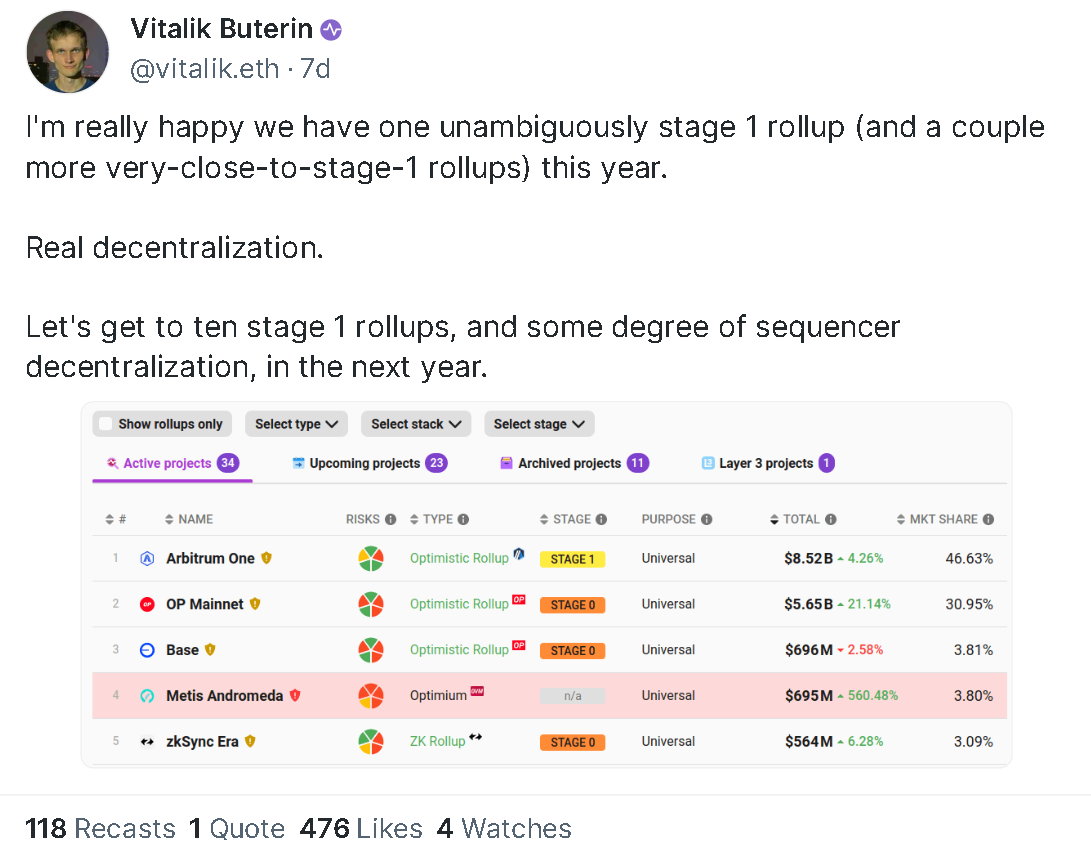
Achieving Rollup Stage One means Arbitrum meets five requirements for full decentralization. According to L2BEAT, Arbitrum is currently the only L2 to fulfill all five criteria.
As initially proposed by Vitalik on the Ethereum Magicians forum, the five requirements are: 1. A fully deployed and functional proof system; 2. At least five external participants capable of submitting fraud proofs; 3. Users can exit without needing permission from operators; 4. Users have at least seven days to exit if a more centralized entity like the Security Council implements an unnecessary upgrade; 5. The Security Council is properly constituted.
Additionally, on December 29, Arbitrum-based gaming layer Xai announced its first-season airdrop distribution. A snapshot has already been taken for Xai Odyssey Legends and Pioneers, as well as Sentry Node Key holders.
Low Valuation, High "Odds"
Besides ARB, Ethereum’s rise and expectations around the Dencun upgrade have lifted other L2 tokens. On December 27, OKX data showed broad gains among Layer 2 project tokens: OP up 19.38% in 24 hours; MATIC up 18.34%; METIS up 17.1%.
Besides high-profile projects like Starknet and zkSync, some lower-valued but high-"odds" projects such as Metis and ZK Fair have also drawn attention.
Metis
Metis is an Ethereum Layer 2 scaling solution based on Optimistic Rollup, founded in 2018 by Elena Sinelnikova, Kevin Liu, and Yuan Su. Its native token METIS rose from $20 to $90, surging 350% in just two weeks.
On December 18, MetisDAO announced the creation of the Metis Ecosystem Development Fund (Metis EDF). With the establishment of the Metis EDF, 4.6 million METIS tokens will be allocated to support project deployment, product development, and builder incentives within the ecosystem.
Current projects in the Metis ecosystem include Hermes, a DEX built on Metis positioning itself as a capital-efficient AMM offering users low-cost, near-zero-slippage trades; and NetSwap, the first DEX on Metis enabling swap functionality on the network.
Hummus Protocol is a single-sided AMM built on Metis that allows users to swap stablecoins with minimal loss. Its native token is HUM. Users can stake stablecoins to earn HUM and use staked HUM rewards to boost their stablecoin yields. Metis’ project background has also spawned native meme coins such as VMUM and BARSIK.
According to official blog posts, Metis aims to become the first Optimistic Rollup with a decentralized sequencer in early 2024. Distribution from the Metis Ecosystem Development Fund will begin one week after the decentralized sequencer launches. With the upcoming sequencer launch and ongoing fund incentives, new projects in the Metis ecosystem remain highly anticipated.
ZKFair
ZKFair is the first ZK-L2 built on Polygon CDK and Celestia DA, powered technically by Lumoz RaaS. Fully fairly launched and community-driven, ZKFair aims to solve pain points such as high L2 valuations, excessive marketing hype ("PUA"), and high user entry barriers.
On its testnet launch day, over 30,000 users flooded the community and interacted with the testnet. Its innovative economic model remains a focal point for community members. ZKFair uses USDC as its fee token, while its native token ZKF has a total supply of 10 billion, all distributed via airdrops to the community.
Of this, 2.5 billion ZKF will be airdropped to community users—including those who interacted with Polygon zkEVM, zkSync, Linea, Scroll, ZKSpace, Lumoz points holders, and Ordinals community members. Users can now check their potential airdrop amounts on zkfair.io. No additional ZKF tokens will ever be minted. All 10 billion ZKF tokens will eventually be uniformly released and circulated.
After mainnet launch, cross-chain bridge Owlto Finance announced integration with ZKFair, becoming one of the first bridges to support it. Users can now quickly and securely transfer assets from Ethereum, zkSync Era, Scroll, Optimism, Arbitrum, Linea, and other major L2 networks into ZKFair via Owlto Finance. Additionally, users can claim a share of 75% of ZKFair’s token airdrop through Owlto.
Mainnet Launches and Airdrop Expectations
Starknet
In the Layer 2 landscape, Starknet stands alongside Arbitrum, Optimism, and zkSync as one of the "Four Greats." Compared to fellow ZK阵营 player zkSync, Starknet uses zk-STARKs, offering higher transparency and security.
On December 1, 2023, the Starknet Foundation announced it had taken an airdrop snapshot and plans to distribute STRK tokens to certain historically active users and contributors in Q1 2024, along with unlocking previously distributed tokens. On December 8, the Starknet Foundation revealed plans to allocate over 1.8 billion STRK tokens across multiple initiatives, with an initial 50 million STRK earmarked for on-chain DeFi incentives. This move has attracted numerous investors to begin positioning themselves early in the Starknet ecosystem.
Over 170 projects are currently being developed on Starknet. Most remain in early stages—put simply, the majority of protocols have not yet launched tokens. RabbitX and Loot Realm are among the few exceptions that have already issued assets.
Recently, the official team released a map of major DeFi applications on the Starknet network, covering five sectors: cross-chain bridges, AMMs/DEXs, aggregators, lending, and derivatives. With the upcoming token launch, official incentives for DeFi protocols, and broader market recovery, these figures are expected to grow further in 2024—benefiting the wider L2 ecosystem.
zkSync
The market has largely become desensitized to technical narratives around ZK-Rollups and OP-Rollups. Likely, zkSync will shift focus from technological breakthroughs to tackling the tougher challenge of building out its ecosystem.
In terms of ecosystem development, amid fierce Layer 2 competition, zkSync must aggressively nurture a breakout derivative platform. Fueled by Holdstation’s token incentives, its derivatives platform has seen average daily trading volume exceed $20 million, with APY peaking at 69% and 30-day fees reaching $200,000. Its tokenomics are forming a flywheel: gas subsidies attract users, increasing trading activity and fees, which in turn fund more subsidies.
After quietly completing the Boojum upgrade and integrating STARK and SNARK proofs, zkSync’s gas fees have dropped by about 30% over the past 30 days, bringing them on par with Arbitrum. Combined with its existing UX advantages, this has helped it attract broader user adoption and traffic.
On the other hand, much of zkSync’s current activity stems from bounty hunters (“lumber parties”), who are willing to pay gas fees primarily due to anticipated airdrops. zkSync lowers user barriers through account abstraction, adopts NFT strategies for community growth like Pudgy Penguins, and Matter Labs members have recently been vocal about AA (account abstraction), leading community speculation that wallet usage involving AA accounts might be an airdrop criterion.
Overall, over half a year after mainnet launch, zkSync has firmly secured its place among the top ZK-Rollups, even surpassing Starknet in market expectations. While under constant spotlight and carrying significant public pressure, the community widely believes zkSync will make strategic moves in community engagement.
Taiko
Taiko is a decentralized, Ethereum-equivalent ZK-Rollup that inherits Ethereum’s security while offering lower transaction fees. Taiko enables developers and users to safely interact with Ethereum without any modifications. Thanks to its decentralized design, Taiko supports a vibrant community of block proposers, provers, and node operators.
Taiko is a "Based Rollup"—a first among competitors. It lacks a centralized sequencer, instead relying on Ethereum validators to order transactions and blocks. As a disputable rollup, Taiko allows app chains to define their own proof systems and adopt newer, more efficient validity proofs as technology evolves, without modifying Taiko’s core protocol.
On December 5, Taiko announced its Taiko Grants Cycle 2 developer incentive program, with a total pool of $30 million. On December 8, Taiko launched a community education campaign on Galxe, featuring three tasks: creating an account-abstraction-powered wallet using Particle, registering a .taiko domain, and reading official articles and taking quizzes. Participants will earn loyalty points.
Taiko is currently fine-tuning its new design and rollup contract codebase. Once complete, this will be deployed as Taiko’s Alpha-6 testnet, featuring a four-layer proof system. In the upcoming A6 testnet, Taiko will implement a 24-hour cooldown period across all levels. Ultimately, Taiko aims to combine the best aspects of optimistic and ZK-rollups through its disputable rollup architecture.
Manta
Manta Network is the first public chain built on Celestia as an Ethereum L2, having raised $60 million. It allocates 5% of its airdrop token supply to provide native yield for ETH and stables.
Manta launched a liquidity incentive campaign called New Paradigm—similar in logic to Blur’s Blast liquid staking initiative. The basic reward structure is 3% (base) + 2% (bonus) + 1.5% (ecosystem) = 6.5% total. Users stake ETH or USDC to earn blind box fragments, which can be redeemed for blind boxes. The NFTs obtained from opening blind boxes can later be exchanged for future token airdrops.
As early as January 2024, users can exchange their NFTs for token rewards. After receiving the token reward, users must wait 69 days before they can unlock and withdraw their staked ETH and USDC from the Manta ecosystem. Currently, an invitation link is required to access the campaign page.
Join TechFlow official community to stay tuned
Telegram:https://t.me/TechFlowDaily
X (Twitter):https://x.com/TechFlowPost
X (Twitter) EN:https://x.com/BlockFlow_News
 BlockBeats







