








ArkMoney: The Next DeFi Ponzi King You Absolutely Didn't Understand
TechFlow Selected TechFlow Selected
ArkMoney: The Next DeFi Ponzi King You Absolutely Didn't Understand
The mined cryptocurrency from mining machines is not being sold on the market, while the money from selling mining machines is being used to repurchase more cryptocurrency.
 Navigating Web3 tides with focused insights
Author: Cook Sun Crypto Chef
Regarding the ArkMoney project, after reviewing KOL analyses and media coverage in the market, I feel all existing understandings and interpretations are completely off-base—no one truly grasps the logic behind this project. Users entering seem confused, and so are the media. Today, based on hands-on experience, I’ll provide an interpretation that will make everything crystal clear:
Cognitive Reset
“This is not a financial product—it’s a MARK mining machine. The regular maintenance cost (electricity fee) is 200 USDC, with a daily yield of 0.5%.”

If you’re a beginner or don’t want to dive deep into the internal mechanics, stop here. You can treat MARK as a mining rig. Your initial investment is the purchase price of the rig—the higher the price, the greater the hash power, and thus the higher the absolute value of the 0.5% daily returns. By regularly paying the electricity fee (reinvesting 200 USDC), you accumulate earnings from the miner.
IQ 50: How High Are the Returns?
Feel the power of compounding: investing 10,000 USDC to buy a miner and paying 200 USDC weekly for electricity:
-
112 days: Cost = 10,000 + 3,200 = 13,200; Total return = 21,282; ROI = 160%;
-
6 months: Cost = 10,000 + 5,200 = 15,200; Total return = 32,145; ROI = 211%;
-
1 year: Cost = 10,000 + 10,400 = 20,400; Total return = 85,511; ROI = 419%;

IQ 100: Three Fundamental Questions — How Does It Work? Where Does the Money Come From? How Big Is the Bubble?
First, the project’s documentation and marketing materials do not clearly explain how it works. Let's summarize the official descriptions:
-
Users deposit $USDC into the vault and earn 0.5% daily yield growth;
-
Holders of $MARK tokens benefit from transaction taxes and increasing liquidity, leading to asset appreciation.
Immediately, the 0.5% daily yield triggers associations with Ponzi schemes and unsustainability. But few understand the underlying mechanism—where does the money come from? How big is the bubble? Let’s start there:
1. Operating Mechanism
Although the 0.5% daily yield accumulates in real time, there’s a condition to unlock it: you must reinvest (compound). Without reinvestment, the accumulated 0.5% daily yield doesn’t count toward your total TVL (think of TVL as your deposit balance). If you withdraw without compounding, the accrued yield is directly deducted from your TVL. So if you never compound after depositing, your principal unlocks at 0.5% per day—with zero interest.
Here’s a concrete example (the system requires a minimum re-investment of 200 USDC, so we'll use that):
-
Initial deposit: 39,370 USDC
-
No reinvestment made
-
Personal TVL: 39,370 USDC
-
TVL after reinvestment: 40,123 USDC

So the calculated yield accumulated via 0.5% daily compounding is 40,123 - 39,370 = 753 USDC. Whether or not you reinvest leads to two outcomes:
-
Withdraw without reinvesting: Yield is deducted from personal TVL. TVL drops to 39,370 - 753 = 38,617;
-
Reinvest 200 USDC: Yield is added to TVL along with new capital. TVL increases to 39,370 + 753 + 200 = 40,323.

Currently, the minimum reinvestment amount is 200 USDC. Regardless of whether you deposited 1,000 or 50,000 USDC, reinvesting just 200 USDC allows you to add your accumulated yield to your TVL and activate further earnings.
Therefore, the conclusion is: you need to periodically reinvest a certain amount to activate your 0.5% daily yield. Without reinvestment, this 0.5% simply acts as a rate at which your TVL gradually unlocks.
Now, forget about deposits and reinvestments—let’s reframe this using the mining analogy:
Buy a MARK mining rig,
-
The price of the rig determines its hash power—the higher the price, the greater the computing power and the higher the output from the 0.5% daily yield.
-
Regular maintenance cost / electricity fee is 200 USDC. If you want the rig to run faster, you can pay more to boost performance.
-
Output is based on hash power at 0.5% daily, but to realize gains, you must pay electricity fees regularly.
-
When you stop paying electricity, the rig stops running—but the earnings remain inside. After 200 days, you can return the rig to the factory, claim your earnings, and get back your original purchase price.
2. How Much Bubble? Who Is Carrying the Load?
First, let’s talk about the bubble. As explained above, the mechanism is clear: only when you reinvest do you receive the 0.5% daily yield. In other words, your miner only earns money if you keep paying electricity.
This seemingly massive 0.5% daily yield bubble is actually diluted over time by reinvestment costs. When no one reinvests, the bubble doesn’t exist. Suppose everyone who joins never reinvests—like a miner with no electricity, not operating. After 200 days, they can return the rig and get their full principal back, with no profit. No bubble is created during this process.
But when someone pays the electricity bill (reinvests), the miner produces some yield—paid out in USDC. Since USDC cannot be created out of thin air, isn’t this just redistributing later users’ funds to earlier ones? What? Is this still a pyramid scheme?

To answer this, first we must understand what exactly constitutes the system’s generated returns.
On the surface, each user receives USDC as yield, which must come from newer investors buying miners. We know the system cannot generate USDC internally nor has direct USDC revenue streams. However, it *can* mint its own token $MARK—so ultimately, the system’s returns must be backed by $MARK.
In principle, for short periods, early users’ yields are paid with incoming USDC from later users—because there’s cash flow in the reserve pool, eliminating the need to sell tokens to cover payouts.
⚔️ Here comes the first master technique:
❝ Substitution Technique
The coins mined by the rig aren't immediately sold on the market—they’re first used to settle payouts using reserve cash.

The brilliance here is that although the system’s returns are fundamentally derived from $MARK tokens, for a long time these tokens face no selling pressure. They are designed as the last resort for payout settlement, effectively delaying any token sell-off indefinitely. Put simply: as long as enough people keep buying rigs and the reserve cash remains sufficient, there’s no need to sell $MARK at all.
Of course, this reveals who’s “carrying the load” for the system: $MARK itself. In the worst-case scenario—when no new users join and the reserve cash is gradually drained—the system must begin selling $MARK to pay the final few rigs’ yields.
3. Where Does the Money Come From?
$MARK carries the system’s burden—so what supports the value of $MARK?
This brings us to the management of ArkMoney’s reserve cash (USDC):
-
86% used to buy back $MARK
-
10% held as buffer cash for rig redemptions and yield withdrawals
-
5% undetermined
⚔️ Second Master Technique:
❝ Grand Transfer Technique
Coins mined by the rig aren't dumped on the market—instead, money from selling rigs is used to repurchase $MARK.
First, recall that user payments for rigs (deposits) go into the project treasury as reserve cash. Of this, 86% is allocated to buy $MARK on the open market, while 10% is kept as a buffer for user redemptions and withdrawals.
This 10% buffer can theoretically last a very long time because from the moment a user starts mining, redeeming the rig or claiming yield takes at least 200 days. (You could technically withdraw daily at a loss, but such a loss-making operation goes against human nature.)
Thus, the system uses most of its reserve cash to generate returns—a concept similar to DeFi projects using treasury reserves for yield farming, investments, or wealth management—except here, the team chooses to buy their own token.
⚔️ Third Master Technique:
❝ Celestial Shift Technique
At this point, most people should understand: depositing USDC equals buying a $MARK mining rig. While the rig theoretically mines $MARK, users are actually paid in USDC. $MARK isn’t sold on the market—in fact, reserve funds continuously buy it back. This expectation attracts significant external buying interest, bringing in fresh capital from outside the system.
-
What? You figured it out and won’t buy $MARK—you’ll just mine for free?
But your rig purchase still fuels $MARK buys—and then $MARK begins a bulldozer-like climb. -
What? I’ll just buy $MARK directly—more flexible, no need to pay rig electricity.
Congratulations, you’ve just contributed “revenue” to the entire project.

The system currently has $6M in TVL. At this point, sharp minds will realize: either no one plays and it stalls, or once funding and user numbers reach a critical mass, it becomes nearly unstoppable.
4. If No New Funds or Users Enter, Will It Collapse?
Let’s clarify again: if no one continues to pay electricity (reinvest), the rig generates no real yield—therefore, no bubble exists. All participants stay put, no new entrants. Everyone unlocks their principal at 0.5% per day and returns the rig after 200 days to reclaim their full deposit—no losses, no collapse.
Under normal conditions, users buy rigs and pay electricity at different times, so withdrawal timing varies. As more people buy rigs, more reserve cash flows into $MARK purchases, fewer $MARK tokens are sold, more buyers enter, encouraging sustained holding of appreciating $MARK. Rising $MARK value supports yield payouts, enabling more rigs to turn on, attracting even more buyers—creating a virtuous cycle.

What about extreme scenarios?
Suppose someone pays electricity and turns on a rig, generating USDC-denominated yield. But if no new users join within 200 days, and all active rigs simultaneously request redemption and profit withdrawal after 200 days—that would be the most extreme bank run. In this case, the test lies in whether $MARK’s market liquidity and valuation can withstand the run.
⚔️ Fourth Master Technique:
❝ Ambidextrous Combat Technique
Another brilliant design—the continuous appreciation system for $MARK
-
Sustained Buying Power
As previously mentioned, the “Grand Transfer Technique” allocates 86% of rig-sale proceeds to continuously buy $MARK, creating consistent upward price anchors. Unlike POW or DeFi mining models, there’s almost no additional token selling pressure—leading to bulldozer-like price surges.
We must also consider another cash flow: the “electricity fee”—i.e., reinvestment funds. To maintain yield generation, users must keep paying electricity, providing steady inflow to the system even without new rig buyers.
-
10% Tax: The Black Hole
A genius feature of the system is the “Black Hole.” Initially, the Black Hole holds 49% of $MARK tokens, uncontrolled by anyone and non-tradable. Every trade or transfer of $MARK incurs a 10% tax, distributed proportionally to all $MARK holders—including the Black Hole. Because the Black Hole absorbs most of this tax revenue, once its share exceeds 51%, it automatically sells excess $MARK holdings and pairs them with USDC to form LP, injecting them into the $MARK pool. This mechanism ensures the $MARK liquidity pool deepens over time—the more trades, the more tax collected, permanently locked in the pool, forming the foundational value layer of the entire system.
Classic “we don’t mind you profiting—we just hope you participate” model. Every transaction contributes to the system’s core value.
-
No One Can Resist an Uptrend
Following this logic, the ultimate source of external blood supply is those trading $MARK. The allure of $MARK lies in its irresistible uptrend. Once everyone understands the game, they’ll realize $MARK is the invisible ultimate backstop—but ArkMoney ingeniously engineered a perpetual engine for its rise. Whether driven by speculation or investment, when you see that price chart, no one can resist the temptation. (That’s Elephant’s chart.)
Many ask why such bulldozer-shaped price action occurs. The reason is simple: most of the USDC vault’s funds are used to buy $MARK on the market, concentrating supply increasingly in the project’s hands, reducing circulating supply. This steadily raises the average cost basis of user-held tokens, expanding market cap.
-
Infinite Restart Capability
What if a run happens and it collapses? There’s a clever safeguard: $MARK backs the entire system’s value—very similar to the LUNA & UST relationship:
However, unlike LUNA, $MARK has no infinite minting mechanism. Additionally, UST redemption was instant, greatly increasing run risk. Any panic could trigger a death spiral due to unlimited LUNA issuance.
$MARK has no inflation mechanism, most tokens are concentrated in ArkMoney’s buyback treasury, and USDC vault redemptions are time-locked—nearly every design choice mitigates run risk. Because $MARK cannot inflate and circulation is limited, whenever prices dip to psychological support levels, buyers rush in, injecting new life. LUNA’s collapse was partly due to failure to halt infinite minting promptly.
As long as bottom-fishers appear, infinite restart potential exists.
-
LUNA’s market cap determined UST’s upper limit
-
$MARK’s market cap determines how much USDC deposits the vault can absorb while maintaining solvency
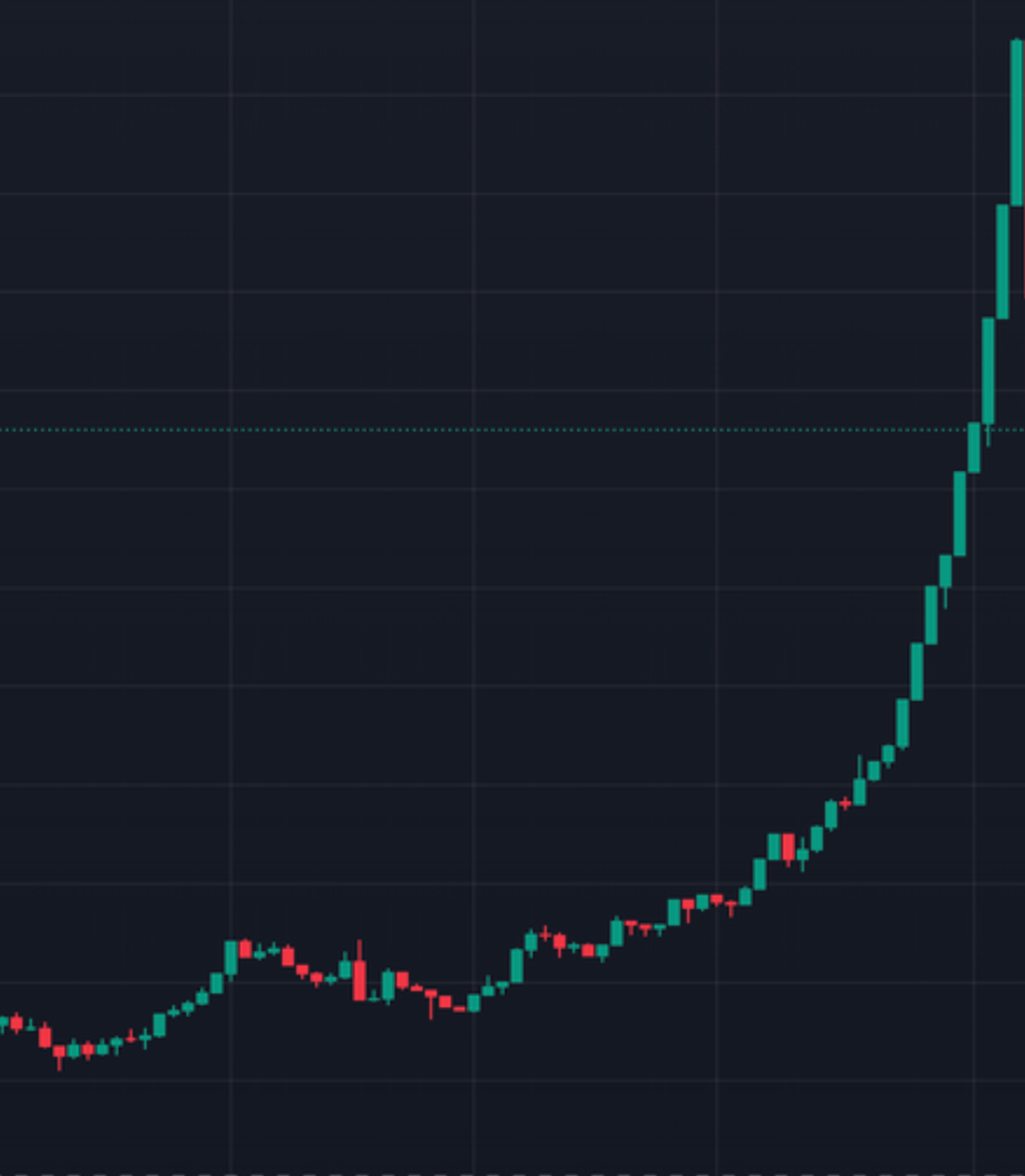
Elephant’s uptrend phase
So,
External blood comes from those trading $MARK,
Internal blood comes from those buying rigs with USDC.
This is entirely different from classic Ponzi or pass-the-parcel finance—even more dynamic than typical DeFi liquidity mining.
Finally, let’s analyze using data from Elephant (the "Elephant"), which has been running for over two years:
Since launching in 2021, Elephant has operated continuously for two years. Its worst drawdown occurred in 2022 due to a hack. Otherwise, it’s been a near-perfect bulldozer rally—including strong recovery post-hack—and survived events like BNB downturns and BUSD token swaps. Elephant now boasts a $380M market cap.
From its 2021 low of 0.000000001217 to today’s 0.0000003804, it has gained over 300x. From peak highs, over 500x.

MARK currently has a $30M market cap—still at least 10x below Elephant’s level.

MARK’s advantage lies in being built on Ethereum, where assets like USDC and ETH are more stable than BNB and BUSD, with broader appeal. I won’t deny this is a highly Ponzi-like project—but I believe it’s a remarkable social experiment. Every design detail is worthy of the title “King of Ponzis,” yet few truly grasp it. Whether compounding in the USDC vault or holding $MARK long-term, both offer solid returns. $MARK and the USDC vault together form a self-reinforcing “step-on-your-own-feet-to-climb-sky” combo, while downward risks are minimized through time-based mechanisms.
This is a skyward-climbing vine that grows taller the more people join!
Join TechFlow official community to stay tuned
Telegram:https://t.me/TechFlowDaily
X (Twitter):https://x.com/TechFlowPost
X (Twitter) EN:https://x.com/BlockFlow_News
 @Cook0x







