








Ethereum's Latest On-Chain Data, Technical Developments, and Highlights to Watch in 2024
TechFlow Selected TechFlow Selected
Ethereum's Latest On-Chain Data, Technical Developments, and Highlights to Watch in 2024
The Dencun upgrade is scheduled for deployment in March or April 2024. With EIP-4844, Ethereum L2 gas costs will be significantly reduced, improving Ethereum's scalability.
 Navigating Web3 tides with focused insights
Author: Ebunker
ETH/BTC Exchange Rate & On-Chain Data Comparison
Since October through December 15, BTC has risen by 57.5%, while ETH has increased by 48.34%. Although the difference is not significant, ETH's underperformance relative to BTC has persisted for nearly a year.
BTC’s strong performance is primarily driven by expectations surrounding spot BTC ETFs, the approaching halving cycle, and recent growth in the BTC ecosystem. While ETH lacks similar short-term catalysts, on-chain data still shows relatively positive signals.
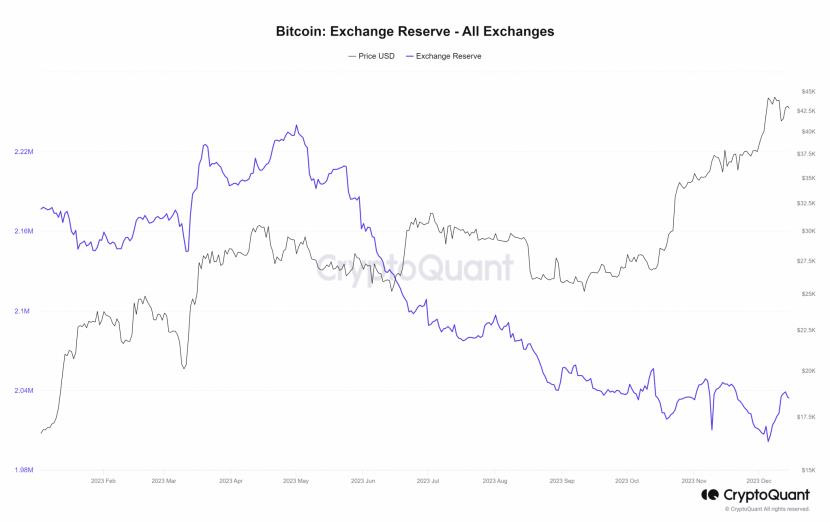
First, regarding direct selling pressure, BTC balances on exchanges have been steadily declining since June, but showed a clear rebound between December 5 and December 12. Following this peak, BTC price briefly dropped to $41,000.
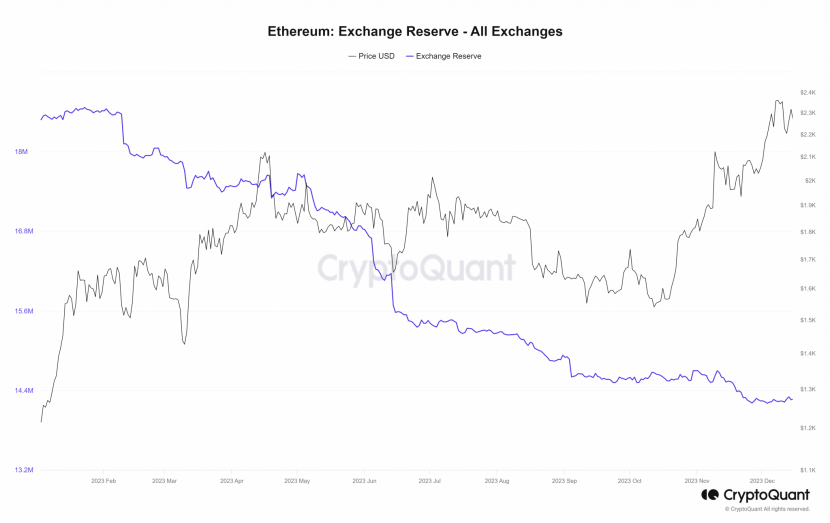
Compared to BTC, ETH exchange balances exhibit lower volatility. Since February 2023, ETH balances on exchanges have been on a continuous downward trend. Between December 11 and 13, there was also a slight rebound in ETH exchange holdings, but this occurred during and after a market price decline.
This suggests that some investors chose to move ETH onto exchanges for cashing out following a temporary market dip.
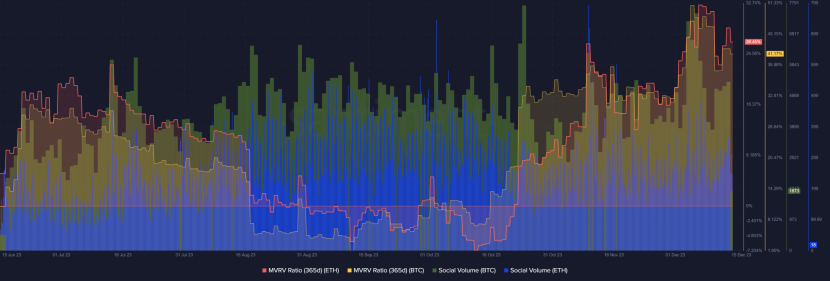
Additionally, according to data from Santiment, social sentiment trends for both assets are broadly similar, though BTC consistently shows higher热度 than ETH. In terms of MVRV (Market Value to Realized Value ratio, commonly used to assess buying/selling pressure), both follow similar overall trends but differ significantly in magnitude. As of December 15, BTC’s MVRV stands at 41.17%, compared to ETH’s 26.45%, with both values at six-month highs.
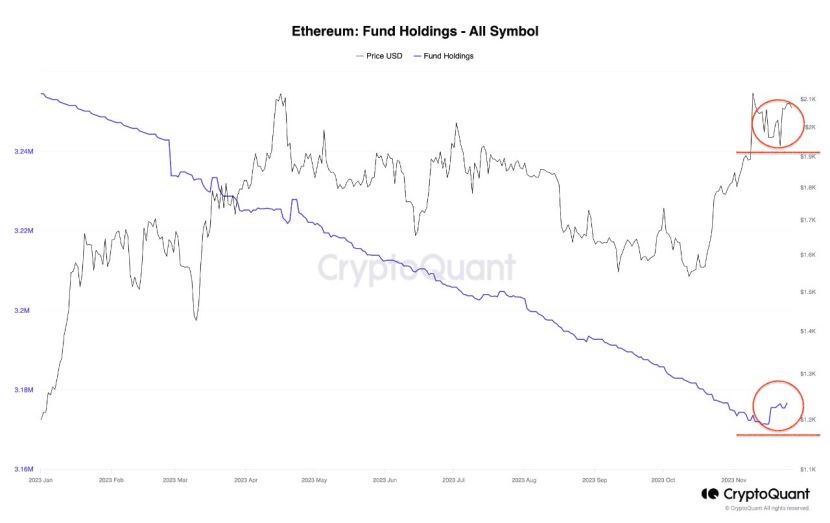
Despite Ethereum’s recent underperformance compared to Bitcoin, shifting trends in institutional interest toward Ethereum remain noteworthy—a phenomenon that has become more pronounced since November 2023.
According to charts from on-chain analytics platform Cryptoquant, when ETH prices stabilized around $1,800–$1,900 recently, institutional holdings of ETH saw a notable rebound.
Cryptoquant believes the recent surge in institutional ETH holdings reflects growing investor interest and recognition of Ethereum’s long-term value and market growth potential. This trend is driven not only by ETH’s price stability and anticipation of a spot ETH ETF, but also by Ethereum’s solid fundamentals and ongoing technical upgrades.
In its recently released 2024 financial outlook report, JP Morgan expressed its stance on the cryptocurrency sector. The report notes that despite BTC approaching its halving cycle, it expects ETH to outperform BTC next year. JP Morgan identifies the upcoming EIP-4844 upgrade (Proto-dank sharding) as a key potential catalyst, which will enhance Ethereum’s network efficiency and scalability, giving it a competitive edge in the market.
On the other hand, the bullish impact of BTC’s halving has already been largely priced into current valuations. The reduction in block rewards is expected to increase production costs and could lead to a 20% drop in hash rate. According to JP Morgan, this may raise operational costs for miners and force less efficient miners to exit the market.
Key Step Ahead of Dencun Upgrade Activated
Per reports from core developer consensus calls, by the end of 2023, Ethereum developers finally initiated a critical step ahead of the Dencun upgrade. Developers announced they would launch a Goerli shadow fork within the next one to two weeks across all clients to test the Cancun/Deneb upgrade.
Testing of the Cancun/Deneb upgrade on Devnet 12 is currently underway. All execution layer (EL) and consensus layer (CL) client combinations—including PRYSM—are now deployed on Devnet 12. MEV-BOOST software has been activated for most client combinations, except those using PRYSM.
The Ethereum Dencun upgrade will introduce changes to both main layers of the network—the execution layer and the consensus layer. The upgrade to the execution layer is known as the Cancun upgrade, while the consensus layer upgrade is called Deneb; together, they form the Dencun upgrade.
Dencun will further scale ETH and Layer 2 (L2) networks by implementing EIP-4844. The Dencun upgrade represents a major milestone in Ethereum’s roadmap—once completed, L2 transaction fees will become significantly more competitive.
Returning L2 Functionality to L1 via Wrapped zkEVM
Layer 2 networks improve Ethereum’s scalability by batching transactions off-chain before settling them back on the main chain—a solution highlighted by Vitalik Buterin during a 2020 conference amid soaring Ethereum network fees.
Recently, Ethereum co-founder Vitalik Buterin proposed that as "light clients" grow stronger, wrapping zkEVM functionality and returning it to L1 will be Ethereum’s next step. He suggested reintegrating certain capabilities of L2 networks or rollups back into the Ethereum mainnet. This concept of a “wrapped zkEVM” (zero-knowledge Ethereum Virtual Machine) contrasts with his earlier vision of moving computational load from Ethereum’s main chain to L2 networks.
In a recent blog post, Vitalik emphasized the importance of light clients—nodes that run lightweight client software. These light clients request data only when needed, rather than independently verifying blockchain changes by storing full copies of the data. Typically, light clients process only block headers and occasionally download actual block content.
Vitalik believes that as their capabilities and data access improve, these light clients will become powerful enough to fully validate L1 transactions like L2 networks do. At that point, the Ethereum network would effectively have a built-in ZK-EVM.
ZK (zero-knowledge) proofs are cryptographic protocols allowing one party to prove the correctness of a transaction to another without revealing specific details. Meanwhile, the EVM (Ethereum Virtual Machine) functions like a computer executing programs—it is responsible for running smart contracts on Ethereum.
Currently, L2 platforms such as Polygon, Scroll, and Matter Labs utilize zero-knowledge proofs and serve as major players in DeFi. Therefore, Vitalik’s wrapped zkEVM approach might reduce incentives for these platforms. So what happens to L2 functionality if zkEVM becomes encapsulated within Ethereum’s native protocol?
According to Vitalik Buterin, these L2 projects will still retain responsibility for many critical functions, including fast pre-confirmations, MEV mitigation strategies, and EVM extensions. Moreover, the wrapped zkEVM approach will also enhance usability for end users and developers.
He stated, “L2 teams have done extensive work attracting users and projects into their ecosystems and making them feel welcome; they earn profit compensation by capturing MEV and congestion fees from transactions. This relationship will continue.”
Key Highlights for ETH in 2024
The Dencun upgrade is scheduled for deployment in March or April 2024. With EIP-4844, gas costs on Ethereum’s L2 networks will be significantly reduced, improving Ethereum’s scalability.
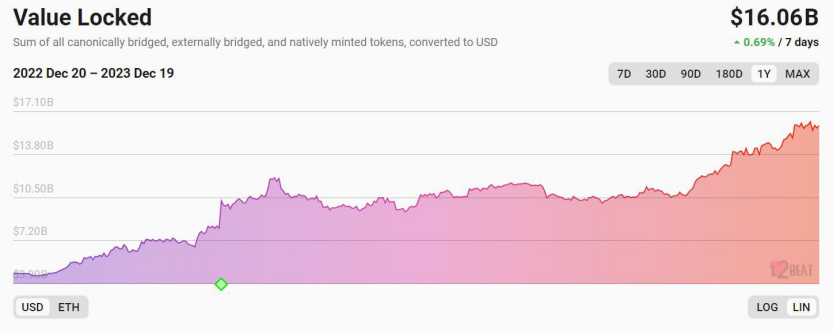
Activity on Ethereum’s L2 networks continues to grow and has reached an all-time high. According to recent data from L2Beat, the total value locked across the ecosystem stands at $16 billion.
Current L2s are predominantly EVM-compatible, such as Arbitrum, Optimism, and Metis. Meanwhile, non-EVM L2s like Eclipse and Fluenty are launching, bringing new types of applications and developers. Blockchain gaming will primarily build on L2 ecosystems, wallet user experiences will continue to improve, helping the Ethereum ecosystem onboard more new users.
Finally, tokenization of real-world assets continues gaining momentum, bringing more traditional financial products onto the Ethereum blockchain.
Join TechFlow official community to stay tuned
Telegram:https://t.me/TechFlowDaily
X (Twitter):https://x.com/TechFlowPost
X (Twitter) EN:https://x.com/BlockFlow_News
 @ebunker_eth







