Understanding IoTeX: IoT New Infrastructure Under the DePIN Narrative
TechFlow Selected TechFlow Selected
Understanding IoTeX: IoT New Infrastructure Under the DePIN Narrative
As a rising star in the DePIN sector, IoTeX has the potential to leverage DePIN by providing underlying infrastructure.
 Navigating Web3 tides with focused insights
Author: FMResearch
Introduction
Integrating with the real world has always been a key goal for blockchain applications. Against the backdrop of a strengthening U.S. dollar this year, RWA (Real World Assets) has bridged traditional finance and crypto finance, emerging as one of the few standout sectors during the bear market. DePIN, as a branch of RWA—short for Decentralized Physical Infrastructure Networks—has recently begun drawing increasing attention. Messari defined this new concept in its 2022 DePIN research report, calling it "one of the most important areas in crypto investment over the next decade."
Just as RWA is not a new phenomenon but rather an evolution of DeFi adapting to external conditions, DePIN is also not new. Ever since Ethereum's inception, numerous projects have attempted to decentralize infrastructure such as energy, storage, and computing. Projects like Filecoin and Helium have already achieved notable success.
At the recent Hong Kong Fintech Week, DePIN became a focal point within the Web3 industry, with the convergence of Web3 and physical infrastructure seen as the next major trend. Techub News declared, “DePIN is the biggest narrative for Hong Kong’s Web3 ecosystem.”
FutureMoney has long prioritized research into the DePIN sector. This article focuses on IoTeX, a leading DePIN project. Combining both DePIN and IoT (Internet of Things) concepts, IoTeX is a next-generation blockchain platform oriented toward IoT. It features unique strengths in scalability, deep privacy protection, and autonomy, aiming to provide comprehensive support for IoT applications and the development of a blockchain ecosystem.
Market Potential of DePIN
Currently, well-known DePIN projects are primarily concentrated in storage and communication. In fact, DePIN holds application potential across industries including energy, computing, IoT, and supply chains. For example, React, a decentralized energy storage asset network, leverages decentralized Web3 technology to save energy and improve grid efficiency. It allows participants to connect their home batteries to a Web3 energy storage network, offering cash and token incentives to participating enterprises and individuals. The decentralized GPU platform Render Network provides rendering capabilities for large-scale video production, 3D modeling, and film visual effects projects, rewarding contributors with tokens based on GPU rendering performance tiers.
Traditional physical infrastructure development suffers from high capital intensity, long investment cycles, and low returns. By leveraging blockchain's token incentive mechanisms, DePIN unlocks the potential of decentralized hardware, effectively addressing these pain points. At its core, the DePIN model connects fragmented demand with idle physical resources through token incentives and a flywheel effect, satisfying needs at lower cost and higher efficiency.
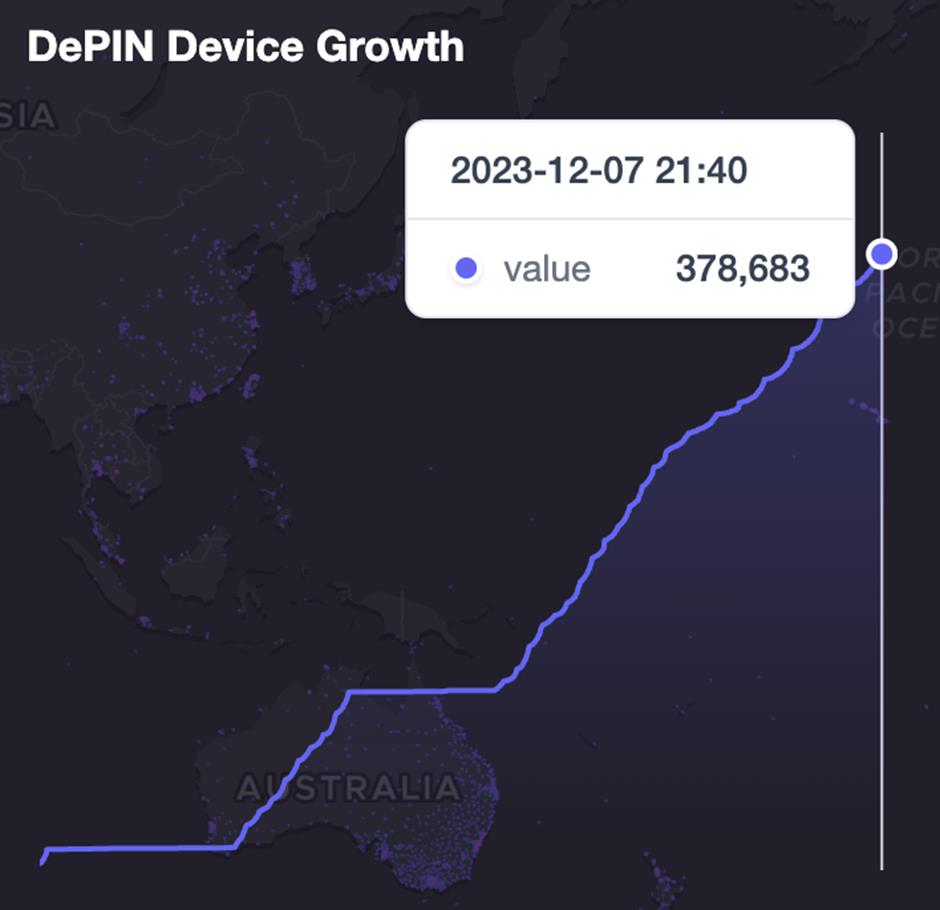
According to DePINscan, a public data platform for DePIN created by IoTeX, over 370,000 devices are now connected to Web3. Despite rapid growth, this number represents only a tiny fraction of the physical world.
IoTeX: A Full-Stack Solution for DePIN Applications
Founded in 2017, IoTeX has consistently focused on integrating physical devices (and their data) with blockchain technology. IoTeX ensures individuals can own and control their devices, data, and the value they generate, empowering builders and users to become owners and beneficiaries of the trillion-dollar IoT economy. Recognized for its contributions to IoT, IoTeX was jointly appointed with Amazon and Huawei as co-chair of the Blockchain Task Group within the Industrial Internet Consortium (IIC).
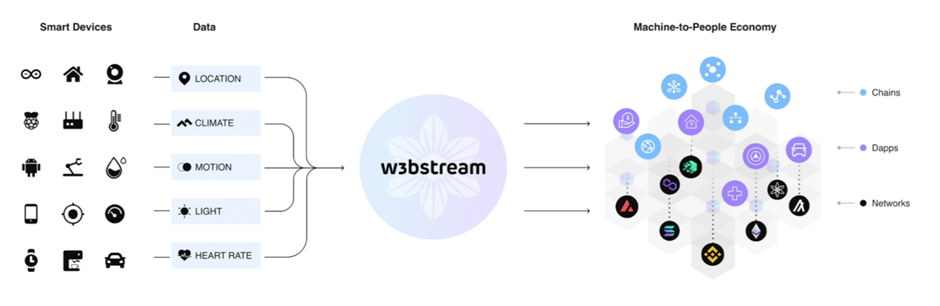
IoTeX has built an EVM-compatible Layer 1 blockchain specifically designed for IoT data and DePIN applications. Through its DePIN middleware W3bstream, IoTeX connects physical DePIN devices and their data to the Layer 1 chain. Any DePIN application can use W3bstream to instantly launch its own dApp, incorporating hardware components, off-chain logic, on-chain logic/tokenomics, incentivizing real-world data flows, and generating token rewards for users.
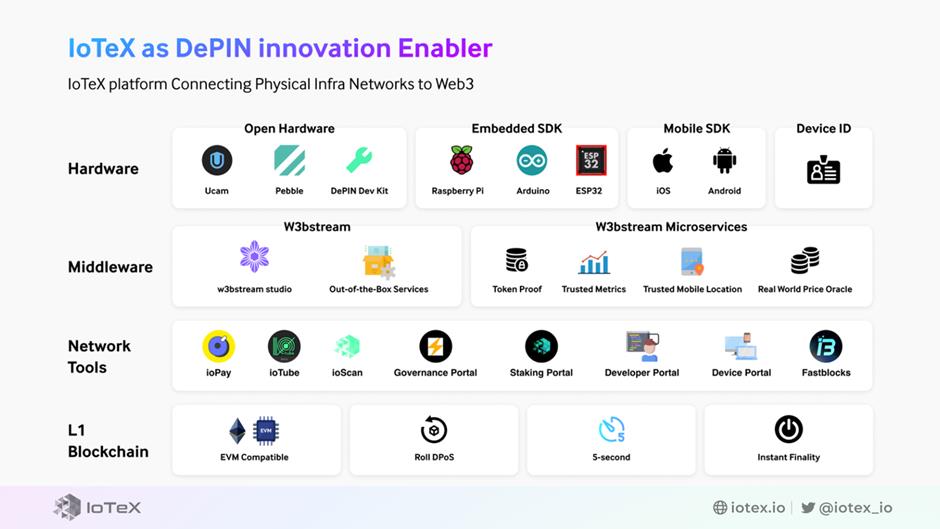
IoTeX’s full-stack DePIN solution offers a complete suite of “plug-and-play” products and tools for blockchain-powered IoT applications, enabling developers to focus solely on business logic. Its full-stack DePIN infrastructure consists of four layers:
-
Hardware Layer: MachineFi is a hardware portal platform where developers and users can register devices, access visualized data, and interact with MachineFi dApps.
-
Middleware Layer: W3bstream acts as middleware between smart devices and blockchains, connecting smart devices to smart contracts and generating proofs for on-chain dApps.
-
Tooling Layer: IoTeX offers a suite of tools to facilitate data interaction and value transfer. For instance, ioScan is a blockchain explorer for querying on-chain data, while ioTube is a cross-chain bridge enabling two-way token transfers between IoTeX, Ethereum, BNB Chain, and other top L1s.
-
Blockchain Layer: IoTeX Blockchain is an EVM-compatible L1 purpose-built for IoT data.
IoTeX’s Development History and Real-World Applications
IoTeX Development Timeline
Founded in 2017, IoTeX raised approximately $30 million in early 2018 from top-tier venture capital firms to begin building its Layer 1 blockchain. That same year, it launched its L1 testnet and listed its token on exchanges including Binance, KuCoin, and Gate.
In 2019, IoTeX developed a PoS-based EVM public chain and incubated numerous DeFi and NFT projects. Its ecosystem grew to over 100 applications, including ioPay, staking portals, and IoTeXScan.
In 2020, IoTeX launched its first vertical experiment combining IoT and blockchain: Ucam. The product won a CES award and surpassed 20,000 units sold on Amazon. In 2021, it launched its second IoT + blockchain vertical: Pebble, selling over 1,000 units within two weeks. These social experiments led to the conceptualization of “MachineFi,” which is now recognized by the industry as DePIN.
In 2022, IoTeX began developing W3bStream, partnering with DePIN projects to provide foundational infrastructure. The team aims for W3bStream to become an industry standard. In May and June of that year, MachineFi Lab completed two funding rounds totaling $60 million. In 2023, IoTeX formally announced its “DePIN First” strategic plan, focusing on improving infrastructure gaps within the DePIN ecosystem. It launched W3bStream and actively collaborated with various projects to drive overall ecosystem growth.
IoTeX Application Cases
With the rapid development of IoT, connected devices and generated data are growing exponentially. However, the IoT industry faces several challenges: sensing and actuating devices often come from different vendors, lack coordination, and suffer from low utilization; massive data streams from devices and sensors remain fragmented and isolated, making data sharing difficult and value extraction inefficient.
The root cause lies in the absence of digital representation systems and effective circulation mechanisms for real-world devices and data. There is an urgent need for IoT economic infrastructure to address device fragmentation and data silos, enabling digital management and transfer of assets. IoTeX’s solution supports developers across diverse fields—including IoT ecosystems, shared economies, smart homes, autonomous driving, and supply chains—to build their own DePIN applications.
IoTeX has built its entire blockchain and IoT middleware stack from scratch and launched multiple blockchain-powered IoT products.
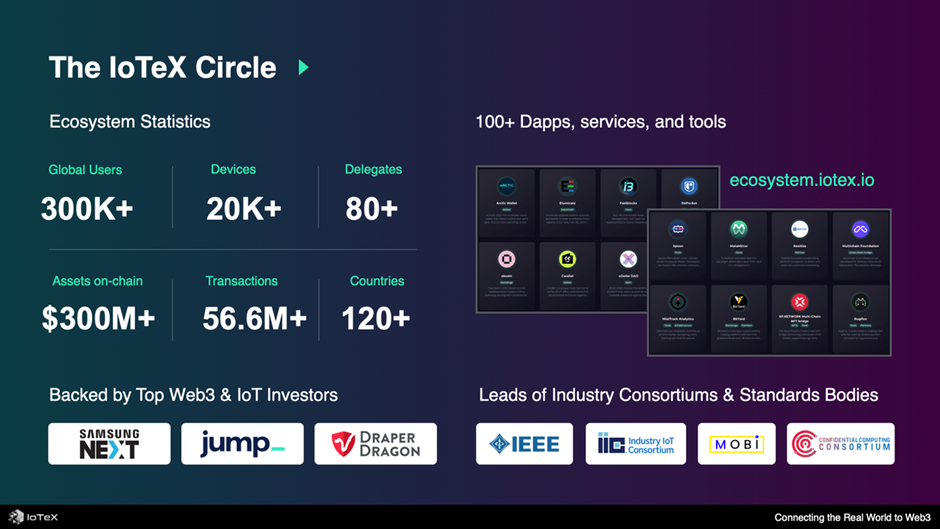
Notable IoTeX-supported products include:
-
Ucam: The world’s first home security camera co-developed by IoTeX and Tenvis, leveraging decentralized identity to give users control over privacy and data ownership. Tenvis is a hardware giant and currently an Amazon Choice brand for cameras.
-
Pebble Tracker: A decentralized asset tracking device developed with Nordic Semiconductor, one of the world’s largest chipmakers. When paired with Edge Oracle, PebbleTracker writes verifiable real-world IoT data (e.g., location, motion, climate) onto the blockchain for use in smart contracts. It is now available via Mouser Electronics.
-
DIMO: A DePIN mobility project focused on collecting and analyzing vehicle data to offer value-added services to car owners. In April 2023, DIMO announced integration with W3bstream, IoTeX’s blockchain-IoT middleware, to connect vehicle data to smart contracts. This enables Web3 developers to easily access zero-party mobility data, supporting the development of revolutionary mobility DApps and empowering consumers and fleet operators to truly own and control their vehicle-generated data.
Initiatives involving IoTeX include:
-
Automotive and supply chain pilots: Collaborations using Pebble Tracker technology with MOBI, the U.S. Navy, and the Industrial Internet Consortium (IIC).
-
Blockchain standards: Development within IEEE and the Confidential Computing Consortium (CCC).
Token Economics
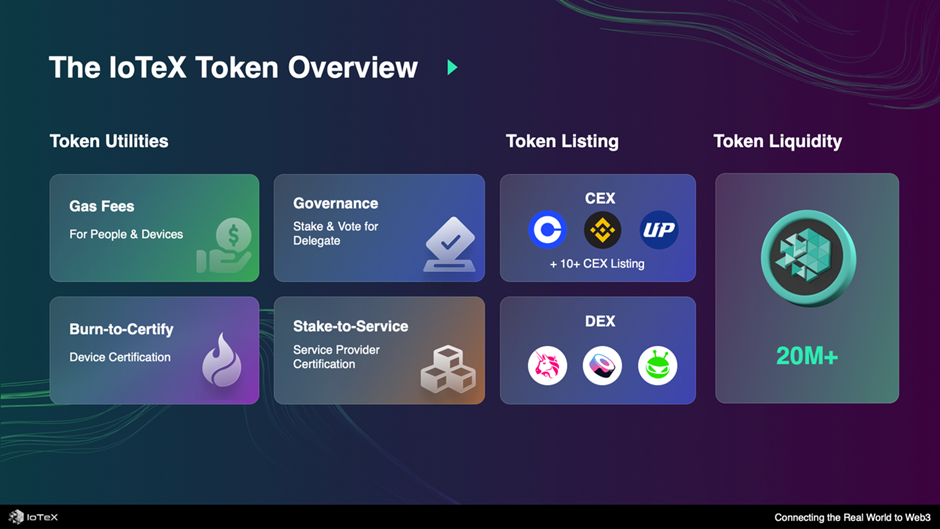
In June 2022, IoTeX’s mainnet and its native token $IOTX officially launched. IOTX is the native utility token for the IoTeX blockchain network (IoTeX L1 + IoTeX W3bstream), serving multiple roles such as gas fees, destruction for authenticating real-world devices, network governance, and staking. IOTX is listed on major cryptocurrency exchanges including Coinbase, Binance, Gemini, Upbit, KuCoin, and Crypto.com.
Token Overview
Token Supply
-
Total Supply: 9,442,702,397
-
Circulating Supply: 9,442,702,392 (as of current)
-
Private Sale Price: 1 IOTX = 0.0000125 ETH (≈$0.0083)
-
Public Sale Price: No public sale
Initial Token Distribution and Release Schedule
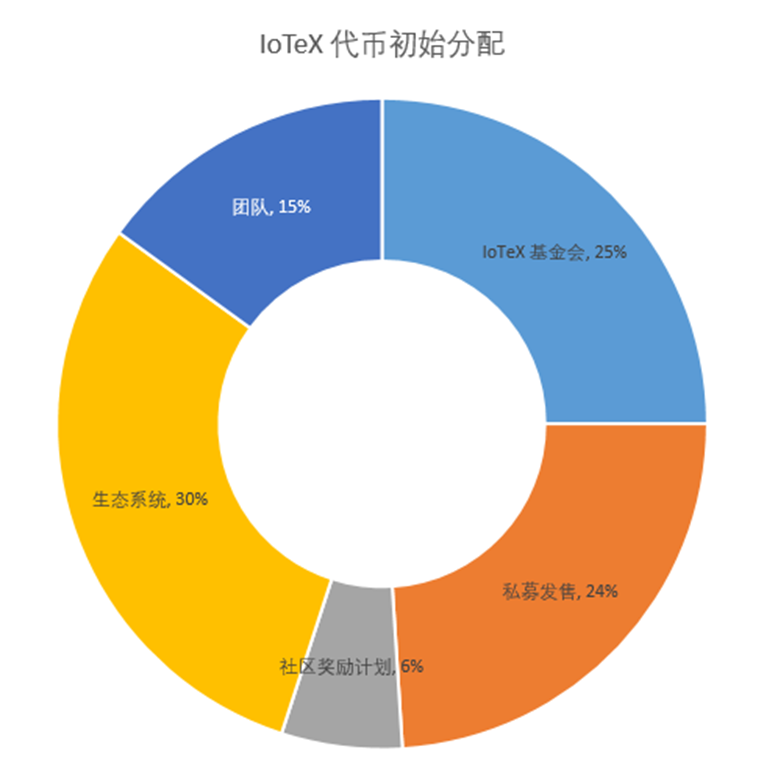
Initial token allocation was divided into five main parts: IoTeX Foundation (25%), private sale (24%), community rewards (6%), ecosystem (30%, including Ecosystem Development and Roll-DPoS Mining), and team (15%). All tokens were gradually unlocked over three years post-launch and fully released by the end of 2022.
Token Use Cases
Bitcoin’s proof-of-work was an early form of DePIN validation, using massive computational power secured by every node in the global network. Today’s DePIN validation follows a similar principle—participants leverage their owned infrastructure services to contribute to the network and earn fees and rewards.
By providing middleware and hardware, IoTeX has positioned itself as a modular infrastructure provider for DePIN. All DePIN projects built on IoTeX participate in the IOTX token economy.
IOTX serves multiple purposes, aiming to enable trusted and transparent interactions among entities on the IoTeX network—including representatives, stakeholders, product builders, service providers, and consumers. Key uses include:
-
Gas Fees: IOTX pays for transactions and contract execution on the IoTeX network
-
Staking & Governance: Tokens are staked to participate in voting and governance
-
Staking Services
-
Device Registration: Trusted devices are registered via staking or burning tokens
Token Economic Model
Burn-Drop
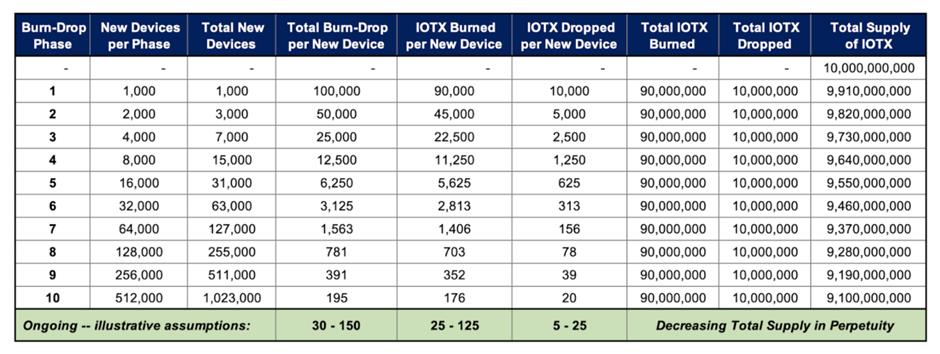
During the process of reaching the first 1 million IoTeX-supported devices, a total of 1 billion IOTX (10% of total supply) will be subject to Burn-Drop—900 million tokens will be permanently burned, and 100 million will be distributed (e.g., to voters who auto-stake for ≥91 days).
This process is driven by smart contracts, automatically triggering new Burn-Drop phases as milestone device counts are reached.
Burn-to-Certify
After the Burn-Drop phase concludes, the Burn-to-Certify mechanism will activate. Device manufacturers burn IOTX to obtain a “Powered by IoTeX (PBI)” certificate. PBI-certified devices earn monthly token rewards funded by transaction fees paid by other devices.
IoTeX Team and Funding
Team Overview
Headquartered in Silicon Valley, IoTeX’s team comprises over 30 top engineers and scientists from companies such as Uber, Google, Intel, and Facebook. The platform is currently maintained by over 60 global representatives, including Blockfolio, CoinGecko, and DraperDragon.
Founding Members
-
Raullen Chai: Co-founder and CEO of IoTeX, Ph.D. in Computer Science from the University of Waterloo. Former Head of Cryptography R&D at Uber and Technical Lead at Google.
-
Qevan Guo: Co-founder of IoTeX, Ph.D. in Machine Learning and Computer Vision from National University of Singapore. Former Product Lead at Facebook.
-
Xinxin Fan: Co-founder of IoTeX, Ph.D. in Cryptography from the University of Waterloo. Former Senior Research Scientist at Bosch.
-
Jing Sun: Co-founder of IoTeX, formerly Managing Partner at Sparkland Capital, a Silicon Valley venture firm.
Key Advisors
-
Robert Parker: Former CTO of Samsung SmartThings, Founding Director of Amazon Alexa, General Manager at Microsoft, award-winning leader in IoT
-
Daniel Mason: Co-founder of Spring Labs, a leading data exchange platform in financial services
-
Ken Seiff: Managing Partner at Blockchange Ventures
-
Anoop Nannra: Global Blockchain Leader at AWS, Co-chair of IIC DLT Working Group, former Global Blockchain Head at Cisco
-
Michael (Minsik) Cho: Board Director at Upbit and Kakao Corp, founding member of KPMG Korea
-
Robert Wolff: Chief Developer Advocate at Arm, blockchain and IoT KOL
-
A.D: Chief Developer Mentor at Google
-
Mitch Tseng: Chair of the Testbed Committee and Innovation Task Force at the Industrial Internet Consortium (IIC)
Investors
Current investors include: SamsungNEXT, Draper, GoodWater, Jump, Wintermute, EV3, Hashkey, Blockchange, IOSG, Hanwha, Wemade, NGC, Hashed, Kenetic, Xoogler.

Funding History
-
Early 2018: Raised approximately $30 million from top-tier venture capital firms.
-
May 2022: MachineFi Lab completed a $10 million seed round at a $100 million valuation.
-
June 2022: MachineFi Lab led a Series A round, raising $50 million.
Conclusion
The distributed and immutable nature of blockchain technology, combined with IoT’s connectivity and data exchange capabilities, holds immense potential for revolutionary IoT projects. Currently, most IoT devices operate in centralized models, contradicting their inherently decentralized nature. This leads to numerous issues such as limited scalability, high operational costs, frequent privacy breaches, significant security risks, and lack of usage value. Blockchain, with its intrinsic decentralization, is well-suited to resolve these problems plaguing today’s IoT landscape.
However, the promise of blockchain does not mean any existing blockchain is suitable for IoT deployment. In reality, due to various technical hurdles, no current public blockchain is fully applicable to IoT. IOTA, launched in 2015 specifically for IoT, attracted significant market attention upon launch and briefly rose to fourth in market cap. IOTA incorporated highly appealing concepts—IoT applications, a novel DAG (Directed Acyclic Graph) structure, and low-fee micropayments. While its technological innovation and futuristic vision were compelling, immature technology and incentive mechanisms ultimately stalled its progress.
Today, after years of advancement, both blockchain technology and the scale of IoT devices and data have significantly matured. As a bridge connecting physical-world devices and Web3, DePIN now stands on much firmer ground. IoTeX, emerging as a rising star in the DePIN space, has the potential to leverage its foundational infrastructure to amplify the DePIN ecosystem. Founded in 2017 with a world-class team and technology, IoTeX has endured two market cycles, achieving substantial progress in both R&D and real-world applications—demonstrating strong commitment and capability in this domain. FutureMoney will continue to monitor and research IoTeX and the broader DePIN sector.
Join TechFlow official community to stay tuned
Telegram:https://t.me/TechFlowDaily
X (Twitter):https://x.com/TechFlowPost
X (Twitter) EN:https://x.com/BlockFlow_News
 @fmgroupxyz





![In-depth Analysis of Trade[XYZ]: How Were 92 Markets and 98% HIP-3 Trading Volume Established?](https://upload.techflowpost.com/upload/images/20260716/20260716061117965147.jpeg?x-oss-process=image/resize,p_50/quality,q_80)