Model War: UTXO vs. Account Model in Privacy-Focused Public Blockchains
TechFlow Selected TechFlow Selected
Model War: UTXO vs. Account Model in Privacy-Focused Public Blockchains
In contrast, the account model is simpler to manage and well-suited for implementing token transfers and smart contract execution.
 Navigating Web3 tides with focused insights
Author: Kyle Liu, Investment Manager at Bing Ventures
Currently, privacy public blockchains are mainly divided into two categories: privacy computing networks and privacy transaction networks. Privacy computing networks utilize secure multi-party computation (MPC) technology to enable collaborative computation while protecting data privacy, with projects like PlatON and Phala Network standing out. Privacy transaction networks focus on safeguarding user privacy by offering enhanced security in transactions, exemplified by projects such as Aztec and Iron Fish. Privacy public blockchains have unique advantages in protecting both data and transaction privacy and play a crucial role in decentralization and security. As the privacy blockchain market evolves, UTXO and account-based models have become focal points of discussion. However, we need deeper reflection on the strengths and weaknesses of these models and how they can adapt to future evolving demands.
Understanding UTXO and Account Models
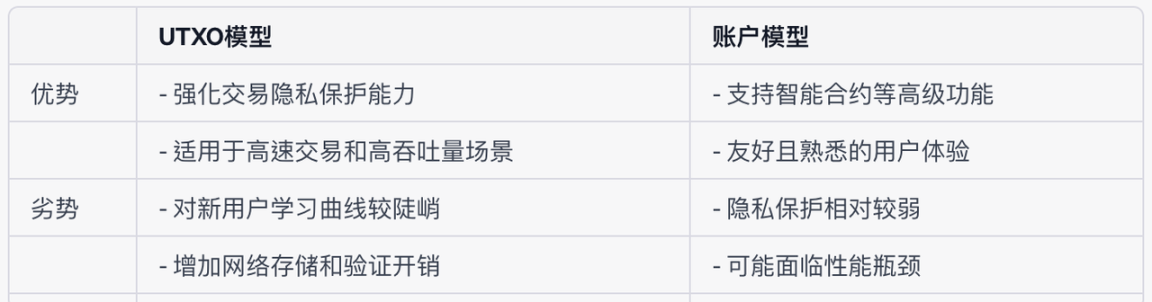
In blockchain systems, UTXO and account models are common ledger paradigms. The UTXO model treats each transaction as a set of inputs and outputs, embedding additional content within output scripts to provide better privacy protection. It offers benefits such as reduced transaction verification time and cost, improved privacy, and higher transaction throughput. However, the complexity of UTXO validation presents challenges, particularly regarding scalability and efficiency in large-scale networks.
In contrast, the account model is simpler to manage and well-suited for token transfers and smart contract execution. However, it may compromise user privacy since accounts form part of the global state. In summary, both UTXO and account models present trade-offs between privacy protection and security. For the UTXO model, we must consider its scalability and efficiency in large networks, along with storage and verification overheads. For the account model, we need to address issues related to global state and privacy, as well as computational resources and time costs associated with transaction validation.
Account Model Privacy vs. UTXO Model Privacy
It's important to note that UTXO and account models face different challenges in protecting transaction privacy. The traditional UTXO model enhances privacy by breaking transactions into smaller parts, increasing the difficulty for attackers to trace specific payment information—giving it an edge in transaction privacy. However, this model has limitations in scalability and flexibility. In contrast, the account model excels in handling complex smart contracts and state management. Therefore, in privacy-focused blockchain projects, exploring hybrid approaches that combine both models could achieve a better balance between privacy protection and functional requirements.
However, because UTXOs are not self-contained, they depend on prior transactions, increasing validation complexity—each input requires verifying previous transactions, which may span multiple blocks. This increases storage and validation overhead across the network. Nodes must build a UTXO set when syncing with the network. Once a node validates the current block header, it only needs to look up outputs in the UTXO set, simplifying verification. But as nodes approach miner-like roles, their security assumptions and risks become more critical.
In conclusion, regarding the current development of "UTXO" and "account" systems, we can highlight the following points:
-
The UTXO model faces challenges due to validation complexity, requiring careful consideration of scalability and efficiency in large-scale networks.
-
The account model has issues concerning global state dependency and privacy; UTXO-based privacy expansion techniques can offer stronger privacy protection.
-
The construction and validation process of the UTXO model may increase network storage and validation overhead.
Overall, the UTXO model is more widely adopted in privacy blockchains due to its superior ability to protect transaction privacy. In contrast, the account model is better suited for scenarios requiring high readability, such as standard transfer operations. When selecting a ledger model, privacy blockchains should align their choice with specific application scenarios, balancing the needs for privacy and usability.
Future Demand Evolution
Looking ahead at the evolution of demands in privacy blockchains, we must consider how to balance privacy protection with functional requirements. One potential solution is combining the UTXO and account models to leverage their respective strengths. By introducing account-like concepts into the UTXO model, we could achieve stronger privacy protection while supporting richer functionality. However, such hybrid models also face technical implementation and design challenges. We need in-depth research on how to balance and integrate these two models effectively to enhance user experience and security.
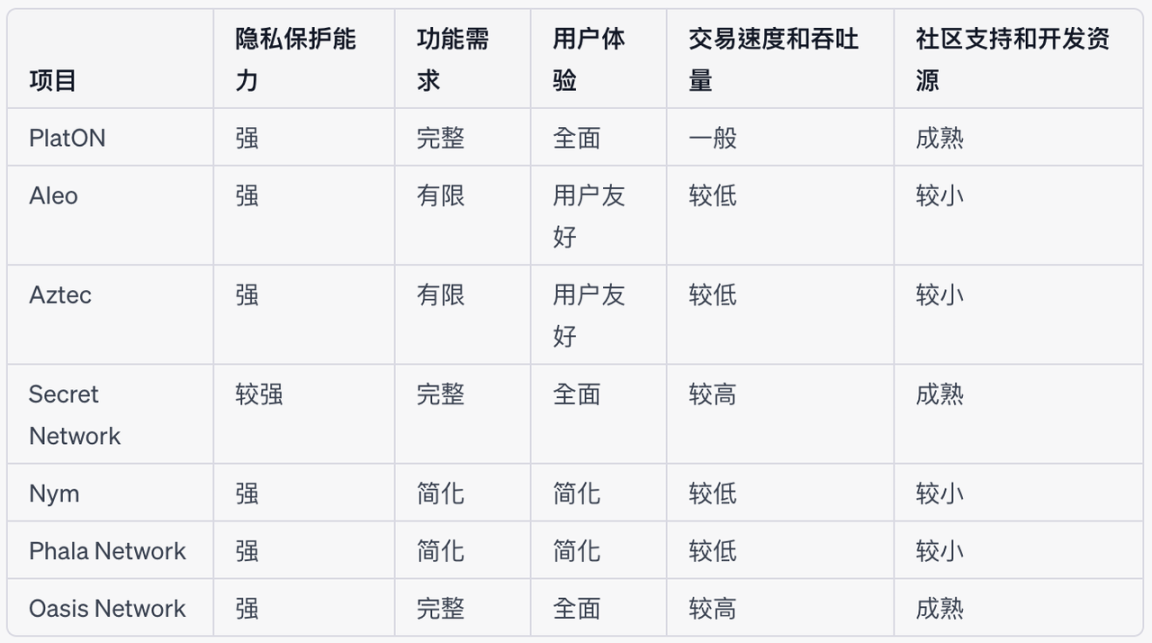
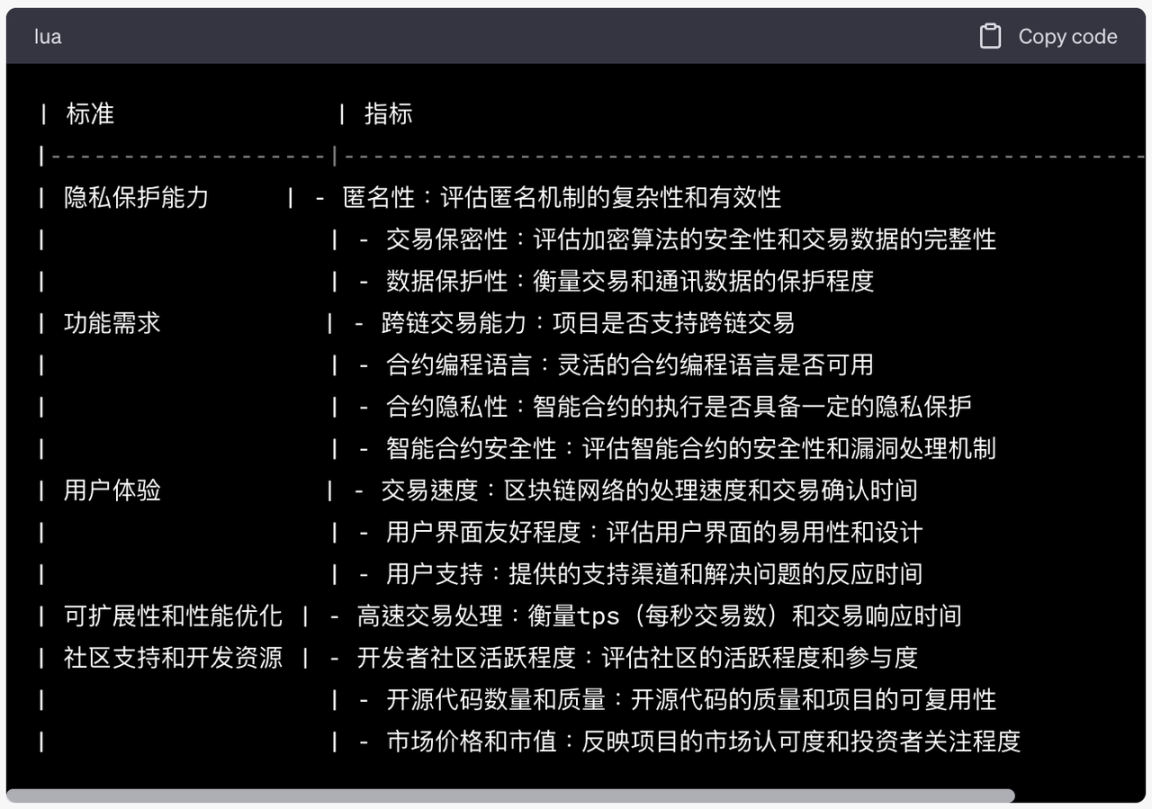
We should also consider the sustainability of privacy blockchain projects. Strong community support and developer resources are vital for long-term success. An active developer community drives innovation and technological advancement, providing robust backing for future growth. Therefore, we should evaluate factors such as community engagement, quality and quantity of open-source code, and overall ecosystem activity. These indicators help assess a project’s sustainability and growth potential. A comprehensive evaluation of privacy capabilities, functional needs, user experience, transaction speed and throughput, as well as community and development resources, is essential. Only through holistic analysis can we accurately judge a project’s long-term competitiveness.
In short, privacy blockchain projects face significant challenges and opportunities in meeting future demand shifts. UTXO and account-based architectures are key factors influencing chain security, scalability, performance, and user experience. By deeply analyzing the pros and cons of UTXO and account models and exploring hybrid alternatives, we can build more competitive and forward-looking privacy blockchain projects that balance privacy and functionality. Investors should pay close attention to details and weigh multiple dimensions when evaluating projects to make informed decisions.
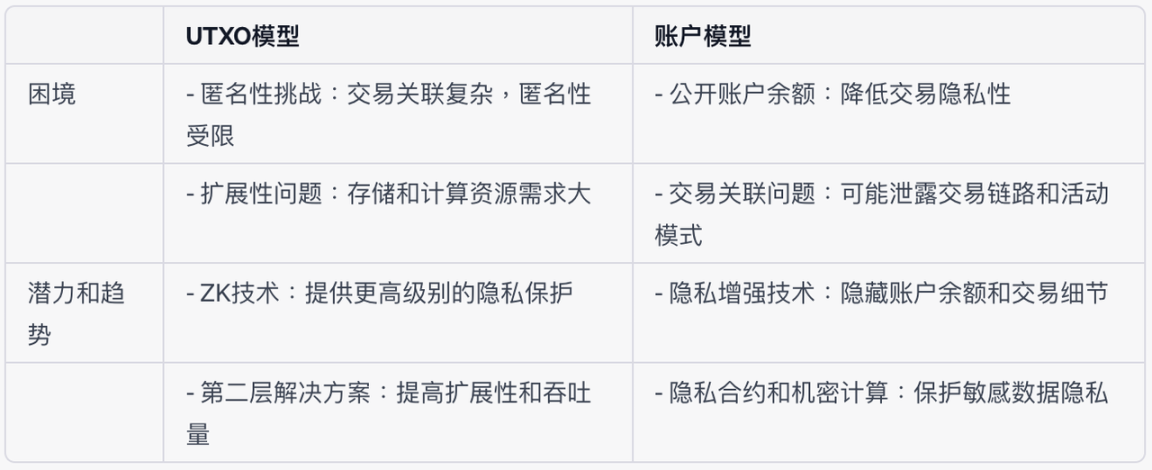
Alternative Innovations
For the UTXO model, applying ZK technologies and building Layer 2 solutions can enable higher levels of privacy protection while improving transaction throughput and efficiency. For the account model, techniques such as ring signatures and zero-knowledge range proofs can hide account balances and transaction details, offering stronger privacy. Moreover, to overcome the limitations of both UTXO and account models, alternative approaches have emerged. Hybrid models are one option, combining the strengths of both paradigms. Some emerging blockchain projects are also exploring other architectures, such as state-machine-based or resource-oriented models. These new models aim to address the shortcomings of existing ones and offer novel solutions in terms of privacy, performance, and functionality.
Market Performance Does Not Equal User Demand
There is currently a view that for most users, privacy is not an urgent need, so integrating privacy features into the foundational layers of mainstream blue-chip protocols would be more reasonable—making privacy invisible or non-prioritized for end users. However, I argue that the development of privacy applications isn't limited to hackers or niche institutions. As blockchain technology advances and use cases expand, more people are recognizing the importance of privacy.
Therefore, offering better privacy protection solutions—whether via privacy plugins or dedicated privacy blockchains—is both justified and aligned with real market demand. For instance, designs based on Tornado Cash do introduce certain regulatory and KYC-related risks. But this doesn’t mean combining privacy with KYC is ineffective. On the contrary, implementing appropriate KYC mechanisms and compliance measures can strike a balance between privacy and regulation. By establishing trusted KYC providers and effective regulatory frameworks, it's possible to balance privacy protection with anti-money laundering (AML) requirements.
Introducing Account Abstraction into UTXO
In the traditional UTXO model, each transaction is treated as a collection of unspent outputs that serve as inputs for new transactions. This model excels in ensuring transaction immutability and integrity but can be relatively complex for users and developers to work with. Introducing the concept of "Account Abstraction" aims to transform the UTXO model into a form closer to the traditional account model, offering simplified user experiences and developer tools. Under this abstracted model, users can manage their own accounts without needing to track individual transaction inputs and outputs.
However, integrating "Account Abstraction" into the UTXO model may encounter several challenges:
-
Increased Complexity: Applying account abstraction to the UTXO model may increase system complexity. Implementing this requires new mechanisms to track account balances and states while ensuring transaction correctness and consistency. This could necessitate major modifications to the existing UTXO architecture, raising development and maintenance complexity.
-
Privacy Concerns: In the UTXO model, transaction inputs and outputs are clearly visible, enabling traceability and analysis. Introducing account abstraction might reduce transaction privacy, as patterns and linkages between transactions could become more apparent, potentially threatening user privacy.
-
Compatibility and Migration Costs: Introducing account abstraction into the existing UTXO ecosystem raises compatibility and migration concerns. This includes integration with current UTXO wallets, exchanges, and smart contracts, as well as the transition process for users and developers. If account abstraction leads to incompatibility with the existing ecosystem, significant effort may be required to balance compatibility with performance improvements.
In summary, both UTXO and account-based systems have distinct advantages and disadvantages in blockchain contexts. Choosing the right architecture should be based on a comprehensive assessment of specific application needs, privacy requirements, transaction speed and throughput demands, and considerations around development and user experience. As blockchain technology continues to evolve, we believe new architectural solutions will emerge to overcome the limitations of current models.
Join TechFlow official community to stay tuned
Telegram:https://t.me/TechFlowDaily
X (Twitter):https://x.com/TechFlowPost
X (Twitter) EN:https://x.com/BlockFlow_News
 Bing Ventures