









Once called V God, now called Xiao V—what has Solana been through these days?
TechFlow Selected TechFlow Selected
Once called V God, now called Xiao V—what has Solana been through these days?
The FTX collapse severely impacted liquidity for many key projects in the Solana ecosystem, but its rapid recovery within just one year demonstrates the vitality and resilience of the Solana ecosystem in action.
 Navigating Web3 tides with focused insights
Author: Joyce
Recently, the Solana ecosystem has been gaining significant momentum. The rise and popularity of projects such as inscriptions, DePINs, and Memes have placed it in direct competition with the equally red-hot Bitcoin ecosystem, far surpassing other public chains like Ethereum in market attention.
Once deeply tied to the FTX platform, Solana's price plummeted to single digits after FTX collapsed. After nearly a year of dormancy, Solana’s price has steadily climbed and is now approaching $97.
Beyond just token appreciation, the Solana ecosystem has also seen the emergence of several standout new projects—truly impressive developments.
Solana’s ecosystem, once severely damaged by the FTX collapse, has recently become a frequent market highlight. Aside from these already successful breakout projects, what other promising ventures are worth watching? Let’s take a closer look.
Overview of the Solana Ecosystem
According to the latest data from DeFiLlama, the total value locked (TVL) in the Solana ecosystem is currently around one billion USD, ranking fifth among all public blockchains—behind Ethereum, Tron, BSC, and Arbitrum.
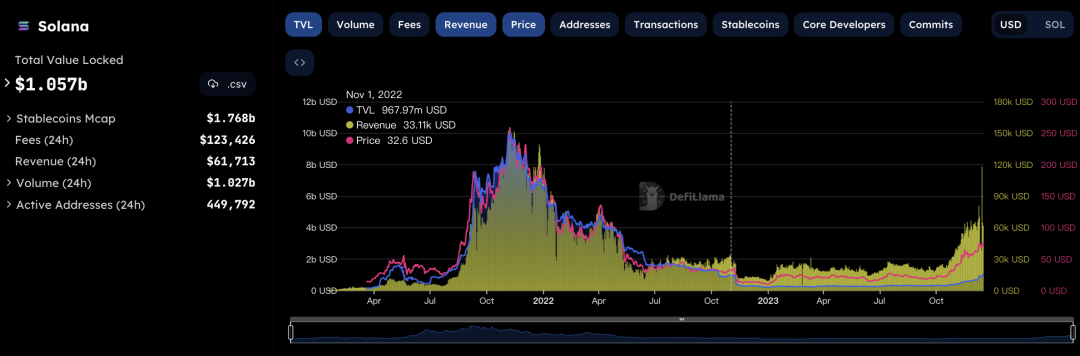
Solana ecosystem TVL, SOL price, and overall chain revenue trends. Data source: DeFiLlama
Before and after the FTX collapse, Solana’s TVL dropped from nearly $1 billion to $300 million, while the SOL price fell from $32 to a low of $14. Nearly a year later, TVL has surpassed pre-FTX levels, and the token price has surged past $97.
From the chart above showing TVL, token price, and chain revenue trends on Solana, the growth in token price significantly outpaces TVL growth, while chain revenue growth exceeds even the token price increase.
Admittedly, Solana’s daily chain revenue remains relatively low—only tens of thousands of dollars—so absolute figures aren’t highly meaningful. However, compared to leading chains like Ethereum, TRON, BSC, and Arbitrum, its growth trajectory is quite strong.
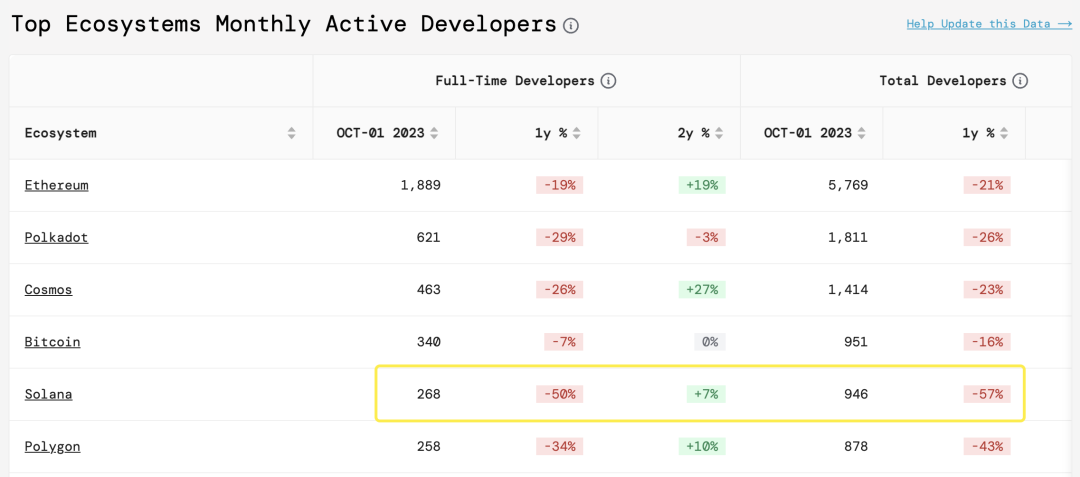
Number of developers across blockchain ecosystems. Data source: developerreport.com
Developers form the foundation of any blockchain ecosystem. Currently, Solana has a modest number of developers—946 full-time and part-time combined—ranking fifth among all public chains, comparable to the number in the Bitcoin ecosystem.
As for the number of ecosystem projects, although numerous hot projects have emerged from Solana recently, in terms of total project count, the Solana ecosystem isn't particularly large. DeFiLlama currently lists 104 projects, far fewer than Ethereum, BSC, and Arbitrum—all top five in TVL—and also fewer than Avalanche, OP, and Polygon, which have lower TVL. However, the recent surge of breakout projects suggests that, in terms of project quality, the Solana ecosystem holds its own.
Staking Protocols
According to Staking Rewards, the total staked amount on Solana has reached 400 million SOL, valued at approximately $28 billion at current prices, representing over 71.4% of Solana’s total market cap.
Compared to Ethereum’s 23.7% staking ratio, Solana’s is exceptionally high—surpassing not only Ethereum but most other public chains. As a result, there are many staking projects on Solana; four of the top ten TVL projects are liquid staking protocols.
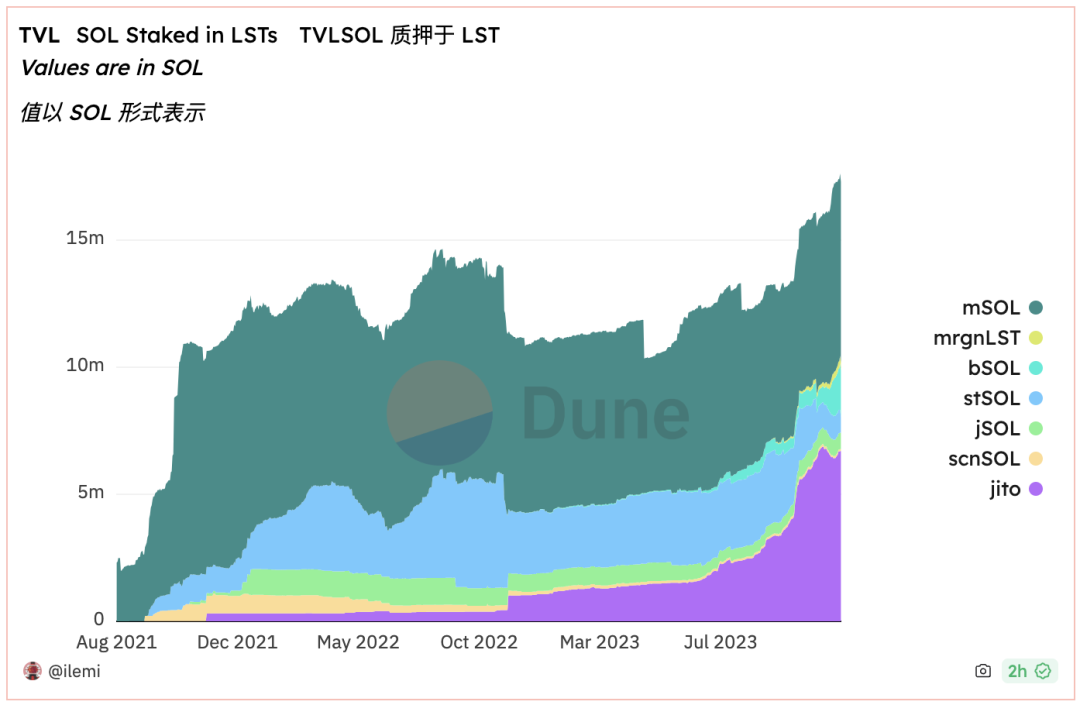
Market share trend of Solana staking protocols. Data source: Dune@ilemi
Marinade Finance is the leader in Solana’s liquid staking sector and ranks first in ecosystem TVL. Launched in 2021, it benefits from early-mover advantage. However, as shown in the chart above, Marinade Finance (whose staked token is msol) has seen its market share gradually eroded.
Jito has emerged as a standout newcomer, with an extremely steep growth curve in staking share over the past year. Jito is the first staking protocol on Solana to distribute MEV rewards to users. Users can stake SOL to receive JitoSOL, earning both staking and MEV rewards. Since October, Jito’s staking metrics have exploded, and its TVL is now close to that of market leader Marinade Finance. At the end of November, its governance token launched simultaneously on Coinbase and Binance, performing strongly and capturing widespread attention.
Blaze Stake ranks third, with its staked token bSOL. Launched in May 2022, Blaze has benefited from the broader Solana ecosystem boom, with its token surging multiple times over the past few months.
Beyond these headline staking protocols, several innovative, yet-to-launch-token staking projects in the Solana ecosystem have also seen rapid growth, drawing attention due to anticipated airdrops.
DePIN
DePIN (Decentralized Physical Infrastructure Networks) is a recently booming sector. Leveraging Solana’s high speed and low fees, the Solana ecosystem now covers decentralized physical infrastructure, AI computing power, mapping, and IoT services. Notable projects include Helium, Mobile, Hivemapper, DIMO, and RNDR.
Helium is a pioneer in the DePIN space and currently the leader in Solana’s DePIN ecosystem. Founded in 2013 as a distributed IoT project, Helium initially used its own Layer 1 before migrating to Solana for better EVM compatibility and higher TPS. Its IoT ecosystem is now relatively mature—Mobile, one of the hottest recent DePIN projects, is a Helium ecosystem project that surged over 16x in the past month.
Hivemapper and DIMO are both decentralized mapping projects, incentivizing users with tokens to contribute driving map data. Both have already launched their tokens.
RNDR, a peer-to-peer AI rendering compute marketplace, is arguably this year’s industry darling. As the AI sector booms, RNDR’s market cap has risen sharply, reaching a circulating market cap of $1.6 billion. Positioned at the intersection of the popular DePIN and AI sectors, and recently announcing expansion from Polygon to Solana, RNDR remains highly visible.
NFTs and Inscriptions
Inscriptions and NFTs in the Solana ecosystem have drawn significant attention recently. Two leading inscription projects—SOLs and Lamp—are progressing well.
SOLs, the leading inscription project on Solana, created a sensation by surging fivefold in a single day after listing on CEXs. Though it has pulled back recently, overall热度 remains strong.
Lamp is also gaining traction. As the smallest unit of Solana, Lamp shares meme-like qualities similar to Sats, with a current floor price of 1.66 SOL and over 5,200 holding addresses.
Beyond inscriptions, NFTs in the Solana ecosystem have seen soaring热度, with Mad Lads emerging as the recent leader. Launched by Coral, Solana’s framework development company, and minted via its Backpack wallet, Mad Lads stands out as xNFTs—enabling direct interaction with DeFi, GameFi, and more through xNFTs, vastly expanding their utility. With a floor price exceeding 200 SOL, Mad Lads is shaping up to be Solana’s “Bored Ape.”
Beyond Mad Lads, numerous hot NFT projects have recently emerged in the Solana ecosystem, such as Open Solmap, positioned as a Bitmap counterpart, now boasting over 18,000 holders and a 24-hour trading volume exceeding 50,000 SOL, firmly leading Solana NFT trading volume.
And Saga, known as the "Red Box," ranked second in 24-hour volume (as of December 21), saw its floor price skyrocket from 0.3 SOL to over 14 SOL within hours, now settling around 5 SOL—highlighting the intense FOMO and狂热 surrounding Solana NFTs.
Meme Coins
When it comes to memes, beyond inscription-based tokens on various chains, the two hottest meme coins in the market recently both originated from the Solana ecosystem: BONK and Silly.
BONK, the first meme coin on Solana, gained massive attention with over 50x gains in two months. As the first Shiba Inu-themed meme on Solana, it was airdropped to the community last Christmas, injecting much-needed vitality and confidence into the ecosystem during the FTX collapse.
In May, Solana’s blockchain phone Saga was released at $599, bundled with 30 million BONK tokens. At BONK’s peak, the token value far exceeded the phone price, causing previously sluggish Saga sales to surge dramatically…
However, BONK’s热度 has cooled, giving way to Solana’s newest meme, Silly. Silly originated from Solana co-founder Toly wearing a “dragon” costume at a conference, amplified by the Year of the Dragon theme, propelling Silly Dragon to viral status—gaining over tenfold in three days—a testament to the market’s powerful FOMO dynamics.
The Four Pillars of DeFi
Oracle
Pyth Network is the recent star of the Solana ecosystem. For years, Chainlink dominated the oracle narrative, but Pyth Network has injected fresh innovation into the space.
Pyth Network aggregates data from top trading platforms, market makers, and financial service providers to deliver real-time data to smart contract dApps. It currently connects to over 90 data sources including CBOE, Binance, OKX, and Bybit, and supports more than 230 dApps—an exceptional real-world adoption case for oracles recently.
Lending & Borrowing
Beyond oracle leader Pyth Network, lending protocol MarginFi has also delivered stellar performance over the past year. MarginFi is currently the largest lending protocol in the Solana ecosystem, with TVL exceeding $300 million—second only to staking giants Marinade Finance and Jito.
MarginFi launched a points system in July, rewarding deposits, borrowing, and referrals. Since then, its TVL has taken off, growing over a hundredfold in just six months—making it one of the fastest-growing dApps in the Solana ecosystem. Moreover, MarginFi has not yet issued a token. Given the recent history of lucrative airdrops in the Solana ecosystem, MarginFi is definitely one to watch.
Another lending protocol, Kamino, with TVL just behind MarginFi, has recently attracted market attention amid rumors of an upcoming airdrop. Kamino is also one of the fastest-growing DeFi protocols in the Solana ecosystem. Since launching in September last year, its TVL has reached $1.4 billion.
Solend was once the dominant lending protocol in the Solana ecosystem. After losing over 90% of its TVL during the FTX crisis, it is now gradually recovering, with TVL returning to $150 million. Especially after launching a points system in August, both TVL and token price have rebounded sharply.
DEX
Orca and Raydium are both native DEXs on Solana. At their peaks, both achieved over $1 billion in TVL, with Raydium even surpassing $2 billion. However, during this bear market and the FTX fallout, both suffered sharp declines. Currently, Orca has $160 million in TVL, while Raydium sits at roughly half of that.
Orca is the only DEX in the Solana ecosystem with a pure automated market maker (AMM), offering users a superior trading experience. Raydium, launched around the same time, shared liquidity with Serum, which was heavily impacted during the FTX collapse. Its recovery has lagged behind Orca’s.
Overall, DEXs in the Solana ecosystem haven’t stood out much during this latest wave of activity, except for DEX aggregator Jupiter, which drew attention in November due to its first round of airdrop distributions.
Others
Solana has long positioned itself as a high-speed chain competing against other public chains, and derivative dApps are clearly the applications with the highest demand for speed and low fees in crypto today. GMX on Arbitrum, the leading Layer 2 for Ethereum, is a prime example. Unfortunately, however, Solana has yet to produce a breakout derivatives protocol.
Among current derivatives, Drift shows relatively strong TVL performance. Unaffected by the FTX collapse, its TVL has grown over a hundredfold in the past year. With no token yet launched, Drift’s potential airdrop continues to attract interest.
Conclusion
In summary, this bull run—from the inscription热潮 spreading from Bitcoin to other chains, to the rise of Bitcoin’s infrastructure, and Solana’s DePINs, NFTs, Memes, and core infrastructure—the market热度 and FOMO sentiment continue to build, generating countless stories of overnight wealth.
The rise of the Bitcoin ecosystem is hardly surprising. As the leader in crypto, abundant capital flows and continuous innovation naturally lead to ecosystem prosperity.
But Solana’s resurgence has brought genuine surprises. The FTX collapse devastated liquidity for many key Solana projects, yet the ecosystem managed a swift recovery within a year—proving its resilience and vitality.
Recently, the term “Ethereum killer” is re-emerging. After a long bear market where many believed Ethereum had captured all public chain opportunities, renewed hopes are rising for these challengers.
Join TechFlow official community to stay tuned
Telegram:https://t.me/TechFlowDaily
X (Twitter):https://x.com/TechFlowPost
X (Twitter) EN:https://x.com/BlockFlow_News
 白话区块链
白话区块链









